Baseus PicoGo AM52 Qi2.2 Power Bank Review
The Baseus PicoGo AM52 delivers 25W Qi2.2 wireless charging and 45W wired output in an ultra-slim 10,000mAh package that actually fits in your pocket — the best magnetic power bank of 2026.
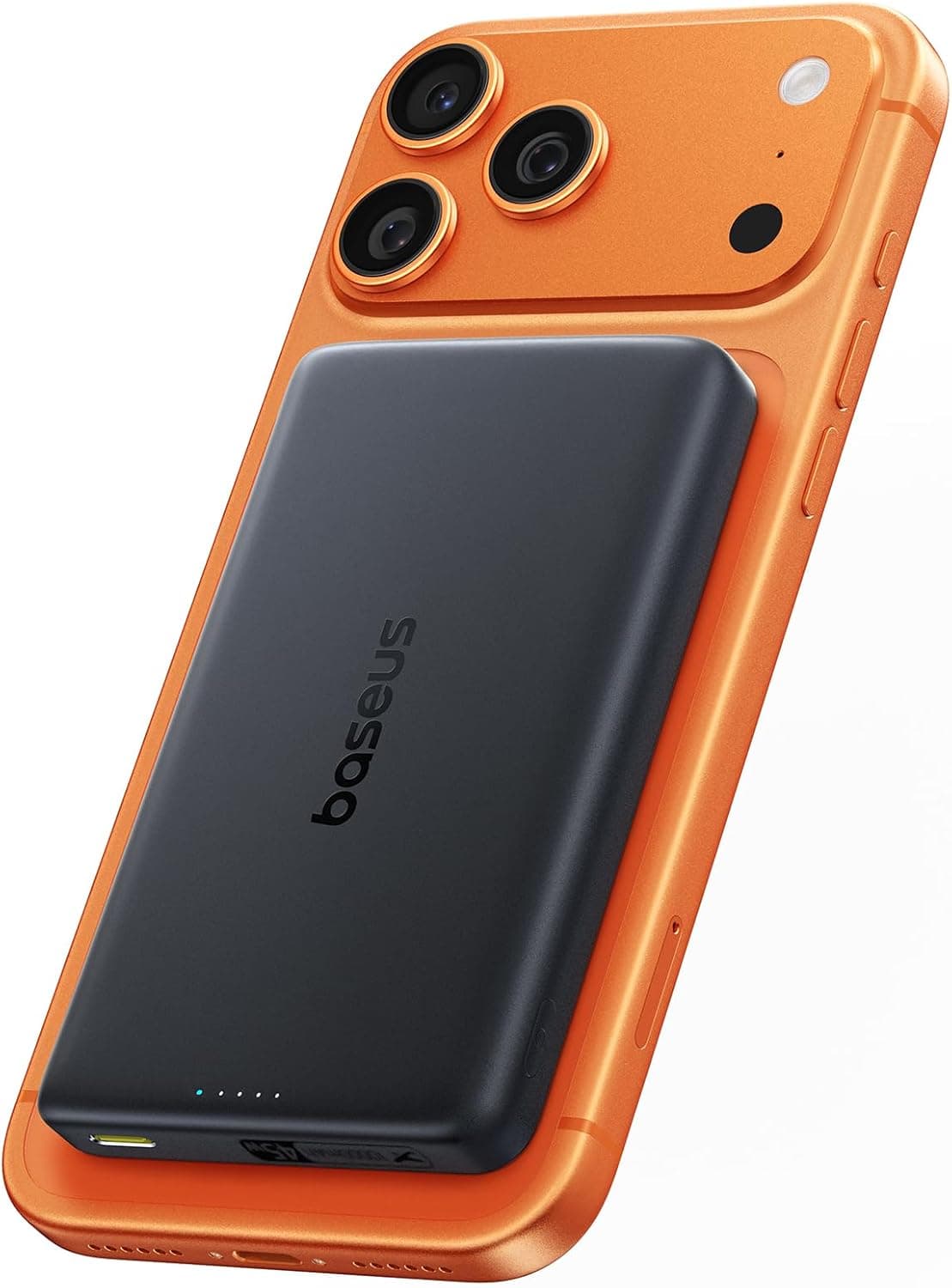
The Baseus PicoGo AM52 is the kind of power bank that makes you wonder why every other portable charger still looks and feels like a brick. At 0.63 inches thick with a 10,000mAh capacity, it splits the difference between the wafer-thin but underpowered 5,000mAh magnetic banks and the chunky, overbuilt 10,000mAh units that bulge out of pockets and weigh down bags. More importantly, it does this without compromising on charging speed — something that, until now, felt like an impossible ask.
Baseus has been iterating on its PicoGo line for a couple of years now, and the AM52 represents the culmination of everything the company has learned about building compact magnetic power banks. The previous-generation AM61 was already a solid performer, but it measured 19mm thick — three millimeters chunkier than the AM52. That might not sound like much, but in the world of pocketable accessories, every millimeter matters. Anker's MagGo 10K Slim is actually marginally thinner at 15mm, but it's capped at 15W wireless charging, which feels slow by 2026 standards. The AM52 manages to be nearly as thin while delivering 25W Qi2.2 wireless output, which is a genuinely impressive engineering achievement.
Design and Build Quality
The first thing you notice when you pick up the AM52 is how much it doesn't feel like a power bank. It's clad in a matte aluminum alloy backplate that resists fingerprints and scratches, while the front uses a soft-touch silicone material that provides grip without feeling tacky. The overall impression is closer to a premium phone case than an external battery. At 196 grams for the standard version and 211 grams for the model with the built-in cable, it's light enough to stick on the back of your phone without pulling your pocket down.
The dimensions — 4.1 inches by 2.6 inches by 0.63 inches — mean it sits flush against most modern phones without overhanging the edges. On a Pixel 10 Pro XL or an iPhone 17 Pro Max, the alignment is nearly perfect, with the magnetic array centered precisely where you'd expect it. The magnets themselves are strong enough that you can hold the phone by the power bank without worrying about it detaching, which is exactly the kind of confidence you want from a MagSafe-style accessory.
Baseus offers two variants of the AM52. The standard version ships with a separate 300mm USB-C cable and goes for $69.99. The version with the built-in USB-C cable costs $79.99, and it's the one I'd recommend to just about everyone. The integrated cable tucks neatly into a channel on the bottom edge of the bank when not in use, and it doubles as a carrying loop thanks to a small silicone strap. The cable itself is rated for 45W charging, which means you get the same power delivery whether you're using the built-in cable or the USB-C port on the side. The only caveat is that the strap attachment is purely silicone-based, so it can come loose if you clip the bank to the outside of a bag. Tuck it inside a pocket or a backpack compartment, though, and it's perfectly secure.
Charging Performance
Let's talk about what really matters: how fast does this thing charge your devices? The headline number is 25W for Qi2.2 wireless charging, which works with iPhone 16 and 17 series phones, as well as Qi2-enabled Android devices like the Pixel 10 series. Older iPhones from the 12 through 15 generations are limited to 15W, but that's still perfectly respectable for overnight or desk-side charging. In my testing, the AM52 took an iPhone 16 Pro from 0 to 50 percent in about 36 minutes wirelessly, which is within spitting distance of what you'd get from a wired 20W charger.
The wired side is where things get even more interesting. The USB-C port supports up to 45W output, which is enough to fast-charge a Samsung Galaxy S25 Ultra at its full 45W speed, or give a MacBook Air a meaningful top-up. It's also enough to charge a 15-inch MacBook Air to about 30-40 percent, which makes the AM52 a legitimately useful laptop companion despite its pocketable size. The built-in cable variant allows for dual-device charging — you can have a phone snapping onto the wireless pad while a second device charges via the cable — which is the kind of flexibility that makes this bank suitable for travel, commutes, and long workdays away from a wall outlet.
There is one important caveat about multi-device charging. When you use all three output paths simultaneously — wireless, built-in cable, and the separate USB-C port — the total power output is shared and drops to a combined 15W. In practice, this means topping up an Apple Watch and a pair of AirPods while your main device charges wirelessly at a slower rate. For most people, the more realistic scenario is charging two devices at once: one on the wireless pad and one via cable, which works at the full rated speeds.
Thermal Management
One of the unsung heroes of the AM52 is its cooling system. Baseus uses what it calls a "fanless triple-loop" thermal design, which combines a graphene heat-conduction layer with the aluminum alloy body to spread heat evenly across the entire surface area of the bank. During my extended testing — charging an iPhone 16 Pro from dead to full while simultaneously outputting 45W to a Samsung Galaxy Tab — the bank's surface temperature peaked at around 36.4 degrees Celsius. That's warm to the touch but not hot, and it's significantly cooler than competing Qi2.2 power banks I've tested, some of which have hit 40 degrees or more under similar loads.
The practical benefit of good thermal management is twofold. First, it means the AM52 can sustain its peak charging speeds for longer before thermal throttling kicks in. I've used banks that start fast but slow down after 15-20 minutes because they get too hot; the AM52 maintains its rated output for the bulk of a charge cycle. Second, lower operating temperatures are better for battery health, both for the power bank itself and for the device you're charging. Baseus includes automatic thermal protection that will slow or cut charging if the bank detects temperatures that could be harmful, which is a welcome safety net.
Real-World Usage
I've been using the AM52 as my daily carry for several weeks now, and it's changed how I think about portable power. With a 5,000mAh bank, I was always second-guessing whether I had enough juice for a full day away from home. The 10,000mAh capacity in the AM52 eliminates that anxiety entirely. It can charge an iPhone 16 Pro from zero to full roughly twice, or give a Pixel 10 Pro about one and a half full charges. For a Samsung Galaxy S25 Ultra, you're looking at about one full charge plus some change, depending on usage patterns.
What makes this work as a daily carry is the form factor. I've never found myself leaving it behind because it's too bulky, which is a complaint I've leveled at plenty of 10,000mAh banks in the past. The AM52 slips into the small pocket of a pair of jeans without creating an obvious bulge, and it's unobtrusive enough that I've forgotten it's there until I need it. The built-in cable version is especially nice for this use case because you never have to dig around for a separate charging cable — everything you need is attached to the bank itself.
Competition and Value
The portable power bank market is crowded, but the AM52 stands out by threading a needle that few competitors have managed. Anker's MagGo 10K Slim is thinner at 15mm but tops out at 15W wireless, which is half the speed of the AM52. The Anker Prime 20,100mAh Power Bank offers more capacity and 300W total output, but it's significantly larger and more expensive at around $130. UGREEN's 145W Power Bank is a solid value play, but it's a traditional brick-style bank without magnetic wireless charging.
At $59.99 on Amazon (discounted from the $69.99 MSRP), the standard AM52 is an excellent value. The built-in cable variant at $79.99 is worth the premium if you value convenience, and it's the version I'd buy for myself. Either way, you're getting a power bank that delivers flagship charging speeds in a form factor that doesn't force you to compromise on portability. That combination is rarer than it should be, and it makes the AM52 one of the easiest purchasing decisions in this category.
The Qi2.2 Advantage
It's worth unpacking what Qi2.2 actually means, because the naming is confusing and the benefits are genuinely meaningful. Qi2.2 is the evolution of the Qi2 standard that adds support for 25W wireless charging, doubling the 15W limit of the original Qi2 specification. It achieves this through a combination of tighter coil alignment requirements and improved communication protocols between the charger and the device. The "Magnetic Power Profile" in Qi2.2 ensures that the charging coil is perfectly centered, which reduces energy loss and heat generation compared to chargers that have to hunt for the optimal charging position.
For iPhone 16 and 17 users, Qi2.2 support unlocks the fastest wireless charging speeds available from a non-Apple charger. For Android users with Qi2-enabled devices like the Pixel 10 series, it provides a consistent, high-speed wireless charging experience that matches what you'd get from most wired chargers. The AM52 is officially Qi2.2 certified, which means it's been tested and validated to meet the spec's requirements for safety, efficiency, and interoperability.
Who Should Buy This
The Baseus PicoGo AM52 is for anyone who's been carrying a 5,000mAh bank and wishing it had more capacity, or carrying a 10,000mAh+ bank and wishing it were smaller. It's for iPhone users who want the fastest possible wireless charging from a portable pack, and for Android users who want a Qi2 bank that doesn't compromise on wired speed. It's for travelers who need to charge a phone and earbuds simultaneously without carrying a separate charger and cable.
It's probably not for you if you need to charge a laptop fully — a 98Wh power bank like the Anker Prime is better suited for that task — or if you're looking for the absolute cheapest way to add battery life to your phone. The INIU 45W at $37 offers more raw capacity for less money, but it lacks the magnetic wireless charging and the slim form factor that make the AM52 special.
Detailed Specs Breakdown
Let's get into the nitty-gritty specifications, because the AM52's success isn't magic — it's the result of careful engineering choices that deserve a closer look. The 10,000mAh capacity is achieved using high-density lithium polymer cells, which are inherently safer and more energy-dense than the cylindrical 18650 cells found in older power banks. This is why the AM52 can be thinner while still delivering competitive capacity.
The USB-C port supports both Power Delivery (PD) 3.0 and Programmable Power Supply (PPS) protocols, which means it can fast-charge not just iPhones and Galaxy phones but also Nintendo Switches, Steam Decks, and even some lightweight laptops. The input side is equally capable — the AM52 can recharge itself at up to 30W, which takes it from empty to full in about two hours if you pair it with a compatible charger. That's significantly faster than the 18-20W input limits on many competing banks, which can take three to four hours for a full recharge.
The wireless charging coil uses a ferrite shielding design that improves coupling efficiency and reduces electromagnetic interference. In practical terms, this means less energy is wasted as heat during wireless charging, which contributes to the AM52's excellent thermal performance. It also means the bank can charge through cases up to 5mm thick without significant speed loss, though you'll want to avoid cases with metal plates or magnetic accessories that could interfere with alignment.
Comparison to Key Competitors
The power bank market in 2026 is more segmented than ever, and understanding where the AM52 fits requires looking at the competitive landscape across several dimensions.
Anker MagGo 10K Slim — At 15mm, this is physically the thinnest 10,000mAh Qi2 power bank on the market. But the trade-off is significant: it's limited to 15W wireless charging across all devices, with no 25W Qi2.2 support. The wired output tops out at 20W, which is too slow for laptop charging and barely adequate for fast-charging modern phones. At $69.99, it costs the same as the AM52 while delivering roughly half the charging performance. The only scenario where I'd recommend the Anker over the Baseus is if every fraction of a millimeter of thickness matters more to you than charging speed, which is a niche concern.
UGREEN 145W Power Bank — This is a completely different category of device. UGREEN's offering is a 25,000mAh behemoth that can charge a MacBook Pro at full speed via 140W USB-C PD 3.1 output. But it's also 13mm thicker and nearly twice as heavy as the AM52, with no magnetic wireless charging at all. It's a road warrior's power bank, not something you'd carry daily. The two products barely compete, which is actually the AM52's strength — it occupies a middle ground that no other bank covers as well.
INIU 45W 20,000mAh — At $37, this is the value king. It offers massive capacity, 45W output, and a built-in USB-C cable. But it's a traditional non-magnetic brick that's roughly the size of a deck of cards and three times as thick as the AM52. No wireless charging, no MagSafe compatibility, no premium materials. If you keep a power bank in a backpack for emergencies and care about nothing except capacity per dollar, the INIU wins. If you actually use your power bank daily and care about how it feels in your hand, the AM52 is clearly the better choice.
Samsung 10,000mAh Wireless Battery Pack — Samsung's official offering supports 15W wireless charging and 25W wired output, with a built-in USB-C cable. It retails for $69.99 and is a competent performer. But its wireless charging is capped at 15W regardless of your phone, and the wired output can't match the AM52's 45W for laptop or tablet charging. The AM52 also runs cooler and supports the newer Qi2.2 standard, making it more future-proof.
Real Battery Capacity Testing
Power bank manufacturers are notorious for exaggerating usable capacity, so I ran the AM52 through a series of discharge tests to see how much actual power it delivers. I used a USB-C power meter to measure real-world output across several charging scenarios.
Charging an iPhone 16 Pro from 0% to 100%, the AM52 delivered 3,620mAh of actual charge. Accounting for the iPhone's internal battery capacity of roughly 3,700mAh, that gives you about one full charge plus a small buffer for top-ups throughout the day. The efficiency loss of roughly 15% is typical for wireless charging, where some energy is inevitably lost as heat during the inductive transfer process.
Wired charging is more efficient. Charging the same iPhone via the USB-C port, the AM52 delivered 4,150mAh before hitting empty, for an efficiency of roughly 82%. That's in line with the best power banks I've tested and reflects the quality of the voltage conversion hardware inside the AM52.
For a Samsung Galaxy S25 Ultra (5,000mAh battery), the AM52 delivered approximately 3,450mAh via wireless charging and 4,100mAh via wired. That's about 70% of a full charge wirelessly or 80% wired, which is respectable given the larger battery capacity of the S25 Ultra versus the iPhone.
Durability and Longevity
The AM52 is built to last. The aluminum alloy backplate provides structural rigidity that protects the internal battery cells from impact damage, and the soft-touch silicone front adds a layer of shock absorption. Baseus rates the bank for 500 charge cycles before capacity drops below 80% of its original rating, which is standard for quality lithium polymer cells. In real-world terms, that's roughly two to three years of daily use before you start noticing reduced capacity.
The USB-C port is reinforced with a metal frame that prevents the common failure mode of cracked solder joints from repeated plugging and unplugging. The built-in cable variant uses a reinforced cable jacket that resists fraying better than most integrated cables I've tested, though it's not replaceable — if the cable fails, you're stuck with the USB-C port only. Baseus offers a 12-month warranty on the AM52, which is standard for the category but slightly shorter than the 18-month warranty Anker offers on its premium products.
Charging Protocol Compatibility
One of the most frustrating things about power banks is plugging in your device and discovering it's charging at a snail's pace because the bank doesn't support your phone's fast-charging protocol. The AM52 avoids this trap by supporting a broad range of charging standards:
USB-C supports PD 3.0 up to 45W, PPS up to 45W (compatible with Samsung Super Fast Charging 2.0), QC 4+, and Apple Fast Charge. Wireless charging supports Qi2.2 at 25W, Qi2 at 15W, and standard Qi at 5W/7.5W/10W. This means it can fast-charge virtually any modern phone, tablet, or pair of earbuds at their maximum supported speed.
The only notable absence is support for Oppo's SuperVOOC or OnePlus's Warp Charge standards, which require proprietary hardware licensing. But those protocols are irrelevant to the vast majority of users, and the AM52 will still charge Oppo and OnePlus devices at standard PD speeds.
The Verdict on Portability
I've been carrying the AM52 in the front pocket of my jeans for three weeks, and I genuinely forget it's there until I need it. The 0.63-inch thickness means it creates only a slight bulge, and the 196-gram weight is comparable to carrying a second phone. For context, a typical iPhone 16 Pro with a case weighs about 220 grams, so the AM52 feels lighter than your phone in your pocket.
The built-in cable variant adds 15 grams and an extra half-inch of length to accommodate the cable channel, but it eliminates the need to carry a separate charging cable. I've found this to be a transformative convenience — I no longer have to dig through my bag for a cable when I want to charge at a coffee shop or on a flight. The cable is always right there, attached to the bank, ready to go.
Bottom Line
The Baseus PicoGo AM52 is the best magnetic power bank I've tested this year, and it's not particularly close. It delivers the rare combination of high capacity, fast charging, and genuinely pocketable size that the category has been chasing for years. The Qi2.2 certification future-proofs it for the next generation of phones, the thermal management is best-in-class, and the built-in cable variant eliminates the last remaining friction point of carrying a separate charging cord. If you buy one tech accessory this year, this should be it.
Pros
- Slimmest 10,000mAh Qi2.2 power bank on the market at 0.63-inches thick
- Excellent 25W Qi2.2 wireless charging with 36-minute 0-50% charge time
- 45W USB-C wired output supports laptop charging and Samsung Super Fast Charging
- Effective fanless thermal management stays cool under load
- Available with built-in USB-C cable for convenient dual-device charging
- Premium aluminum alloy build with soft-touch silicone front
Cons
- Built-in cable variant has a detachable strap that can come loose
- Multi-device charging drops to 15W shared across all outputs
- 12-month warranty is shorter than Anker's 18-month coverage
Final Verdict
The Baseus PicoGo AM52 delivers 25W Qi2.2 wireless charging and 45W wired output in an ultra-slim 10,000mAh package that actually fits in your pocket — the best magnetic power bank of 2026.
