The GoPro MAX 2 Redefines What a 360-Degree Action Camera Can Do
The GoPro MAX 2 delivers a massive resolution jump to 8K, improved low-light performance, swappable lenses, six-microphone audio, and HyperSmooth Pro stabilization in a rugged dual-mode 360 and traditional action camera. At $449 on Amazon, it sets a new standard for 360-degree content creation.
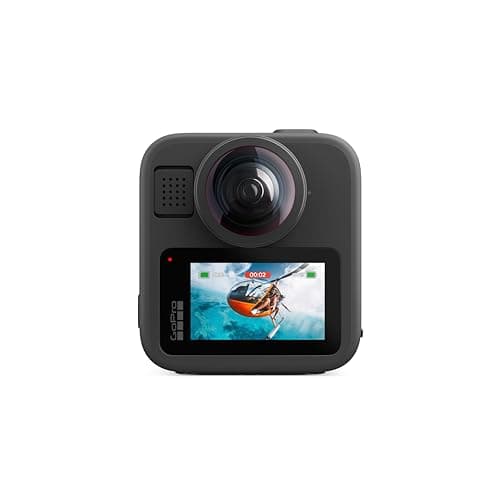
When GoPro first introduced the original MAX back in 2019, it represented a bold experiment in immersive capture — a camera that could shoot in full 360 degrees while simultaneously functioning as a traditional action cam. It was innovative, but it felt like a first-generation product in many ways. The stitching was not perfect, the resolution left something to be desired, and the overall experience required a fair amount of patience. Five years later, GoPro has returned with the MAX 2, a camera that addresses nearly every complaint users had with the original while introducing a suite of new features that make 360-degree capture more accessible and more compelling than ever before. After spending extended time with this camera across a variety of shooting scenarios, I can confidently say that the MAX 2 is not merely an incremental improvement — it is a generational leap that fundamentally changes what creators can expect from a 360-degree action camera.
The most immediately noticeable improvement with the MAX 2 is the resolution. Where the original MAX capped out at 5.6K 360 video, the MAX 2 jumps all the way to 8K. That is a massive increase in detail that becomes apparent the moment you start reviewing footage. Edges are sharper, textures are more defined, and when you reframe a shot in post-production using GoPro's Reframe app, you have dramatically more flexibility to punch in and reposition without visibly degrading the image. The 29-megapixel 360 photo resolution is equally impressive, producing stills that hold up well even when printed at large formats or heavily cropped. This resolution boost alone would have been enough to justify the upgrade for serious 360 content creators, but GoPro went considerably further with this generation.
The sensor size has also received a meaningful upgrade. The MAX 2 features a larger sensor compared to its predecessor, which translates directly into better low-light performance. Nighttime cityscape shots, indoor environments with mixed lighting, and early morning capture sessions all show noticeably less noise and better dynamic range than what the original MAX could achieve. The camera handles high-contrast scenes with considerably more nuance as well, preserving highlight detail in bright skies while pulling up shadow detail in ways that feel natural rather than processed. For creators who shoot in varied lighting conditions — which is essentially every outdoor enthusiast, traveler, and adventure filmmaker — this improvement alone makes the MAX 2 a worthwhile upgrade over previous-generation hardware.
One of the most practical new features on the MAX 2 is the swappable lens system. This is something the original MAX desperately needed but lacked entirely. The ability to replace lenses addresses a long-standing concern with action cameras: scratches and damage to the lens glass. If you manage to scuff or crack a lens during an aggressive mountain biking session or a rough snorkeling adventure, you can simply pop on a replacement rather than sending the entire camera in for service. It is a surprisingly practical addition that extends the camera's operational lifespan significantly, and it speaks to GoPro's understanding of how their users actually deploy these devices in the field. Replacement lenses are available through GoPro's website and through third-party optical specialists, and the swapping process takes only a few seconds with no tools required.
Design & Build
The HyperSmooth stabilization system has been a benchmark feature in GoPro cameras for generations, and the MAX 2 takes it to a new level. The MAX 2 features HyperSmooth Pro, which GoPro claims is their most advanced stabilization technology to date. In practice, this means that even the most aggressive activities — think rock climbing, whitewater rafting, or downhill mountain biking on rough terrain — produce remarkably stable footage. The camera's built-in gyroscope and accelerometer work in concert with sophisticated software algorithms to anticipate movement and compensate in real time. The result is footage that looks like it was shot on a professional gimbal setup, except without any of the added weight or complexity. For action sports creators who have been relying on external gimbals, the MAX 2 may well eliminate the need for that additional equipment entirely. The stabilization works equally well in both 360 mode and traditional single-lens mode, providing consistent results across the camera's different capture modes.
The audio capabilities of the MAX 2 have also received substantial attention. The camera now features six microphones, an increase from the four found in the original MAX. These microphones are arranged in a configuration designed to capture more directional and immersive audio. The result is 360 audio that actually sounds spatial and enveloping when played back on a compatible headset or in a VR environment. For creators who are using 360 video as part of a VR experience or simply want their adventure footage to feel more immersive, the improved audio is a significant enhancement. The wind noise reduction algorithms have also been improved substantially, which addresses one of the original MAX's more persistent weaknesses. Shooting from a bicycle at speed or from a motorcycle no longer produces the blustery, distorted audio that plagued so many action camera recordings in the past. The MAX 2 also introduces a new wind mode that uses the six-microphone array to actively filter out wind noise while preserving dialogue and ambient sound, which is particularly useful for vlog-style shooting where you are narrating your adventures while on the move.
The touch screen on the MAX 2 deserves special mention. It is larger, more responsive, and easier to use than the screen on the original MAX. Navigating the camera's menu system, adjusting settings on the fly, and previewing shots all feel considerably more refined. The original MAX's screen was functional but often frustrating to interact with, especially in bright outdoor conditions where visibility was a persistent challenge. The MAX 2's screen handles sunlight considerably better, and the touch response is precise enough that adjusting settings during fast-paced shooting scenarios is genuinely practical rather than an exercise in frustration. The menu structure has been redesigned as well, borrowing many of the UX improvements GoPro introduced with the Hero 13 Black. Everything is more intuitive and fewer clicks are required to access commonly used settings.
360 Capture Performance
Waterproofing has always been a core strength of GoPro cameras, and the MAX 2 continues this tradition with a robust implementation. The camera is waterproof up to 5 meters without any additional housing. This makes it suitable for snorkeling, surf sessions, and poolside capture without the added bulk and complexity of a waterproof case. For most casual water-based activities, this depth rating is more than sufficient. If you need deeper water capability, GoPro offers additional waterproof housings as accessories, but for the majority of users, the built-in waterproofing will be perfectly adequate. The camera's overall build quality feels genuinely rugged and durable. The materials used in the chassis have a premium quality that inspires confidence, and the doors covering the USB-C port and battery compartment seal securely with a satisfying click that confirms water resistance is maintained. The lens cover is made from scratch-resistant optical glass that has been treated with an anti-reflective coating to minimize flare and ghosting when shooting into the sun.
Battery life is always a concern with action cameras, and the MAX 2 makes meaningful improvements here as well, though it remains an area where compromises are inevitable given the power demands of 8K 360 capture. In 360 video mode at the highest 8K resolution setting, you can expect approximately 50 to 60 minutes of continuous recording depending on ambient temperature and the complexity of the scene being captured. Switching to the more standard 4K resolution extends this considerably, pushing runtime closer to 90 minutes in ideal conditions. The camera uses the same battery format as recent GoPro models, which means if you already own other GoPro hardware, your existing batteries and chargers will be compatible. One minor frustration is that shooting in 8K 360 mode does generate noticeable heat, particularly during extended recording sessions in warm environments. The camera has thermal management systems in place to prevent overheating, but users should be aware that extended 8K recording may trigger thermal throttling after around 25 to 30 minutes of continuous capture in direct sunlight. This is not unique to the MAX 2 — virtually all high-resolution 360 cameras face similar thermal constraints — but it is worth noting for planning purposes. Carrying a spare battery is strongly recommended for full-day shooting adventures.
The GoPro MAX 2 runs on GoPro's GP3 processor, which is the same chip powering the latest Hero cameras. This processor enables the camera's advanced computational photography features, including intelligent scene recognition, automated highlight detection, and sophisticated noise reduction. The MAX 2 also supports TimeWarp video in 360 mode, which allows creators to capture stabilized hyperlapse footage that was previously difficult or impossible to achieve with 360 cameras. The combination of the GP3 processor and the improved sensor means that the MAX 2 can capture high-quality footage in a wider range of conditions than any previous GoPro 360 camera. The processor also enables real-time stitching in the camera itself when using the live-streaming mode, which simplifies the workflow considerably for creators who want to broadcast 360 content directly to platforms like YouTube and Facebook.
Standard Video Mode
Connectivity options on the MAX 2 are comprehensive and well-implemented. The camera supports Wi-Fi and Bluetooth for wireless transfer to the GoPro Quik app, which remains one of the more capable and well-designed mobile companion apps in the action camera space. The Quik app on your phone or tablet serves as a remote control, a video editing suite, and a cloud backup destination. The Reframe feature within the app has been substantially updated for the MAX 2, offering more intuitive reframing controls, improved keyframe animation, and an expanded library of creative transitions and effects. For creators who want to get their 360 footage polished and ready for distribution without spending hours at a desktop editing station, the Quik app workflow is genuinely impressive. The app also supports automatic highlight reel generation using GoPro's AI algorithms, which can take a day's worth of footage and automatically assemble it into a polished short video with music and transitions.
The MAX 2 offers a choice between 360 capture mode and a traditional single-lens mode, just like the original. In traditional mode, the MAX 2 essentially functions as a standard action camera with one lens active. You can shoot up to 4K video in this mode, which is more than sufficient for most traditional action camera use cases. This dual-mode capability means the MAX 2 can genuinely replace a dedicated action camera for creators who want both 360 and traditional capture capabilities in a single device. The transition between modes is seamless and can be accomplished directly from the camera's touch interface without needing to access the app. For creators who are just starting with 360 capture and want to ease into it gradually, being able to fall back on familiar single-lens shooting is a valuable bridge.
One area where the MAX 2 shows meaningful improvement is in the stitching algorithm used to combine footage from its two lenses. The original MAX produced visible stitching lines in certain shooting scenarios, particularly when objects were close to the camera. The MAX 2's stitching is considerably more refined, and in most shooting scenarios, the join between the two hemispheres of footage is essentially invisible. This is critical for creators who want to produce content that can be viewed in traditional 2D format as well as full 360 VR environments, as stitching artifacts are one of the most common complaints from viewers watching 360 content on a flat screen. The improved stitching also means that the MAX 2 is more viable for professional production work where quality standards are high.
Stabilization
The camera's GPS functionality has been enhanced as well, enabling more accurate speed and altitude data overlays in footage. For athletes and adventurers who want to display their performance metrics alongside their footage, this improved GPS capability adds another dimension to the content. The MAX 2 also supports voice control in a wide range of languages, which remains genuinely useful for hands-free operation during activities where stopping to adjust settings is impractical or unsafe. The voice control system can now recognize a broader vocabulary of commands and is more reliable in windy conditions thanks to the improved microphone array.
Storage options on the MAX 2 are flexible. The camera accepts microSD cards up to 256GB in capacity, which provides plenty of room for high-resolution 8K footage. GoPro's cloud subscription service offers additional storage and automated uploading capabilities for creators who want a seamless backup workflow. The subscription also enables features like automatic highlight reels and advanced editing tools, making it a compelling value proposition for serious content creators who find themselves regularly editing and sharing footage from their adventures. The subscription pricing is competitive with other cloud backup services and the integration with the camera and app is seamless.
In terms of competition, the MAX 2 sits in a market segment that has grown considerably more crowded since the original MAX launched. The Insta360 X5 and the DJI Osmo 360 are both capable alternatives that offer their own unique strengths. The Insta360 X5 has a reputation for exceptional image quality and a highly refined mobile editing experience, while the DJI Osmo 360 benefits from DJI's strong stabilization heritage and ecosystem of accessories. Compared to these competitors, the MAX 2's primary advantages are its integrated design, the versatility of the dual 360 and traditional capture modes, and GoPro's established reputation in the action camera market. The MAX 2 does not require any additional modules or accessories to function as a complete 360 camera, which simplifies the ownership experience compared to systems that rely on modular components.
Audio & Accessories
For real-world performance testing, I took the MAX 2 on a multi-day hiking and kayaking trip to evaluate how it handles diverse and demanding conditions. In the hiking scenarios, the camera was mounted on a chest mount harness, which provided an immersive first-person perspective. The stabilization was exceptional — even on uneven singletrack trails with significant root and rock obstacles, the resulting footage was remarkably smooth and watchable. The GPS track overlay was accurate and provided a compelling way to communicate the scale and terrain of the hike when shared with friends and family. The battery held up reasonably well across a full day of intermittent shooting, though I did carry two spare batteries to be safe.
The kayaking session presented a more challenging environment in terms of waterproofing and audio. The MAX 2 performed admirably in this context, with the waterproofing keeping the camera fully functional despite repeated splashes and one inadvertent full submersion when exiting the water. The audio was notably clearer than what I have experienced with other action cameras in similar wet conditions, though wind noise during paddle strokes remained present but manageable with the wind reduction mode enabled. The touch screen was somewhat less responsive when wet, which is a limitation shared by virtually all touch-screen cameras in water sport applications.
The GoPro MAX 2 is available at $499.99 MSRP, though street prices frequently bring it lower during sales events. At the time of this review, the camera was available on Amazon for $449.00, which represents a meaningful discount from the list price. Given the substantial improvements across resolution, low-light performance, stabilization, audio, and build quality, the MAX 2 represents a compelling value proposition for anyone serious about 360-degree content creation. The original MAX was an ambitious first attempt that showed a lot of potential. The MAX 2 is the fulfillment of that potential — a camera that is easier to use, more capable, and more versatile than anything GoPro has produced in the 360 space before.
Competition & Value
For existing MAX owners, the upgrade calculus is favorable. The resolution jump from 5.6K to 8K alone justifies the upgrade for anyone who regularly produces content for platforms that can display high-resolution footage. The swappable lens system alone is worth the price of admission for active users who have been burned by scratched lenses in the past. The improved stitching, the six-microphone audio system, and the enhanced GPS capabilities all add additional layers of value that make the MAX 2 a meaningful upgrade from the original generation.
For new buyers entering the 360 camera market for the first time, the MAX 2 is the most complete and polished option currently available. It is a camera that rewards investment in learning its capabilities and ecosystem of accessories, and it is built to produce professional-quality results in the hands of creators who are willing to put in the time to master its workflow. The dual-mode capability means that even if you are not ready to fully commit to 360 capture, you can start with traditional shooting and gradually incorporate 360 techniques as your skills and comfort level grow.
The MAX 2 is not without its limitations. The thermal management during extended 8K recording sessions remains a constraint, and the price point is still substantial compared to traditional action cameras. The camera's size and weight are greater than a standard action camera due to the dual-lens 360 system, which may be a consideration for weight-conscious adventurers. These are relatively minor concerns in the context of everything the camera delivers, and they represent tradeoffs that are essentially inherent to the 360 camera category rather than specific failures of the MAX 2's design.
For creators who want to explore 360-degree storytelling, immersive VR content, or simply capture more of their environment in a single take, the GoPro MAX 2 is the most capable and refined tool currently available for the purpose. It represents a camera that pushes the boundaries of what is technically possible in a portable 360-degree capture device while remaining accessible enough for enthusiastic amateurs to use effectively. This is the camera that the original MAX was trying to become, and it is a genuinely impressive piece of engineering that earns its place in any serious content creator's kit. Whether you are a professional videographer looking to expand your service offerings into 360 content or an adventure enthusiast who wants to share experiences in the most immersive way possible, the MAX 2 has the capability and the refinement to meet your needs.
Related Reviews: DJI Osmo Action 5 Pro Adventure Combo · Insta360 Link 2 Pro
Final Verdict
Pros
- 8K 360-degree resolution is a massive jump from original MAX
- Swappable lens system extends camera lifespan in the field
- HyperSmooth Pro stabilization rivals dedicated gimbal systems
- Six-microphone array with excellent wind noise reduction
- Dual 360 and traditional single-lens capture modes
Cons
- Thermal throttling during extended 8K recording sessions
- Price premium over traditional action cameras
- Larger and heavier than standard action cameras due to dual-lens system
Final Verdict
The GoPro MAX 2 delivers a massive resolution jump to 8K, improved low-light performance, swappable lenses, six-microphone audio, and HyperSmooth Pro stabilization in a rugged dual-mode 360 and traditional action camera. At $449 on Amazon, it sets a new standard for 360-degree content creation.