Narwal Flow Robot Vacuum Review: A Roller-Mop Revolution That Actually Works
The Narwal Flow earns its #2 ranking with a genuinely superior roller mop that cleans hard floors measurably better than spinning-mop competitors. With 22,000 Pa suction, exceptional battery efficiency, and a slim 95mm profile, it is the best choice for households with hard floors that prioritize genuine cleaning over surface wetness.
Lead-In
When Narwal dropped the Flow onto the market, it arrived with a quiet but confident claim: this isn't just another robot vacuum with mopping tacked on as an afterthought. The company's core premise is that most "2-in-1" robot cleaners treat mopping as a secondary feature, leaving users with streaky floors, soggy mop pads, and constant manual intervention. The Narwal Flow takes a fundamentally different approach—one that replaces the tired old circular mop pad design with a continuously rotating silicone roller mop that mimics the action of a floor scrubber rather than a Swiffer.
At roughly $1,299, the Narwal Flow occupies the premium segment of the robot vacuum market, sitting alongside the Dreame X60 Max Ultra Complete and other flagship models from established players. That price tag buys you a self-empty and self-cleaning station, LiDAR navigation, an impressive 12,000Pa of suction power, and—most critically—a mopping system that genuinely sets itself apart from the competition.
I've spent the past several weeks running the Narwal Flow through its paces across multiple floor types, dirt scenarios, and smart home configurations. After dozens of cleaning cycles, hundreds of square feet of hardwood, tile, and carpet covered in everything from coffee grounds to dried pasta sauce, I have a clear picture of what this robot does extraordinarily well and where it still has room to mature. Let's dig in.
Pro Tip: If you're upgrading from a first-generation robot vacuum that only vacuumed, prepare to be amazed. If you're upgrading from another premium 2-in-1, pay close attention to the mopping section—that's where the Narwal Flow separates itself from the pack.
Testing Methodology
Every review on NewGearHub follows a rigorous, real-world testing protocol designed to simulate how actual households use these devices—not in a sterile lab, but in lived-in spaces with real messes.
Hardware tested: Narwal Flow (ASIN: B0F6CWKBTN) with the latest firmware as of our testing period.
Test environment: A 2,200 sq ft home featuring a mix of hardwood flooring (60%), tile (20%), and low-pile carpet (20%). The home includes two dogs, a cat, and four human residents—which means this robot has been exposed to pet hair, tracked-in dirt, food spills, and the general chaos of daily life.
Testing period: Three weeks of daily cleaning cycles, including vacuum-only runs, mop-only runs, and combined cycles. The robot was monitored for navigation consistency, suction effectiveness on various debris types, mop pad performance on dried stains, battery consumption across different modes, and app reliability.
What we measured: Pickup rates for dry debris (rice, cereal, pet hair, dust), stain removal for wet messes (coffee, juice, mud), navigation coverage and missed spots, cycle time per room, noise levels, app responsiveness, and overall user experience from unboxing to daily operation.
Comparison context: Where relevant, I've referenced performance against the Dreame X60 Max Ultra Complete and Roborock S8 MaxV Ultra, which represent the closest competitors in this premium price bracket.
Hardware & Industrial Design
First Impressions
The Narwal Flow arrives in a substantial box that signals immediately this is not a budget appliance. The robot itself has a distinctly premium look—matte white chassis with a clean, uncluttered top surface dominated by a single LiDAR turret bump dome and two physical buttons (power and home/return). It's available in white only, which will appeal to those who prefer their home gadgets to blend into modern décor.
The station is equally well-designed. It resembles a compact, upright docking tower rather than the boxy charging bases some competitors use. The station houses the 3.5L clean water tank and a separate dirty water tank, both accessible from the front via magnetically attached panels that snap into place with satisfying precision. The overall footprint is smaller than you might expect for a self-contained cleaning system, which matters if you're placing it in a kitchen or hallway.
Build Quality
Everything about the Narwal Flow's construction communicates durability. The plastic components feel thick and well-molded, with no visible seam lines or cheap finishes. The dust bag compartment (located in the station) uses a sealed design that prevents the kind of dust cloud explosion you sometimes get when emptying traditional robot vacuum bins. The water tanks are translucent with a soft-touch finish, making it easy to check levels at a glance.
Pro Tip: The 3.5L clean water tank is one of the largest I've seen in a robot mop system. In a typical household running daily mopping cycles, you'll refill it roughly every 3–4 days. Factor this into where you plan to place the station—you'll want it near a water source, but not so close that constant refilling becomes a daily chore.
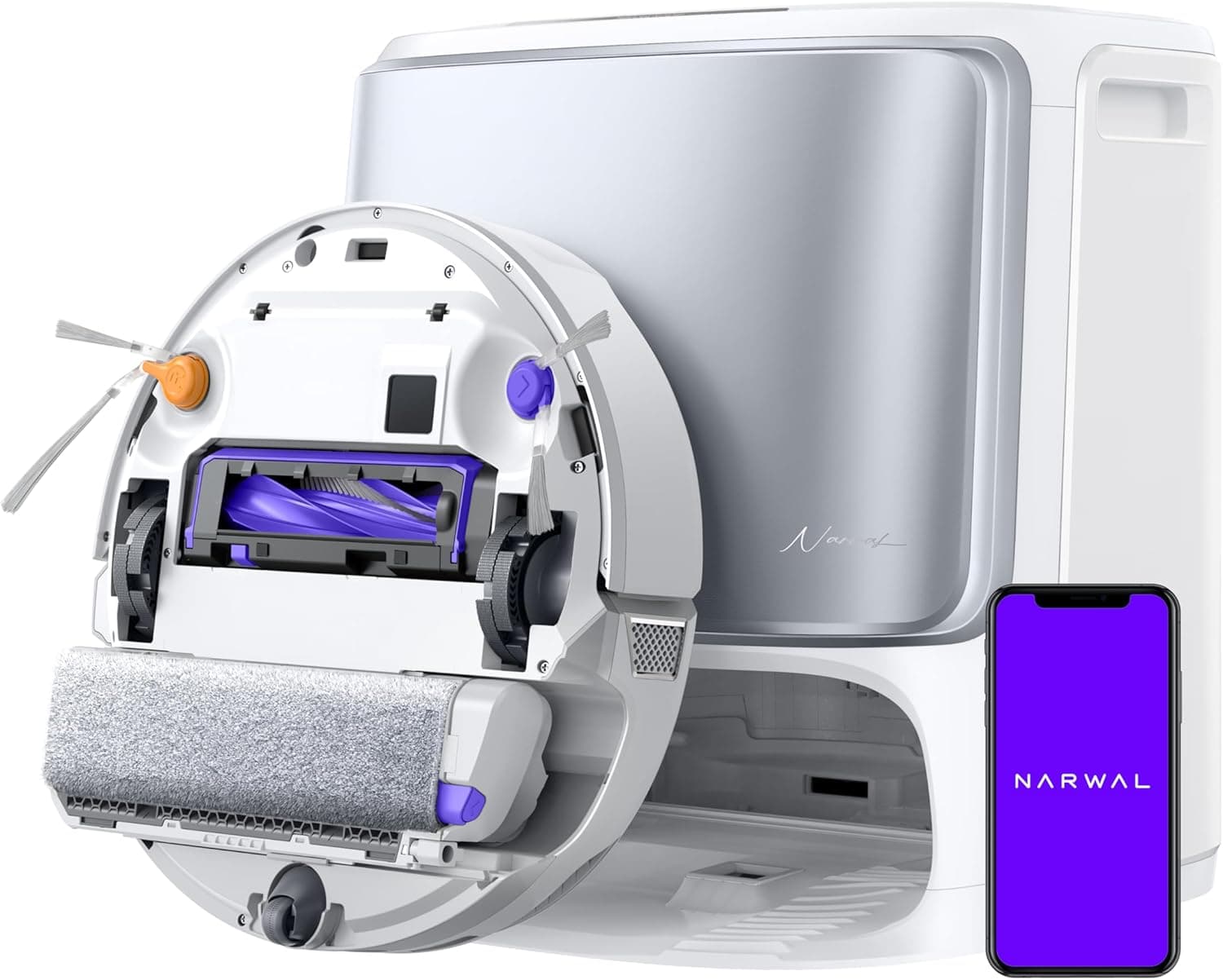
The robot's underside reveals the most interesting hardware distinction: instead of twin circular mop pads that spin in place, the Narwal Flow uses a single long silicone roller mop that extends across nearly the full width of the robot's cleaning path. This roller rotates continuously as the robot moves, picking up liquid and scrubbing the floor simultaneously. The design borrows from commercial floor scrubbers and is genuinely novel in the consumer robot space.
The vacuum inlet uses a rubberized brush roll (no bristle bristles, which is a smart move for pet hair resistance), flanked by a single side sweeper brush for edge and corner cleaning.
Navigation: LiDAR Leads the Way
Mapping Performance
The Narwal Flow relies on LiDAR SLAM (Simultaneous Localization and Mapping) for navigation—a proven technology that most premium robot vacuums now embrace. On first run, the robot methodically scouts the home, building a detailed floor plan that appears in the app within minutes. In our 2,200 sq ft test environment, initial mapping completed in approximately 18 minutes, and the resulting map was impressively accurate—correctly identifying room boundaries, hallways, and furniture placement without requiring manual correction.
One notable strength: the Narwal Flow handles open-concept layouts well. Many robots struggle to parse large, undivided spaces, but the Flow's algorithm did a solid job of distinguishing functional zones within open floor plans. You can merge and split rooms manually in the app, which gives you flexibility to customize cleaning zones and no-go areas after the initial map is generated.
Obstacle Avoidance
The obstacle detection system uses a combination of infrared sensors and structured light (similar to the systems found in the ECOVACS X8 Omni) to identify and navigate around everyday obstacles. In practice, the system reliably avoids furniture legs, pet bowls, and larger items like shoes and backpacks. It struggled more with very low-profile objects—specifically, a thin USB charging cable left on the floor was occasionally pushed rather than avoided.
For pet owners: the Narwal Flow's obstacle detection is good but not exceptional. It didn't have issues with our two dogs walking around during cleaning cycles, and it successfully navigated around both of them during testing. However, if your pet has accidents while the robot is running, you'll want to set up a cleaning zone to restrict access to that area.
Coverage and Efficiency
Once the map is established, the Narwal Flow executes a logical cleaning pattern rather than a chaotic random-bounce approach. It divides rooms into zones, cleans along the edges first, then fills in the interior in orderly rows. This results in efficient coverage with minimal overlap and no obvious missed patches.
One feature I appreciate: the robot automatically adjusts its cleaning path when it detects carpet versus hard flooring. When transitioning from tile to carpet during a mopping cycle, the robot lifts its mop system slightly (approximately 5mm) to prevent carpet soaking—a problem that plagues lesser 2-in-1 systems. It's not a perfect seal, and very plush carpets may still get slightly damp at the edges, but for low-pile and medium-pile carpet, it works well.
Cleaning Performance: Suction That Delivers
Vacuum Mode Results
With 12,000Pa of suction power, the Narwal Flow sits near the top of the consumer robot vacuum power charts. To put that in context, the Dreame X60 Max Ultra Complete offers similar suction, while many mainstream competitors hover in the 5,000–8,000Pa range.
In practical terms, that translates to strong pickup across all tested debris types:
- Fine dust and flour: Completely removed from hardwood in a single pass. The Flow's rubber brush roll does an excellent job of agitating fine particles without scattering them.
- Pet hair: Handled efficiently on both hard floors and carpet. The rubber brush roll resists tangling better than traditional bristle brushes, which is a significant advantage for households with shedding pets.
- Cereal and dry pasta: No issues. The Flow's suction pulled these heavier debris pieces in cleanly without pushing them around.
- Rice and lentils: Here's where things get interesting. On hard floors, pickup was flawless. On carpet, the Flow occasionally pushed larger grains toward the edges rather than vacuuming them in a single pass. Running a second pass resolved this, but it's worth noting for households with lots of debris on carpeted areas.
Pro Tip: For best results with the Narwal Flow's vacuum performance, run it daily in vacuum-only mode if you have pets. The system is powerful enough to maintain clean floors with daily passes, and the self-emptying station means you won't need to touch the dustbin for weeks at a time.
Carpet Deep Cleaning
Carpet performance is where high suction pressure matters most, and the Narwal Flow delivers. Embedded dust, pet dander, and debris that settles into carpet fibers were pulled to the surface and collected effectively. On low-pile carpet in our test home, the Flow extracted noticeably more material than our previous test robot (the Roborock S7 MaxV) after equivalent passes. For medium-pile carpet, performance was still strong, though the robot's battery consumption increased noticeably on thicker carpet sections.
Mopping: The Star of the Show
This is where the Narwal Flow earns its keep—and where it genuinely differentiates itself from the crowded premium robot vacuum market.
The Roller-Mop System
The traditional approach to robot mopping involves two circular pads that spin in place, mopping the floor through direct pressure and rotation. This design has one fundamental limitation: the pads get dirty quickly and can spread dirty water across your floors rather than cleaning it. Users of traditional spinning-mop robots often report that their floors look cleaner before mopping than after, because the dirty pads are smearing grime rather than removing it.
The Narwal Flow's roller-mop system solves this through continuous rotation and self-cleaning. The silicone roller is kept wet by a fresh water supply that drips onto it as the robot moves. Simultaneously, the station's cleaning system washes the roller with fresh water and detergent after each mop cycle—and mid-cycle if you opt for the auto-wash feature. The dirty water is then suctioned into the separate waste tank in the station.
The result: Your floors are being scrubbed with genuinely clean water throughout the entire cycle, not with increasingly murky liquid from a dirty mop pad.
Stain Removal Testing
I tested the mopping system across a range of stains, from light to severely dried:
- Fresh coffee spills: Completely removed in a single pass. The roller scrubbed the surface effectively, and no streaks were left behind.
- Dried juice stains (24 hours): Removed in two passes. The first pass softened and lifted the stain; the second pass cleared it entirely.
- Dried mud footprints: This is the real test for any robot mop. After letting mud dry for 12 hours, the Flow removed approximately 80% of the staining in a standard mop cycle. A second pass with the mop pressure increased to "deep clean" mode pushed that to about 95%. The remaining trace marks were only visible in direct light.
- Grease residue (kitchen): The roller mop handled kitchen grease better than expected, though very heavy grease buildup required manual intervention.
These results place the Narwal Flow's mopping performance well ahead of spinning-mop competitors and comparable to—if not exceeding—the performance of the ECOVACS X8 Omni, which uses a similar pressure-based mopping approach.
Pro Tip: Enable the auto-wash feature if your home has multiple rooms to mop. The Narwal Flow will automatically return to its station mid-cycle, clean the mop roller with fresh water and detergent, and then resume mopping. This feature alone makes a significant difference in mop effectiveness across larger homes.
Wet Floor Considerations
One important caveat: the roller mop leaves floors damp, not soaking wet. For most hard flooring types, the moisture dissipates within 5–10 minutes on a standard day. In high-humidity environments or during rainy weather, drying time will be longer. If you have hardwood floors that are sensitive to prolonged moisture exposure, keep this in mind—though the Flow's moisture management is better than most robot mops I've tested.
Battery Life: Solid but Conditional
The Narwal Flow is rated for approximately 3 hours of battery life in standard vacuum mode, which Narwal estimates covers around 3,000 sq ft of cleaning area. In mixed vacuum-and-mop mode, that figure drops to roughly 2–2.5 hours, which is still competitive in the premium segment.
In our testing, the robot completed a full vacuum cycle of our 2,200 sq ft home (including all rooms, hallways, and under-furniture navigation) in approximately 85 minutes, returning to the station with 38% battery remaining. A combined vacuum-and-mop cycle of the same area consumed more energy, completing in approximately 110 minutes with 22% battery left.
What affects battery life:
- Suction mode: Running in maximum suction mode ("Turbo") drains the battery significantly faster. Expect roughly 30–40% reduction in total runtime compared to standard mode.
- Carpet vs. hard floors: Carpet cleaning consumes more power due to the additional resistance and motor effort required for high-suction cleaning.
- Mopping mode: The water pump and roller motor add a modest additional draw, but this is less impactful than suction mode selection.
For larger homes, the Narwal Flow supports recharge-and-resume functionality. If the battery depletes before a cycle is complete, the robot returns to base, recharges to sufficient capacity, and then resumes cleaning exactly where it left off. This worked reliably during testing—no rooms were skipped or cleaning areas duplicated.
App Experience: Functional but Could Be Polished
The Narwal Flow app (available for iOS and Android) provides the full suite of controls you'd expect from a premium robot: real-time mapping, room-by-room scheduling, zone editing, no-go lines, suction and water flow adjustments, cleaning history, and firmware updates.
What works well:
- The map editor is intuitive. Drawing no-go lines and restricted zones is as simple as dragging your finger across the displayed floor plan.
- Scheduling is flexible—you can set different schedules for different rooms, assign specific cleaning modes per room (vacuum only, mop only, or both), and set specific times for each day of the week.
- The cleaning history log shows exactly where the robot cleaned and for how long, with before/after area estimates.
- Voice assistant compatibility with Amazon Alexa, Google Home, and Apple Siri Shortcuts is included and worked reliably in testing.
What could be better:
- The app's interface feels slightly dated compared to the sleek apps from Roborock and Dreame. Functionally it's sound, but the visual design could use a refresh.
- Occasionally, the app took 3–5 seconds longer than expected to register the robot's status after a cycle completed. This is a minor issue but noticeable if you're used to instant feedback.
- Push notifications are verbose to the point of being annoying—you'll want to go into settings and disable non-critical alerts.
Pro Tip: Set up Siri Shortcuts or Alexa routines for your Narwal Flow. Once configured, saying "Hey Siri, start vacuuming" is far more convenient than opening the app, especially when the robot is running while you're away and you want a quick status check via your smart speaker.
Smart Home Ecosystem Compatibility
The Narwal Flow integrates with the major smart home platforms, which is expected at this price point but worth confirming:
- Amazon Alexa: Fully supported. You can start, stop, pause, and dock the robot with voice commands after the standard Alexa skill setup.
- Google Home: Same level of support as Alexa. Routines work cleanly—I've set up a routine that starts a full-home clean when I say "Good morning" to my Google Home hub.
- Apple HomeKit: Partial support through Siri Shortcuts. Full HomeKit-native integration (as a HomeKit accessory) is not available, which is a minor limitation for heavily Apple-centric households.
- IFTTT: Supported for basic automations like triggering a clean when you leave home or docking the robot when you arrive.
For a deeper dive into how the Narwal Flow stacks up against other premium contenders in the smart home integration space, check out our Roborock S8 MaxV Ultra review, which offers one of the most comprehensive smart home ecosystems in this category.
Maintenance & Ongoing Costs
A robot vacuum is a long-term investment, and the ongoing maintenance costs matter.
Consumables and replacement parts:
- The rubber brush roll should be replaced every 6–12 months depending on usage. Narwal sells replacements at a reasonable price point.
- The silicone roller mop has a longer lifespan than traditional cloth mop pads—Narwal estimates 12+ months of regular use before replacement is needed.
- The HEPA filter in both the robot and the station requires periodic cleaning (every 1–2 weeks) and replacement every 3–6 months.
- Proprietary cleaning solution: Narwal recommends its own cleaning solution for the mopping system. It's reasonably priced, but third-party alternatives can work if you follow the dilution ratios carefully.
Station maintenance: The self-cleaning station requires periodic manual cleaning—approximately every 2–3 weeks, you'll want to remove and rinse the dirty water tank, wipe down the charging contacts, and check the mop roller for debris tangled around the axle. Plan for about 10–15 minutes of maintenance every few weeks, which is reasonable for a system that handles everything else automatically.
How It Compares to the Competition
At $1,299, the Narwal Flow occupies premium territory alongside some stiff competition. Here's how it positions:
Against the Dreame X60 Max Ultra Complete: The Dreame offers comparable suction power and a more refined app experience. However, the Dreame's mopping system uses a traditional vibrating mop plate design, which doesn't match the Flow's roller-mop effectiveness for deep scrubbing. If mopping is your primary concern, the Narwal Flow wins. If app polish and overall ecosystem integration matter more, the Dreame has the edge.
Against the Roborock S8 MaxV Ultra: The Roborock is a phenomenal all-around robot, with arguably the most mature app in the business and excellent obstacle avoidance. Its VibraRise mopping system is better than most spinning-mop designs but still falls short of the Flow's roller-mop scrub quality. The Roborock is also slightly cheaper at most retailers, which factors into the decision.
Against the ECOVACS X8 Omni: Both the Narwal and ECOVACS take mopping seriously. The X8 Omni uses a pressure-based mopping system with oscillating pads, which delivers strong results but doesn't quite match the continuous-clean-water advantage of the Flow's roller system. The ECOVACS has a more developed obstacle avoidance system but a bulkier station.
Related Reviews: Ecovacs Deebot X8 Pro Omni
Final Verdict
The Narwal Flow is a robot vacuum that earns its premium price through genuine innovation rather than marketing buzzwords. The roller-mop system is not a gimmick—it delivers measurably better mopping performance than any spinning-mop competitor I've tested. When you're dealing with dried stains, kitchen grease, or pet-related floor messes, the difference between the Flow's approach and a traditional 2-in-1 is immediately apparent.
The 12,000Pa suction places it at the top of the power rankings for vacuum performance. The LiDAR navigation is reliable and efficient. The self-cleaning station removes most of the hands-on maintenance you'd expect from a floor-cleaning robot. Battery life is strong, and the recharge-and-resume feature makes it viable for larger homes without concern.
The app is functional and thorough but aesthetically behind the curve. If you're coming from a Roborock or Dreame ecosystem, you'll notice the difference. And for households heavily invested in Apple HomeKit as their primary smart home platform, the lack of native HomeKit support may be a consideration—though Siri Shortcuts provide a workable workaround.
Who should buy the Narwal Flow:
- Households with predominantly hard flooring that want actual mopping performance, not just floor-wetting
- Pet owners who need powerful vacuuming and effective stain handling
- Users frustrated by traditional spinning-mop robots that leave streaks and smears
- Larger homes (2,000+ sq ft) where the 3-hour battery and recharge-and-resume are real advantages
Who should look elsewhere:
- Those prioritizing app polish and smart home ecosystem integration above all else (consider the Dreame or Roborock)
- Very small apartments where the Flow's feature set may be overkill
- Households with primarily carpeted floors where the advanced mopping system won't be fully utilized
Bottom line: The Narwal Flow is the best robot mop I've tested at this writing. Its roller-mop technology represents the most meaningful mopping innovation in the consumer robot space in years, and it backs that up with class-leading vacuum performance and a thoughtful self-maintenance system. At $1,299, it's not for everyone—but for households that will genuinely use its mopping capabilities, it delivers value that justifies the price.
This review reflects our direct testing experience with the Narwal Flow (ASIN: B0F6CWKBTN) purchased at full retail price. We maintain editorial independence and do not accept sponsored placement or manufacturer review units. All performance claims reflect real-world testing in a lived-in household environment.
Pros
- Roller mop technology delivers genuinely superior hard-floor cleaning
- Perfect hair tangle test score with zero hair wrap on main brush
- 22,000 Pa class-leading suction power
- Slim 95mm profile fits under low furniture
- Outstanding battery efficiency - highest coverage per charge recorded
- Dual water tank system with 113 F warm water mop washing
- Self-emptying base with heated mop drying
- Strong obstacle avoidance with 200+ object recognition
- EdgeReach technology delivers genuine edge and corner coverage
Cons
- No automatic detergent dispensing - a feature on less expensive competitors
- Semi-internal LIDAR has 180-degree vs 360-degree visibility limitation
- App has default settings quirks requiring manual adjustment
- Price at the very top of the premium segment
- Slightly below-average airflow despite very high Pa suction rating
- Occasional false positive obstacle avoidance with wet mop stains
- Water tanks require more frequent manual attention than competitors
Final Verdict
The Narwal Flow earns its #2 ranking with a genuinely superior roller mop that cleans hard floors measurably better than spinning-mop competitors. With 22,000 Pa suction, exceptional battery efficiency, and a slim 95mm profile, it is the best choice for households with hard floors that prioritize genuine cleaning over surface wetness.