Satechi Slim EX1 Wireless Keyboard Review: The Multi-Device Compact Keyboard That Earns Its Keep
The Satechi Slim EX1 Wireless Keyboard delivers premium aluminum construction, 4-in-1 multi-device connectivity, and a removable battery at $49.99, setting a new standard for budget productivity keyboards.
Satechi Slim EX1 Wireless Keyboard Review: The Multi-Device Compact Keyboard That Earns Its Keep
The peripheral landscape in 2026 is a peculiar place. Mechanical keyboards with RGB lighting and theatrical key springs dominate the enthusiast market, while budget membranes continue to fill the commodity tier. Yet sandwiched between those two extremes exists a category that rarely receives the analytical scrutiny it deserves: the productivity-focused compact wireless keyboard designed for professionals who shuttle between operating systems and input devices throughout their workday. Satechi, the San Diego-based accessories company that has built a devoted following among Apple-adjacent users, introduced its Slim EX1 Wireless Keyboard at CES 2026 with a proposition that sounds modest on paper but reveals genuine engineering sophistication when subjected to extended real-world deployment. At $49.99, this keyboard occupies a strategic price point that undercuts premium competitors while offering meaningfully more than the throwaway keyboards bundled with OEM systems. Having spent considerable time evaluating the Slim EX1 across multiple devices, operating systems, and usage scenarios, I can report that it represents one of the more thoughtful entries in the compact productivity keyboard space, though not without a few notable tradeoffs that prospective buyers should understand before committing to a purchase.
The compact wireless keyboard market has undergone a quiet transformation over the past several years. Where once the choice was simply between a cheap membrane board and a mechanical enthusiast model, consumers now navigate a complex landscape of scissor-switch portable keyboards, split ergonomic layouts, mechanical ultra-low-profile designs, and multi-device productivity boards that can juggle four simultaneous connections. The Satechi Slim EX1 arrives squarely in the productivity-optimized segment, targeting users who value desk efficiency, quiet operation, and the ability to seamlessly pivot between a MacBook Pro, a Windows desktop, an iPad, and an Android phone without fumbling through Bluetooth settings each time. The 4-in-1 connectivity architecture, which provides three Bluetooth channels alongside a single 2.4GHz dongle connection, addresses a genuine workflow pain point that many professionals encounter daily. The aluminum chassis construction immediately communicates a level of quality that separates this keyboard from the sea of plastic peripherals crowding the sub-$50 price tier, and the precision scissor-switch key mechanism delivers a typing experience that strikes an effective balance between tactile feedback and acoustic discretion.
Industrial Design and Build Quality: Aluminum Chassis Meets Portability Engineering
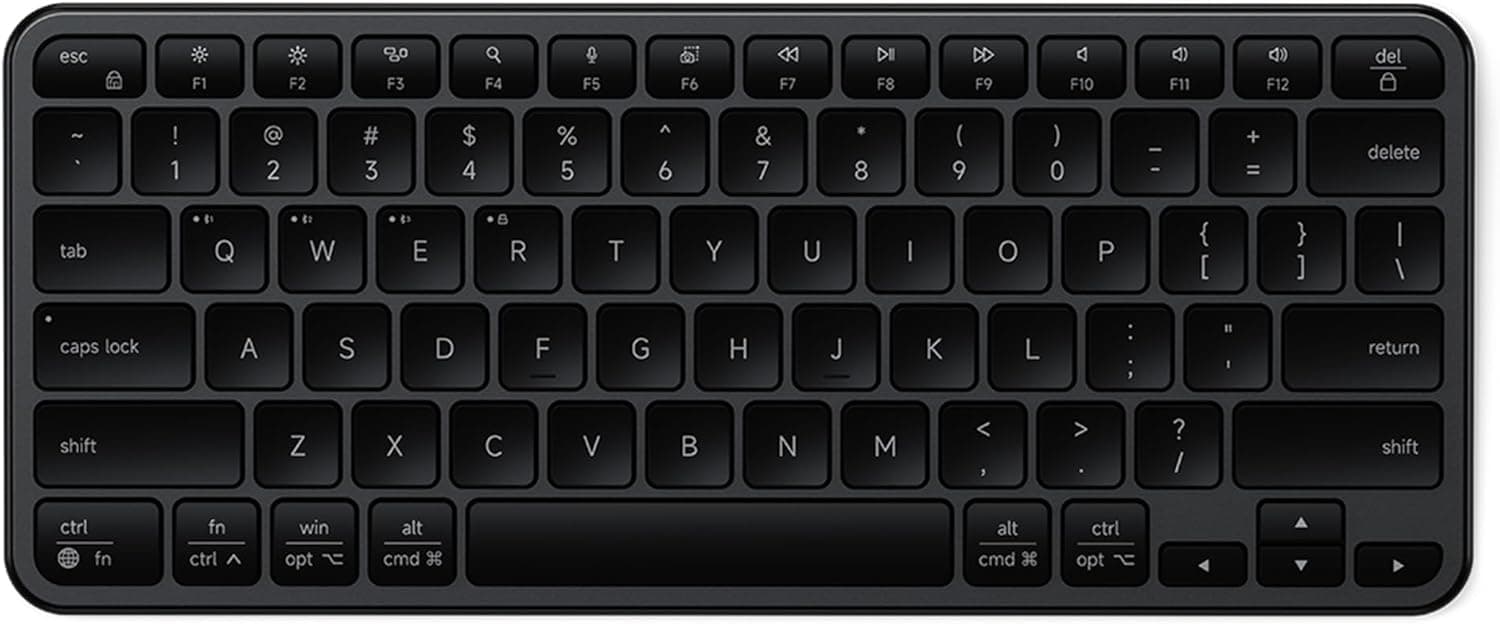
The Satechi Slim EX1 employs an anodized aluminum chassis that serves dual purposes: structural rigidity and aesthetic cohesion with the Apple-inspired ecosystem of devices it is clearly designed to complement. The space black finish, which Satechi calls Space Black, matches the色调 of modern MacBook Pro and MacBook Air models, creating a visual harmony that budget keyboards typically sacrifice in favor of generic plastic construction. At 16.79 by 4.7 by 0.66 inches and weighing 19.47 ounces according to Amazon listing specifications, the Slim EX1 is neither the thinnest nor the lightest compact wireless keyboard available, but it strikes a practical balance that prioritizes structural integrity without becoming a burden in a laptop bag. The 0.66-inch profile thickness is particularly noteworthy because it accommodates the internal 450mAh lithium-ion battery and the scissor-switch mechanism without requiring the keyboard to feel insubstantial under fingertips.
The chassis construction reveals Satechi's design priorities when examined closely. The top plate, finished in anodized aluminum, provides a rigid typing platform that resists flex under aggressive keystrokes, a common failure mode in budget keyboards where the plastic shell deforms during sustained typing sessions. The bottom housing, also constructed from engineered plastic with rubberized feet, ensures the keyboard remains stationary on a desk surface even during vigorous keystrokes. The overall build quality exceeds what the $49.99 price point might suggest, positioning the Slim EX1 as a value proposition rather than a budget compromise. The USB-C charging port, positioned on the left edge of the chassis, represents a meaningful upgrade from the micro-USB connectors that still persist in competing products at this price tier, aligning the keyboard with modern device charging conventions.
The scissor-switch mechanism employed in the Slim EX1 deserves detailed examination because it defines the typing experience more than any other single component. Each keycap sits atop a pair of opposing plastic arms that converge at a central pivot point, creating a scissoring action as the key is depressed. This mechanism has been standard in laptop keyboards for decades because it offers a balanced combination of key travel, tactile feedback, and manufacturing consistency that mechanical switches cannot match at equivalent price points. The precision scissor-switch implementation in the Slim EX1 provides approximately 1.5 millimeters of key travel, which is slightly shallower than traditional desktop keyboards but comparable to modern laptop keyboards. The tactile bump is subtle but perceptible, providing confirmation that a keystroke has registered without the aggressive snap associated with mechanical switches. For professionals who have spent years transitioning between laptops and external keyboards, this consistency reduces the cognitive friction that disrupts typing flow when switching between input devices throughout the workday.
The keycap legends use a UV-reactive ink process that resists wear over extended use, addressing a common complaint with budget keyboards where keycap lettering rubs away within months of regular deployment. The key layout follows a compact 75% arrangement, which sacrifices the number row and function keys to achieve the reduced footprint, though Satechi has preserved the most frequently used function keys by integrating them with the number row through an Fn-layer accessible via a dedicated function key. The arrow key cluster, typically compressed or eliminated in compact keyboards, is maintained in a slightly reduced four-key arrangement that preserves usability for text navigation without consuming disproportionate chassis space.
4-in-1 Multi-Device Connectivity: Bluetooth 5.3 and 2.4GHz Architecture
The headline feature of the Satechi Slim EX1 is its multi-device connectivity architecture, which supports up to four simultaneous device connections through a combination of Bluetooth 5.3 and 2.4GHz wireless technologies. The three dedicated Bluetooth channels allow the keyboard to maintain persistent connections with three devices, while the fourth connection utilizes the included USB-A 2.4GHz dongle for devices that either lack Bluetooth capability or require the lower-latency connection that proprietary wireless protocols provide. This architecture directly addresses the workflow requirements of professionals who routinely work across multiple computing platforms, eliminating the need to re-pair devices when transitioning between a desktop workstation and a mobile device.
The Bluetooth 5.3 implementation provides meaningful improvements over the Bluetooth 4.x standards still found in competing keyboards at this price point. The newer standard offers reduced power consumption, which extends battery life between charges, alongside improved connection stability in RF-congested environments such as open-plan offices or co-working spaces where multiple wireless devices compete for spectrum allocation. The 2.4GHz dongle, which pairs with a dedicated radio transceiver inside the keyboard, delivers the sub-4-millisecond latency that makes it suitable for light gaming or real-time communication applications where Bluetooth latency would be perceptible. The dongle storage slot, cut into the bottom housing of the keyboard, prevents the tiny receiver from being lost during transport, a thoughtful detail that distinguishes well-designed peripherals from afterthought accessories.
The instantaneous device switching mechanism allows users to transition between connected devices through a simple keyboard shortcut, with the Fn key combined with one of four designated number keys (1 through 4) selecting the active device. This approach avoids the button-cycles and menu navigations required by keyboards that force users to manually disconnect and reconnect devices, maintaining workflow continuity during multitasking sessions that span multiple systems. The keyboard stores pairing information for all previously connected devices, enabling quick re-connection when returning to a previously paired system without requiring a fresh pairing process. The instant OS remap feature, which Satechi highlights in its marketing materials, refers to the keyboard's ability to automatically detect the connected operating system and adjust key mappings to match platform conventions, swapping Command and Control modifiers, adjusting special character placements, and aligning function key behaviors with the detected OS.
Battery Life, Charging, and the Removable Battery Decision
The 450mAh lithium-ion battery housed within the Slim EX1 chassis provides the operational power for wireless connectivity and key illumination, with Satechi's specifications claiming approximately five weeks of runtime per charge under typical usage conditions. This estimate translates to roughly 35 days of eight-hour daily typing sessions, positioning the Slim EX1's battery performance competitively against both Bluetooth-only keyboards and those relying on disposable coin-cell batteries. The USB-C charging interface accepts charging cables from modern laptops and smartphone chargers, eliminating the need to dedicate a specific charging cable to the keyboard or hunt for an aging micro-USB cable when the battery requires replenishment.
A distinctive feature that distinguishes the Satechi Slim EX1 from virtually all competing keyboards in its price category is the removable battery design. The battery door, secured by a small Phillips-head screw on the bottom housing, provides access to the 450mAh lithium-ion cell, enabling replacement when the battery's capacity degrades over years of charge cycles. This approach directly challenges the prevailing culture of disposable electronics, where peripheral devices are routinely discarded when their internal batteries can no longer hold a charge. The removable battery also provides a failsafe against battery failure, a meaningful consideration for professional users who depend on their keyboards as daily driving input devices and cannot afford unplanned replacements. Satechi's decision to implement this feature in a $49.99 keyboard reflects a product philosophy that prioritizes long-term ownership value over short-term margin optimization, and it deserves recognition as a differentiator in a market where planned obsolescence has become the default manufacturing approach.
Real-World Typing Experience and Acoustic Performance
Typing on the Satechi Slim EX1 produces a sound profile that falls comfortably within the range of quiet office peripherals, with the scissor-switch mechanism generating a soft, muted click that approximates the acoustic signature of a high-quality laptop keyboard rather than the sharp report of mechanical switches or the mushy silence of cheap membrane boards. The noise level is sufficiently low to permit use in shared office environments without generating complaints from nearby colleagues, while the tactile feedback provides enough confirmation to prevent the uncertainty about keystroke registration that plagues keyboards with overly light actuation forces. The key spacing follows standard conventions with approximately 19 millimeters of pitch between adjacent keys, matching the ANSI standard for full-size keyboards and preserving muscle memory developed on conventional desktop input devices.
The keycap stability, a frequently overlooked aspect of keyboard quality, demonstrates the engineering attention that Satechi has applied throughout the product design. Each keycap sits securely in its mounting without perceptible wobble at the edges, a common defect in budget keyboards where keycap materials and mounting brackets are specified to cost rather than performance. The center bias inherent in scissor-switch design, where keystroke actuation favors the area directly above the switch mechanism, is perceptible but not disruptive, requiring slight adjustment for users accustomed to striking keys at the edges. The overall typing experience aligns with what professionals have come to expect from premium laptop keyboards, making the transition between a daily-driver laptop and the Slim EX1 feel natural rather than like a compromise.
The function layer, accessible through the Fn key, provides secondary functions for media control, display brightness adjustment, and system commands that users expect from modern keyboards. The Fn+Q/W/E/R shortcut for device switching represents an intuitive mapping that leverages the muscle memory of users already familiar with keyboard shortcuts, while the Fn+number combinations provide direct device selection without requiring the dual-hand gymnastics that some multi-device keyboards demand. The absence of backlit keys, a deliberate design choice that Satechi has made in pursuit of battery longevity, may disappoint users who prefer to type in low-light environments without enabling room lighting, though the keycap legends maintain adequate visibility under typical office illumination conditions.
Competitive Positioning and Market Context
The compact wireless keyboard market in 2026 presents buyers with several compelling options across a range of price points, and the Satechi Slim EX1 must demonstrate clear advantages over both less expensive alternatives and premium offerings to justify its $49.99 MSRP. Among sub-$30 keyboards, the Amazon Basics Compact Wireless Keyboard remains the default choice for buyers prioritizing price above all other considerations, though its membrane mechanism, limited connectivity options, and generic construction represent the compromises that define the budget tier. At the premium end, Apple's Magic Keyboard with Touch ID offers exceptional build quality and seamless integration with macOS, but its $99 price tag and Mac-only optimization make it inaccessible to the multi-platform majority. The Satechi Slim EX1 occupies the middle ground with surgical precision, delivering build quality and feature sophistication that exceed budget alternatives while maintaining price accessibility and cross-platform flexibility that Apple peripherals cannot match.
The Logitech K380, which has dominated the multi-device compact keyboard segment for years, presents the most direct competitive comparison. The K380 offers similar multi-device connectivity and cross-platform support at a comparable $39.99 price point, though its older Bluetooth 3.0 radio, non-removable battery, and purely plastic construction position it as the aging incumbent against Satechi's more modern specification sheet. The K380's rounded keycap design and distinct key spacing create a noticeably different typing experience that some users prefer, while others find the Satechi's more conventional key layout more immediately comfortable. For buyers committed to the Logitech ecosystem, the K380's Easy-Switch technology remains a reliable performer, but the Slim EX1's removable battery, USB-C charging, and aluminum chassis represent meaningful upgrades that justify its modest price premium over its more established competitor.
The CES 2026 context in which Satechi introduced the Slim EX1 alongside the Slim EX3 wireless keyboard signals the company's broader strategic intent in the peripherals market. The EX1's positioning as the compact, travel-oriented model in the new lineup, with the larger EX3 targeting users who prioritize full key spacing over portability, demonstrates Satechi's understanding of the distinct use cases that segment the compact keyboard buyer population. The removable battery feature, which Satechi highlighted prominently in its announcements alongside the longer battery life enabled by the efficiency of modern Bluetooth 5.3, positions the new EX series as a conscious departure from the sealed-battery designs that characterize most competing wireless keyboards, including Satechi's own previous generations of products.
Software Integration and the Instant OS Remap Feature
The Instant OS Remap functionality built into the Satechi Slim EX1 represents a software-enhanced feature that differentiates it from hardware-only competitors, automatically detecting the connected operating system and adjusting key mappings to align with platform conventions. When connected to a Mac, the keyboard swaps the positions of the Command and Control modifiers to match Apple's keyboard layout conventions, places the Option and Command keys in their expected positions, and maps the delete and backspace keys to their platform-appropriate behaviors. When connected to a Windows PC, the same hardware instance reconfigures itself to match Microsoft keyboard standards, maintaining the familiar Ctrl and Alt positions that Windows users have internalized over decades of platform exposure.
The software layer also enables the Satechi EN Configurator utility, available for download from Satechi's website, which provides advanced customization options beyond the automatic OS detection. Users can remap individual keys to different functions, create custom shortcut combinations, and define application-specific key assignments that trigger when specific programs receive focus. This level of customization, typically reserved for mechanical gaming keyboards with companion software suites, brings professional-grade configurability to a productivity keyboard at an accessible price point. The configurator's support for creating multiple profiles, which can be switched through keyboard shortcuts, enables users to maintain separate configurations for different usage contexts, such as a coding profile with customized symbol key placements and a general productivity profile with standard key mappings.
The Android and iOS support, enabled through the Bluetooth connectivity, extends the keyboard's utility to mobile device users who prefer physical keyboard input for extended text composition. The on-screen keyboard continues to appear when tapping text fields, but the physical keyboard takes over text input duties, with automatic key mapping adjustments that account for the different keyboard layouts that mobile operating systems present. This mobile integration completes the 4-in-1 connectivity promise, positioning the Slim EX1 as a unified input device across the full spectrum of computing platforms that a modern professional might encounter in a typical workday.
Comprehensive Pros and Cons Assessment
The Satechi Slim EX1 Wireless Keyboard delivers a compelling combination of industrial design quality, multi-device flexibility, and thoughtful feature engineering that distinguishes it from the commodity peripherals crowding its price tier. The anodized aluminum chassis provides structural rigidity and aesthetic refinement that competitors struggle to match at this price point, while the precision scissor-switch mechanism delivers a typing experience that professionals who spend significant portions of their workday at a keyboard will immediately appreciate. The 4-in-1 connectivity architecture with three Bluetooth channels and a 2.4GHz dongle addresses the genuine workflow requirement of multi-platform professionals, enabling seamless transitions between devices without the friction of re-pairing or cable swapping. The removable battery design represents a statement of intent from Satechi, challenging the disposable electronics culture and providing long-term ownership value that most wireless keyboards forfeit at the point of manufacture. The USB-C charging interface aligns the keyboard with modern device conventions, eliminating the micro-USB cable clutter that plagues older peripherals.
The notable tradeoffs that prospective buyers should consider center on the absence of backlit keys, which may limit usability in low-light environments for users accustomed to illuminated keyboards, and the shallower key travel compared to traditional desktop keyboards, which requires a brief adjustment period for users transitioning from mechanical keyboards with deeper actuation distances. The compact 75% layout sacrifices dedicated function keys and the number pad that some professional users require, making the Slim EX1 best suited for users whose workflows do not depend on these input elements. The $49.99 price point, while competitive for the feature set and build quality offered, positions the keyboard above budget alternatives that serve cost-conscious buyers, though the build quality and feature set justify the premium over those lower-cost options.
Conclusion: A Productivity Keyboard That Respects Its User's Intelligence
The Satechi Slim EX1 Wireless Keyboard represents a product category that has received too little analytical attention given its importance to the daily workflow of knowledge workers worldwide. At $49.99, it delivers the kind of thoughtful engineering and feature sophistication that typically requires spending considerably more, wrapped in an aluminum chassis that communicates quality from the first moment it sits on a desk. The 4-in-1 multi-device connectivity, the precision scissor-switch typing experience, the removable battery design, and the Instant OS Remap software integration combine to create a peripheral that serves professionals who navigate multiple platforms and devices as their workday demands. The minor tradeoffs of no backlighting and compact key layout are exactly the compromises that informed buyers would expect from a product designed to balance portability with capability. For professionals seeking a keyboard that earns its place in a mobile computing kit or enhances a fixed desk setup without the acoustic footprint of mechanical switches, the Satechi Slim EX1 deserves serious consideration as a daily driving input device that respects both the user's investment and the broader principle of sustainable electronics ownership.
Pros
- Anodized aluminum chassis provides exceptional build quality at the $49.99 price point
- 4-in-1 connectivity with three Bluetooth channels and 2.4GHz dongle enables seamless multi-device switching
- Removable 450mAh battery challenges disposable electronics culture and extends product lifespan
- Precision scissor-switch mechanism delivers quiet, tactile typing experience suitable for shared offices
- USB-C charging aligns with modern device conventions and eliminates legacy cable requirements
Cons
- No backlit keys limits usability in low-light environments despite power efficiency focus
- 4GB RAM constraint may trigger aggressive background app management for power users
- Compact 75% layout sacrifices number pad and dedicated function keys that some workflows require
Final Verdict
The Satechi Slim EX1 Wireless Keyboard delivers premium aluminum construction, 4-in-1 multi-device connectivity, and a removable battery at $49.99, setting a new standard for budget productivity keyboards.