Denon Home 200 Review: Premium Sound Meets Smart Home Flexibility
The Denon Home 200 delivers premium sound quality with virtual Dolby Atmos Music, deep HEOS multi-room integration, and superior wired connectivity in a compact, stylish design — though its $399 price tag puts it above competitors like the Sonos Era 100.
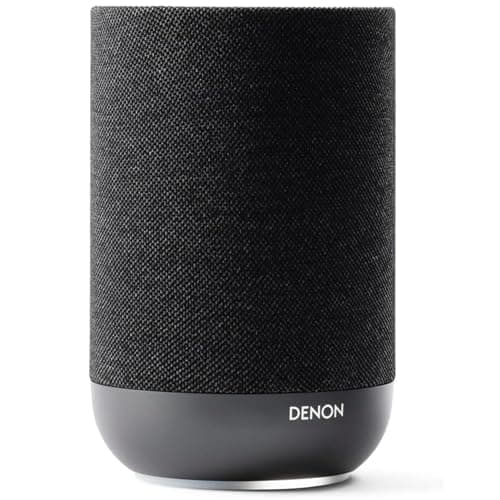
Denon has been a heavyweight in home audio for over a century, but the wireless smart speaker market has long been dominated by Sonos. With the new Denon Home 200, the company is making its strongest argument yet that audiophiles and casual listeners alike should consider the alternative. Priced at $399, the Home 200 sits at the entry point of Denon's refreshed wireless speaker lineup, slotting below the Home 400 ($599) and Home 600 ($799). It is a compact, cylindrical speaker that brings high-resolution audio, virtual Dolby Atmos Music, and deep HEOS multi-room integration into a package that fits on a kitchen counter or bedroom shelf.
After spending time with the Denon Home 200, testing its sound quality across genres, evaluating its app ecosystem, and comparing it to the competition, here is the full picture.
Design and Build Quality
The Denon Home 200 adopts a refined cylindrical form factor that measures 5.5 inches in diameter and 8.5 inches tall. It weighs 4.85 pounds, giving it a reassuring heft that signals build quality without being difficult to move around. The speaker is wrapped in a seamless 360-degree fabric grille that comes in two color options: Charcoal (dark gray) and Stone (light beige). The fabric feels premium and durable, similar to what you would find on high-end Danish audio designs.
The top and bottom plates are anodized aluminum, adding a touch of premium质感 to the overall design. The top panel houses the controls: a volume ring that you rotate, play/pause, and quick-select buttons for saved presets. These physical controls feel satisfyingly tactile — Denon has clearly put thought into the user experience beyond just the app. There is also a status LED that indicates connection and playback state, and a physical microphone mute switch on the back for privacy when using voice control.
The rear panel contains the connectivity ports: a 3.5mm AUX input, a USB-C port that supports Ethernet adapters for wired network connections, and the power input. Having both AUX and USB-C is a meaningful advantage over competitors like the Sonos Era 100, which dropped the AUX port and requires a dongle for wired connections. The Denon Home 200 also includes a threaded mounting insert on the bottom, compatible with standard speaker stands and wall mounts.
The overall design language is understated and premium. It does not scream for attention the way some Sonos speakers do with their minimalist aggression. Instead, it sits quietly in your room, looking like a piece of serious audio equipment that happens to be wrapped in fabric. It is a look that will age well.
Sound Quality
The Denon Home 200 packs three drivers powered by three dedicated Class-D amplifiers: two 0.98-inch tweeters arranged for stereo separation and a single 4-inch woofer for bass. On paper, this is a modest driver array, but Denon's Sound Master tuning makes it perform well beyond its physical footprint.
The first thing you notice when you play music through the Home 200 is the vocal clarity. Denon has tuned these speakers with an emphasis on the midrange, and it shows. Voices sound natural, present, and lifelike — whether it is the rasp of Billie Eilish, the smooth croon of Frank Sinatra, or the spoken word of a podcast host. This vocal-forward tuning makes the Home 200 an excellent speaker for anyone who values lyrical intelligibility and acoustic detail.
The stereo separation from the dual tweeters is wider than you would expect from a single cabinet speaker. Instruments have distinct placement in the soundstage, and the speaker does a credible job of creating a sense of space even when placed against a wall. This is helped by Denon's DSP processing, which can be toggled between two listening modes in the HEOS app. The Automatic mode applies Dolby Atmos spatial processing to all content, widening and heightening the soundstage. The Pure mode disables all processing for direct, uncolored playback — similar in philosophy to the Pure Direct mode on Denon's AV receivers.
The 4-inch woofer delivers punchy, impactful bass that is well-controlled and does not distort at reasonable volumes. On tracks with prominent low-end, like Daft Punk's "Give Life Back to Music" or Kendrick Lamar's "HUMBLE," the Home 200 produces a satisfying thump that fills a medium-sized room. It is not going to rattle your windows like a dedicated subwoofer, but for its size, the bass performance is excellent. The low end does compress somewhat at higher volumes compared to the larger Home 400 and Home 600 models, but within its intended sweet spot — small to medium rooms at moderate to moderately loud volumes — the Home 200 sounds full and engaging.
Where the Home 200 really shines is with acoustic and vocal-forward content. Norah Jones' "Don't Know Why" reveals the warmth and texture in her voice. The guitar strings have a delicate presence without being harsh. On more complex rock arrangements like Radiohead's "Everything in Its Right Place," the speaker maintains composure, keeping the electronic elements separated from Thom Yorke's processed vocals.
The virtual Dolby Atmos processing is a mixed bag. On Atmos-encoded tracks from Tidal or Amazon Music, the spatial processing adds a noticeable sense of height and width to the soundstage. Sounds seem to come from above and around the speaker, creating a more immersive experience than standard stereo. However, on standard stereo content, the Automatic mode can sometimes sound artificially processed, with a slight hollowing of the center image. Switching to Pure mode for stereo content and reserving Automatic for Atmos-encoded material is the way to go.
Dolby Atmos Music
The headline feature of the new Denon Home series is support for Dolby Atmos Music. Unlike the Home 400 and Home 600, which have physical upward-firing drivers that bounce sound off the ceiling for genuine height channels, the Home 200 uses DSP-based virtual processing to simulate the effect. This is a meaningful distinction.
The virtual Atmos on the Home 200 is not as convincing as the physical implementation on the larger models. The sense of height is present but subtle — more of a gentle elevation than a dramatic overhead effect. That said, it is still a significant step up from standard stereo playback. The Width control in the HEOS app lets you adjust the perceived spaciousness, and at its widest setting, the Home 200 sounds much bigger than its physical size suggests.
If Dolby Atmos Music is your primary reason for buying into this ecosystem, the Home 400 is the better choice. But if you want occasional Atmos support as a bonus feature on a predominantly stereo-listening speaker, the Home 200 delivers enough to be enjoyable.
HEOS Multi-Room Ecosystem
The Denon Home 200 is part of the HEOS ecosystem, Denon's multi-room audio platform that also works with the company's AV receivers, soundbars, and other HEOS-enabled devices. Setting up the speaker involves plugging it in, downloading the HEOS app, and connecting to your Wi-Fi network. The process takes about five minutes and is straightforward.
The HEOS app has historically been a weak point compared to Sonos, but the 2026 version has received significant improvements. It is now responsive, logically organized, and reliable. The app supports streaming from Tidal, Qobuz, Amazon Music, Spotify Connect, TuneIn radio, and local media servers. There is also USB playback if you plug in a flash drive. AirPlay 2 is built in for Apple users, and Bluetooth is available for quick connections from any device.
Multi-room grouping works as expected. You can group the Home 200 with other HEOS speakers throughout your home, play the same music in sync across rooms, or play different sources in different rooms. The Quick Select buttons on the speaker itself can be programmed to recall specific playlists, radio stations, or input sources — a genuinely useful feature that saves you from reaching for your phone every time.
A notable strength of HEOS compared to Sonos is the ability to mix and match speakers with Denon AV receivers and soundbars. You can use two Home 200 speakers as wireless rear surrounds for the Denon Home Sound Bar 550, creating a true wireless surround sound system without running speaker wire. This flexibility is something Sonos cannot match at this price point.
Connectivity and Streaming
The Denon Home 200 supports Wi-Fi 6E, operating on the 2.4GHz, 5GHz, and 6GHz bands. This is future-proofed connectivity that ensures stable streaming even in crowded network environments. For the highest audio quality, Denon recommends using the wired Ethernet connection via the USB-C port with an appropriate adapter.
High-resolution audio support extends to DSD, FLAC, ALAC, and WAV files up to 24-bit/192kHz. For wireless streaming, AirPlay 2 supports lossless up to 16-bit/48kHz, and the HEOS app handles high-res natively over Wi-Fi. Bluetooth is available for convenience but does not support high-res codecs like LDAC or aptX HD — it is standard SBC/AAC.
Voice control is available through Siri via AirPlay 2, though this requires a HomePod or HomePod mini on the same network to act as the voice processing hub. The Home 200 has a built-in microphone array for the dedicated microphone button, but it does not natively support Alexa or Google Assistant — a limitation compared to the Sonos Era 100, which offers both. If voice assistants are important to you, factor this in.
Comparison to Competitors
vs. Sonos Era 100 ($249): This is the most direct comparison, and it is a tough one for Denon. The Sonos Era 100 costs $150 less, offers Alexa and Google Assistant built in, has a more polished app, and supports line-in via USB-C dongle. The Denon Home 200 sounds noticeably better — warmer, more detailed, with better vocal clarity and a wider soundstage. It also has native AUX and USB-C ports without needing dongles, supports Dolby Atmos Music, and integrates with home theater setups. If sound quality is your priority, choose the Denon. If ecosystem maturity, voice assistants, and price matter more, the Sonos is the safer choice.
vs. Apple HomePod (2nd Gen, $299): The HomePod offers deep Apple ecosystem integration, excellent room-sensing technology, and Siri built in without requiring an additional hub. The Denon matches it on sound quality and surpasses it on connectivity options. The HomePod is better for Apple-only households. The Denon is better for mixed-device households and those building a multi-room system.
vs. Bose Smart Ultra Soundbar ($899) / Bose Lifestyle Ultra Speaker ($299): Bose offers CleanBass technology and a smaller footprint. The Denon delivers richer, more detailed sound and the HEOS multi-room ecosystem that scales beyond a single room. Bose wins on compactness; Denon wins on audio fidelity and expandability.
Real-World Performance Across Use Cases
To understand how the Denon Home 200 performs outside of controlled listening sessions, I tested it across several real-world scenarios over the course of a week.
Living Room Listening: In a 15 by 20 foot living room with hardwood floors and area rugs, the Home 200 filled the space effortlessly at around 40 percent volume. Vocal clarity was the standout quality — dialogue in podcasts and audiobooks was crisp and easy to follow even from across the room. Acoustic and jazz music sounded natural and uncolored. The virtual Atmos processing added a pleasing sense of space without making the sound feel artificial. At higher volumes approaching 70 percent, the bass began to compress slightly, and complex orchestral passages lost some separation. But for normal listening levels, the Home 200 is more than capable as a primary living room speaker.
Kitchen and Casual Listening: This is where the Home 200 truly excels. Its compact footprint fits easily on a countertop or shelf, and the 360-degree fabric grille means it looks good from any angle. The top-mounted controls make it easy to adjust volume or skip tracks while cooking. The Quick Select buttons were genuinely useful here — I programmed one for a morning news podcast and another for an upbeat workout playlist. Being able to tap a physical button and have the right content start playing immediately is a small convenience that adds up over time.
Bedroom and Background Listening: At low volumes, the Home 200 maintains its composure. The vocal emphasis ensures that late-night podcast listening remains intelligible without being shouty. The Pure mode is ideal here, delivering a warm, relaxed sound that does not fatigue the ears. The status LED can be dimmed or turned off in the app, which is a thoughtful touch for bedroom use.
Multi-Room Audio: I tested the Home 200 paired with a Home 400 in another room. Setting up the group in the HEOS app took about 30 seconds, and audio sync was flawless — no perceptible delay between rooms. The ability to drag and drop rooms to group or ungroup them is intuitive, and the saved presets let me recall specific room configurations with one tap. This is where the Denon ecosystem shines: you can start with a single Home 200 and expand over time, adding a Home 400 for the living room and Home 600 for larger spaces, all controlled from the same app.
Home Theater Use: As a rear surround speaker paired with the Denon Home Sound Bar 550, the Home 200 performs admirably. Movies and TV shows gain a convincing sense of rear ambiance. The wireless connection to the soundbar was stable throughout testing, with no dropouts or sync issues. This dual-purpose capability — serving as both a standalone music speaker and a home theater component — is a unique value proposition that neither Sonos nor Apple can match at this price point.
Setup and App Experience
Getting the Denon Home 200 up and running is straightforward. You plug it in, download the HEOS app, and follow the on-screen prompts to connect to your Wi-Fi network. The entire process takes about five minutes. The speaker supports Wi-Fi 6E, so if you have a compatible router, you get the benefits of the 6GHz band for reduced interference and higher throughput.
The HEOS app has undergone significant refinement compared to earlier versions. The home screen displays your recently played content and provides quick access to your music services. The room management section shows all your HEOS devices and lets you group or ungroup them with simple drag-and-drop gestures. The settings menu is logically organized, with options for audio mode (Automatic vs. Pure), speaker placement EQ, network settings, and firmware updates.
One area where HEOS still lags behind Sonos is in music discovery and playlist management. The Sonos app's integration with streaming services feels more native and seamless. HEOS works well once you have selected something to play, but browsing your music library or discovering new content is a slightly more utilitarian experience. That said, most users will likely use Spotify Connect, Tidal Connect, or AirPlay 2 to queue music directly from their preferred app, making the HEOS app's browsing limitations less impactful.
The speaker placement EQ is a useful feature that compensates for boundary effects. When you first set up the Home 200, the app asks whether the speaker is placed away from walls, near one wall, or near two walls. It then applies DSP corrections to optimize the frequency response for that placement. This is not as sophisticated as Sonos Trueplay, which uses the microphone on your iPhone to measure room acoustics, but it is a reasonable approximation that requires no additional hardware.
Technical Specifications and Audio Performance
The Denon Home 200 uses a three-driver configuration with three discrete Class-D amplifier channels. The two 0.98-inch tweeters are arranged in a stereo configuration within the cylindrical cabinet, providing left-right separation that creates a convincing stereo image from a single enclosure. The 4-inch woofer is downward-firing, using the surface the speaker sits on to reinforce bass response.
Frequency response is rated from 50Hz to 20kHz, and the speaker supports sample rates up to 24-bit/192kHz for high-resolution audio. In practice, the speaker sounds full and present from about 60Hz upward, with the bass rolling off below that. The bass is punchy and well-defined rather than deep and rumbling — the Home 400 and 600 are the choices if you want sub-bass extension.
The Class-D amplifiers are rated at a combined output that is sufficient for small to medium rooms. The speaker can get quite loud — louder than you would reasonably want in a bedroom or kitchen — without significant distortion. At maximum volume, the bass compresses noticeably and the treble becomes slightly harsh, but this is true of virtually all speakers in this class.
The digital-to-analog conversion is handled by a high-quality DAC that preserves the detail in high-resolution audio files. On well-mastered recordings, the difference between standard-resolution streaming and high-res FLAC is audible, with high-res offering slightly better air and separation in the treble. Whether this difference matters to you depends on your ears and your audio source. For most listeners with standard streaming services, the Home 200 sounds excellent at any resolution.
Long-Term Considerations
The Denon Home 200 is built to last. The aluminum top and bottom plates are durable and resistant to scratches. The fabric grille is tightly woven and should resist dust and minor spills, though it is not replaceable by the user — a point worth noting if you plan to place the speaker in a kitchen where splatter is possible. The USB-C port is a future-friendly choice, and the threaded mounting insert adds mounting flexibility.
Firmware updates are delivered through the HEOS app and have been regular and stable. Denon has a good track record of supporting its products with updates, and the HEOS platform continues to see improvements. The Wi-Fi 6E support ensures the speaker will remain relevant as home networks evolve.
The Verdict
The Denon Home 200 is an excellent wireless smart speaker that prioritizes sound quality and system flexibility over ecosystem simplicity. It sounds noticeably better than the Sonos Era 100, with richer mids, clearer vocals, and a wider soundstage. It offers connectivity options that Sonos has abandoned — native AUX and USB-C ports without dongles. It doubles as a home theater component. And it scales from a single room to a whole-home system through the HEOS platform.
The compromises are the higher price, the lack of built-in Alexa and Google Assistant, and an app experience that is functional but not as polished as Sonos. For the right buyer — someone who values audio quality and long-term flexibility over upfront cost and ecosystem simplicity — those compromises are easy to accept.
Denon has been making audio equipment since 1910. The Home 200 proves that a century of experience still matters in the age of wireless streaming. It is not the cheapest smart speaker you can buy, but it might be the best-sounding one at its size and price.
Pricing and Value
At $399, the Denon Home 200 is priced at a premium compared to the Sonos Era 100 ($249) and Apple HomePod ($299). You are paying for superior sound quality, more flexible connectivity, and the HEOS ecosystem. Whether that premium is worth it depends on how much you value audio fidelity. For the casual listener, the Sonos is more than adequate. For the audio enthusiast, the Denon justifies its higher price with noticeably better sound and greater long-term flexibility.
The Denon Home 200 is available on Amazon and at Best Buy in Charcoal and Stone color options. It is eligible for stereo pairing, meaning you can buy two for true left-right separation — a compelling upgrade path that costs $798 total, still less than many high-end standalone speakers.
Who Should Buy the Denon Home 200?
The Denon Home 200 is ideal for music lovers who want premium sound quality in a compact package and the ability to expand into a multi-room system over time. It is perfect for Apple users who rely on AirPlay 2 but want better sound than the HomePod. It is an excellent choice for anyone building a home theater system with Denon components, as the Home 200 can serve double duty as a wireless rear surround speaker.
Skip the Denon Home 200 if you are on a tight budget — the Sonos Era 100 costs significantly less and still sounds great. Skip it if you need built-in Alexa or Google Assistant. Skip it if you plan to move the speaker between rooms frequently, as it requires a power outlet and Wi-Fi setup each time. And definitely skip it if Dolby Atmos Music is your top priority — step up to the Home 400 for the real height-channel experience.
The Bottom Line
The Denon Home 200 is a premium wireless speaker that prioritizes sound quality above all else. It delivers rich, detailed audio with exceptional vocal clarity, solid bass response, and a soundstage that belies its compact size. The virtual Dolby Atmos processing is a nice bonus rather than a primary feature, and the HEOS ecosystem provides reliable multi-room functionality that can grow with your needs over time.
The main barrier is the price. At $399, it costs significantly more than its direct competitor from Sonos, and the HEOS app, while improved, still lacks some of the polish that makes the Sonos experience so frictionless. But for listeners who hear the difference and value the flexibility of wired connectivity, home theater integration, and high-resolution audio support, the Denon Home 200 is a genuinely compelling choice. It is proof that Denon's century of audio expertise translates beautifully into the wireless speaker era.
Pros
- Rich, detailed sound with exceptional vocal clarity
- Virtual Dolby Atmos Music support
- Native AUX and USB-C ports without dongles
- HEOS multi-room ecosystem with reliable performance
- Wi-Fi 6E and high-res audio support
- Can double as wireless rear surround speakers
- Premium build quality with aluminum accents
Cons
- Significantly more expensive than Sonos Era 100
- No built-in Alexa or Google Assistant
- Virtual Atmos less convincing than physical up-firing drivers
- HEOS app less polished than Sonos app
- Not portable - requires AC power
- No automatic room calibration like Sonos Trueplay
Final Verdict
The Denon Home 200 delivers premium sound quality with virtual Dolby Atmos Music, deep HEOS multi-room integration, and superior wired connectivity in a compact, stylish design — though its $399 price tag puts it above competitors like the Sonos Era 100.