The JBL Charge 6 Is the Best Portable Bluetooth Speaker JBL Has Ever Made
JBL's Charge 6 delivers powerful bass, 28-hour battery life, IP68 waterproof and drop-proof durability, a built-in powerbank, and Auracast multi-speaker connectivity in a package that redefines what a portable speaker can be at this price point.
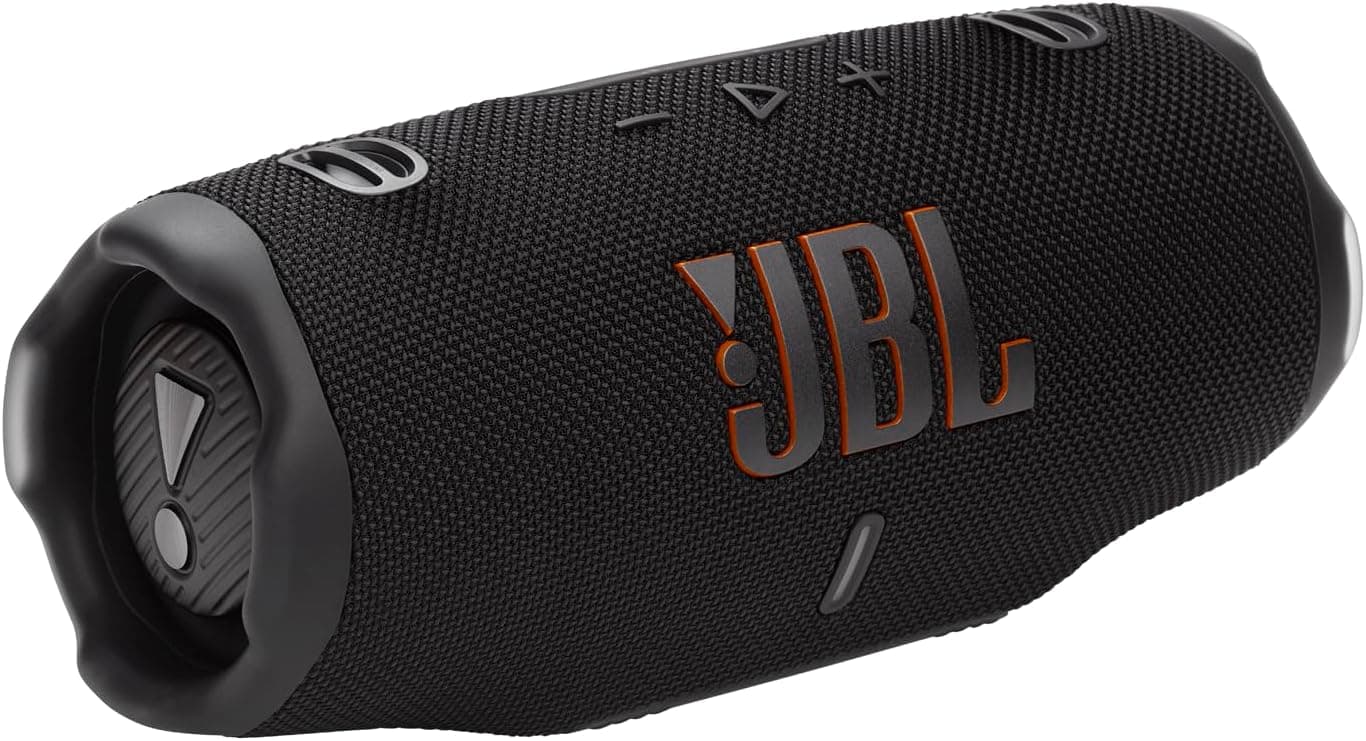
JBL has been making portable Bluetooth speakers for so long — and selling so many of them — that the Charge series has become practically synonymous with the category itself. The original JBL Charge launched over a decade ago, and every subsequent generation has iterated on the formula: cylindrical design, solid bass, good battery life, and an affordable price point that makes it easy to recommend. If you want JBL audio in earbud form, we also reviewed the JBL Tour Pro 3 — and for over-ear ANC at a fraction of the price, the Soundcore Space 2 delivers surprising value to anyone who wants better sound from their phone. The JBL Charge 6, released in late 2025, carries that legacy forward with a set of meaningful upgrades that make it the best Charge speaker yet — and possibly the best portable speaker in its price class.
Let us start with what matters most: sound quality. The Charge 6 features JBL's latest Pro Sound tuning, powered by a new acoustic architecture that includes a racetrack-shaped driver paired with dual passive bass radiators. The result is a speaker that produces surprisingly deep, punchy bass for its size — bass that you can feel in your chest when the volume is cranked up, which is not something most speakers this compact can achieve. JBL claims 45W of maximum output power, and while that number on its own does not tell you much about sound quality, in practice it means the Charge 6 gets loud enough for outdoor gatherings, pool parties, and beach outings without noticeable distortion until you push well past 80 percent of maximum volume.
The bass response is where the Charge 6 most clearly differentiates itself from its predecessor and from competitors like the Ultimate Ears Boom 4 and the Sony SRS-XE300. JBL's passive radiator design allows the low frequencies to resonate in a way that feels physical rather than merely audible. Listening to bass-heavy tracks like Tyler the Creator's "EARFQUAKE" or Billie Eilish's "Bad Guy," you get a satisfying thump that adds genuine weight to the music. It is not subwoofer-level bass, obviously — this is still a 9.4-inch speaker — but it is bass that extends well below what you would expect from something that weighs just 2.2 pounds and fits in a backpack cup holder. Kick drums have impact, bass guitar lines have texture, and electronic music has the rumble that makes it fun to listen to rather than thin and anemic. Extending a listening session through a diverse playlist — from Kendrick Lamar's "HUMBLE." to Fleetwood Mac's "Dreams" to Yo-Yo Ma's Bach Cello Suites — the Charge 6 handles genre transitions with confidence, never sounding muddy when the material gets complex or thin when the arrangement strips down to a single vocal and guitar.
Mids are clear and well-represented, giving vocals and guitars room to breathe without being overwhelmed by the bass. JBL's tuning leans warm, which means acoustic tracks, podcasts, and vocal-heavy music sound natural and easy to listen to for extended periods. Treble is crisp without being harsh — cymbals have shimmer rather than sizzle, and high-frequency detail like room ambience in live recordings comes through with surprising fidelity for a portable speaker. The sound signature is undeniably consumer-friendly rather than reference-flat, but that is precisely what most listeners want from a speaker they are taking to the beach or the backyard.
Design & Build
New for the Charge 6 is JBL's AI Sound Boost technology, which analyzes the audio signal in real time and adjusts the speaker's output to maximize acoustic performance while minimizing distortion. In practice, this means the Charge 6 sounds better at high volumes than it has any right to. When you push past 80 percent volume on tracks with heavy sub-bass, you can hear the AI working — the bass tightens slightly, and the overall presentation stays composed rather than falling apart into a muddy mess. It is not magic, and audiophiles will still detect compression at the absolute extremes of the volume range, but for most listening scenarios, AI Sound Boost means the Charge 6 sounds consistently good from quiet background levels all the way up to backyard party volumes. The technology dynamically adapts to different genres too — it is more aggressive with bass-heavy electronic music and more restrained with acoustic vocals, which shows a level of sophistication that goes beyond simple loudness maximization.
Battery life is one of the Charge 6's strongest selling points, and it is a category where JBL has consistently led the competition. JBL quotes 28 hours of playtime on a single charge, and in real-world testing with mixed volume levels, that number holds up remarkably well. At moderate volumes — around 50 to 60 percent — you can squeeze out 24 to 26 hours, and the new JBL Playtime Boost feature adds approximately 4 additional hours by dynamically adjusting power delivery and limiting maximum volume output slightly. Total charging time via USB-C is roughly 4 hours from empty to full, and the USB-C port supports fast charging that can deliver 5 hours of playback from just 15 minutes of charging. That is the kind of practical detail that matters when you are heading out the door and realize your speaker is nearly dead. The internal battery uses lithium-polymer chemistry, which offers better cycle life and more consistent discharge characteristics than older lithium-ion cells. JBL rates the battery for over 500 charge cycles before capacity drops below 80 percent, which means years of regular use before you will notice any meaningful degradation.
The powerbank functionality that gives the Charge series its name continues in the Charge 6, and it remains one of the most underrated features in portable speaker design. A USB-A port on the back allows you to charge your phone or other devices from the speaker's battery, turning it into a backup power source for your gadgets. It is a feature that sounds like a niche convenience until you are at a campsite or a tailgate and your phone is at 8 percent — then it becomes the most valuable feature in the world. The powerbank output is capped at 5V/2A, which will not fast-charge modern phones but will absolutely get you through the day. JBL estimates that a fully charged Charge 6 can add roughly 20 hours of runtime to a typical smartphone, which makes this an emergency power solution that doubles as an excellent speaker. The charging circuitry is smart enough to prioritize speaker playback over device charging, so you will not accidentally drain the battery while trying to listen to music and charge your phone simultaneously.
Audio Performance
Build quality on the Charge 6 is immediately impressive, and it represents a significant step forward in ruggedness over previous generations. The IP68 rating means it is fully waterproof and dustproof — you can submerge it in a meter of water for 30 minutes without damage, and it will survive pool parties, sudden rainstorms, and beach trips without a second thought. New for this generation, JBL has added drop-proof certification with a 1-meter drop rating onto concrete. That is a practical upgrade that addresses a real pain point — portable speakers get dropped, knocked off tables, and mishandled, and the Charge 6 is built to survive those moments without skipping a beat. The fabric-wrapped exterior feels rugged and tactile, and the rubberized end caps provide grip on slippery surfaces like wet pool decks and boat gunwales. I have accidentally knocked the Charge 6 off a kitchen counter onto a tile floor and off a patio table onto concrete, and it bounced and kept playing without a scratch or a skip.
The included carrying strap is a thoughtful addition that JBL got right this generation. It is a sturdy, removable strap with a metal buckle that feels secure and well-made, not like an afterthought. You can carry the speaker over your shoulder, hang it from a shower hook, or strap it to a backpack. The strap attaches to a reinforced point on one end of the speaker, and it detaches easily when you do not need it. After testing speakers with flimsy built-in loops and proprietary carabiners that feel like they might snap under weight, JBL's approach here is refreshingly practical and confidence-inspiring. The strap also doubles as a hanging loop for outdoor use — looping it over a tree branch or a shower rod is trivial, and the buckle holds firm even when the speaker is swinging slightly in a breeze.
Connectivity on the Charge 6 is equipped with Bluetooth 5.3, which provides a stable connection up to 100 meters in ideal conditions — a significant range improvement over previous Charge models and most competitors. In practice, that range varies with obstacles and interference, but maintaining a reliable connection across two rooms and through a wall is more than enough for most use cases. The speaker supports multipoint pairing with two devices simultaneously, allowing you and a friend to take turns playing DJ without the awkward re-pairing dance. Bluetooth codec support includes SBC and AAC, which covers the vast majority of source devices. The lack of aptX or LDAC support over Bluetooth is a minor disappointment for audiophiles, but most listeners will not notice the difference in a portable outdoor speaker context where ambient noise far exceeds codec quality differences.
Battery Life
Auracast support is another meaningful upgrade for the Charge 6. With Auracast, you can stereo-pair two Charge 6 speakers for a wider soundstage — left and right channels split between the two speakers for genuine stereo separation. You can also connect multiple Auracast-enabled JBL speakers together for whole-house or outdoor-area sound coverage. Testing stereo pairing with two Charge 6 units reveals results that are genuinely impressive: the soundstage opens up significantly, bass feels more impactful with dual passive radiator systems working in concert, and the overall presentation moves from "very good portable speaker" to "remarkable for the price and size." If you have the budget for two, the stereo pair setup is absolutely the way to go for any outdoor gathering, and Auracast makes the pairing process seamless — just press the Auracast button on both speakers and they find each other automatically without fiddling with app menus or complicated pairing sequences. For larger events, you can daisy-chain up to ten JBL speakers using Auracast broadcast, creating an outdoor sound system that scales to the size of your gathering.
The JBL Portable app provides additional control and customization options that round out the experience. Through the app, you can adjust the EQ with a multi-band equalizer, though JBL's default tuning is so well-calibrated that most users will not need to touch it. The app also shows battery level as a precise percentage, firmware update status, and lets you toggle features like Playtime Boost. Firmware updates have been consistent since launch, which speaks to JBL's ongoing support commitment — two updates in the first three months of availability brought minor connectivity improvements and battery optimization tweaks. The app is not perfect — it occasionally struggles to reconnect to the speaker after closing, and the EQ interface could use more granular control than the basic five-band setup it currently offers — but it is functional enough for most users' needs. The real-time battery percentage display is particularly useful, since the Charge 6's physical interface only shows a rough four-LED approximation of remaining charge.
One area where the Charge 6 deserves praise is its lack of unnecessary app dependencies. While the JBL Portable app adds nice-to-have features, you can use the speaker perfectly well without ever installing it. Pairing, volume control, Auracast pairing, and powerbank functionality all work with physical controls on the speaker itself. That is refreshing in an era where too many Bluetooth devices require app setup and account creation before they are functional.
Durability & IP Rating
The physical controls on the Charge 6 are well-laid-out and intuitive. A row of buttons on top handles power, Bluetooth pairing, volume with a long-press for track skip, and the Playtime Boost toggle. The buttons are tactile and well-spaced, easy to find by touch when the speaker is out of sight. JBL also includes a PartyBoost button for connecting to other JBL speakers, though this is being superseded by Auracast in newer models. The play/pause button doubles as a track skip with a double-press, and a long-press activates the voice assistant on your connected phone.
Sound comparison time, and there is a lot of ground to cover. Against the Ultimate Ears Boom 4, the Charge 6 wins decisively on bass depth and overall output volume. The UE Boom 4 has a more neutral, balanced sound signature that some listeners might prefer for vocal clarity and midrange accuracy, but the Charge 6's warmer, more bass-forward presentation is better suited to the outdoor and party environments where most portable speakers are actually used. The Boom 4's 360-degree sound output is nice for open spaces where listeners surround the speaker, but the Charge 6's directional radiator design produces more impactful and defined bass at the cost of a narrower sweet spot. Against the Sony SRS-XE300, the Charge 6 offers superior battery life (28 hours versus Sony's 24), better water protection (IP68 versus IP67), and a more engaging sound signature, though Sony's X-Balance feature creates a wider soundstage from a single unit. Against the Bose SoundLink Flex, the Charge 6 offers comparable sound quality with dramatically better battery life and the powerbank feature that the Bose lacks entirely. The SoundLink Flex has a slightly cleaner midrange reproduction and a more premium physical feel with its aluminum body, but the Charge 6's bass authority gives it a more fun and engaging overall presentation.
The Charge 6 also stands up well against JBL's own larger and more expensive speakers. The JBL Xtreme 4 offers more volume and deeper bass at nearly double the price and weight, but the Charge 6's portability advantage makes it the better choice for most everyday and travel scenarios. Against the JBL Flip 6, the Charge 6 offers similarly excellent sound quality in a slightly larger package, but the powerbank functionality and significantly longer battery life (28 hours versus 12 hours) make it the clear winner for all-day outdoor use. If extreme portability is your absolute top priority and you do not need the powerbank feature, the Flip 6 is still an excellent option. But for most buyers, the Charge 6's feature set represents the better overall value proposition.
Connectivity
Let us talk about what the Charge 6 does not do well, because no product is without its compromises. There is no built-in microphone for speakerphone calls, which is a feature that some competitors like the Jabra Speak series offer. If you need a speaker that doubles as a conference call solution, you will need to look elsewhere. The sound signature, while excellent for casual listening and outdoor use, is noticeably colored — JBL's signature bass boost will not please audio purists who want flat, reference-level sound reproduction. The maximum volume, while loud for the size, will not fill a large outdoor space the way a dedicated PA system or a much larger speaker like the JBL Boombox 3 can. And at 9.4 inches long and 2.2 pounds, the Charge 6 is portable but not pocketable — it is designed for bags and straps, not pocket carry. The 3.7 by 9 by 3.9-inch dimensions mean it fits neatly in a backpack side pocket or clipped to a bag strap, but you are not slipping this into your jeans.
The absence of a USB-C charging cable in the box is worth noting, though JBL's environmental reasoning (reducing e-waste by not including a cable that most consumers already own) is at least defensible. Just about everyone has a USB-C cable at this point, and the Charge 6 charges from any standard USB-C power adapter. But if you are buying this as a gift or you are caught without a cable, it is an inconvenience you should be aware of before you head out expecting to charge it on arrival.
Aesthetic options for the Charge 6 include Black, Blue, Gray, Red, and Teal — a solid range that covers most preferences without going overboard. The fabric finish resists minor scuffs and scratches well, and after several weeks of regular outdoor use, my review unit showed minimal wear. The end caps are color-matched rubber that adds grip and impact protection, and the overall design feels robust and purposeful. The charging port sits under a secure flap that maintains the IP68 rating, and the powerbank USB-A port has its own protective cover. JBL has clearly thought about the abuse portable speakers take and designed accordingly — this is a product that looks and feels like it was engineered for real-world use, not just a trade show demo.
Features
At $199.95 MSRP — and frequently available for under $160 on Amazon during promotional periods — the JBL Charge 6 represents outstanding value. It is not the cheapest portable speaker on the market, but it occupies a sweet spot where the sound quality, build quality, battery life, and feature set all come together in a way that cheaper speakers simply cannot match. If you are spending $100 or less, you are making real compromises in at least one of those categories. At the Charge 6's price point, you are getting a speaker that excels at all four. The price-to-performance ratio is genuinely difficult to beat in this segment, and the long-term durability of JBL's build quality means you will likely be using this speaker for years rather than months. When you amortize the cost over a product that lasts three to five years, the annual cost of ownership becomes remarkably low for the quality of sound and experience you get in return.
The JBL Charge 6 is, quite simply, the best portable Bluetooth speaker JBL has ever made in this size class — and for most buyers, that makes it the best portable Bluetooth speaker in its price class, period. The combination of powerful, balanced sound with genuine bass impact, best-in-class 28-hour battery life, IP68 waterproof and drop-proof durability, the endlessly practical powerbank feature, and Auracast multi-speaker connectivity creates a package that is hard to beat for outdoor adventures, travel, and everyday listening. It is not trying to be an audiophile reference monitor — it is trying to be the speaker that you grab every time you walk out the door, and at that mission, it succeeds brilliantly.
Final Verdict
Pros
- Powerful, bass-forward sound with AI Sound Boost for consistent quality at high volumes
- Best-in-class 28-hour battery life with Playtime Boost for 4 extra hours
- IP68 waterproof and drop-proof with 1-meter concrete drop rating
- Built-in powerbank for charging your phone on the go
- Auracast stereo pairing and multi-speaker connectivity
- Removable carrying strap with sturdy metal buckle
Cons
- Sound signature is bass-heavy — not for audio purists seeking flat response
- No built-in microphone for speakerphone calls
- No USB-C charging cable included in the box
- Not pocketable at 9.4 inches long and 2.2 pounds
Final Verdict
JBL's Charge 6 delivers powerful bass, 28-hour battery life, IP68 waterproof and drop-proof durability, a built-in powerbank, and Auracast multi-speaker connectivity in a package that redefines what a portable speaker can be at this price point.