JBL Endurance Zone Review: Open-Ear Sport Earbuds Built for the Elements
JBL's first open-ear sport earbuds pair an IP68 rating and 32-hour battery with strong call quality and a secure adaptable fit, though finicky touch controls hold them back.
The open-ear earbud category has quietly become one of the most competitive corners of the audio market, and for good reason. Runners, cyclists, and gym-goers have realized that sealing your ears off from the world while training outdoors is not just inconvenient — it can be genuinely dangerous. JBL has spent years building its Endurance line around workout durability, but until 2026 the company never had a true open-ear entry. The JBL Endurance Zone changes that, arriving at CES 2026 as the brand's first open-ear true wireless sport earbud and immediately staking a claim in a segment currently dominated by Shokz, Bose, and a wave of budget challengers. At $179.95, it sits right in the middle of that competitive field, and after spending weeks training, commuting, and taking calls with them, I have strong opinions about where they land.
The pitch is straightforward: flexible earhooks keep the buds anchored to your ears while 18x11mm drivers fire audio at your ear canal from just outside it, leaving your ears physically open to ambient sound. JBL calls this OpenSound technology, borrowed from its Sense line, and pairs it with an IP68 dust and water rating that goes beyond what most competitors offer. Add four beamforming microphones, Bluetooth 5.3 with multipoint, and a claimed 32 hours of total battery life, and the Endurance Zone reads like a spec sheet designed to check every box a serious athlete could want. The real question is whether the execution matches the ambition, so let's dig into the details.
Design and Build Quality
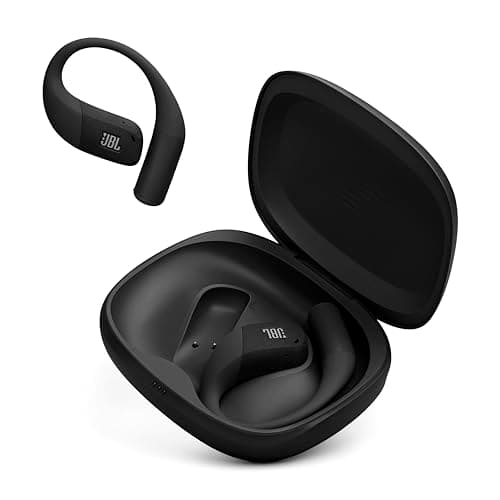
The Endurance Zone adopts the earhook form factor that has become the default for open-ear true wireless buds, but JBL's execution differs from the competition in meaningful ways. Each bud features a liquid silicone earhook that wraps over the top of your ear, connected to the main housing via a flexible memory wire. That wire is the key design decision: it lets you bend the hook to match the contour of your own ear, which sounds like a small thing but makes a real difference in fit consistency. Shokz's OpenFit line uses rigid hooks that either fit your ears or don't; the Endurance Zone's adaptable wire gives you a degree of customization most rivals simply don't offer.
The buds themselves are larger than typical in-ear earbuds, but that extra bulk is deliberate. The main housing sits outside the ear canal with the driver angled toward it, and the hook distributes the weight across the top of the ear rather than letting it dangle. At roughly 10 grams per earpiece, they're not the lightest open-ear buds on the market — the Shokz OpenFit Pro comes in a touch lighter — but the weight distribution is good enough that I forgot I was wearing them during a two-hour trail run. The over-ear hook design also means they never felt like they were going to fall out, even when I was adjusting a hat, wiping sweat from my face, or doing the kind of head-shake test that sends poorly designed earbuds flying across the room.
JBL offers the Endurance Zone in a range of colorways — Black/Gray, Black/Lime, Purple/Grape, Blue/White, and White/Orange — though availability varies by region, and the Amazon listing I tested was the Black/Gray version. The finish is matte rubberized plastic that grips well and doesn't show fingerprints, which matters for something that will be handled with sweaty hands. The charging case is compact, only slightly larger than the AirPods 3rd generation case, and features a flip-open lid with a snug magnetic closure. The buds seat firmly in their charging cradles and the case communicates charge status through a small LED. The case is functional but not luxurious; the plastic feels a bit thin, and if you're coming from a premium metal-clad case like the one that ships with the Bose Ultra Open, you'll notice the difference. For a workout-focused product, though, weight and pocketability matter more than premium materials, and the Endurance Zone case is genuinely pocket-friendly.
The one design element that deserves special attention is the IP68 rating. IP68 is the highest ingress protection rating commonly found on consumer electronics: the "6" means total dust resistance, and the "8" means the device can be submerged in water beyond one meter for extended periods. JBL goes a step further by recommending that you rinse the buds under running water after particularly sweaty workouts, which is a level of confidence most manufacturers don't express about their waterproofing. There's even a clever feature called Pulse Dry that plays a specific low-frequency tone through the drivers, designed to vibrate moisture droplets off the speaker mesh after rinsing. It's the kind of thoughtful detail that tells you JBL actually thought about how these will be used, and I've never seen it on a competitor's product.
Fit and Comfort
Fit is the make-or-break factor for any open-ear earbud, because there's no in-ear seal to hold the bud in place — the entire retention strategy is the hook and the angle of the driver housing. The Endurance Zone's adaptable memory wire gives it an advantage here, and in my testing the fit was stable across running, cycling, and gym workouts. The hook wraps securely around the ear and the housing rests against the tragus, the small cartilage flap near the ear canal opening. Positioning the housing so it lightly contacts the tragus is the trick to getting both comfort and sound quality out of these buds, and once I figured that out, they stayed put through everything I threw at them.
That said, fit is deeply personal, and the reviews I read before testing flagged this as the product's most divisive attribute. Some testers with smaller ears reported that the hooks felt loose or that the housing pressed uncomfortably against the ear. Others found them perfectly secure. The memory wire mitigates some of this variance — you can bend the hook tighter or looser to match your ear — but it can't fix a fundamental mismatch between the housing size and your ear anatomy. If you have very small ears, these are worth trying before buying. For average and larger ears, the fit is likely to be a non-issue, and the hook design is genuinely more secure than the neckband-style bone conduction alternatives many runners are used to.
Comfort over long sessions was a pleasant surprise. Open-ear buds don't create the pressure sensation of sealed in-ears, and the Endurance Zone's soft silicone hook material never caused the hot spots that rigid hooks can produce after an hour or two. I wore them for a full workday of video calls plus an evening run and experienced no discomfort. The trade-off is that the buds are visible — they're not discreet like the tiny in-ear stems you see on commuters — but for a sport-focused product, that's expected and acceptable.
Sound Quality
Let's address the elephant in the room: open-ear earbuds cannot match sealed in-ear or over-ear headphones for bass depth, and the Endurance Zone does not defy physics. The 18x11mm rectangular dynamic drivers deliver clear, crisp audio with a surprisingly full midrange, but the low end is inherently limited by the lack of an ear canal seal. Bass response is present — JBL's tuning gives it a noticeable warmth that's unusual for the category — but it lacks the physical punch you'd get from a sealed bud like the JBL Endurance Peak 4 or a traditional in-ear. If you're a bass head, these are not for you, and no amount of EQ in the companion app will change that.
Within the constraints of the category, though, the Endurance Zone sounds genuinely good. Vocals come through with clarity and presence, which matters for both music and podcasts. Treble is detailed but can occasionally edge toward harshness at high volumes, particularly with sibilant vocals or cymbal-heavy tracks. The overall tuning is energetic and forward, which suits workout playlists — you're not listening for audiophile nuance while you're pushing through the last interval of a session. In quieter settings, the sound quality is good enough that I happily used them for podcasts and even some casual music listening around the house.
The more important consideration for open-ear buds is how they handle the environments they're designed for. JBL's OpenSound technology aims to minimize sound leakage — the audio that escapes the driver and is audible to people around you — and it does a decent job. Someone standing next to you on the treadmill will hear a faint version of your music, but it won't be as obnoxious as the tinny bleed you get from some bone conduction headphones. In return, you get excellent situational awareness: I could hear approaching cars, other runners calling out, and gym staff announcements without pausing my audio. That awareness is the entire point of this category, and the Endurance Zone delivers it faithfully.
Where the sound falls short is in noisy environments. Because there's no isolation and no noise cancellation, loud ambient sound simply overwhelms the drivers. In a crowded gym with music blaring and weights clanging, I found myself maxing out the volume and still struggling to hear lyrics clearly. The Lifehacker review I read encountered exactly the same issue, describing the buds as a "no-go" for loud gyms. These are optimized for outdoor training and quieter indoor settings, not for drowning out a packed gym floor. If your workouts happen in a cacophonous environment, a sealed bud with ANC is the better tool, and JBL would point you to the Endurance Peak 4 for that job.
Microphone and Call Quality
The single biggest surprise in my testing was the call quality. The Endurance Zone packs four microphones — two per bud — arranged in a beamforming array, and the implementation is excellent. In quiet environments, voices come through with striking clarity, and the beamforming does a good job of rejecting background noise. The wind resistance is particularly impressive for an open-ear product, which is notable because open designs are usually the worst performers in wind, since there's no seal to block gusts from hitting the mic ports.
I tested these on calls while walking along a busy street, and the person on the other end reported hearing me clearly with minimal background noise — a result I did not expect from a $180 open-ear bud. In a direct comparison, a family member who is notoriously picky about call quality said the Endurance Zone sounded noticeably better than their AirPods. The weak spot is sustained wind: in a strong gust, wind noise cuts through and can make the stream sound muffled or choppy. That's a limitation shared by virtually every open-ear product on the market, and it's not a reason to avoid these unless you take calls exclusively while cycling in gale-force conditions.
Battery Life and Charging
Battery life is one of the Endurance Zone's strongest selling points, and the numbers hold up in real-world testing. JBL rates the buds at 8 hours per charge, with the case adding another 24 hours for a total of 32 hours. In my testing, the 8-hour figure for the buds is accurate at moderate volume, and the case's 24 hours of reserve capacity is believable given how little the case drained during a week of daily use. The total is among the best in the open-ear category — the Shokz OpenFit Pro claims 11 hours per charge but with a smaller case total, and many budget competitors fall well short of 30 hours combined.
The case charges via USB-C and supports JBL's Speed Charge technology: a 10-minute top-up delivers roughly 3 hours of playback. That's genuinely useful when you realize your buds are dead right before a workout and you have time to grab a coffee before heading out. There's no wireless charging, which is a minor miss at this price point — the Shokz OpenFit Pro's case supports it — but it's far from a dealbreaker.
Battery performance in cold weather is worth calling out. I used these during a stretch of freezing winter runs, and the 8-hour per-charge figure held up even at temperatures well below freezing, which is notorious for hammering lithium-ion batteries. The cold-weather resilience, combined with the IP68 rating, makes these a legitimate year-round training companion.
Controls and App Experience
Now we get to the product's biggest weakness: the touch controls. The Endurance Zone uses capacitive touch surfaces on each bud for playback, volume, and call management, and the implementation is frustratingly finicky. In theory, a tap plays or pauses, taps adjust volume, and long presses skip tracks or cycle modes. In practice, the controls are overly sensitive and inconsistent. Volume adjustment is the worst offender — turning the volume down takes an eternity of micro-taps, and it's easy to trigger unintended commands like pausing playback or skipping a track while you're fumbling with the surface mid-run. I repeatedly overshot my target volume or accidentally invoked commands I didn't want, and the problem is compounded when your fingers are sweaty or you're wearing gloves.
The companion JBL Headphones app lets you disable the touch controls entirely, and that's the workaround most reviewers land on — but it's an admission that the controls don't work well enough to trust during a workout. The absence of any physical button fallback is a real oversight for a product aimed at athletes who need reliable, eyes-free control mid-exercise. You can use your phone or smartwatch instead, which is what I ended up doing, but at $179.95 you shouldn't have to surrender on-device controls entirely. If JBL ships a revision with physical buttons or significantly better touch sensitivity, it would remove the single biggest reason to hesitate on these.
The app itself is otherwise solid. You get a five-band equalizer, volume limiter, left/right balance adjustment, an auto power-off timer, and battery status for both buds and case. There's also a "Relax" mode that plays ambient soundscapes for meditation, which feels oddly tangential for a sports-focused product but is harmless. The equalizer made only a subtle difference in my testing — boosting bass helped a little, but as noted, you can't EQ your way around the physics of an open design. The app also hosts the Pulse Dry function, which is worth using after rinsing the buds, and it displays remaining battery life clearly. Multipoint Bluetooth lets you connect to two devices simultaneously, and Google Fast Pair, Google Finder, and Google Audio Switch are all supported, which makes the Android experience particularly seamless. Pairing was straightforward on both Android and iOS, though I did encounter occasional Bluetooth hiccups — a random disconnection from one bud, an occasional need to re-pair — that are common across the wireless earbud category but worth noting.
How It Compares to the Competition
The open-ear market has several well-established players, and the Endurance Zone's positioning against them is interesting. The Shokz OpenFit Pro is the closest direct competitor at $249.95, offering a similar earhook design with a lighter build and wireless charging. The Endurance Zone undercuts it by $70 while countering with a higher IP rating and better call quality, but the OpenFit Pro's superior bass response and refinement give it the edge for pure audio. The Shokz OpenRun Pro 2, a neckband-style bone conduction model that many runners swear by, is cheaper at around $159.95 and offers a more secure, guaranteed-sync form factor — but it lacks the Endurance Zone's call quality and total battery life.
Bose's Ultra Open Earbuds are the premium option in the category, with a clip-on design and excellent sound, but they cost roughly double the Endurance Zone and have been criticized for battery life that trails the competition. On the budget end, Soundcore's Aerofit 2 and Oladance's open-ear models undercut JBL significantly, but they don't match the IP68 rating, the call quality, or the 32-hour battery claim. For the price, the Endurance Zone's combination of durability, battery, and call performance is arguably the best value in the open-ear category — provided the touch controls and fit work for you personally.
The other JBL Endurance models are worth mentioning for context. The Endurance Peak 4 at $129.95 is the sealed alternative with adaptive noise canceling, spatial audio, and a massive 48-hour total battery. The Endurance Pace at $89.95 is a neckband-style open-ear option for budget-conscious athletes. JBL has clearly segmented the line to cover every workout style, and the Zone sits at the top as the flagship open-ear offering.
Real-World Use Cases
The Endurance Zone is purpose-built for outdoor training, and that's where it shines. On runs, the secure fit and situational awareness combine to create a genuinely better experience than sealed buds: you hear traffic, other runners, and your own surroundings while music plays clearly. The IP68 rating means rain, sweat, and even an accidental dunk in a puddle are non-issues. For cyclists, the open design is arguably a safety feature, and the call quality means you can take a call mid-ride without stopping. For gym work, they're excellent for lifting and circuit training where you want to hear a trainer or spotter, and the hook design stays put during bench presses and burpees. The one gym scenario to avoid is the loud group fitness class, where ambient noise will drown them out.
Beyond training, the Endurance Zone works well as a general-purpose open bud for commutes, walks, and work-from-home calls. The call quality alone makes them a credible headset replacement for people who spend their days on video calls and want something more comfortable than a headset. The open design also means you can wear them in the office without fully disconnecting from your surroundings, which some people genuinely prefer. They're not the right choice for flights, libraries, or anywhere you need isolation — buy sealed buds for that — but as a versatile, durable, do-everything-outdoors bud, they cover an enormous amount of ground.
Verdict
The JBL Endurance Zone is a strong first entry into the open-ear category from a brand that clearly understands athletic audio. The IP68 durability, 32-hour battery life, excellent call quality, and secure adaptable fit make it one of the most capable workout earbuds available at this price. The sound quality is good for the category, if not category-leading, and the situational awareness that open-ear design provides is exactly what outdoor athletes need. The touch controls are the one significant flaw, and they're flawed enough that JBL's own app suggests the workaround of disabling them entirely. If you can live with using your phone or watch for volume and track control — or if you simply don't mind finicky touch surfaces — there's very little else to complain about at $179.95.
For runners, cyclists, and outdoor trainers who want durability and awareness without sacrificing call quality and battery life, the Endurance Zone is an easy recommendation. For anyone who works out in loud gyms, has very small ears, or demands seamless on-bud controls, the alternatives — the Endurance Peak 4 for gym use, or the Shokz OpenFit Pro if fit and controls are priorities — are worth a look first. JBL has announced itself as a serious player in the open-ear space, and the Endurance Zone is a compelling argument that the category's center of gravity is shifting.
Pros
- Genuine IP68 water and dust resistance with rinse-and-dry Pulse Dry feature
- Excellent 32-hour total battery life with 10-minute Speed Charge for 3 hours
- Surprisingly strong four-microphone call quality for an open-ear design
- Adaptable memory-wire earhooks provide a secure, customizable fit
- Multipoint Bluetooth 5.3 with Google Fast Pair, Finder, and Audio Switch support
Cons
- Finicky, overly sensitive touch controls with no physical button fallback
- Open design is easily overwhelmed by loud gym noise and offers minimal bass
- Fit varies significantly for smaller ears
Final Verdict
JBL's first open-ear sport earbuds pair an IP68 rating and 32-hour battery with strong call quality and a secure adaptable fit, though finicky touch controls hold them back.