Marshall Middleton II Review: Style Meets Substance in a Premium Portable Speaker
The Marshall Middleton II delivers warm, engaging sound with impressive bass response, 30-hour battery life, and a built-in power bank, wrapped in the brand's iconic guitar amp design.
Marshall has been making iconic guitar amplifiers since 1962, and in recent years the company has translated its signature rock-and-roll aesthetic into a lineup of Bluetooth speakers that look as good as they sound. The Marshall Middleton II is the latest iteration of the company's mid-range portable speaker, bringing upgraded 30-watt woofers, a new built-in power bank feature, LE Audio support, and 30-plus hours of battery life to a package that's unmistakably Marshall. After spending two weeks with the Middleton II, using it at home, in the backyard, on a weekend trip, and even at a small outdoor gathering, I can report that it sounds fantastic, looks like a piece of audio history, and makes a strong case for itself as the best-looking Bluetooth speaker you can buy under $330. But it's not without its compromises, and whether those compromises matter to you depends entirely on how you plan to use it.
Design and Build Quality
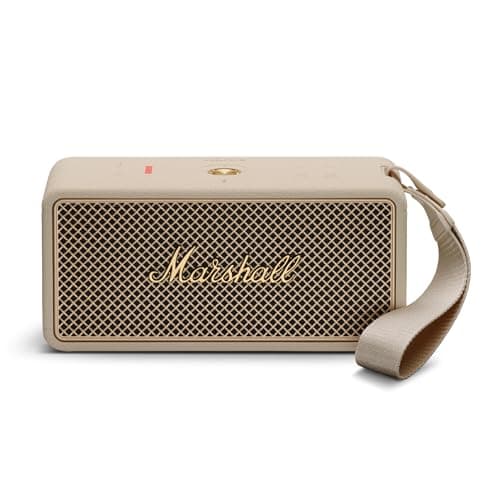
The Marshall Middleton II is, without question, one of the best-looking Bluetooth speakers on the market at any price point. It measures 9.05 inches wide, 4.33 inches tall, and 3.86 inches deep, and weighs in at a substantial 3.9 pounds. The design is pure Marshall from every angle: a black vinyl-wrapped body that mimics the texture of a guitar amp, a silver mesh grille that spans the front and wraps partially around the sides, the iconic Marshall script logo emblazoned across the front in white, and gold-accented controls on the top panel that catch the light. It looks like a tiny guitar amp that got shrunk in the wash, and if you're the kind of person who appreciates vintage-inspired design with modern construction, you'll find yourself just staring at it when you should be listening to music.
The top panel is where the Middleton II most clearly distinguishes itself from the sea of black cylinders and rectangles that dominate the Bluetooth speaker market. Marshall's signature multidirectional control knob sits front and center — you push it to play or pause, twist it to adjust volume, and tilt it left or right to skip tracks forward or backward. It's a single physical control that replaces the touch-sensitive, finicky controls found on many competing speakers. On either side of the control knob are dedicated bass and treble adjustment knobs, a feature that's becoming increasingly rare on portable speakers. Having physical controls for EQ adjustments means you can dial in the sound to your preference without diving into a mobile app — though you can also fine-tune via the Marshall Bluetooth app if you prefer a more granular approach with a five-band EQ.
The build quality is excellent, with a solid, weighty feel that inspires confidence. The cabinet is rigid with no creaking or flexing when you pick it up, and the IP67 rating means the Middleton II is fully dust-proof and can survive submersion in up to one meter of water for 30 minutes. This is a significant upgrade from many speakers in this class that settle for IPX5 or IPX7, which only protect against water jets or submersion without dust ingress protection. The Middleton II can handle beach trips with sandy conditions, pool parties with splashes and spills, and even dusty campsites without breaking a sweat. The rubber base keeps it planted on most surfaces, and the grille is recessed enough that it's unlikely to get punctured during normal use.
A detachable carrying strap is included in the box, which makes it easier to carry the speaker around. The strap attaches to sturdy metal loops on either side of the speaker and feels well-made with a solid metal buckle and robust nylon webbing. The USB-C charging cable is also included, along with a quick-start guide and legal information. There's no carrying case or pouch included, which is a minor omission at the $330 price point — the Bose SoundLink Max comes with a carrying case, and even the cheaper JBL Charge 6 includes a carrying strap.
However, at nearly four pounds, the Middleton II is not what I'd call truly portable in the everyday sense. It's fine for moving from your living room to the backyard or tossing in the car for a road trip, but I wouldn't want to carry it in a backpack for any significant distance. The JBL Charge 6, by comparison, weighs just over two pounds and is far easier to toss in a day bag. The Ultimate Ears EPICBOOM weighs about the same as the Middleton II but has a more rounded, backpack-friendly shape. The Middleton II straddles an awkward line between "portable" and "stationary" — it's too heavy for true on-the-go use but not powerful enough to replace a dedicated home speaker system.
Sound Quality
The Middleton II sounds genuinely impressive for its size and price. The dual 30-watt woofers and dual tweeters deliver a 60-watt total output that can easily fill a medium-sized living room or cover a backyard gathering of 15-20 people with room to spare. The sound signature is warm and slightly bass-forward, which suits rock, pop, and electronic music beautifully. Marshall's guitar amp heritage shines through in the midrange — electric guitars sound present and articulate with authentic crunch, vocals cut through the mix with clarity without sounding shouty, and cymbals and hi-hats have a satisfying shimmer that extends just far enough into the treble without becoming brittle or fatiguing over long listening sessions.
Bass response is the Middleton II's standout feature, and it's the primary reason to choose this speaker over flatter-sounding alternatives. The frequency response extends down to 45 Hz, which is respectable for a speaker this size and significantly deeper than the original Middleton's 50 Hz. You're not going to get the chest-thumping sub-bass of a dedicated party speaker like the JBL PartyBox 720 or the sheer low-end authority of the Brane X, but for a portable speaker that can run on battery power for 30 hours, the Middleton II delivers bass that you can actually feel in your chair. I tested it with a carefully curated selection of bass-heavy tracks — Daft Punk's "Give Life Back to Music," Kendrick Lamar's "HUMBLE.," Billie Eilish's "bad guy," and The Weeknd's "Blinding Lights" — and the Middleton II handled them all with composure. The bass is punchy and well-defined rather than boomy and muddy, and even at higher volumes, the low end stays controlled without bleeding into the midrange.
The 360-degree sound delivery, which Marshall calls True Stereophonic, works impressively well in real-world conditions. The speaker fires sound from both the front and rear grilles, creating a wide, immersive soundstage that doesn't tether you to a specific listening position. Walk around the room, and the music follows you without a significant drop in volume or a noticeable shift in frequency response. This makes the Middleton II an excellent choice for parties, backyard barbecues, and gatherings where people are moving around rather than sitting in a dedicated listening spot. I tested it at a small outdoor gathering with about 12 people, and the speaker covered the entire patio area evenly without anyone needing to sit right next to it for good sound.
Sound quality at higher volumes is where the Middleton II most clearly separates itself from the original Middleton and from many competitors in its price range. The speaker can hit volumes up to 91dB without noticeable distortion, which is loud enough for outdoor parties and large rooms. Even at maximum volume, the sound remains composed and musical, with no crackling, compression artifacts, or audible driver distress. This is a significant improvement over the original Middleton, which would start to exhibit distortion and dynamic compression at around 85% volume. The upgraded drivers and amplifier section in the II give it noticeably more headroom.
That said, the Middleton II isn't the most detailed-sounding speaker in its price range, and it's important to set expectations accordingly. If you're looking for audiophile-grade clarity with precise instrument separation, a wide and deep soundstage, and a neutral frequency response that reveals every detail in complex recordings, the Bose SoundLink Max ($349) offers a more refined sound signature with better vocal clarity, crisper highs, and more precise imaging. The Middleton II prioritizes warmth and presence over precision, which makes it more fun and engaging for casual listening and for the kinds of music that benefit from a little extra low-end weight. It's a speaker designed for enjoyment rather than analysis.
Battery Life and Power Bank Feature
Marshall promises 30-plus hours of playtime on a single charge, and in my testing, that claim holds up under normal use conditions. I used the Middleton II for about four to five hours per day over the course of a week — a mix of music streaming at moderate volumes during work hours, louder playback for evening listening sessions, and a few hours of podcasts at low volume — and I didn't need to charge it until day six. When I did need to charge it, the USB-C fast charging brought the speaker from empty to full in about two and a half hours, and a 20-minute quick charge provides about four hours of playback, which is useful if you forget to charge it before heading out for the day.
The built-in power bank feature is a genuinely useful addition that I didn't expect to appreciate as much as I did. You can plug your smartphone into the USB-C port on the back of the speaker to charge it, effectively turning the Middleton II into a backup battery for your phone. In my testing, the speaker had enough juice to charge an iPhone 17 Pro from 20% to about 70% while still having enough battery left for several hours of music playback after the phone was fully charged. This is a feature I didn't think I'd use, but it came in handy during a beach day when my phone was running low and I didn't have a separate power bank. It also works as a conversation starter — people notice when you pull out a Marshall speaker and use it to charge your phone.
However, it's worth noting that a small but notable number of user reviews report charging reliability issues with the Middleton II. A detailed one-star review on Amazon describes experiencing charging problems on two separate units — the first unit's power bank function stopped working after a few months of normal use, and the replacement unit had charging issues right out of the box where the charging indicator light would turn on but the battery never actually charged. While this seems to be an isolated issue rather than a widespread manufacturing defect based on the overall volume of positive reviews, it's something to be aware of, especially given that several users have reported that Marshall's customer support is difficult to work with on warranty claims. The company requires original receipts for warranty service, and at least one detailed review describes being offered only a 20% discount code instead of a replacement or repair.
Connectivity and Features
The Middleton II supports Bluetooth 5.3 with LE Audio and Auracast, which means it's ready for the next generation of Bluetooth audio that's gradually rolling out across new phones and audio devices. LE Audio enables lower latency for video watching and gaming, better sound quality at lower bitrates, and multi-stream audio for true wireless stereo with compatible devices. Auracast allows you to broadcast audio from your phone to an unlimited number of Auracast-compatible speakers simultaneously, which is useful for multi-room setups or for filling a large space with multiple speakers.
Pairing is straightforward and reliable: hold down the Bluetooth button on the top panel until the LED flashes, select the speaker from your phone's Bluetooth menu, and you're connected within a few seconds. The speaker remembers up to eight previously paired devices and can maintain active connections with two devices simultaneously, which is great for sharing DJ duties at a party or for switching between your phone and laptop without re-pairing. The Bluetooth range is solid at about 30-40 feet through walls, which is typical for this class of speaker.
The built-in microphone allows for hands-free calling, and call quality is decent for a speaker of this type. The person on the other end could hear me clearly when I was in a quiet room, though they noted that I sounded slightly distant compared to when I use my phone's speakerphone. In noisier environments — near a busy street or with background conversation — call quality degraded noticeably, with the microphone picking up ambient noise and struggling to isolate my voice. The microphone is a secondary feature rather than a primary use case for this speaker, and calling is best reserved for quiet environments.
The Marshall Bluetooth app provides access to EQ settings, firmware updates, and power management features. The app is straightforward and responsive, though it doesn't offer the same level of customization as the JBL Portable app or the Bose Music app. You can adjust a five-band EQ with frequency sliders for 60 Hz, 230 Hz, 910 Hz, 3.6 kHz, and 14 kHz, which gives you reasonable control over the sound signature. The app also lets you enable or disable voice prompts, check battery level, and adjust standby timer settings. It works reliably and didn't crash or lose connection during my testing period, which is more than I can say for some competing apps.
Middleton II vs. the Original Middleton
If you're wondering whether to upgrade from the original Marshall Middleton, here's what the II brings to the table. Battery life has been substantially improved from 20+ hours to 30+ hours — that's a 50% increase that makes a real difference for weekend trips. The new power bank feature lets you charge your phone from the speaker, turning a potential single-use device into a multitool for travel. LE Audio and Auracast support future-proof the speaker for the next generation of Bluetooth devices. A built-in microphone enables hands-free calling for the first time on this speaker line. And the drivers have been upgraded for higher output and better clarity at maximum volume.
The original Middleton is still a solid speaker with excellent sound quality and the same classic design, and if you already own one and are happy with it, there's no urgent need to upgrade. But the longer battery life and power bank feature make the Middleton II a noticeably more versatile travel companion. If you're buying your first Marshall portable speaker, the II is the one to get — the improvements justify the modest price premium over any remaining stock of the original.
Middleton II vs. JBL Charge 6
The JBL Charge 6 ($179) is the Middleton II's most direct competitor, and the comparison reveals interesting trade-offs. The Charge 6 is significantly lighter at 2.1 pounds (nearly half the Middleton II's weight), more portable with a built-in carrying strap, and $120 cheaper at its regular retail price. It also offers a comparable 28 hours of battery life, a more rugged IP68 dust and water resistance rating (vs IP67), and its own built-in power bank feature.
Where the Middleton II wins decisively is in sound quality and style. The Middleton II sounds warmer, fuller, and more engaging than the Charge 6, with noticeably better bass response — the Charge 6's bass is punchy but lacks the depth and authority of the Middleton II. The soundstage is wider and more immersive, and the Middleton II maintains composure at higher volumes where the Charge 6 starts to show signs of dynamic compression. And there's no contest in the looks department — the Middleton II is a design statement that people will comment on, while the Charge 6 is a perfectly functional but visually anonymous Bluetooth speaker.
The choice between them is clear based on your priorities. If weight, portability, and value are paramount, the JBL Charge 6 is the smarter buy and will serve you well. If you want a speaker that sounds genuinely good and turns heads when people see it on your shelf, the Middleton II is worth the significant price premium.
Middleton II vs. Bose SoundLink Max
The Bose SoundLink Max ($349) is $50 more expensive than the Middleton II and represents a different philosophy of portable audio design. The SoundLink Max has a more neutral, balanced, and detailed sound signature with superior vocal clarity, crisper highs, and more precise instrument separation. It's also lighter at 2.8 pounds and has a more discreet, minimalist design that blends into any environment without drawing attention to itself.
The Middleton II fights back with warmer, more immediately enjoyable sound for casual listening, physical EQ controls that let you adjust bass and treble without an app, a longer 30-hour battery life (versus the SoundLink Max's 20 hours), and that unmistakable Marshall aesthetic that makes the speaker a conversation piece. The Bose is the better choice for audiophiles, for anyone who wants a speaker that disappears into the background of their decor, and for people who prioritize vocal clarity for podcast listening. The Marshall is for people who want their speaker to be a statement piece that sounds great doing double duty as a party machine.
Potential Concerns
The most significant concern with the Middleton II, based on my research into user feedback across multiple retail platforms, is the potential for charging reliability issues. While my review unit worked flawlessly throughout testing, reports of charging failures occurring within weeks or months of purchase, combined with accounts of difficult customer support experiences, give me pause. Marshall's one-year limited warranty should theoretically cover manufacturing defects, but the anecdotal evidence suggests that actually getting warranty service can be an uphill battle that requires persistence and original purchase documentation.
The weight is another consideration that bears repeating. At 3.9 pounds, the Middleton II is heavier than virtually any direct competitor in its size class. The IP67 rating means it can handle rain, dust, and splashes, but its weight makes it better suited for car camping, backyard parties, patio use, and indoor living spaces than for backpacking, beach trips where you're walking any distance, or daily commuting. If your primary use case involves carrying a speaker for more than a few minutes at a time, look at the JBL Charge 6 or the Ultimate Ears EPICBOOM.
The omission of a 3.5mm auxiliary input is a notable downgrade from the original Middleton. The original had an aux port that let you connect virtually any audio source with a headphone jack — older MP3 players, turntables with built-in preamps, portable game consoles, airplane seat entertainment systems, and audio interfaces. The Middleton II's exclusively Bluetooth connectivity limits your options for wired connections and means you're dependent on Bluetooth codec support for audio quality.
Who Should Buy the Marshall Middleton II
The Marshall Middleton II is for people who care about how their tech looks and sounds in equal measure. It's for the person who wants a Bluetooth speaker that complements their decor rather than hiding it behind a plant or shoving it in a corner when guests come over. It's for rock fans who appreciate the Marshall heritage and the visual connection to the amps that shaped popular music, and for anyone who wants a speaker that delivers warm, engaging sound with real bass presence.
The Middleton II is also a solid choice for small gatherings, dinner parties, and backyard hangouts, where its 360-degree sound and 91dB maximum volume can fill a space without audible distortion. The 30-hour battery life means you don't need to worry about charging it before a weekend trip, and the power bank feature is a genuinely useful bonus that makes the speaker more versatile.
Who Should Skip It
If you need a truly portable speaker for hikes, bike rides, beach walks, or daily commuting, the Middleton II is too heavy to be practical. The JBL Charge 6 or the smaller JBL Flip 7 would serve you better at a lower price. If you're an audiophile who prioritizes neutral, detailed sound reproduction for critical listening, the Bose SoundLink Max offers better clarity and precision at a slightly higher price. If you need the smallest possible speaker that still sounds good, the JBL Go 5 at $55 will surprise you with its sound quality for the size. And if you're on a tight budget, the original Middleton is still available from third-party sellers and offers much of the same experience for significantly less money, as long as you can live without the power bank and the extra 10 hours of battery life.
Final Thoughts
The Marshall Middleton II is a Bluetooth speaker that unapologetically prioritizes style and sound quality over portability and price. It delivers warm, engaging audio with impressive bass response for its size, looks like nothing else on the market in 2026, and offers all-day-plus battery life with the genuinely useful bonus of a built-in power bank. The 360-degree sound makes it a natural choice for gatherings where people are moving around, and the physical EQ controls are a rare and welcome feature in a world of app-dependent gadgets.
The compromises are real and worth considering before you buy. The weight makes it less portable than competitors, the lack of an aux input limits connectivity options, and the handful of concerning reports about charging reliability and customer support are worth factoring into your decision. But for anyone who values design and sound quality above all else in a portable speaker, the Middleton II is one of the most compelling options you can buy in 2026.
For a deeper dive into premium wireless audio, check out our Sony WF-1000XM6 review for flagship ANC earbuds or our OnePlus Buds 4 review for a value-packed alternative.
Get the Marshall Middleton II on Amazon: https://www.amazon.com/dp/B0FBH7MDC5?tag=newgearhub-20
Pros
- Stunning vintage-inspired design that stands out from every competitor
- Warm, engaging sound with excellent bass response for its size
- 30-hour battery life with built-in power bank for phone charging
- Physical bass and treble controls eliminate app dependency
- IP67 dust and water resistance for outdoor use
Cons
- Heavy at 3.9 pounds — not truly portable for daily carry
- No 3.5mm auxiliary input limits wired connectivity
- Customer support experiences reported as difficult by some users
- Audiophiles may prefer the Bose SoundLink Max for neutral sound
Final Verdict
The Marshall Middleton II delivers warm, engaging sound with impressive bass response, 30-hour battery life, and a built-in power bank, wrapped in the brand's iconic guitar amp design.