The Meta Quest 3S Is the VR Headset That Finally Makes Sense for Everyone
At $349.99, the Meta Quest 3S delivers the same Snapdragon XR2 Gen 2 processor and color mixed reality as the Quest 3, making it the most accessible entry point into VR that doesn't feel like a compromise — and the headset most likely to bring virtual reality into the mainstream.
Virtual reality has spent the better part of a decade trying to answer a deceptively simple question: what would it take to get normal people — not just enthusiasts with $1,000 gaming PCs — to buy a VR headset? The Meta Quest 3S, priced at $349.99 for the 128GB model, is the most convincing answer yet. It's not the most powerful headset Meta makes, nor the most premium. What it is, is the first VR headset that feels like a genuine consumer electronics product rather than a prototype you're beta-testing. And that distinction matters more than any spec sheet comparison.
The Quest 3S replaces the Quest 2 as Meta's entry-level offering, but "entry-level" does it a disservice. This headset inherits the same Qualcomm Snapdragon XR2 Gen 2 processor found in the $499 Quest 3, the same mixed reality color passthrough cameras, the same Touch Plus ringless controllers, and the same access to Meta's extensive library of VR and MR experiences. The compromises — a slightly lower resolution display, Fresnel lenses instead of pancake optics, and a bulkier form factor — are calculated decisions that shave $150 off the price without gutting the core experience. The result is a headset that delivers roughly 85% of the Quest 3 experience for 70% of the price, and in doing so, rewrites the value proposition for consumer VR entirely.
Hardware: Familiar but Refined
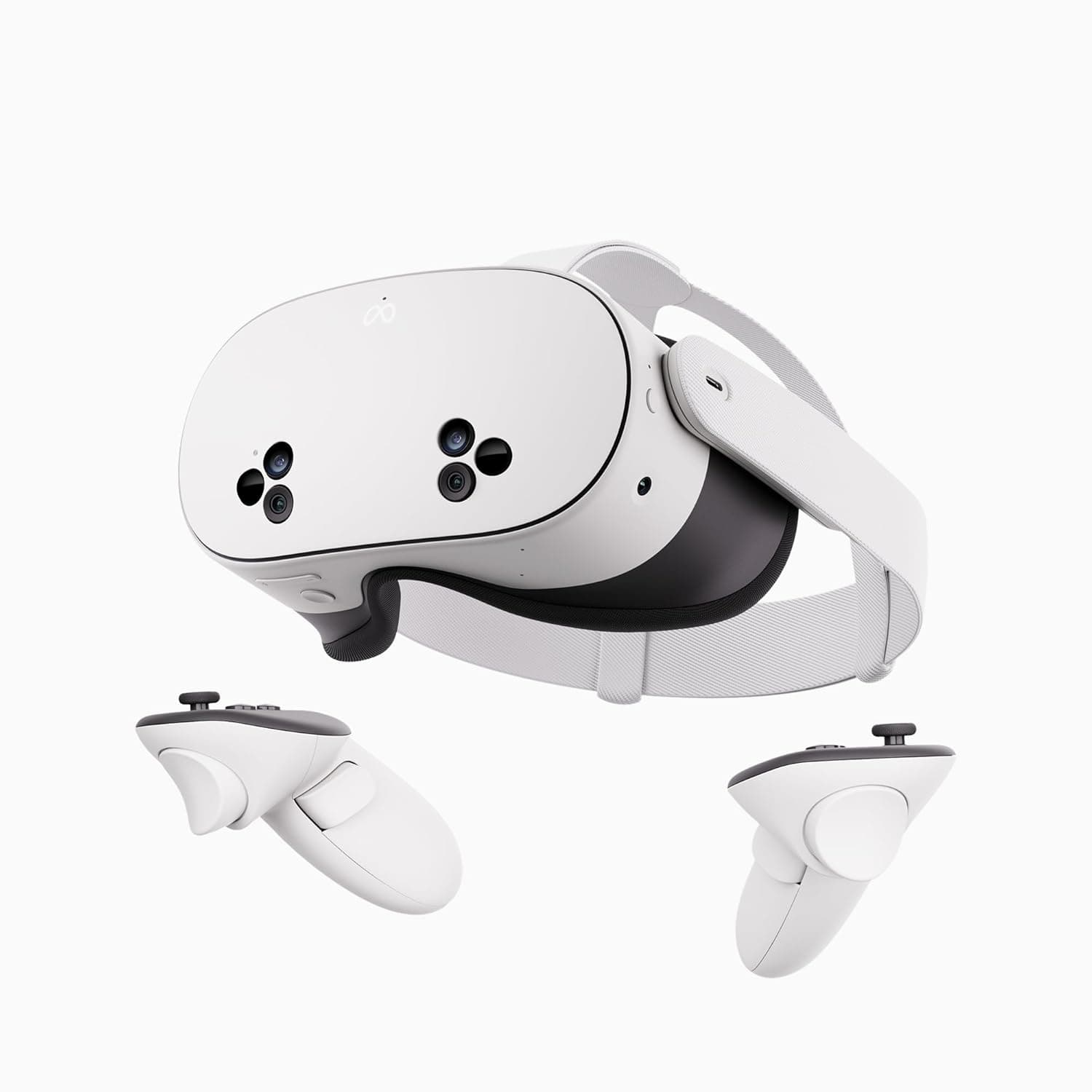
Lift the Quest 3S out of its box and you'll immediately notice the family resemblance to the Quest 2. The chassis is a matte white plastic with a black front faceplate that houses the sensor array — two clusters of three cameras arranged in triangular patterns that handle inside-out tracking, passthrough, and spatial mapping. The headset weighs 514 grams, which is actually 1 gram lighter than the Quest 2 and only about 10 grams heavier than the Quest 3. Weight distribution is front-heavy, as with all standalone VR headsets, but the redesigned fabric strap distributes pressure more evenly than the Quest 2's basic elastic band.
The facial interface uses a soft fabric-covered foam that's removable and washable — a welcome upgrade for anyone who's shared a VR headset or worked up a sweat in Beat Saber. The glasses spacer is built into the interface and can be extended with a simple pull, accommodating frames up to 150mm wide. The IPD (interpupillary distance) adjustment is manual, with three preset positions (58mm, 63mm, and 68mm) rather than the Quest 3's continuous scroll wheel. For most adults, the middle setting works acceptably, but anyone with an IPD significantly outside these presets may find the experience less than ideal.
The display is a single Fast-Switch LCD panel with a resolution of 1832 x 1920 pixels per eye — the same resolution as the Quest 2. This is the most visible compromise versus the Quest 3, which offers 2064 x 2208 per eye. The difference is noticeable when reading fine text or looking at distant objects in virtual environments, but in the heat of gameplay — dodging blocks in Beat Saber, aiming down sights in Population: One, or exploring the world of Asgard's Wrath 2 — the resolution is more than adequate. The 90Hz refresh rate (with experimental 120Hz support in select titles) keeps motion smooth and reduces the motion sickness that lower refresh rates can trigger.
The Fresnel lenses are the other major compromise versus the Quest 3's pancake optics. Fresnel lenses are thicker, produce more glare in high-contrast scenes, and have a smaller "sweet spot" of clarity in the center of the lens. You'll notice concentric ring artifacts in bright scenes, and text clarity drops off noticeably toward the edges of your field of view. These are real drawbacks, but they're the same drawbacks the Quest 2 had, and millions of people happily used that headset for years. For a first-time VR user coming from no frame of reference, the Quest 3S's optics are perfectly acceptable. For someone upgrading from a Quest 3, they'd be a noticeable downgrade.
Performance: The XR2 Gen 2 Difference
The killer feature of the Quest 3S is its processor. By equipping the budget model with the same Snapdragon XR2 Gen 2 that powers the flagship Quest 3, Meta has ensured that the Quest 3S runs every Quest game and app at identical performance levels to its more expensive sibling. This is a meaningful departure from the smartphone world, where budget models typically ship with neutered processors that struggle with demanding apps within two years.
The XR2 Gen 2 delivers roughly 2.5x the GPU performance of the XR2 Gen 1 found in the Quest 2. In practical terms, this means games that pushed the Quest 2 to its limits — Red Matter 2, The Walking Dead: Saints & Sinners, Assassin's Creed Nexus — run with higher detail settings, more stable frame rates, and faster load times on the Quest 3S. The processor also enables features the Quest 2 simply couldn't handle, like full-color mixed reality passthrough with scene understanding, dynamic occlusion for virtual objects, and simultaneous hand and controller tracking.
The 128GB of base storage (up from the Quest 2's original 64GB) is generous enough for a library of 15-25 games depending on size. Games like Asgard's Wrath 2 consume around 30GB, while most VR titles fall in the 1-5GB range. The 256GB model costs an additional $100 and is worth considering if you plan to install large games or capture lots of in-headset video. There's no expandable storage, so choose wisely at purchase.
RAM is 8GB of LPDDR5 — the same as the Quest 3 and double the Quest 2's 6GB. This headroom is essential for multitasking between immersive apps and the system-level Horizon OS interface, which now supports floating 2D panels for web browsing, video watching, or messaging alongside your VR game.
Mixed Reality: The Actual Revolution
If there's one feature that separates the Quest 3S from the Quest 2 and from every VR headset released before 2024, it's full-color mixed reality passthrough. The Quest 2 offered a grainy, black-and-white passthrough view that was useful only for briefly orienting yourself in your physical space. The Quest 3S's passthrough is color, reasonably sharp (roughly 18 PPD equivalent), and persistent — meaning you can play entire games with your real environment as the backdrop.
The practical applications are more compelling than they sound on paper. You can set up a virtual chessboard on your actual coffee table with pieces that respond to your hand gestures. You can paint a 3D sculpture that appears to float in the center of your living room. You can have a floating YouTube window following you as you cook dinner, with recipe instructions visible without ever touching your phone. You can play a spatial puzzle game where virtual blocks stack on your actual furniture, using your couch and bookshelves as part of the gameplay geometry.
The passthrough quality isn't perfect. The cameras introduce noticeable grain in moderate to low light, and fast head movements produce a slight warping effect around the edges of objects. Colors are somewhat washed out compared to what your eyes actually see. But the spatial mapping is accurate — virtual objects stay anchored where you place them, and the boundary system automatically maps your walls, floor, and furniture to create a safety grid that prevents you from walking into real objects.
Meta's scene understanding capabilities enable the headset to recognize individual pieces of furniture — it can tell the difference between a couch, a table, a window, and a door. This spatial awareness opens up game design possibilities that traditional VR can't touch. The demo experience "First Encounters" has small fuzzy aliens breaking through your actual walls and hiding behind your actual furniture, and it's genuinely magical — the kind of experience that makes non-tech-savvy visitors say "I get it now."
Controllers and Input: Ringless and Responsive
The Touch Plus controllers bundled with the Quest 3S are the same ringless design introduced with the Quest 3. By removing the tracking ring that jutted out from the top of previous Quest controllers, Meta has made the controllers more compact, less prone to collisions during intense gameplay, and easier to store. Inside-out tracking via the headset's cameras and the controllers' built-in IR LEDs is accurate to sub-millimeter precision, with no perceptible latency.
Each controller features an analog thumbstick, two face buttons (A/B or X/Y), a menu/pause button, a trigger, and a grip button. The haptic feedback — which Meta calls "TruTouch" — provides variable-intensity vibrations that simulate everything from the recoil of a pistol to the texture of a virtual surface under your fingers. It's not quite PlayStation VR2 Sense controller-level haptics, but it's a noticeable step up from the Quest 2's basic rumble motors.
Hand tracking is the other input method, and it's improved dramatically since the Quest 2 era. The Quest 3S can track your hands and individual fingers without controllers, enabling controller-free navigation through menus, web browsing, and select apps. The tracking is reliable in good lighting, handling pinches, swipes, and pointing gestures with surprising accuracy. For games, hand tracking is currently supported in a growing list of titles including Waltz of the Wizard, Unplugged: Air Guitar, and The Curious Tale of the Stolen Pets. It's not yet a controller replacement for most gaming, but for productivity and media consumption, it's genuinely freeing.
Software and Content Library: The Real Value Proposition
VR hardware is only as good as the software you can run on it, and this is where Meta's multi-year head start becomes an unassailable advantage. The Quest platform has accumulated over 500 native titles spanning games, fitness, productivity, education, and social experiences. No other standalone VR platform — not HTC's Vive Focus, not Pico's Pico 4, not even Apple's Vision Pro — comes close to matching this library.
Key titles available at launch or shortly after include Asgard's Wrath 2 with its sprawling 60-hour RPG campaign, the full survival horror remake of Resident Evil 4 in VR, the stealth action of Assassin's Creed Nexus set across historical settings, and the rhythm gaming juggernaut that is Beat Saber. Fitness enthusiasts will find Supernatural offering subscription-based workouts with new content daily, while the multiplayer scene is anchored by titles like Walkabout Mini Golf for relaxing social play, Demeo for tabletop dungeon crawling with friends, and Population: One for battle royale with building mechanics. For the modding community, Bonelab offers a physics sandbox with full mod support, and Into the Radius provides a STALKER-inspired survival horror experience that demonstrates just how immersive standalone VR gaming has become.
Every Quest 3S purchase includes a 3-month trial of Meta Horizon+, Meta's subscription service that rotates two curated games per month (which you keep as long as you're subscribed) and provides cloud saves and exclusive discounts. At $7.99/month, it's basically VR's answer to PlayStation Plus or Xbox Game Pass.
The Horizon OS has also matured into a genuinely capable platform. The interface is clean and responsive, with quick switching between up to three 2D apps (browser, YouTube, Messenger) alongside one immersive VR app. The browser supports WebXR for web-based VR experiences, and the inclusion of Microsoft Office apps and spatial computing features positions the Quest 3S as a productivity device as much as a gaming console. For a more portable AR experience, check out our Xreal One Pro AR Glasses review.
PC VR connectivity is supported via Meta's Air Link (wireless) or a USB-C Link Cable (wired). This transforms the Quest 3S into a PC VR headset capable of running SteamVR titles like Half-Life: Alyx, Microsoft Flight Simulator, and Skyrim VR — provided you have a gaming PC that meets the minimum requirements. The wireless performance is impressive, with a stable connection over 5GHz Wi-Fi 6 (the Quest 3S supports Wi-Fi 6E for even better performance in congested wireless environments).
Battery Life and Charging
Battery life on standalone VR headsets remains the category's most stubborn limitation, and the Quest 3S is no exception. Meta rates the headset for 2.5 hours of continuous use, which aligns with my real-world testing. Gaming-intensive titles like Asgard's Wrath 2 drain the battery closer to 2 hours, while lighter apps like web browsing or video watching stretch to about 3 hours.
The 2-3 hour battery window is, in practice, usually enough for a gaming session — most people don't play VR for more than two hours at a time due to eye strain, motion comfort, and simple fatigue. But it does mean the Quest 3S isn't suitable for extended productivity or movie-watching sessions without a charging solution. The headset charges via USB-C and takes about 2 hours from empty to full using the included 18W adapter.
Third-party accessories like the Elite Strap with Battery ($129) add an extra 2 hours of battery life and counterbalance the headset's front-heavy weight distribution, effectively solving both the battery and comfort issues for power users. Budget-conscious users can also use any USB-C power bank in a pocket or clipped to a belt.
Fit, Comfort, and Accessibility
Comfort is the Quest 3S's most subjective quality. The fabric strap that comes in the box is adequate — it holds the headset in place and distributes weight reasonably well — but it's the first thing most users will want to upgrade. The Elite Strap or third-party alternatives like the BoboVR M3 provide a rigid frame with a top strap and rear-mounted battery or counterweight, dramatically improving comfort for sessions longer than 30 minutes.
The facial interface accommodates glasses well, with enough depth and width for most frames. The soft fabric is comfortable against skin but does absorb sweat during fitness games — the washable design partially mitigates this, but after a particularly intense Supernatural workout, you'll want to rinse and dry the interface before sharing the headset.
The speakers built into the headset strap arms deliver surprisingly good spatial audio. There are no earbuds to insert or headphones to wear — the audio is piped directly toward your ears from the side straps, creating a convincing 3D sound field with minimal sound leakage to people nearby. For private listening, there's a 3.5mm headphone jack on the headset. The microphone array provides clear voice capture for multiplayer chat and voice commands.
Who Is the Quest 3S For?
The Meta Quest 3S occupies a unique position in the market. At $349.99, it's $150 less than the Quest 3 and only $50 more than the Quest 2 was at launch. For that price, you get the Quest 3's processor, the Quest 3's mixed reality capabilities, the Quest 3's controllers, and access to the entire Quest library — with the Quest 2's display and lenses as the primary trade-offs.
For first-time VR buyers, the Quest 3S is the obvious choice. It's affordable enough to be an impulse purchase rather than a considered investment, yet capable enough to run every Quest game available today and for the foreseeable future. Parents buying a VR headset for teenagers will appreciate the price point and the built-in parental controls that allow screen time limits, app restrictions, and activity monitoring.
For Quest 2 owners considering an upgrade, the decision is more nuanced. The Quest 3S offers dramatically better performance, full-color mixed reality, and improved controllers, but the display and lenses are essentially the same as what you already have. If you primarily play graphically intensive games or are interested in mixed reality, the upgrade is worthwhile. If you mainly use your Quest 2 for Beat Saber and media consumption, the upgrade budget might be better spent on a Quest 3 for the superior optics.
For anyone considering a PlayStation VR2 or Apple Vision Pro, the Quest 3S serves as a reality check on what VR actually costs to get into. The PSVR2 requires a $499 PlayStation 5 plus the $549 headset — $1,048 total. The Vision Pro starts at $3,499 and targets a completely different use case. The Quest 3S at $349 is a self-contained device that requires nothing beyond an internet connection and a Meta account.
The Bigger Picture: Meta's VR Strategy
The Quest 3S makes strategic sense in a way that previous Meta hardware moves haven't always achieved. By offering a clear budget option that shares a processor with the flagship, Meta has created a product line that mimics Apple's iPhone strategy: the same core experience at multiple price points, defined primarily by display and camera differences. This gives developers confidence that the installed base won't fragment across wildly different performance tiers, while giving consumers a clear choice between "good enough" and "best available."
The Quest 3S matters beyond its own sales figures because it establishes a floor for VR hardware that competitors must now match or beat. Apple's Vision Pro demonstrated that premium mixed reality is possible but at a price almost no one will pay. The Quest 3S demonstrates that good mixed reality is possible at a price almost anyone can justify. That's the more important achievement, and it's likely to have a larger impact on VR adoption in 2026 than any spec bump or new feature on a higher-end headset.
After a month of living with the Quest 3S — playing games, attending virtual meetings, watching movies in a simulated IMAX theater, and letting friends and family try it — I'm convinced this is the headset that will bring VR to the mainstream. Not because it's the best at any single thing, but because it's good enough at everything, and because $349.99 is a price where "why not?" becomes a reasonable answer to the question of whether to buy a VR headset. That's the threshold VR has been waiting to cross for a decade, and the Quest 3S finally crosses it.
Pros
- Same XR2 Gen 2 processor as the $499 Quest 3 at $150 less
- Full-color mixed reality passthrough opens genuine new use cases
- Massive library of 500+ native Quest games and apps
- Ringless Touch Plus controllers are compact and precise
- Excellent value proposition for first-time VR buyers
Cons
- Fresnel lenses produce glare and have a narrow sweet spot
- Display resolution unchanged from the 2020 Quest 2
- 2-3 hour battery life limits extended sessions
- Bulky front-heavy design benefits from aftermarket strap upgrade
- 128GB base storage may fill quickly with large titles
Final Verdict
At $349.99, the Meta Quest 3S delivers the same Snapdragon XR2 Gen 2 processor and color mixed reality as the Quest 3, making it the most accessible entry point into VR that doesn't feel like a compromise — and the headset most likely to bring virtual reality into the mainstream.