OnePlus Watch 3 Review: The Android Smartwatch Battery King
The OnePlus Watch 3 delivers class-leading battery life, a bright 2,200-nit AMOLED display, and unique health features like the 60-Second Check-In at a price that undercuts the competition. It is the best value Android smartwatch available, despite missing cellular and safety features.
Android smartwatch buyers have had a frustrating few years. Samsung's Galaxy Watch lineup offers great hardware but ties you into Samsung's proprietary ecosystem. Google's Pixel Watch delivers clean software but underwhelming battery life. And the Apple Watch simply doesn't work with Android phones at all. The OnePlus Watch 3 enters this landscape with a simple proposition: give you everything you actually need from a premium smartwatch — excellent battery life, solid fitness tracking, a bright display, and Wear OS — at a price that undercuts the competition. After wearing it daily for weeks, I can report that OnePlus has delivered on that promise more completely than any previous attempt.
OnePlus Watch 3 Review: The Android Smartwatch Battery King
Design and Build Quality
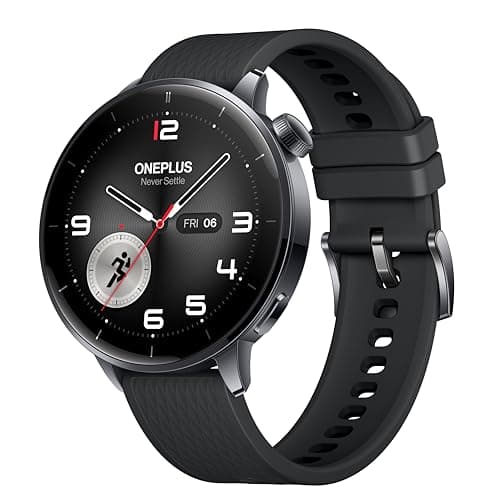
The OnePlus Watch 3 makes a strong first impression. The round stainless steel case measures 47.6mm across, which puts it in the larger end of the smartwatch spectrum alongside the Galaxy Watch Ultra and Apple Watch Ultra 2. It is not a small watch, and it sits noticeably larger on the wrist than the Google Pixel Watch 3 or the standard Galaxy Watch 8. If you have smaller wrists, you should absolutely try this on before buying — there is only one size option and no smaller variant available.
That said, the build quality is exceptional for the price. The stainless steel body is polished to a subtle sheen, and the titanium alloy bezel around the display adds a premium feel that rivals watches costing twice as much. The flat sapphire crystal covering the display provides excellent scratch resistance, and after weeks of daily wear including workouts and general desk work, the crystal shows no marks whatsoever. The fluoro rubber strap that ships with the watch is comfortable right out of the box with no break-in period needed, and it uses standard 22mm quick-release pins, so swapping to a third-party band is straightforward.
The colors available are Obsidian Titanium, which is an all-black finish that looks professional and discreet, and Emerald Titanium, which pairs a silver case with a green strap for a more distinctive look. I tested the Obsidian version, and it transitions well from gym sessions to business casual settings without looking out of place. The watch weighs 81 grams with the strap attached, which is noticeable but not heavy enough to be uncomfortable during sleep tracking.
One of the most welcome hardware upgrades over the OnePlus Watch 2 is the functionally rotating digital crown. The previous generation had a crown that looked like it should rotate but remained static, which was a frustrating bit of form-over-function design. The Watch 3's crown actually turns, providing smooth haptic feedback for scrolling through notifications, zooming in maps, and navigating the app drawer. It is not as precise as the Apple Watch's digital crown, but it represents a meaningful improvement and makes the watch feel like a complete product rather than a work in progress.
Display: Bright and Legible
The 1.5-inch LTPO OLED display is one of the Watch 3's strongest features. At 2,200 nits peak brightness, it is more than twice as bright as the OnePlus Watch 2's panel and matches the best in the Android smartwatch market. Outdoor visibility is excellent — even under direct California sun, I had no trouble reading notifications, workout stats, or the always-on watch face. The bezels are noticeably slimmer than the previous generation, giving the display a more modern look with higher screen-to-body ratio.
The LTPO technology allows the display to dynamically adjust its refresh rate from 1Hz in always-on mode up to 60Hz during active use. This contributes to battery life without sacrificing smoothness when you need it. The always-on display mode is well implemented with a variety of customizable watch faces, including support for animated and video watch faces that add a bit of personality.
One thing worth noting about the display: the 1.5-inch size paired with the 47mm case diameter means the screen-to-body ratio is good but not class-leading. The Pixel Watch 3 with its smaller 41mm case achieves a higher screen-to-body ratio, though of course the actual screen real estate on the OnePlus is larger. The sapphire crystal sits flat rather than slightly domed, which means it catches fewer reflections than the curved glass on some competitors.
Battery Life: The Headline Feature
The OnePlus Watch 3's 631mAh battery is the largest I have seen in any mainstream smartwatch, and it shows in real-world usage. OnePlus claims up to five days of battery life in standard smart mode with the always-on display turned off, and my testing largely confirms this. Over a typical week of usage — wearing the watch 24/7 including sleep tracking, receiving push notifications from my phone, tracking two or three workouts per week, and using GPS for outdoor runs — I averaged just over four days between charges.
With always-on display enabled, battery life drops to roughly two to two and a half days, which is still competitive with the Galaxy Watch 8 and Pixel Watch 3 in the same configuration. The power saver mode, which switches the watch to its RTOS (real-time operating system) backend, extends battery life to a claimed 16 days. In this mode, the watch tracks steps, sleep, and heart rate while showing the time and notifications, but loses access to Wear OS apps and full smartwatch functionality.
The silicon-carbon battery chemistry is the same NanoStack technology used in the OnePlus 13 smartphone, and it allows OnePlus to pack more capacity into the same physical space as the previous generation's 500mAh battery. This is the same battery technology that is gradually making its way into more flagship phones, and seeing it in a smartwatch at this price point is encouraging for the industry as a whole.
Charging is reasonably fast thanks to the 10W magnetic charger. The charger uses a spring-loaded pogo pin base with a detachable USB-C cable, which is a welcome design choice — you can replace the cable if it breaks without buying a whole new charger. A ten-minute charge got me from 20 to 32 percent, which OnePlus claims is enough for a day of use. A full charge from empty takes about 80 minutes. This is not the fastest charging in the smartwatch category, but the excellent battery life means you will only need to charge once every four or five days anyway, which makes charging speed less of a concern than it is for watches with one-to-two-day battery life.
I want to emphasize the real-world impact of this battery life because it is the single biggest differentiator for this watch. With the Galaxy Watch 8, I am constantly thinking about battery — did I charge it last night? Will it make it through a full day of GPS tracking? Can I wear it to sleep tonight or does it need to be on the charger? With the OnePlus Watch 3, those questions simply do not come up. I put it on and forget about charging until I see a low-battery notification around day four. That mental freedom is hard to quantify but genuinely improves the ownership experience.
Health and Fitness Tracking
The Watch 3 introduces several new health features that help it stand out in a crowded market. The 60-Second Health Check-In is the most distinctive new capability. You hold your finger on the physical button for sixty seconds while the watch measures seven health indicators including ECG (not available in the US currently), heart rate, blood oxygen saturation, vascular age, wrist temperature, sleep quality, and mind-body wellness. After the minute is up, the watch displays a comprehensive report with a wellness score and flag indicators for any metrics that fall outside normal ranges. It is one of those features that sounds gimmicky on paper but turns out to be genuinely useful for tracking trends over time. I found myself running the check-in every morning after waking up, and over several weeks I could see clear patterns correlating my recovery scores with sleep quality and previous-day exercise.
The new arterial stiffness measurement, accessible through the Vascular Health app, is a feature typically reserved for medical-grade devices. It uses the watch's sensors to estimate an indicator related to blood pressure health. I cannot speak to its clinical accuracy compared to proper medical equipment, but it provides a consistent baseline measurement that trended in the right direction during my testing. For anyone interested in cardiovascular health monitoring, having this data point available from a $329 wearable is genuinely impressive, even if it is not a substitute for proper medical assessment.
Heart rate tracking has been improved with a redesigned sensor layout that uses more transparent glass and a new LED configuration. During workouts, I found heart rate readings to be within a few beats per minute of a chest strap monitor for steady-state cardio, though accuracy dropped somewhat during high-intensity interval training with rapid heart rate changes. Optical heart rate sensors on wrist-worn devices all face this limitation to some degree, and the Watch 3 performs on par with the Galaxy Watch 8 and Pixel Watch 3 in this regard. The curved back of the watch helps maintain consistent skin contact even during dynamic movements, which is a thoughtful design improvement over the flatter back of the Watch 2.
GPS tracking uses dual-frequency L1 and L5 bands with a new 7-nanometer Broadcom chip and an omnidirectional antenna design. In my testing during runs through urban areas with tall buildings, the GPS track was noticeably more accurate than the OnePlus Watch 2, with fewer wander-off moments and more consistent pace data. Outdoor run tracking matched my phone's GPS within a 1-2 percent distance variance, which is excellent for a watch at this price. The watch supports over 100 workout types, with 11 pro modes that provide advanced metrics. Running pro mode, for example, displays pace, cadence, stride length, vertical oscillation, real-time power output, and ground contact time — data typically reserved for dedicated running watches like those from Garmin.
Sleep tracking has also seen meaningful improvements. The Watch 3 automatically detects when you fall asleep and tracks sleep stages including deep, light, REM, and awake periods. The sleep score takes into account duration, consistency, heart rate variability, breathing rate, and movement. It also detects naps, which is a nice touch for anyone who takes afternoon siestas. Compared to the sleep tracking on my reference device, a Withings Sleep Analyzer mat, the Watch 3's stage detection was reasonably accurate for deep and light sleep but showed the same tendency as most wearables to overestimate REM sleep. The sleep tracking interface in the OHealth app is clear and actionable, showing not just last night's data but trends over 30 days so you can see patterns.
One notable omission is sleep apnea detection, which Samsung added to the Galaxy Watch 7 and Apple added to the Watch Series 10. This is a meaningful health feature that is becoming standard on premium smartwatches, and its absence here is a real gap. Similarly, there is no fall detection or crash detection, which are safety features that competitors offer. If those features are priorities for you, the OnePlus Watch 3 is not the right choice.
Software and Daily Experience
The OnePlus Watch 3 runs Wear OS 5, Google's full smartwatch operating system, which means you get access to the Google Play Store, Google Maps, Google Wallet, Google Assistant, and thousands of third-party watch apps. The experience is essentially identical to what you would get on a Pixel Watch or Galaxy Watch in terms of app availability and notification management. Google Messages works seamlessly for replying to texts, Google Maps provides turn-by-turn navigation on your wrist, and Google Wallet handles contactless payments reliably.
The dual-chipset architecture that OnePlus calls the "dual-engine system" uses the Snapdragon W5 processor for active tasks and the BES2800 efficient chip for background operations and power saver mode. The transition between the two is seamless, and I never noticed any lag or delay when waking the watch from standby. App loading times are snappy, and navigating the Wear OS interface feels smooth even with several apps installed.
The OnePlus Health app, also called OHealth, is required for initial setup and ongoing data review. It is clean and well-organized, with a dashboard that shows your daily activity ring, recent workouts, sleep data, and health metrics. The app is not quite as polished as Samsung Health or Google Fit, but it covers the essentials competently. One frustration is that the watch requires the OHealth app specifically and does not fully support Google's Fitbit integration or Samsung Health, which means you are locked into OnePlus's ecosystem for health data. If you have been tracking your fitness history in Samsung Health or Google Fit for years, migrating to OHealth involves starting from scratch or accepting that your historical data lives in a separate app.
The watch faces deserve a mention. OnePlus has improved its watch face selection significantly, offering dozens of options in the OHealth companion app. The ability to use video and animated watch faces adds personality, and the always-on variants are well designed with proper power management. Third-party watch faces from the Play Store work without issue as well.
Notification handling follows standard Wear OS conventions. You receive notifications from your phone, can expand them to read more, and can reply to messages using canned responses, voice dictation, or a tiny on-screen keyboard. The voice dictation quality is good — Google's speech recognition is excellent — and the haptic feedback for notifications is strong enough to feel without being jarring. As mentioned earlier, the haptic motor itself is not great, lacking the precision and range of the Galaxy Watch's vibration motor, but it gets the job done for alerts and alarms.
The watch is compatible with any phone running Android 9 or later, which is a broader compatibility range than Samsung's Galaxy Watch (which works best with Samsung phones) or the Pixel Watch (which is designed around Pixel phones). You do not need to own a OnePlus phone to get the full experience. The watch does not support iPhones at all, so if you are on iOS, this is not an option.
How It Stacks Up Against the Competition
At $329 — and frequently available for $249 during promotional periods — the OnePlus Watch 3 undercuts the Galaxy Watch 8 ($349), the Pixel Watch 3 ($349), and the Apple Watch Series 11 ($399) while offering better battery life than all of them. The Galaxy Watch 8 matches it on features and arguably surpasses it on health tracking with sleep apnea detection, but Samsung's watches push you toward Samsung Health and Samsung phones for the best experience. The Pixel Watch 3 has cleaner software and faster updates but its battery life is a day and a half at best, which is half of what the OnePlus delivers.
The Galaxy Watch Ultra starts at $649 and offers a more rugged build with a titanium case, a third customizable button, and a brighter display at 3,000 nits. But it costs roughly double the OnePlus Watch 3 and does not offer proportionally double the functionality. The OnePlus Watch 3 is lighter, has a larger battery, and runs the same Wear OS software. Unless you specifically need the Ultra's 3,000-nit display or its extra physical button for outdoor sports, the Watch 3 is the better value.
The Apple Watch Ultra 2 starts at $799 and requires an iPhone, so it is not a direct competitor for Android users. But for anyone considering switching ecosystems, it is worth noting that the OnePlus Watch 3 at $329 delivers 80 percent of the Ultra experience for less than half the price.
For Garmin users considering a smartwatch with Wear OS, the comparison is interesting. Garmin's watches like the Venu 4 deliver significantly better battery life measured in weeks rather than days and offer more advanced training metrics for serious athletes. But they lack the Wear OS app ecosystem, meaning no Google Maps navigation, no Google Wallet contactless payments, and no third-party apps. The OnePlus Watch 3 splits the difference — good enough fitness tracking for most people plus full smartwatch capabilities — which is the right tradeoff for the vast majority of buyers.
The 32GB of onboard storage is worth highlighting. This is double what the Pixel Watch 3 offers and matches the Galaxy Watch 8. It means you can store plenty of music for phone-free runs via Spotify or YouTube Music offline playback, and you will not run out of space for watch apps anytime soon.
What Could Be Improved
Beyond the specific omissions already mentioned, there are a few areas where the OnePlus Watch 3 falls short. The haptic motor is the most noticeable day-to-day compromise — it feels buzzy and indistinct compared to the precise taps of the Galaxy Watch or the gentle nudges of the Pixel Watch. For notifications and alarms, it works fine. But for the kind of subtle haptic feedback that makes a smartwatch feel premium, it does not measure up.
The single size option is a significant limitation. At 47mm, this watch is genuinely large, and it will look oversized on smaller wrists. OnePlus offers no smaller variant and no larger variant — this one size must fit all, which is a limitation that Samsung, Google, and Apple do not impose on their customers. If the Watch 3 fits your wrist, it is excellent. If it does not, you have no other option in the OnePlus ecosystem.
The always-on display battery tradeoff is steeper than some competitors. With AOD enabled, the watch lasts about two to two and a half days, which is still good but brings it closer to the pack. To achieve the headline five-day battery life, you need to disable AOD, which means you lose the always-visible watch face that many smartwatch users consider essential.
The Bottom Line
The OnePlus Watch 3 is the best Android smartwatch for most people right now because it makes the right tradeoffs. It prioritizes battery life over gimmicks, delivers a premium build with stainless steel and sapphire glass at a midrange price, and offers unique health monitoring features like the 60-Second Check-In and arterial stiffness measurement that you simply cannot get from Samsung or Google at any price.
It is not perfect. The single 47mm size will not suit everyone. The lack of a cellular option limits its usefulness for phone-free runs. The missing safety features — fall detection, crash detection, sleep apnea monitoring — are genuine omissions that competitors already offer. And the haptic motor is mediocre compared to the Galaxy Watch and Pixel Watch, which is a letdown for a device you wear on your wrist all day.
But the core experience is excellent. The display is bright and beautiful. The battery lasts four to five days in normal use, which is transformative compared to the daily charging that most smartwatches require. The health tracking is comprehensive and the 60-Second Check-In is genuinely innovative. At $329, it represents the best overall value in the Android smartwatch category right now, and that makes it an easy recommendation for anyone on the platform.
If you are an Android user who wants a smartwatch that can keep up with your lifestyle without needing to be charged every night, the OnePlus Watch 3 is the watch to buy. If you need fall detection, sleep apnea monitoring, or a smaller size, look elsewhere. But for everyone else — and that covers most Android users — this is the smartwatch that gets the fundamentals right and lets you stop thinking about your watch so you can focus on what matters.
If you're comparing smartwatch options, also check out our reviews of the Apple Watch Series 10 for iOS users, the Google Fitbit Air for fitness-focused buyers, and the Samsung Galaxy Buds 4 Pro for the Samsung ecosystem.
Pros
- Class-leading five-day battery life in smart mode
- Bright 2,200-nit LTPO OLED display with excellent outdoor visibility
- Premium build with stainless steel, titanium bezel, and sapphire crystal
- Unique 60-Second Health Check-In and arterial stiffness monitoring
- Competitive pricing at $329 with frequent discounts to $249
Cons
- Single 47mm size only — no smaller or cellular option available
- No fall detection, crash detection, or sleep apnea monitoring
- Mediocre haptic motor compared to Galaxy Watch and Pixel Watch
Final Verdict
The OnePlus Watch 3 delivers class-leading battery life, a bright 2,200-nit AMOLED display, and unique health features like the 60-Second Check-In at a price that undercuts the competition. It is the best value Android smartwatch available, despite missing cellular and safety features.