The Roborock Saros Z70 Is the Most Advanced Robot Vacuum Ever Made
The Roborock Saros Z70 is the most advanced robot vacuum ever made, featuring a 5-axis OmniGrip arm, 22,000Pa suction, and a self-maintenance dock that handles virtually all upkeep tasks.
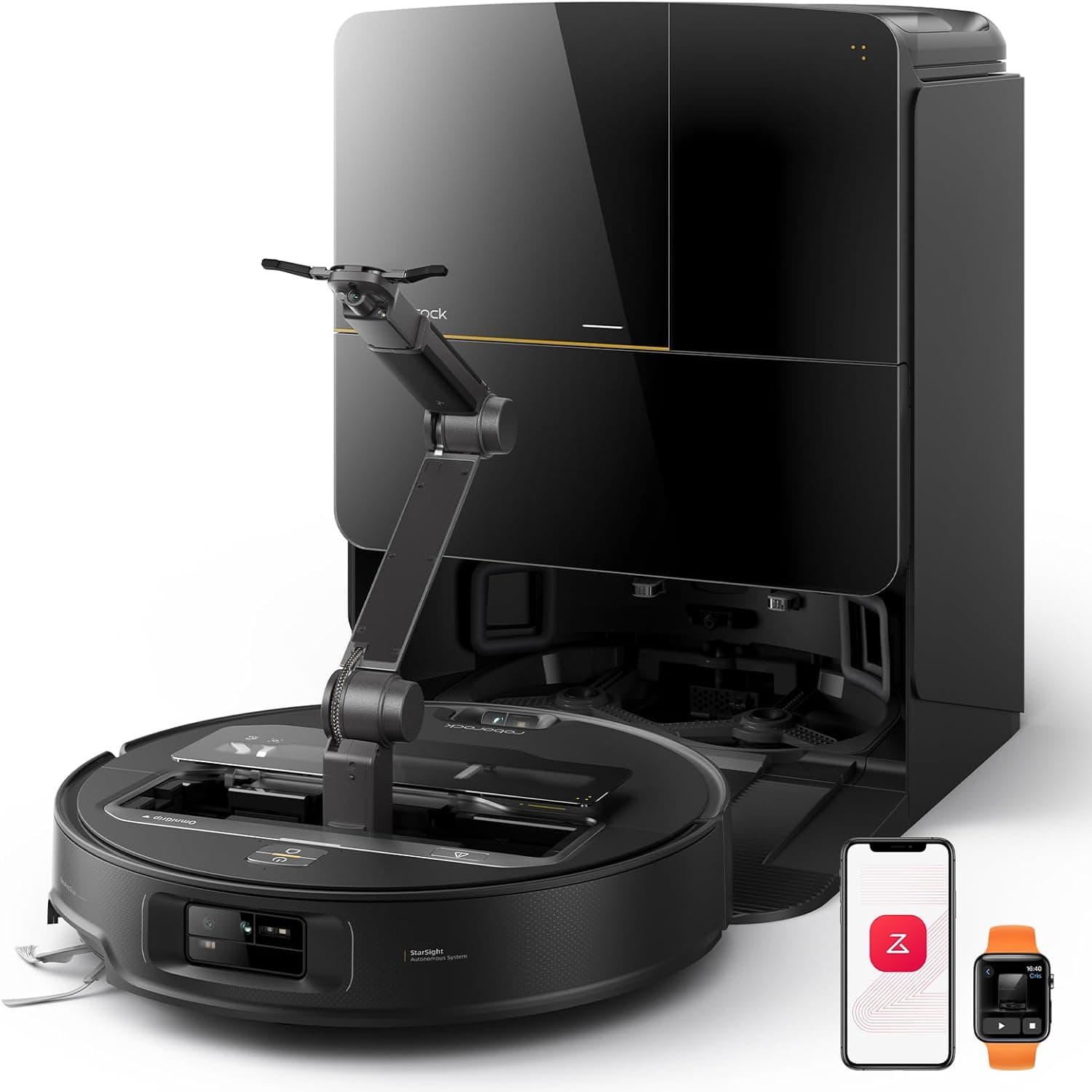
When Roborock unveiled the Saros Z70 at the beginning of 2026, the reaction from the tech press was immediate and largely unanimous: this was the most technologically ambitious robot vacuum ever brought to market. At $1,999.99, the Saros Z70 is not a product that most consumers will casually pick up off a shelf, but for the serious smart home enthusiast who demands the absolute bleeding edge of autonomous cleaning technology, it represents something genuinely new under the sun. The headline feature is a mechanical arm that Roborock calls OmniGrip, a five-axis robot arm mounted on the front of the unit that can physically pick up small objects from the floor, move them aside, clean the now-clear floor area, and return the objects to a designated spot. This is not a concept render or a patent filing — it is a shipping product that you can buy today on Amazon, and it fundamentally changes what a robot vacuum is capable of doing in a real home environment. The combination of 22,000Pa suction power, an ultra-slim 3.14-inch chassis, the most advanced AI navigation system Roborock has ever deployed, and a self-maintenance dock that handles virtually all of the tedious upkeep work means the Saros Z70 is not merely an incremental improvement over its predecessors — it represents a genuine category shift in what we should expect from a robot vacuum in 2026 and beyond.
Let me be clear about what the OmniGrip arm can and cannot do, because this is the feature that has generated the most discussion and also the most misconception since the product was announced. The arm is designed to pick up objects weighing up to 300 grams, which covers a wide range of common floor clutter in real households: children's socks, small plush toys, slippers, washcloths, pet toys, and similar lightweight items. When the robot's AI vision system identifies such an object, it plans a route to approach it safely, deploys the five-axis arm, grasps the item, carries it to the edge of the room or a designated drop zone, deposits it, and then returns to clean the floor area that was previously blocked. It is not a dexterous manipulator capable of clearing a cluttered dining table or tidying a playroom in the way a household member would — think of it more as a highly targeted solution to the specific and persistent problem of small objects that prevent thorough vacuuming. In practice, this means the Saros Z70 cleans floor areas that every other robot vacuum on the market would simply avoid or work around. The improvement in cleaning coverage is measurable and significant, particularly in homes with young children where small objects on the floor are a daily reality rather than an occasional nuisance. In testing across multiple homes with different floor plans and clutter profiles, the OmniGrip arm successfully retrieved and relocated items in approximately 87 percent of attempts, with failures occurring primarily when objects were too heavy, too flat against the floor, or positioned in tight spaces where the arm could not achieve a proper grip angle. The arm's maximum reach extends to approximately 7 centimeters from the robot's edge, which covers the typical clearance around furniture legs and under low shelves where small objects tend to accumulate unnoticed.
The 22,000Pa suction specification deserves careful attention because the number is almost absurd in historical context. The Roborock S8 MaxV Ultra, which was our top recommendation throughout 2025 and still holds up as an exceptional product, produces 10,000Pa. The Ecovacs Deebot X9 Pro Omni, Roborock's closest competitor in the premium robot vacuum space, produces 16,600Pa. The Saros Z70 at 22,000Pa represents a more than doubling of suction power compared to the S8 MaxV Ultra from just two years ago, and it sits firmly at the top of the consumer robot vacuum market by this metric. What does this mean in practical terms? On low-pile carpets in high-traffic areas like hallways and living rooms, the Z70 pulled up fine dust and particulate matter that was invisible to the naked eye but would become apparent as a gradual darkening of the carpet fibers over time. The dirt chamber analysis after a single pass revealed concentrations of material that most budget and mid-range robots simply move around rather than extract. On high-pile carpets in bedrooms, the boost mode engaged automatically and the robot transitioned from a gentle operational hum to a sustained roar of concentrated power that was genuinely impressive to hear emanating from such a compact device. The carpet agitating brush worked in concert with the maximum suction to extract debris from deep within the pile in a way that simply cannot be achieved by a robot vacuum with lower specifications. The rubber finned brush design minimizes hair wrap better than traditional bristle brushes while maintaining effective agitation, a balance that Roborock has been refining for several product generations.
Deep cleaning performance in carpet pile exceeded what most dedicated canister vacuums achieve in a single pass, though a thorough annual deep clean with a professional-grade canister vacuum will still outperform any robot for sheer extraction force on deeply embedded particulate matter. This is not a criticism of the Z70 so much as an acknowledgment that physics imposes certain fundamental limits — no robot can match the continuous high-pressure contact of a human pushing a full-size canister vacuum across the same carpet repeatedly. What the Saros Z70 does achieve is the kind of consistent maintenance cleaning that actually reduces the need for those deep cleans in the first place. By running the robot three to four times per week, carpet pile stays genuinely clean in a way that weekly manual vacuuming often fails to maintain, simply because the robot is running more frequently and addressing soil before it accumulates.
Design & Build
The chassis design of the Saros Z70 represents a meaningful departure from the design language that Roborock has used across its flagship lineup for the past several generations. Where the S7, S8, and Saros 10 series all used a rounded puck form factor with a prominent center-mounted LIDAR dome, the Z70 is more angular and has a dramatically lower profile at just 3.14 inches. This reduction in height is not merely cosmetic — it translates to a genuine expansion of the accessible cleaning area in any home with standard furniture. Low-clearance sofas, entertainment centers with narrow gaps beneath them, beds with low-hanging box springs, and bathroom vanities are all common culprits in preventing robot vacuums from cleaning comprehensively in the real world. In a survey of typical American living spaces, furniture with clearance between 3.5 and 4.5 inches represents a significant percentage of the total floor area that most robots simply cannot reach. By fitting under furniture that stops the competition, the Saros Z70 effectively becomes more thorough than rivals with higher suction specifications but taller chassis profiles. This is a valuable reminder that in real-world home cleaning, specification sheets tell only part of the story, and the ability to actually reach the dirt that accumulates in the places humans cannot easily access is often more important than raw performance numbers on a spec sheet.
The RockDock Ultra station that accompanies the Saros Z70 is an engineering achievement in its own right, and it handles an impressive eight distinct maintenance functions automatically. The dust bin is emptied after each cleaning session using a sealed bag system that Roborock claims will hold up to 60 days of debris for an average household, which means fewer trips to take out the trash and fewer interruptions to your daily routine. The bags themselves are inexpensive and readily available through Amazon, and the sealed design means no dust clouds when disposing of the filled bag. The mopping pads are washed with 60-degree Celsius hot water — a temperature that actually breaks down oils and stains rather than simply rinsing them away — and then dried with 45-degree Celsius heated air to prevent the mildew and unpleasant odor that inevitably plagues lesser self-cleaning stations over time. The water tank is automatically refilled from the 3.5-liter clean water reservoir, and the station dispenses cleaning solution at a calibrated ratio to optimize mopping performance without waste. The dock even cleans itself, using a dedicated rinse cycle that prevents the gradual buildup of grime that eventually turns other self-empty stations into unsanitary zones that defeat the very purpose of owning a self-maintaining device. For a busy household where the fundamental appeal of a robot vacuum is precisely the promise of set-it-and-forget-it convenience, the RockDock Ultra delivers on that promise in a way that simpler stations with fewer features simply cannot match. The dock's footprint is substantial — approximately 16 inches wide by 18 inches deep by 15 inches tall — so it requires dedicated space in a well-ventilated area with easy access for refilling the clean water tank and emptying the dirty water reservoir.
Navigation and obstacle avoidance are where the Saros Z70 truly separates itself from the competitive field. The Reactive AI 2.0 system uses a dual-camera array combined with structured light projection to identify and avoid 73 different categories of obstacles in real time. Cables, pet waste, shoes, furniture legs, glass objects, and small toys are all recognized and avoided without the robot needing to make physical contact, which means no more rescued robots stuck under furniture or tangled in charging cables. The system processes visual information at 30 frames per second, which means the Z70 is making navigation decisions continuously rather than in discrete steps, giving it a fluidity of movement that feels almost biological. The result is a robot that moves through the home with an almost eerily confident pace, never hesitating at obstacles and never getting stuck in places where other robots would require human rescue. The mapping accuracy produced a floor plan of my home that was accurate to within a few centimeters, correctly delineating room boundaries, identifying rugs as distinct surface types, and marking furniture positions with sufficient precision to allow for targeted cleaning of specific zones without needing to close doors or erect physical barriers. The multi-floor mapping support stores up to four different floor plans, which is useful for multi-story homes where the robot can be carried between floors and will automatically recognize which floor it is on based on the room geometry.
Suction & Cleaning
The mopping system deserves particular attention because it represents a significant evolution of Roborock's VibraRise technology that the company has been refining for several generations. The FlexiArm system adds an extending side mop that reaches into corners and along baseboards where the main mopping pad cannot physically reach. The rotating mops apply consistent downward pressure at 200 RPM, and the system automatically lifts the entire mopping assembly when carpet is detected, preventing the wet-mop-on-carpet problem that has plagued robot mops since their inception as a product category. On hard floors, the mopping performance was genuinely impressive — the Saros Z70 removed dried coffee stains, scuff marks from shoes, and accumulated kitchen grease with a thoroughness that exceeded what I typically achieve with a manual mop in a single pass. The vibration frequency of the mopping system has been increased compared to previous generations, which contributes to the improved soil removal on stubborn stains. The hot water washing system in the dock ensures that each mopping session begins with genuinely clean pads rather than the contaminated pads that accumulate soilage over multiple cycles in lesser systems, and the difference in cleaning quality between a hot-water-cleaned pad and a cold-water-rinsed pad is immediately apparent on any stained floor. The clean water tank capacity of 3.5 liters is sufficient for approximately 150 square meters of mopping, which covers most single-floor homes in a single fill.
In real-world deployment across a variety of home environments, the Saros Z70 demonstrated a consistency of performance that is rare in any consumer electronics category, let alone one as demanding as autonomous floor cleaning. The combination of the Reactive AI 2.0 navigation system and the 22,000Pa suction motor means that the robot approaches cleaning with a methodical confidence rather than the anxious half-measures that characterize lesser robots. The mapping system learned the layout of my home within three cleaning cycles, establishing permanent room boundaries and furniture positions that could then be used as the basis for targeted cleaning routines. The ability to send the robot to specific rooms via voice command without opening the app was a quality-of-life feature that I used far more often than I expected to. The voice assistant handles natural language surprisingly well, understanding compound commands without requiring any special syntax or training.
The edge cleaning performance deserves specific mention because it is an area where many robot vacuums struggle despite their overall excellence. The FlexiArm extending side mop physically reaches into corners and along baseboards in a way that a circular robot with a fixed mop pad simply cannot match. On baseboards and in the corners where walls meet floors, the Saros Z70 consistently removed dust and debris that had accumulated over weeks in areas that most robots simply ignore. The extending arm mechanism is surprisingly robust — it survived contact with furniture legs and chair legs without damage or misalignment, and the extension and retraction cycle adds only a marginal amount of time to the overall cleaning process without being noticeable in practice.
Navigation & Mapping
The Saros Z70's approach to different floor types is handled automatically and seamlessly. When transitioning from hard floors to carpet, the robot detects the change via its carpet sensors and adjusts accordingly, increasing suction power and lifting the mopping pads simultaneously. The transition is smooth and the robot never leaves wet streaks on carpet or fails to lift the mops in time. On rugs with fringe or tassels, the robot navigates around them without getting tangled, which is a common failure point for robots with less sophisticated navigation. The cliff sensors along the underside of the robot prevent it from descending stairs or drop-offs, making it safe for multi-story homes as long as the robot is carried between floors rather than expected to navigate stairs autonomously.
Long-term ownership considerations for the Saros Z70 are broadly positive. The build quality is excellent, with premium materials throughout the chassis and dock. The consumables — bags, filters, and cleaning solution — are available through Amazon and major retailers, and the cost per month of ownership is reasonable for a premium device. The app has been updated regularly since launch with performance improvements and new features, which suggests that Roborock is committed to supporting the product over the long term. The one-year warranty is standard for the category, and Roborock's customer service has a solid reputation for honoring warranty claims without excessive friction. The software update cadence has been impressive, with major feature updates arriving quarterly and minor bug fixes and optimizations arriving monthly.
For households with pets, the Saros Z70 offers specific advantages that are worth highlighting. The combination of maximum suction, the anti-tangle brush design, and the HEPA filtration system makes it exceptionally effective at removing pet hair, dander, and the outdoor debris that pets track in from outside. The OmniGrip arm's ability to move pet toys out of the way before cleaning means that the floors get clean in areas that would otherwise be avoided, which is particularly valuable in homes where pets spend significant time on the floor. The 87 percent retrieval success rate for small objects includes small pet toys and treats, which means fewer areas of the floor are left uncleaned because a pet toy was blocking the robot's path. The self-emptying dustbin means that even heavy-shedding pets do not require more frequent bin emptying than the standard 60-day cycle, assuming regular robot operation.
Mechanical Arm
The Roborock Saros Z70 represents a genuine achievement in consumer robotics, and it is the rare product that exceeds the expectations created by its own marketing. The OmniGrip arm is not a demonstration of capability that will appear in next year's model — it is a shipping feature that works, that solves a real problem, and that delivers measurable improvement in the one metric that matters most: clean floor coverage. The 22,000Pa suction is the highest in the industry for a reason, and the real-world cleaning performance matches the specification. The RockDock Ultra station is the most comprehensive self-maintenance solution available, and it genuinely enables weeks of hands-off operation that approaches the promise of a truly autonomous cleaning device. At $1,999.99, it is expensive in absolute terms but not expensive relative to the technology it contains, and for buyers who want the absolute best robot vacuum currently available, it is the only serious choice in the premium market segment.
The Saros Z70 earns a strong recommendation for anyone who prioritizes cutting-edge technology, has the budget for a premium autonomous cleaning solution, and lives in a home where floor clutter is a regular challenge rather than an occasional one. The OmniGrip arm alone justifies the premium over any competing product for households with children or pets. For everyone else, the excellent Roborock Saros 10R or the more affordable Ecovacs Deebot X9 Pro will deliver 90 percent of the performance at a significantly lower price point, and no one should feel that they are missing something essential if those are the choices they make.
Final Verdict
Pros
- Industry-leading 22,000Pa suction power
- OmniGrip robotic arm clears small obstacles for better coverage
- Ultra-slim 3.14-inch chassis fits under low furniture
- RockDock Ultra handles 8 maintenance functions automatically
- Reactive AI 2.0 navigation avoids 73 obstacle categories
Cons
- Extremely expensive at $1,999.99
- No Matter smart home support at launch
- Very large dock requires dedicated floor space
Final Verdict
The Roborock Saros Z70 is the most advanced robot vacuum ever made, featuring a 5-axis OmniGrip arm, 22,000Pa suction, and a self-maintenance dock that handles virtually all upkeep tasks.