Samsung Galaxy A17 5G Review: Best Budget Phone Gets Even Better
The Samsung Galaxy A17 5G offers a gorgeous 6.7-inch AMOLED display, reliable battery life, decent cameras, and an industry-leading six-year software commitment for just $199 — making it the best budget phone for most people despite its sluggish performance and limited RAM.
Not everyone needs a $1,000+ flagship smartphone — check our Galaxy S26 review if you want the premium experience. In fact, most people don't. The Samsung Galaxy A17 5G is designed for the vast majority of buyers who want a capable, reliable phone that covers the basics well without breaking the bank. At just $199 ($149.99 on sale during Amazon Prime Day), it offers a large 6.7-inch AMOLED display, a versatile triple-camera setup, a massive 5,000mAh battery, and something truly exceptional at this price: six years of both OS and security updates. But there are trade-offs. The Exynos 1330 processor and 4GB of RAM can feel sluggish, multitasking is frequently interrupted by aggressive memory management, and the cameras struggle in less-than-ideal lighting. After living with the Galaxy A17 5G as my daily driver, I can confidently say it's one of the best budget phones available — provided you understand its limitations and work within them.
Design and Build Quality
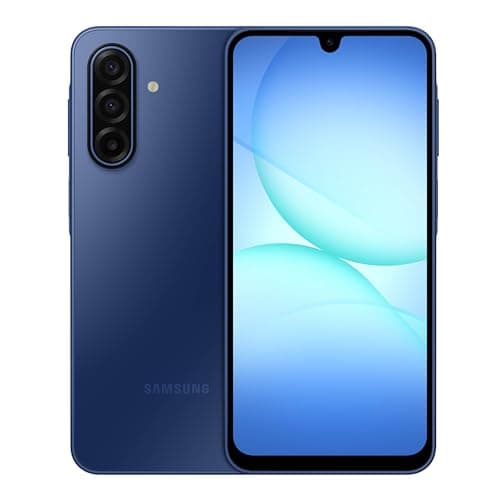
The Galaxy A17 5G adopts the design language of Samsung's more expensive Galaxy S series, and that's a good thing. The vertical oval camera housing on the back is immediately recognizable as Samsung's current aesthetic, and the clean lines give the phone a more premium look than its $200 price tag suggests. Available in Black, Blue, and Gray colorways, the phone has a matte glass fiber reinforced polymer back that resists fingerprints reasonably well and provides a comfortable grip.
At 6.47 by 3.07 by 0.3 inches and 192 grams, the A17 is not a small phone. The 6.7-inch display means you'll need two hands for comfortable operation unless you have large hands. That said, the weight distribution is balanced, and the phone never feels cumbersome in a pocket. The plastic frame keeps weight down and adds a bit of flex that helps with shock absorption during accidental drops.
The IP54 rating is a welcome addition at this price point. It means the phone is protected against splashes and dust ingress — enough to survive being used in light rain or at a dusty construction site, but not enough for submersion. Samsung has upgraded the front glass to Gorilla Glass Victus+, which is impressive for a budget device and provides excellent scratch and drop protection.
The bottom edge houses a USB-C port and the single down-firing speaker. There's no headphone jack here — Samsung removed it starting with the A16 generation, citing the growing adoption of wireless audio. While I understand the cost-saving rationale, it's a notable omission when competitors like the Moto G Power 2026 still include one. You'll need USB-C earbuds, a dongle, or Bluetooth headphones for private listening.
The right side houses the volume rocker and a power button that doubles as a fingerprint sensor. The fingerprint sensor is capacitive rather than optical, which means it's fast and reliable — I'd estimate it recognizes my thumbprint nine out of ten times on the first try. Face recognition is also available as a secondary biometric option, though it's less secure and can be fooled by a photo.
SIM tray on the left side accepts either two nano-SIM cards or one nano-SIM plus a microSD card for storage expansion up to 2TB. Having expandable storage at this price point is a major selling point, especially since internal storage is limited to 128GB. That microSD slot gives you the freedom to store thousands of photos, videos, and music files without worrying about running out of space.
Display
The 6.7-inch FHD+ Super AMOLED display is absolutely the highlight of the Galaxy A17 5G. With a resolution of 2,340 by 1,080 pixels and a pixel density of around 385 PPI, content looks sharp and detailed. Text is crisp, images are clear, and videos are immersive. The AMOLED panel delivers deep blacks and vibrant colors that make the phone feel far more expensive than it is.
The 90Hz refresh rate is a meaningful upgrade over the standard 60Hz panels found on most budget phones. Scrolling through Twitter, Instagram, and Chrome feels noticeably smoother, and while 90Hz isn't as fluid as the 120Hz or 165Hz panels found on flagship devices, the difference from 60Hz is immediately apparent. Once you've used a 90Hz display, going back to 60Hz feels sluggish and dated.
Peak brightness reaches around 800 nits, which is sufficient for outdoor use in most conditions. Direct sunlight will wash out the display somewhat, but you can still read text and see what you're doing with the brightness cranked up. This isn't the 5,000-nit panel of the Razr Ultra 2026, but at this price point, it's more than adequate.
The one visual compromise is the bezels. The Galaxy A17 has an asymmetrical bezel design with a notably thicker "chin" at the bottom — a characteristic visual cue of Samsung's budget Galaxy A series. It's not ugly, but it's a constant reminder that this isn't a premium device. The waterdrop notch at the top houses the 13MP selfie camera and is less intrusive than the dewdrop notches of previous generations.
Performance
This is where the Galaxy A17 5G reveals its budget origins. Powered by Samsung's own Exynos 1330 processor paired with 4GB of RAM, the phone handles basic tasks fine — calling, texting, social media scrolling, light web browsing — but struggles when you push it harder.
The Exynos 1330 is a modest chip built on a 5nm process. In Geekbench 6, it scores approximately 935 in single-core and 1,738 in multi-core. For comparison, the Moto G Power 2026 scores 795 and 2,107, and the Galaxy S26 Ultra scores over 10,000 in multi-core. In 3DMark Wild Life Extreme, the A17 manages 355 — barely enough for casual 3D gaming.
In day-to-day use, the phone exhibits noticeable lag in several scenarios. Swiping down the notification shade sometimes takes a full second to respond. Opening apps can present a blank white screen for a moment while content loads. Switching between apps triggers frequent reloads as the 4GB of RAM forces background apps to close. Multitasking is the biggest weakness — running Google Maps navigation while streaming music causes the music to stutter or the navigation app to crash without warning.
CNET's reviewer encountered the same issues, noting that "whenever I tried to run a navigation app on the phone at the same time as streaming music, I found that either the song had noticeable pauses and dips or the navigation app would automatically quit without any notice." Samsung's aggressive background app management is designed to preserve battery life, but it comes at the cost of usability.
There is a workaround. You can go to Settings > Memory > Excluded apps to prevent specific apps from being killed in the background. This helps with navigation and music apps, but it's a manual fix that most users won't know to look for. The RAM Plus feature, which uses part of the 128GB storage as virtual RAM, exists but doesn't meaningfully improve the multitasking experience.
For a specific type of user — someone who uses their phone for calls, texts, social media, and the occasional photo — this performance is acceptable. But if you regularly juggle multiple apps, play games, or do anything more demanding than light browsing, you'll find the Galaxy A17 frustrating.
Battery Life and Charging
The 5,000mAh battery delivers excellent endurance. In mixed usage — email, messaging, social media, about an hour of YouTube, and 30 minutes of navigation — the A17 easily lasts a full day with 30 to 40 percent remaining at bedtime. Lighter users could stretch this to two days between charges.
The phone supports 25W Super Fast Charging, which gets you from 0 to 54 percent in about 30 minutes. A full charge from empty takes approximately 1 hour and 20 minutes. That's not class-leading — the Moto G Power charges faster at 30W — but it's fast enough for overnight charging or a quick top-up before heading out.
Samsung no longer includes a charging brick in the box, so you'll need to supply your own 25W USB-PD charger. If you're upgrading from an older Samsung phone, your existing charger will work fine. If this is your first Samsung phone, budget an extra $15 to $20 for a compatible charger.
Wireless charging is not supported, which is expected at this price point. The phone also has 5W reverse charging if you have USB-C to USB-C cable — you can share power with earbuds or a smartwatch in a pinch.
Camera System
The Galaxy A17 5G features a triple rear camera setup: a 50-megapixel main sensor, a 5-megapixel ultrawide, and a 2-megapixel macro lens. The 13-megapixel front-facing camera handles selfies and video calls.
The main 50MP camera uses pixel-binning to produce 12.5-megapixel images by default, combining four pixels into one for better low-light performance. In good lighting conditions, the results are genuinely impressive for a $200 phone. Photos have accurate colors, decent detail, and acceptable dynamic range. Samsung's image processing tends toward slightly saturated colors that make food, landscapes, and people look more vibrant in social media feeds.
The 5MP ultrawide camera is where the quality drops off noticeably. Images are softer, with less detail and more noise, especially toward the edges. Colors are less consistent with the main camera — switching between the two in the same scene can produce noticeably different color temperatures. That said, having an ultrawide at all at this price point is a bonus, and it's useful for capturing group shots or landscapes where you want a wider perspective.
The 2MP macro camera is best left unused. Images are low-resolution, soft, and generally disappointing. You'll get better close-up results by using the main camera's 2x digital zoom or simply moving closer. Samsung includes a macro lens for spec sheet purposes, but it's not a feature you'll use regularly.
Low-light performance is acceptable but nothing more. The main camera's Night mode helps, requiring you to hold the phone steady for two to three seconds while it captures multiple exposures. The results are usable for social media — they'll be brighter than what your eyes see, but expect soft details and some noise. The ultrawide camera struggles in low light and is best reserved for well-lit scenes.
The 13MP selfie camera produces decent results in good lighting. Skin tones are natural, detail is acceptable, and portrait mode does a reasonable job of separating subject from background. In low light, selfies become soft and noisy. The front camera records 1080p video at 30fps, which is adequate for video calls but not impressive for vlogging.
Video recording tops out at 1080p at 30fps from the rear cameras — there's no 4K option here, which is a notable omission when even some $150 phones offer 4K recording. Stabilization is electronic rather than optical, and walking footage shows noticeable wobble.
Software and Updates
This is where the Galaxy A17 5G punches far above its weight class. The phone ships with Android 15 and Samsung's One UI 8.0, and Samsung promises six years of both OS upgrades and security patches. That means the A17 will receive updates through Android 21 and security patches through 2032.
Six years of support is unprecedented at this price point. The Moto G Play 2026 promises two years of OS upgrades and three years of security patches. The $300 Moto G Power offers similar software support to the Moto G Play. Even Google's Pixel 10a, which costs $100 more, only guarantees three years of OS updates and five years of security patches. Samsung's commitment is genuinely industry-leading and transforms the A17 from a disposable budget phone into a device that can safely serve you for half a decade or more. When you factor in the total cost of ownership — $199 divided by six years equals just over $33 per year — the A17's value proposition becomes remarkably compelling.
One UI 8.0 on Android 15 is Samsung's feature-rich skin. It includes Samsung Wallet for tap-to-pay, Samsung Health for fitness tracking, Samsung TV Plus for free live TV, and Smart View for screen mirroring to compatible TVs. The Now Bar on the lock screen shows dynamic notifications for music, timers, and navigation — a feature borrowed from the flagship Galaxy S series. Circle to Search with Google is included, letting you circle anything on screen to search for it without leaving your current app.
The phone also includes AI Cross-App Actions via Google Gemini, allowing voice commands that span multiple apps. For example, you can say, "Plan a family game night," and the AI will search for game ideas, add them to your calendar, and message your family — all with one command. While useful, this requires a Google Gemini account and an internet connection.
The main software downside is Samsung's pre-installed app suite. The phone comes with duplicate Samsung apps for almost everything — Samsung Internet vs. Chrome, Samsung Messages vs. Google Messages, Samsung Calendar vs. Google Calendar, Samsung Notes vs. Google Keep. You can hide or disable most of these, but it's an unnecessary extra step that Samsung should address. On a phone with only 4GB of RAM, having multiple redundant apps running in the background also consumes precious memory that could be better used by apps you actually need.
Camera app features include Pro mode, Night mode, Portrait mode, and Single Take. Pro mode gives you manual control over ISO, shutter speed, and white balance — a surprising inclusion at this price that photography enthusiasts will appreciate. Single Take captures a burst of photos and videos with a single press and uses AI to recommend the best shots, which can be handy for capturing action moments where you don't have time to compose perfectly.
Audio and Call Quality
The single bottom-firing speaker gets loud enough for watching YouTube videos, taking calls on speakerphone, and listening to podcasts in a quiet room. At maximum volume, audio remains relatively clear with only minor distortion on bass-heavy tracks. There's no stereo separation, so music and movies lack the spatial immersion you get from flagship phones with dual stereo speakers.
Call quality is solid. The earpiece delivers clear voice reproduction, and the microphone does an adequate job of filtering background noise during calls. Callers reported that my voice came through clearly in quiet environments, though they could hear background noise when I was walking along a busy street.
The lack of a headphone jack is the most controversial omission. The Moto G Power 2026 ($299) and Moto G Play 2026 ($179) both include headphone jacks, as do most competing budget phones. Samsung's decision to remove it was clearly a cost-saving measure, and it's a genuine inconvenience if you have wired headphones you'd like to keep using. You'll need to buy USB-C earbuds, use the included USB-C to 3.5mm adapter (if Samsung includes one — they often don't with the A series), or switch to Bluetooth headphones.
Bluetooth 5.3 is supported with basic SBC and AAC codecs. There's no aptX or LDAC support, so audiophiles with high-end wireless headphones won't get the best possible audio quality, but for the typical user with budget to mid-range Bluetooth earbuds, the audio quality is perfectly acceptable.
Comparison to Competitors
vs. Moto G Power 2026 ($299): Motorola's competitor costs $100 more and offers a larger 6.8-inch LCD with 120Hz refresh rate, 8GB of RAM, 5,200mAh battery with 30W charging, and a headphone jack. It also has an IP68/IP69 dust and water resistance rating — far superior to the A17's IP54. However, the Moto G Power uses an LCD panel rather than AMOLED, so colors and contrast aren't as good. It also trails Samsung on software support by a wide margin. If you need RAM for multitasking and a headphone jack, the Moto G Power is the better choice. If you value display quality and long-term software support, the Galaxy A17 wins.
vs. Moto G Play 2026 ($179): The G Play is $20 cheaper but makes significant compromises: a lower-resolution LCD display with 120Hz but worse colors and contrast, 4GB of RAM, 64GB of storage, and only 2+3 years of software support. The Galaxy A17's superior AMOLED display, double the storage, and vastly better software support justify the extra $20.
vs. Google Pixel 10a ($499): The Pixel 10a costs $300 more and offers a vastly superior processor, better cameras, cleaner software, and three years of OS updates with five years of security patches. But Samsung's six-year commitment actually exceeds Google's, and at less than half the price, the A17 represents better raw value for budget-conscious buyers.
vs. Samsung Galaxy A16 5G: The previous generation is still available and offers similar performance with the same 5,000mAh battery. The A17's advantages include the 90Hz display (the A16 was 60Hz), the IP54 rating (the A16 was not officially rated), Gorilla Glass Victus+ protection, and the longer six-year update commitment. If you can find the A16 at a significant discount, it's still a capable phone, but the A17's improvements are meaningful enough to warrant the price difference.
Who Should Buy the Samsung Galaxy A17 5G?
The Galaxy A17 5G is ideal for anyone who needs an affordable smartphone that covers the basics well and will stay secure and updated for years. It's perfect for:
- Students who need a reliable phone for communication, research, and social media
- Older adults who want a large, clear display and simple functionality without paying for premium features they won't use
- Parents buying a first phone for their teenager
- Budget-conscious shoppers who want maximum value for their money
- Anyone who values long-term software support and wants a phone that will receive security patches through 2032
Who Should Skip It
Skip the Galaxy A17 5G if you need to multitask regularly — the 4GB of RAM and aggressive memory management make this a single-app-at-a-time experience. Gamers should look elsewhere for better performance. And if you need a headphone jack, the Moto G series offers better connectivity.
Final Verdict
The Samsung Galaxy A17 5G is the best budget phone for most people. It delivers a gorgeous AMOLED display, dependable battery life, decent cameras for well-lit scenes, and an industry-leading six-year software commitment that no competitor in this price range can match. The compromises — sluggish performance, limited RAM, no headphone jack, and no 4K video — are real but reasonable given the price.
Samsung understands that for many buyers, a phone is a tool, not a hobby. The Galaxy A17 5G is that tool: capable, reliable, and built to last half a decade or more. Just don't expect it to keep up with power users, and you'll be very satisfied with what $200 buys you in 2026.
Pros
- Gorgeous 6.7-inch Super AMOLED display with 90Hz refresh rate
- Industry-leading 6 years of OS and security updates
- Excellent 5,000mAh battery life lasting well over a day
- Expandable storage up to 2TB via microSD
- IP54 water and dust resistance at an affordable price
Cons
- Sluggish Exynos 1330 processor struggles with multitasking
- Only 4GB of RAM leads to aggressive background app management
- No headphone jack, unlike cheaper competitors
- No 4K video recording, limited to 1080p at 30fps
Final Verdict
The Samsung Galaxy A17 5G offers a gorgeous 6.7-inch AMOLED display, reliable battery life, decent cameras, and an industry-leading six-year software commitment for just $199 — making it the best budget phone for most people despite its sluggish performance and limited RAM.