Samsung Music Studio 7 HW-LS70H Review: Where Hi-Fi Meets High Design
Samsung's Music Studio 7 delivers immersive 3.1.1 channel Dolby Atmos audio from a single beautifully designed wireless speaker with effortless setup, room calibration, and seamless Samsung TV integration — a compelling entry into home hi-fi.
Samsung has spent the better part of a decade dominating the television market and building a formidable soundbar empire that ranges from compact budget models all the way up to the flagship Q990H series that routinely tops best-of lists. But the Korean electronics giant has never seriously tackled the two-channel wireless speaker category — the space where Sonos built a billion-dollar business on the back of the Play:1, Play:3, and Play:5, where Bluesound and Denon HEOS cultivated devoted audiophile followings, and where Apple's HomePod carved out a premium niche combining Siri with surprisingly robust sound. With the Music Studio 7 (model HW-LS70H/ZA), priced at $497.99 on Amazon and $499.99 direct from Samsung, that changes dramatically. This is not a souped-up soundbar accessory or a glorified smart speaker with Samsung branding. The Music Studio 7 is Samsung's opening salvo in the home hi-fi wars, and it arrives with specifications and design ambitions that immediately distinguish it from the generic wireless speaker crowd.
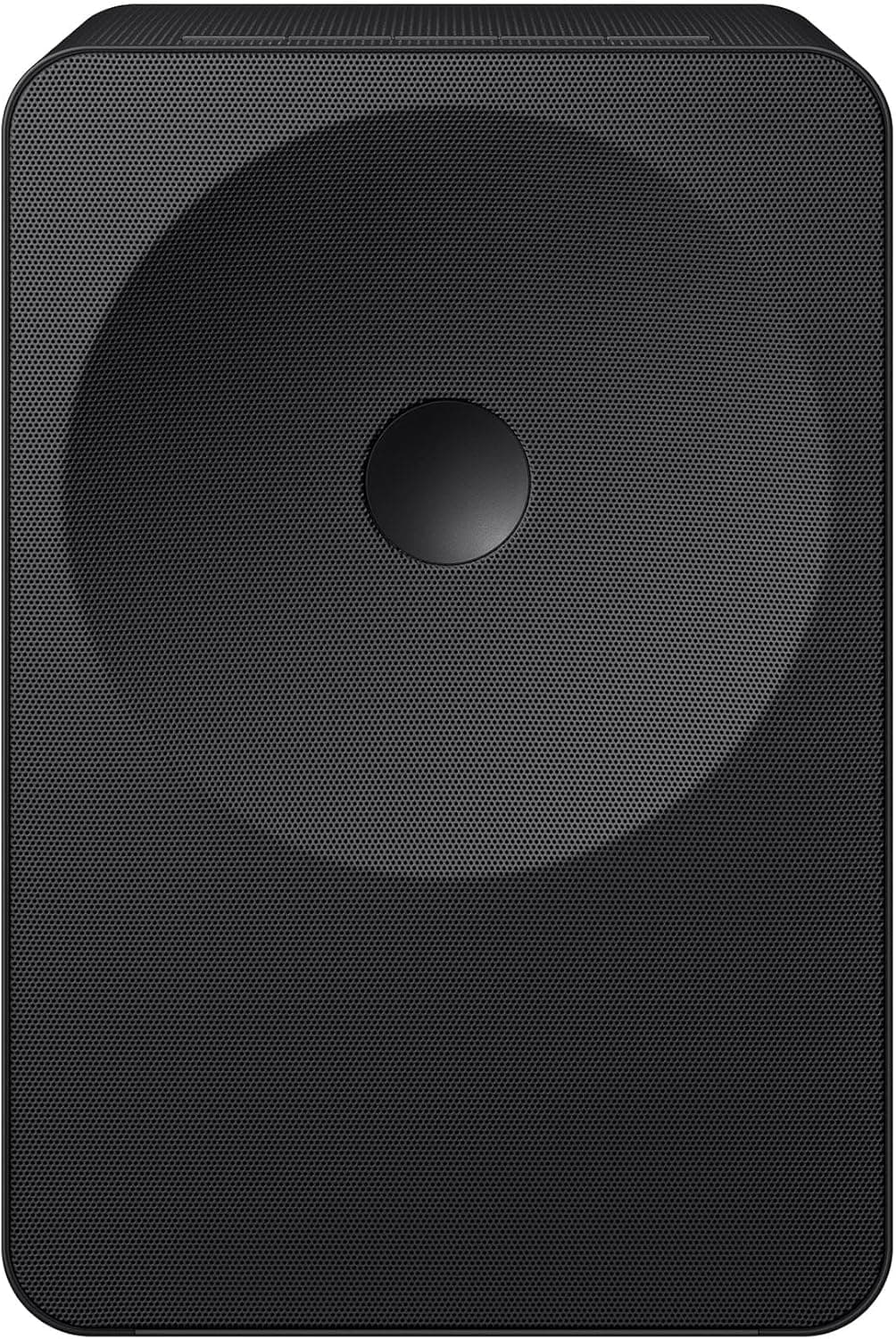
The first thing you notice about the Music Studio 7 is its design, and that is precisely the point. Samsung collaborated with renowned French designer Erwan Bouroullec on what the company calls its "Dot Design" language, and the result is a speaker that looks nothing like its competitors. Where Sonos speakers are dark monolithic cylinders and Apple's HomePod is a fabric-clothed orb, the Music Studio 7 is a rectangular monolith that looks like a piece of modern sculpture. Measuring 7.28 inches wide by 10.59 inches tall by 7.5 inches deep and weighing 12.35 pounds, the LS70H has enough heft to feel substantial without being unwieldy, and its charcoal black fabric mesh exterior gives it the appearance of something that belongs in a high-end furniture showroom rather than an electronics store. The front face is dominated by a large, shallow circular waveguide — a concave depression that houses a smaller central tweeter dome at its exact center — that serves as both an acoustic engineering feature and a dramatic visual focal point. This waveguide is not just an aesthetic flourish; it is a purpose-built design element that helps disperse sound evenly across a room, and it gives the speaker a distinctive visual identity that photographs well and looks even better in person. The top edge of the speaker houses subtle touch-sensitive controls for volume adjustment and a microphone mute button, all seamlessly integrated into the surface so they are invisible when not in use.
The contrast with its sibling, the Music Studio 5 ($299.99), is instructive. The smaller model adopts a circular motif that is arguably more striking visually, weighing just 5.29 pounds at dimensions of 9.88 by 11.18 by 5.39 inches. Both speakers share the Bouroullec "dot" design language, but they express it differently — the Studio 7 is rectilinear and authoritative, while the Studio 5 is circular and approachable. Your preference between the two will likely come down to whether your decor favors sharp angles or soft curves. What both models share is an immediacy of purpose: these speakers are designed to be seen, not hidden away on a shelf or mounted flush to a wall. They are conversation pieces that also happen to deliver serious audio performance.
Under the fabric mesh, the Music Studio 7 packs a 3.1.1 channel configuration — left, center, and right drivers plus a built-in subwoofer and an up-firing height driver for Dolby Atmos content. That hardware arrangement is remarkable for a standalone wireless speaker the size of a large hardcover book. Most speakers in this form factor offer simple stereo playback at best; Samsung is promising immersive, spatially separated audio from a single enclosure, and that is a bold claim that requires serious acoustic engineering to deliver credibly. The front-firing left, center, and right drivers handle the soundstage width and vocal clarity, while the integrated subwoofer provides low-frequency extension that eliminates the need for a separate sub unit. The up-firing height driver bounces Atmos audio off the ceiling to create a sense of verticality — you can hear rain coming from above, helicopters passing overhead, and the spatial positioning cues that make Dolby Atmos content feel more immersive than standard surround sound. Pattern Control Technology, a Samsung-exclusive algorithm, manages signal overlap between the multiple channels, ensuring that dialogue does not get buried under sound effects and that quiet details remain audible during dynamic movie scenes. In practice, this means you can sit slightly off-center and still hear clear, well-separated audio rather than a muddy wall of sound — a significant advantage for real-world living rooms where the primary seating position is rarely perfectly centered on the speaker.
Design & Build
Dolby Atmos is the headline feature, and Samsung has implemented it in a way that removes one of the biggest barriers to Atmos adoption: the cable. The Music Studio 7 supports Wireless Dolby Atmos over Wi-Fi when paired with a compatible Samsung TV, which means you can get height-channel audio without running an HDMI cable across your living room or drilling holes in your wall. If you prefer a wired connection — and for the lowest latency and highest bandwidth, you should — the Music Studio 7 includes an HDMI eARC port with HDMI CEC support, plus an optical input for older TVs. The eARC connection is the preferred route for home theater use because it supports lossless Dolby TrueHD and multichannel PCM, while the optical connection is limited to compressed Dolby Digital Plus. It is worth noting that the less expensive Music Studio 5 ($299.99) lacks both the HDMI eARC connection and the physical up-firing driver, offering only virtualized Atmos instead. The gap between the two models is significant enough that anyone serious about home theater should opt for the 7 — the virtualized Atmos on the 5 is a reasonable approximation, but it cannot replicate the genuine height channels that the 7 provides.
The Samsung Sound app serves as the command center for all connected audio devices, and it represents one of the areas where Samsung's relative inexperience in the multi-room speaker category shows. The app is functional but occasionally frustrating. You can create custom audio groups for multi-room playback, adjust a five-band equalizer, switch between sound modes, and manage firmware updates. The app also handles SpaceFit Sound Pro, a room calibration system that uses built-in microphones on the speaker to analyze your room's acoustics and automatically adjust the audio profile. The calibration process takes roughly two minutes — you walk the speaker around your room while it maps reflective surfaces, distances, and absorption characteristics — and the resulting sound is noticeably improved. Bass that might otherwise boom in a corner placement tightens up, and the soundstage expands beyond what you would expect from a single box. You can re-run calibration anytime, and the system even supports daily automatic recalibration if you prefer a set-and-forget approach. The app's main weakness is its occasional sluggishness and the fact that some advanced settings are buried under too many sub-menus. If you have used the Sonos app, you will find Samsung's offering less intuitive, though it covers all the essential functions competently.
AI Dynamic Bass Control is another Samsung-exclusive technology that monitors low-frequency output in real time and adjusts the subwoofer response to prevent distortion and diffusion. This is the kind of feature that sounds like marketing jargon until you hear it in action. Anyone who has pushed a compact wireless speaker to fill a large room and heard the bass turn to mush — the low end becoming a formless rumble that muddies the entire mix — will appreciate what Dynamic Bass Control does. During testing with bass-heavy tracks like Massive Attack's "Angel" and Hans Zimmer's "Why So Serious?" from The Dark Knight soundtrack, the Music Studio 7 maintained tight, controlled low end even at volumes that would cause most speakers its size to distort. The bass does not plumb the depths of a dedicated subwoofer — that is physically impossible from a driver this size — but it delivers enough low-frequency energy to make action movie soundtracks and electronic music convincing without sounding bloated or one-note. The Active Voice Amplifier Pro feature works in concert with the bass control, analyzing ambient noise in your room and boosting dialogue frequencies to ensure voices remain intelligible even when background sound effects are intense.
Audio Quality
Movie performance is where the Music Studio 7 truly earns its keep, and it is worth discussing in detail because this is ultimately why most people will consider buying one. I tested it with the action film "The Old Guard," a movie known for its complex sound mixing with overlapping dialogue, gunfire, vehicle sounds, and atmospheric effects. The results were impressive across multiple scenarios. Dialogue remained crystal clear even during the most chaotic action sequences — Charlize Theron's lines never got lost beneath explosions and shell casings, which is a persistent problem with lesser speakers that let midrange frequencies get swallowed by low-frequency effects. The Pattern Control Technology proved its worth here, with each audio element occupying its own space in the soundstage and no audio bleed between channels. Quiet details like the crunch of footsteps on gravel and the soft bleating of goats in a rural scene came through with surprising clarity. Positional audio from the up-firing Atmos driver added genuine height information during overhead helicopter sequences, although the effect is more subtle than what you would get from a dedicated soundbar with discrete height speakers mounted on a wall. Wireless Dolby Atmos via Wi-Fi worked flawlessly with a Samsung S95D OLED, with no perceivable latency or dropouts during multi-hour viewing sessions — an impressive technical achievement given the bandwidth demands of lossless Atmos audio.
Music performance is equally accomplished, and the Music Studio 7's acoustic signature reveals itself as warm, balanced, and forgiving — characteristics that make it an excellent casual listening companion even if it will not replace a dedicated pair of bookshelf speakers for critical listening. I fed the speaker a diet of lossless tracks from Spotify Connect and local FLAC files, spanning genres from jazz to electronic to classical with a few pop and rock recordings thrown in for good measure. Van Morrison's "Moondance" delivered warm, articulate piano with a naturalistic timbre that preserved the tinkling trills at the top of the keyboard register. The bass guitar strumming was clearly defined rather than the muddy blur that lesser speakers produce, and Morrison's vocal sat naturally in the mix with the right amount of presence without being pushed forward artificially. Santana's "Europa (Earth's Cry Heaven's Smile)" showcased another strength — the speaker's ability to separate instruments without creating an artificial sense of distance. Santana's guitar was prominently featured without overwhelming the organ, bass, or synthesized strings. Cymbal hits had brass and texture, and the snare, kick, and hi-hat each occupied a distinct position in the soundstage. Switching to more demanding material, Bruno Mars' "24K Magic" delivered the kind of punchy, bass-forward sound that makes you want to turn up the volume, with the bass synths providing a solid foundation and Mars' falsetto remaining clear and present.
Off-axis listening also held up well, which is an underappreciated quality in a living room speaker. Moving to a seated position roughly 30 degrees from the center of the speaker resulted in a modest reduction in stereo width but no loss of clarity or coherence, thanks to the waveguide technology that disperses sound broadly across a listening area rather than beaming it in a narrow cone. This means that when you have friends over for a movie night, the person sitting on the far end of the couch is not getting a dramatically inferior experience compared to the person in the sweet spot — a real problem with many speakers that use traditional direct-firing driver arrays. High-resolution audio support extends to 24-bit/96kHz for streaming content, which covers the vast majority of high-quality streaming services including Amazon Music Ultra HD, Apple Music Lossless, and Tidal HiFi. Local FLAC files played through the Samsung Sound app or via AirPlay 2 sounded detailed and engaging, with the Music Studio 7 resolving more microdetail than I expected from a single-box wireless speaker at this price.
Smart Features
Q-Symphony is Samsung's ecosystem integration feature, and it is potentially the most compelling reason for existing Samsung TV owners to choose the Music Studio 7 over a competitor. When connected to a compatible Samsung television — which includes all 2022 and newer models above the entry-level Crystal UHD range — the speaker works in concert with the TV's built-in speakers and up to four additional Samsung audio devices. In a home theater configuration, you can use two Music Studio 7 speakers as rear channels alongside a Samsung soundbar, creating an immersive surround setup without running speaker wire across your room. The feature is remarkably easy to set up — the Sound app detects compatible devices automatically and walks you through placement — and the audio handoff between devices is seamless, with no perceivable delay between the front, center, and rear channels. If you pair two Music Studio 7 speakers in a stereo configuration, the soundstage widens dramatically, and you get genuine left-right separation that approaches what a pair of traditional bookshelf speakers would deliver. The combination of Q-Symphony and wireless multi-speaker configuration is genuinely impressive in practice, transforming a living room into a credible home theater with minimal effort and no cable management nightmares.
The connectivity options are comprehensive for a modern streaming-oriented speaker. You get Wi-Fi (both 2.4 and 5 GHz bands for maximum stability), Bluetooth 6, Google Cast, AirPlay 2, and Spotify Connect via a dedicated button on the top of the speaker. Roon Ready support is listed as coming soon, which will make the Music Studio 7 even more attractive to the serious music collector crowd once it arrives. Alexa, Google Assistant, and Bixby voice assistants are all built in, giving you flexibility regardless of which smart home platform you prefer. I tested Alexa integration extensively, and it responded reliably to voice commands from across a medium-sized room for music playback, volume adjustment, and smart home control. The one area where connectivity falls short is the absence of analog inputs — there is no 3.5mm auxiliary jack, no phono input for turntables, and no USB audio port. This is strictly a digital, streaming-first device, which will frustrate anyone with a turntable, vintage receiver, or high-end DAC that relies on analog connections. Samsung's decision to omit analog inputs is consistent with their streaming-first philosophy but limits the speaker's versatility compared to competitors like the Sonos Five, which includes a 3.5mm line-in.
The supported audio format list is extensive but not universal. You get Dolby Atmos, Dolby TrueHD, Dolby Digital Plus, Dolby 5.1ch, MP3, AAC, OGG, FLAC, WAV, ALAC, and AIFF. Noticeably absent is any DTS support — DTS:X, DTS 5.1ch, and DTS-HD are all missing, which is a significant omission for anyone with a Blu-ray collection that uses DTS encoding. Samsung has been steadily reducing DTS support across its product line in favor of Dolby formats, and this continues that trend. Eclipsa Audio, the open immersive audio format co-developed by Samsung and Google, is also supported, making the Music Studio 7 one of the few speakers that can decode spatial audio from YouTube content. Sound modes include Adaptive Sound, which automatically analyzes content and adjusts the equalizer in real time, Night Mode for late viewing at reduced volumes without waking the house, Voice Enhance Mode for boosting dialogue intelligibility, and a standard Stereo mode for purists who want an unprocessed signal.
Connectivity
Multi-room audio capabilities are robust and well-implemented. You can connect up to ten Music Studio speakers throughout your home for synchronized playback, or group up to five in a single room for a home theater configuration. Stereo pairing of two Music Studio 7 speakers is supported and produces a genuinely wide soundstage that rivals a traditional bookshelf speaker pair at twice the price. The Samsung Sound app makes grouping and ungrouping speakers intuitive, and switching between multi-room playback and home theater mode takes just a few taps. I tested multi-room synchronization between a Music Studio 7 in the living room and a Music Studio 5 in the bedroom, and audio delay between the two speakers was imperceptible — a critical quality for whole-home listening that some competitors still struggle with.
Priced at $497.99, the Music Studio 7 enters a market where the Sonos Era 300 ($449) and Era 100 ($249), the Apple HomePod ($299), and the Bluesound Pulse 2i ($749) all compete for attention. Against the Sonos Era 300, the Music Studio 7 offers a more powerful low-end response and built-in Dolby Atmos with a physical up-firing driver, but the Sonos ecosystem is more mature and offers broader third-party integration with services like Roon and voice platforms. Against the Apple HomePod, Samsung delivers dramatically superior spatial audio and multi-room flexibility, though HomePod users get tighter Apple ecosystem integration and superior Siri voice assistant performance. The real question is whether Samsung can convince people outside its TV ecosystem to adopt this speaker as a standalone product, because the Music Studio 7 is genuinely excellent on its own merits — it does not need Q-Symphony to justify its price tag, even though Q-Symphony makes it significantly more valuable for Samsung TV owners. The Bouroullec design alone sets it apart in a market where most speakers look either anonymous or actively ugly, and the sound quality backs up the visual promise with genuinely immersive audio that punches well above its physical size.
The limitations are worth acknowledging clearly. The lack of analog inputs means vinyl enthusiasts and vintage audio collectors need not apply. The absence of DTS support will frustrate Blu-ray collectors. The Samsung Sound app, while functional, is not as polished as the Sonos app, and it occasionally suffers from slow device discovery and inconsistent volume synchronization across multi-speaker groups. The price of $497.99 is steep for a single speaker, and building a full home theater configuration with multiple units quickly escalates into four-figure territory. But the Music Studio 7 is not asking you to build a multi-room system — it is asking you to evaluate a single speaker that delivers immersive, room-filling audio from an enclosure that looks like it was designed by someone who cares about how your living room looks, not just how it sounds.
Setup & App
The Samsung Music Studio 7 is a statement product in every sense of the word. It declares that Samsung takes home audio seriously, that wireless speakers can look like design objects rather than afterthoughts, and that a single-box solution can deliver immersive theater-quality sound without a tangled nest of cables and receivers. The warm, balanced audio signature, the effortless Dolby Atmos integration, the thoughtful room calibration, and the genuinely distinctive Bouroullec design all add up to one of the most compelling wireless speakers released this year. The lack of analog inputs and DTS support are real limitations that will exclude certain buyers, and the price tag demands consideration before committing. But for anyone who values audio quality, cares about how their speakers look in their living space, and wants something that works the moment they plug it in without spending a weekend on calibration, the Samsung Music Studio 7 delivers an experience that feels worth every penny — and for Samsung TV owners, the Q-Symphony integration makes it an even easier recommendation.
Final Verdict
Pros
- Striking Bouroullec Dot Design blends into modern home decor
- Genuine Dolby Atmos with physical up-firing height driver
- 3.1.1 channel configuration from a single compact enclosure
- SpaceFit Sound Pro auto-calibrates to your room acoustics
- Excellent Q-Symphony integration with Samsung TVs
Cons
- No analog inputs limits versatility for vinyl and legacy equipment
- No DTS or DTS:X support for Blu-ray collectors
- Samsung Sound app less polished than Sonos competitor
- Steep price for a single speaker at $497.99
- Room calibration requires manual re-run after moving the speaker
Final Verdict
Samsung's Music Studio 7 delivers immersive 3.1.1 channel Dolby Atmos audio from a single beautifully designed wireless speaker with effortless setup, room calibration, and seamless Samsung TV integration — a compelling entry into home hi-fi.