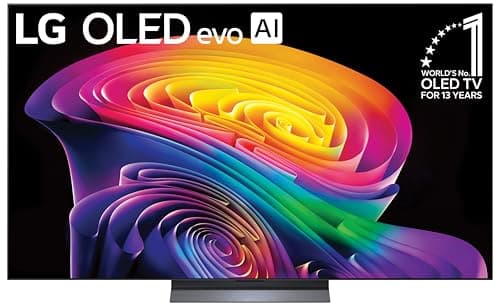
Samsung S95H OLED TV Review: The Brightest OLED Gets a Bold New Look
The Samsung S95H OLED TV delivers the highest brightness ever measured on an OLED, a best-in-class Glare Free screen, and exceptional gaming performance, though HDR color accuracy and the premium price give reason to pause.
The Samsung S95H is the brightest OLED TV Samsung has ever made, and after spending time with the 65-inch model, it is clear that Samsung is aiming for something bigger than just another flagship refresh. The S95H is the first OLED TV to support the Samsung Art Store, the first to come with an optional Wireless One Connect box, and the first to use Samsung's new FloatLayer design language. It is also the first OLED TV I have tested that hits over 2,700 nits of peak brightness in its brightest mode, which puts it in striking distance of the best Mini LED sets while maintaining the perfect blacks and infinite contrast that OLED is famous for. That combination of OLED quality and near-Mini-LED brightness is impressive on paper, but the real question is whether the S95H delivers where it matters most: real-world picture quality, gaming performance, and everyday usability. The short answer is yes, mostly, with a few important caveats that make this a more nuanced recommendation than a simple "best TV of 2026" crown.
FloatLayer Design and Build Quality
The most immediately noticeable thing about the S95H is its design. Samsung calls it FloatLayer — a beveled metal frame that surrounds the screen, giving the TV the appearance of a floating picture frame when wall-mounted. The frame is a substantial departure from the nearly bezel-less designs Samsung has favored in recent years. The metal has a brushed silver finish that catches light in a way that feels premium rather than flashy. The frame varies slightly by size — the 55-inch and 65-inch models have a thinner frame profile, while the 77-inch and 83-inch versions use a slightly wider bezel that better matches their larger proportions.
The tradeoff is thickness. The S95H measures about an inch deep, which is noticeably thicker than last year's S95F (about 0.4 inches). That extra depth comes from Samsung relocating the One Connect box circuitry into the TV chassis itself. The reasoning is that the optional wireless One Connect box handles input switching wirelessly, so there is less need for a separate breakout box. Whether that tradeoff works for you depends on your setup. If you plan to wall-mount the TV in a media room where you want a flush fit, the extra thickness might bother you. If you are placing it on a stand, you will barely notice. For canvas-style wall mounting where the TV sits against the wall like a picture frame, the FloatLayer design actually enhances the effect.
The back of the TV features PlayStation-style ventilation slits that run across the upper half, with the lower section containing the connection panel. The vents are necessary — this TV generates significant heat, especially in its brightest modes — but they are also well-integrated into the design. The stand is a flat metal plate with a brushed finish that provides stable support without being overly wide. The stand does not swivel, which is a minor annoyance if you need to adjust the viewing angle frequently.
The included solar-powered remote is wafer-thin and feels good in the hand. It has dedicated buttons for Netflix, Prime Video, Samsung TV Plus, and Disney Plus. The remote charges from any light source — I tested by leaving it on a windowsill for a few hours, and it went from empty to fully charged. The remote also has a small LED that indicates charging status. My only complaint is that there is no dedicated input button — you have to navigate to "Connected Devices" in the menu to switch inputs, which is one extra step that becomes annoying over time. You can add input switching to the quick settings panel, but it should be a dedicated button out of the box.
Samsung Vision AI and Smart Features
The S95H is powered by Samsung's NQ4 AI Gen3 processor, the same chip found in last year's flagships. That is not a criticism — the Gen3 processor was already excellent, and it handles everything the S95H demands without breaking a sweat. The processor drives 128 neural networks that handle upscaling, motion enhancement, HDR tone mapping, and audio processing in real time.
The new Tizen interface has been redesigned for 2026, and it is a significant improvement over previous versions. The home screen is cleaner, with content recommendations arranged in a logical grid rather than the cluttered wall of tiles that Tizen was known for. App launching is snappy, and switching between inputs feels instant. The built-in storage allows for installing all major streaming apps without running out of space, and the processor ensures smooth scrolling even with the app grid fully loaded.
The Samsung Vision AI features include 4K AI Upscaling Pro, which does a remarkable job with 1080p and 720p content. I tested with standard cable TV and older YouTube videos, and the upscaling was consistently impressive — adding detail and sharpness without introducing the over-processed look that plagues lesser upscaling engines. AI Motion Enhancer Pro handles motion smoothly, handling both 24fps film content and 60fps sports without introducing the soap opera effect. The AI Customization feature is interesting: the TV asks you to rate a series of images based on your preferences, then builds a custom picture profile that matches your taste. It is not a replacement for professional calibration, but it is a thoughtful feature for people who want a personalized picture without hiring a calibrator.
The standout software feature, however, is the Samsung Art Store support. The S95H is the first OLED TV to offer this, and Samsung has implemented pixel-shifting and automatic refresh cycles to prevent burn-in when displaying static artwork. I tested by leaving a high-contrast art image on the screen for several hours, and I saw no retention whatsoever. The Art Store offers over 5,000 pieces from institutions like the Metropolitan Museum of Art, the Museo del Prado, and the Louvre. That said, the implementation is more manual than The Frame TV — there is no Ambient Mode that automatically activates when the TV is off. You have to manually launch the Art Mode, which undermines the "always-on gallery" vision that makes The Frame so compelling. If displaying art is your primary reason for buying this TV, The Frame Pro is a better choice and costs significantly less.
Picture Quality and Brightness
The S95H uses Samsung's new QD-OLED Penta Tandem panel technology, which Samsung claims is 30 percent brighter than last year's S95F. In testing, that claim holds up. The 65-inch model I tested peaked at 2,712 nits in Standard mode (10 percent window) and 2,636 nits in its accurate picture mode. Those numbers are extraordinary for an OLED TV. For comparison, the LG G5 peaked at 2,813 nits in its brightest mode but dropped to 2,297 nits in accurate mode, while the LG G6 managed 2,511 and 2,232 nits respectively. Full-screen brightness measured 251 nits, which is solid for an OLED and sufficient for bright living rooms.
What this means in practice is that the S95H handles HDR content with authority. Explosions in action movies pop with intensity that OLEDs simply could not reach a generation ago. Sunlight glinting off metal surfaces in Dune: Part Two looked brilliantly realistic. The S95H's brightness advantage is most visible in mixed-content scenes where bright highlights sit next to dark shadows — the TV preserves detail in both extremes without the blooming or haloing that plagues Mini LED TVs. I tested with the 4K HDR transfer of Mad Max: Fury Road, and the combination of desert sunlight, fire explosions, and deep shadows was rendered with a dynamic range that genuinely impressed me.
The Glare Free screen is genuinely excellent. Samsung has been refining its anti-glare technology for years, and the S95H represents the best implementation yet. I tested the TV in a room with bright overhead lights and windows on two walls, and reflections were dramatically reduced compared to standard glossy OLED screens. The tradeoff is that blacks appear slightly gray in bright rooms — the LG G6 preserves deeper blacks in these conditions — but in a dark room, the S95H's blacks are perfect, inky, and infinite. The viewing angles are also excellent, with no green shift when viewed from the side, which is a problem that plagues some competing OLEDs.
The Filmmaker Mode is well-calibrated out of the box, with a color gamut that covers 99.9 percent of DCI-P3 and 88.4 percent of BT.2020. Those are reference-grade numbers. However, there is a quirk: the TV automatically adjusts brightness in Filmmaker Mode based on ambient light. If you care about consistent picture quality, you need to turn this off by navigating to Settings, Power and Energy Saving, and Brightness Optimization. It is an easy fix, but it is annoying that the default behavior changes the image while you are watching. Once corrected, the Filmmaker Mode is excellent, with accurate gamma tracking and natural-looking image processing.
HDR Color Accuracy
The S95H's biggest weakness is HDR color accuracy. CNET's testing revealed ColorMatch errors of 17.38 and average Color Checker errors of 12.83 — both significantly higher than the ideal threshold of 3. In practical terms, this means oranges can appear slightly yellow, and reds look somewhat desaturated compared to reference monitors. The issue is most noticeable in content with natural skin tones and vibrant primary colors. Watching a nature documentary with bright tropical fish and coral reefs, I noticed that the reds lacked the punch I have seen on the LG G5 and Sony A95L.
This is a genuine disappointment for a flagship TV at this price. The LG G5, G6, and even Samsung's own S90H all deliver better HDR color accuracy. The S95H's SDR color accuracy is fine — it measures around 1.75 on the Color Checker, which is solid — but the HDR color processing needs improvement. Samsung has historically prioritized brightness over color accuracy in its brightest picture modes, and the S95H continues that trend.
That said, the color accuracy issue is most apparent in side-by-side comparisons and to trained eyes. Most viewers watching normal content will notice that the picture looks punchy and vibrant rather than inaccurate. The color gamut coverage is excellent, so the TV can display a wide range of colors — it just maps them slightly off in HDR. Samsung could potentially improve this with a firmware update, but as of this review, it is a limitation you should be aware of. For SDR content like cable TV and streaming, the colors are accurate and pleasing. The issue is confined to HDR mode, which matters most for Blu-ray and 4K streaming content.
Gaming Performance
Gaming is where the S95H truly shines. The input lag measured 9.33ms at 4K and 9.73ms at 4K HDR, which is among the best results for any TV. The 4K 165Hz support via HDMI 2.1 means this TV is future-proofed for high-refresh-rate gaming on PC and next-generation consoles. All four HDMI ports support 4K 165Hz, VRR, ALLM, and FreeSync Premium Pro. This is a meaningful advantage over the LG G5 and G6, which have two HDMI 2.1 ports running at 144Hz.
I tested with a PlayStation 5 and a high-end gaming PC, and the experience was outstanding. The combination of low input lag, high brightness, and perfect blacks makes games look and feel incredible. In Cyberpunk 2077, the neon-lit streets of Night City had a vibrancy that I have not seen on any other TV. In Call of Duty, the responsive controls and clear motion handling gave me a genuine competitive advantage. The 165Hz support on PC was buttery smooth, and the TV handled frame rate fluctuations without tearing thanks to the VRR support.
The Gaming Hub interface provides quick access to Xbox Cloud Gaming, Nvidia GeForce Now, and other streaming services directly from the TV without needing a console. Cloud gaming performance depends on your internet connection, but streamed games looked great on the S95H's panel, with the low input lag keeping the experience responsive.
The only gaming-related criticism is that Game Mode's default colors can be lurid and oversaturated. You can calibrate via the Game Mode Settings menu, and I recommend taking the time to do so. Once calibrated, the gaming experience is exceptional and arguably the best available on any TV in 2026.
Audio Performance
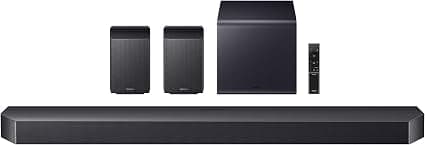
The S95H's 4.2.2-channel, 70-watt speaker system is better than most built-in TV audio but still not a replacement for a dedicated sound system. The Object Tracking Sound Plus (OTS+) feature creates a convincing sense of spatial audio, with sound that seems to follow objects moving across the screen. Dialogue clarity is excellent thanks to the Active Voice Amplifier, which dynamically boosts speech when background noise increases. The TV also supports Adaptive Sound Pro, which analyzes the content and adjusts the audio profile in real time.
The TV supports Q-Symphony, which lets you combine the TV speakers with a compatible Samsung soundbar for a wider soundstage. This works well with Samsung's high-end soundbars like the HW-Q990F and creates a cohesive audio experience that exceeds what either component can deliver alone.
For everyday viewing — news, talk shows, sitcoms — the built-in speakers are sufficient. For movies and gaming, you will want a soundbar or home theater system. The S95H supports Dolby Atmos passthrough via HDMI eARC, so you can connect a high-end audio system without losing quality. The lack of Dolby Atmos decoding in the TV itself (it passes through rather than decoding) is a minor limitation, but anyone serious enough to care about Atmos will have an external audio system anyway.
Connectivity and Wireless One Connect
The S95H comes with four HDMI 2.1 ports, three USB-A ports, one USB-C port, optical audio output, Ethernet, and a cable/antenna input. The HDMI ports all support 4K 165Hz, VRR, ALLM, and eARC. That is an excellent port configuration that covers every possible use case. The USB-C port can handle up to 65W power delivery, which is useful for connecting devices that need charging.
The optional Wireless One Connect Box adds another four HDMI 2.1 ports wirelessly, bringing the total to eight HDMI inputs. The wireless connection supports 4K 165Hz with no perceptible latency penalty. The box works within about 30 feet of the TV and can be hidden in a cabinet or behind furniture, making it an excellent solution for clean installations. At $499.99, it is expensive, but for anyone building a media room where cable management matters, it is worth considering. The box supports HDMI-CEC, so you can control all connected devices with a single remote.
Wireless connectivity includes Wi-Fi 6E and Bluetooth 5.3. The Wi-Fi 6E support ensures fast, reliable streaming even in congested networks, and Bluetooth 5.3 provides stable connections for headphones and peripherals.
Comparison to Competitors
The S95H's main competitors in 2026 are the LG G5 and LG G6. The LG G5 offers similar picture quality for about $1,000 less. The LG G6 has better color accuracy and preserves deeper blacks in bright rooms, but the S95H has better motion handling, lower input lag, and a much better anti-reflective screen. Against last year's S95F, the S95H offers meaningful brightness improvements and the Art Store support, but the S95F can now be found at significant discounts. If you do not care about the FloatLayer design or the Art Store, the S95F is a better value.
The Samsung S90H, the step-down model, offers a Glare Free screen but significantly lower brightness (around 1,483 nits peak) and a simpler design. It is a solid option for anyone who wants OLED quality without the flagship price. The Sony Bravia 8 II is another competitor with excellent picture processing and color accuracy, but it has lower peak brightness and fewer HDMI 2.1 ports. The TCL QM8K and Hisense U8QG offer better value in terms of price-to-performance but use Mini LED technology with blooming artifacts that cannot match OLED's pixel-level contrast.
The Verdict
The Samsung S95H is an excellent OLED TV that pushes the technology forward in meaningful ways. The brightness is genuinely impressive, the Glare Free screen is best-in-class, and the gaming performance is among the best I have tested. The FloatLayer design is a bold aesthetic choice that will appeal to anyone who treats their TV as a design object. The Wireless One Connect Box is a genuinely useful innovation for clean installations. And the Art Store support opens up new possibilities for OLED as a living-room centerpiece beyond just watching content.
The drawbacks are real, though. The HDR color accuracy needs improvement at this price point. The lack of Dolby Vision support remains a disadvantage compared to LG and Sony. The Filmmaker Mode brightness adjustment quirk is annoying. And the price premium over the LG G5 is difficult to justify when the G5 delivers similar brightness with better color accuracy for significantly less money. If you are a gamer who wants the best OLED for gaming, the S95H is an easy recommendation. If you are a movie enthusiast who cares about color accuracy above all else, the LG G6 or Sony Bravia 8 II might be better choices. If you want a TV that looks beautiful on your wall and delivers an art gallery experience, the S95H is compelling but imperfect.
The S95H is a fantastic TV that makes some deliberate tradeoffs. Whether those tradeoffs work for you depends on what you value most in a television. But there is no question that it moves the OLED conversation forward, and that alone makes it worth considering for anyone shopping for a premium TV in 2026.
The S95H represents Samsung's most ambitious OLED TV to date, packing flagship brightness, gaming features, and a bold new design into a package that makes a statement in any room. The Art Store support, Glare Free screen, and Wireless One Connect compatibility are genuinely innovative features that move the OLED category forward. The HDR color accuracy issues and the high price compared to the LG G5 are real considerations, but for gamers and anyone who prioritizes brightness and anti-glare performance above all else, the S95H delivers an experience that no other TV can match.
Pros
- Exceptional peak brightness over 2,700 nits
- Best-in-class Glare Free anti-reflective screen
- Excellent gaming performance with 4K 165Hz support
- Wireless One Connect compatibility for clean installations
- Samsung Art Store support on OLED for the first time
Cons
- HDR color accuracy needs improvement at this price
- Expensive compared to LG G5 which offers similar quality
- No Dolby Vision support
- Filmmaker Mode auto-brightness quirk must be disabled
Final Verdict
The Samsung S95H OLED TV delivers the highest brightness ever measured on an OLED, a best-in-class Glare Free screen, and exceptional gaming performance, though HDR color accuracy and the premium price give reason to pause.