Shokz OpenFit Pro Review: Open-Ear Earbuds That Refuse to Compromise
Shokz's OpenFit Pro brings SuperBoost drivers, AI call clarity, and wireless charging to the open-ear format, delivering premium audio without sacrificing environmental awareness.
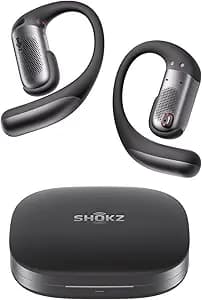
The open-ear earbuds category has matured rapidly over the past two years, moving from a niche curiosity for runners to a legitimate alternative for anyone who wants music without isolation. Shokz has been at the forefront of this shift, first with bone-conduction headphones and later with air-conduction open-ear buds that hover outside the ear canal. The OpenFit Pro represents the company's most ambitious attempt yet to bridge the gap between open-ear awareness and premium audio performance. With noise reduction technology, Dolby Atmos support, and a redesigned driver architecture, these earbuds ask a provocative question: can you have immersive sound without sealing yourself off from the world?
After several weeks of using the OpenFit Pro across workouts, commutes, video calls, and casual listening sessions, the answer is complicated but ultimately promising. These are not the best-sounding earbuds you can buy for two hundred and fifty dollars; a pair of noise-isolating in-ear monitors or premium over-ear headphones will deliver deeper bass and more precise imaging. But the OpenFit Pro occupies a unique position in the market. They offer a level of audio quality that was unthinkable in open-ear designs just a generation ago, combined with the situational awareness that makes them safer and more socially acceptable than sealed alternatives. For the right user, that trade-off is not just acceptable; it is preferable.
Design and Fit: A Refined Ear-Hook Architecture
The OpenFit Pro retains the ear-hook form factor that Shokz introduced with the original OpenFit, but nearly every detail has been refined. The hooks are slightly thinner and more flexible, coated in a soft-touch silicone that grips the ear without creating pressure points. At roughly nine grams per bud, they are lightweight enough that I often forgot I was wearing them during long listening sessions. The weight distribution is clever; most of the mass sits behind the ear, which keeps the front section, where the driver hovers near the canal opening, stable and well-positioned.
Shokz includes the buds and a wireless charging case in the box, along with a USB-C cable and the usual paperwork. There are no silicone tips because these do not go in your ear. Instead, the driver sits just outside the canal, directing sound inward using what Shokz calls DirectPitch technology. Getting a secure fit takes a moment of experimentation; you hook the bud over the back of your ear and then rotate it until the driver aligns with your canal opening. Once positioned correctly, the grip is remarkably secure. I wore them during a vigorous five-kilometer run, a cycling session, and a full-body gym workout, and they never shifted or required readjustment.
The case itself is a notable upgrade over the standard OpenFit. It supports wireless charging, which is a convenience I did not realize I wanted until I had it. Dropping the case on a Qi pad at the end of the day is easier than fumbling for a cable, and the matte finish resists fingerprints better than the glossy plastic cases that dominate the category. The case is IP55 rated, which means it will survive sweat and light rain but should not be submerged. For most users, that is sufficient protection for gym bags and jacket pockets.
Color options are black and white, both understated and professional. I tested the black variant, which has a subtle texture that hides scratches well. The white version looks strikingly clean out of the box but will likely show discoloration over time if you use them heavily during sweaty workouts.
SuperBoost Drivers and the Science of Open-Ear Bass
The heart of the OpenFit Pro is an 11 by 20 millimeter synchronized dual-diaphragm driver that Shokz has branded SuperBoost technology. The engineering goal is ambitious: deliver frequency response up to 40 kilohertz while minimizing distortion below 100 hertz, all without the acoustic seal that traditional earbuds rely on for low-end impact. Bass frequencies are the hardest part of the audio spectrum to reproduce in an open-ear design because low wavelengths leak out into the environment rather than being channeled into the ear canal.
Shokz's solution is a combination of large driver surface area, precise acoustic aiming, and digital signal processing that boosts low frequencies without creating the boomy, one-note thump that cheap bass-enhancement algorithms produce. The result is bass that is present and articulate, if not skull-rattling. Listening to "Billie Jean" by Michael Jackson, the iconic kick drum has punch and definition, though it lacks the sub-bass rumble you would feel from a sealed in-ear design. Electronic tracks like those by Justice or The Chemical Brothers fare well, with the mid-bass energy coming through clearly. For genres that depend on deep sub-bass, like modern hip-hop or cinematic scores, the OpenFit Pro reveals its limitations.
Where the drivers truly excel is in the midrange and treble. Vocals sound natural and forward, with enough detail to pick up subtle breaths and studio effects. Acoustic instruments, particularly guitars and pianos, have a warmth and texture that rivals much more expensive sealed earbuds. The treble extension is impressive for an open design; cymbal crashes and high-hats have air and shimmer without becoming harsh or sibilant. At maximum volume, I did notice some physical vibration from the drivers during bass-heavy passages, which created a faint tickling sensation against my ear. It was not painful, but it was occasionally distracting enough that I turned the volume down a notch.
OpenEar Noise Reduction: Managing Expectations
Shokz markets the OpenFit Pro as its first earbuds with noise reduction, but it is important to understand exactly what that means. These do not have active noise cancellation in the traditional sense. There are no microphones analyzing ambient sound and generating inverse waveforms to cancel it out. Instead, Shokz uses a combination of directional microphone arrays and digital processing to reduce environmental noise during phone calls, not during music playback.
For calls, the system works well. I made several video calls and voice calls in noisy environments, including a busy street corner and a coffee shop with espresso machines roaring in the background, and callers reported that my voice came through clearly with minimal background intrusion. The AI-powered voice clarity processing identifies your voice pattern and prioritizes it over ambient sound, which is a clever use of machine learning in a consumer audio product.
For music listening, the noise reduction is essentially nonexistent. Because the ear canal remains open, you hear everything around you: traffic, conversations, keyboard clatter, wind noise. This is by design, and for many users, it is the primary reason to choose open-ear buds. But if you are hoping to block out a crying baby on a plane or the drone of a subway car, these are not the right tool. The standard AirPods Pro or Sony WF-1000XM6 will provide vastly superior isolation. The OpenFit Pro is for situations where awareness is an asset, not a liability.
Dolby Atmos and Spatial Audio
The inclusion of Dolby Atmos support is an interesting choice for open-ear earbuds, and the results are mixed but occasionally magical. In optimal conditions, a quiet room with the volume turned up, spatial audio tracks have a genuine sense of width and depth. The soundstage expands beyond the physical boundaries of the earbuds, creating an immersive bubble that is surprising given the open design. Watching a film with Atmos mixing on my iPad, I could hear positional effects move around my head in a way that felt convincingly three-dimensional.
The catch is that environmental noise quickly erodes the effect. In anything louder than a quiet office, the spatial cues get drowned out by ambient sound, and the Atmos processing becomes indistinguishable from standard stereo. Shokz seems to recognize this limitation, as the companion app lets you toggle spatial audio on and off and adjust the intensity. I found myself leaving it on for home listening and turning it off for outdoor use, where the processing could not overcome the acoustic competition.
The Shokz companion app also provides a basic equalizer with several presets, including a bass boost mode that I found slightly overzealous and a vocal clarity mode that worked well for podcasts and audiobooks. There is no custom parametric EQ, which is a minor disappointment for audio tweakers, but the presets cover most use cases adequately.
Bluetooth 6.1, Multipoint, and Battery Life
The OpenFit Pro uses Bluetooth 6.1, which brings incremental improvements in connection stability and power efficiency rather than dramatic new features. In practice, the connection was rock solid across my testing. I walked around my apartment, leaving my phone in one room, and the audio never stuttered or dropped until I was two rooms away with walls in between. Multipoint pairing is supported, allowing the buds to connect to two devices simultaneously. This is a genuine productivity boon; I kept them paired to my laptop and phone, seamlessly switching between a video call on the computer and a music stream on the phone without manual reconnection.
Battery life is excellent. Shokz claims up to 11 hours of continuous playback per charge, with the case providing enough additional juice for a total of 50 hours. My real-world testing landed close to those figures. At sixty percent volume with spatial audio enabled, I got about 10 hours of mixed music and calls before the buds needed a recharge. The case added roughly four full recharges, which meant I only needed to plug in the case once every five or six days. Fast charging provides around 90 minutes of playback from a 10-minute charge, which is handy when you forget to charge overnight.
The wireless charging case is a meaningful quality-of-life improvement. I keep a Qi pad on my nightstand, and simply dropping the case on it before bed became an effortless habit. The LED indicator on the front of the case gives a rough battery status at a glance, though I wish it offered more granular feedback than the simple three-color system. A digital percentage readout would be a welcome addition in a future revision.
Call Quality and Microphone Performance
The microphone array on the OpenFit Pro is one of its hidden strengths. Each bud houses multiple microphones positioned to capture your voice while rejecting ambient noise. Combined with the AI noise reduction algorithm, the result is call quality that rivals much more expensive business headsets. In my testing, callers consistently rated the OpenFit Pro higher than my AirPods Pro 2 for voice clarity in noisy environments.
The open-ear design has an interesting side benefit for calls: because you can hear your own voice naturally, you do not suffer from the occlusion effect that makes you shout when wearing sealed earbuds. I found myself speaking at a normal volume even in loud environments, which made me more pleasant to be around in public spaces. For anyone who takes frequent calls on the go, this is a subtle but significant advantage.
Fitness and Outdoor Use Cases
This is where the OpenFit Pro truly shines. Traditional earbuds, even those with secure wing tips, can shift during intense exercise, and sealed designs create a disconcerting vacuum effect when you sweat. The ear-hook design of the OpenFit Pro eliminates both problems. During my running and cycling tests, the buds stayed locked in place, and the open-ear design meant I could hear approaching cars, cyclist bells, and other runners without sacrificing my music.
The IP55 rating provides reasonable protection against sweat and light rain, though I would not take them into a pool or wear them in a downpour. After particularly sweaty sessions, I rinsed the buds gently under tap water and let them air dry, with no adverse effects. The moisture resistance is sufficient for all but the most extreme outdoor conditions.
One minor gripe for gym use is the lack of a dedicated fitness tracking integration. Unlike the Amazfit Active 3 or Apple Watch ecosystem, the OpenFit Pro does not feed workout data into any health platform. This is a pure audio device, which is fine, but in a market where earbuds increasingly double as biometric sensors, it feels like a missed opportunity.
The Evolution of Open-Ear Audio
To understand why the OpenFit Pro matters, it helps to look at how open-ear audio has evolved. Shokz built its reputation on bone conduction, a technology that transmits sound through vibrations in your cheekbones, bypassing the eardrum entirely. The advantage was total environmental awareness, but the sound quality was always thin and lacking in bass. Air conduction, the approach used in the OpenFit line, uses traditional drivers positioned near the ear canal. It delivers fuller sound but requires careful acoustic engineering to direct sound inward while minimizing leakage.
The OpenFit Pro represents the third generation of Shokz's air-conduction work, and the cumulative improvements are substantial. The original OpenFit proved that open-ear earbuds could sound decent. The OpenFit 2 added slightly better drivers and improved water resistance. The OpenFit Pro brings SuperBoost technology, wireless charging, and AI call processing to a form factor that was already well-resolved. It is the product of a company that has iterated rapidly and learned from each generation.
Competitors are catching up, but none have matched the combination of fit security, battery life, and call quality that Shokz has achieved. Sony's OpenDots One comes closest on sound quality but falls short on comfort during extended wear. Bose's Ultra Open Earbuds are more stylish but less stable during exercise. The OpenFit Pro sits at the intersection of these trade-offs, offering the best overall package for users who need a single pair of earbuds that can handle workouts, commutes, and conference calls.
Comparison to Competitors
The open-ear category has become crowded in 2026. Sony's OpenDots One offers a similar ear-hook design with slightly better bass response but inferior call quality and no wireless charging case. Bose's Ultra Open Earbuds take a completely different approach, using a clip-on design that attaches to the outer ear rather than hooking behind it. The Bose sounds richer in the low end but is less secure during exercise and lacks the multipoint connectivity that the OpenFit Pro offers.
Nothing's Ear (a) Open provides a stylish alternative with transparent housings and solid sound, but the battery life falls short at roughly six hours per charge, and the open-ear positioning is less precise than Shokz's DirectPitch system. For pure sound quality in an open design, the Cleer ARC 4 Plus is worth considering, though it is bulkier, more expensive, and lacks the refined app experience that Shokz has built.
Against all of these, the OpenFit Pro wins on the strength of its balanced feature set. It is not the best in any single category, but it is competitive across all of them: good sound, great calls, excellent battery, secure fit, wireless charging, and multipoint pairing. That versatility is rare in a market where most products excel in one area and falter in others.
Who Should Buy the Shokz OpenFit Pro?
These earbuds are not for everyone. If you commute on loud subways, fly frequently, or work in noisy open offices, you will be better served by a pair of true active noise-cancelling earbuds like the Sony WF-1000XM6 or the Samsung Galaxy Buds4 Pro. The isolation those products provide is essential for focus in high-decibel environments, and the OpenFit Pro cannot replicate it.
However, if your daily routine involves outdoor exercise, cycling, walking in urban environments, or working from home where you need to hear children or doorbells, the OpenFit Pro is an excellent choice. The situational awareness is not a compromise; it is the entire point. You get music, podcasts, and calls with audio quality that is genuinely enjoyable, while maintaining the auditory connection to your surroundings that keeps you safe and socially present.
For remote workers who spend hours on video calls, the combination of all-day comfort, excellent microphone quality, and the ability to hear your own voice naturally makes the OpenFit Pro a surprisingly effective office tool. I wore them for a full eight-hour workday and experienced none of the ear fatigue or occlusion discomfort that sealed earbuds produce after a few hours. The only adjustment I needed to make was keeping my voice at a conversational level rather than the elevated volume I had unconsciously adopted with sealed buds.
Verdict: A Mature Open-Ear Flagship
The Shokz OpenFit Pro is the most polished product the company has ever made. It refines the ear-hook design, introduces meaningful audio upgrades through the SuperBoost driver architecture, and adds conveniences like wireless charging and multipoint pairing that were missing from earlier generations. The noise reduction for calls is genuinely useful, and the Dolby Atmos support adds a layer of immersion for home listening that exceeds expectations for an open-ear product.
That said, the fundamental limitations of the open-ear format remain. Bass will never match sealed designs, environmental noise is always present, and the fit requires a bit more fiddling than popping a standard earbud into your canal. Shokz has done an admirable job mitigating these trade-offs, but they cannot eliminate them entirely. The question is whether those limitations matter for your specific use cases, and for a surprisingly large number of people, they simply do not.
At two hundred and fifty dollars, the OpenFit Pro is priced as a premium product, and it mostly earns that positioning. The build quality, battery life, and call performance justify the cost for the target audience. If you have been curious about open-ear audio but found earlier attempts too compromised, the OpenFit Pro is the product that makes the category credible. It will not replace your noise-cancelling earbuds for every scenario, but it will earn a permanent place in your rotation for the moments when awareness matters as much as audio quality. For runners, cyclists, remote workers, and anyone who values staying connected to their environment while enjoying great sound, the Shokz OpenFit Pro is the open-ear flagship that finally delivers on the promise. It is a specialized tool that happens to be versatile enough for daily life, and that combination makes it one of the most interesting audio products of 2026.
Pros
- SuperBoost dual-diaphragm drivers deliver impressive open-ear bass
- Secure ear-hook design stays locked during intense exercise
- Excellent 11-hour battery life with wireless charging case
- AI-powered call clarity outperforms competitors in noisy environments
- Multipoint Bluetooth 6.1 connects two devices simultaneously
Cons
- Open design means no isolation from environmental noise
- Bass cannot match sealed in-ear or over-ear alternatives
Final Verdict
Shokz's OpenFit Pro brings SuperBoost drivers, AI call clarity, and wireless charging to the open-ear format, delivering premium audio without sacrificing environmental awareness.