Sony LinkBuds Clip WF-LC900 Review: Open-Ear Audio With Real Compromises
The Sony LinkBuds Clip offer innovative open-ear clip design with excellent battery life and call quality, but inconsistent touch controls, missing features, and audio trade-offs make them best suited for users who prioritize situational awareness above all else.
Sony's earbud lineup has undergone a fascinating transformation over the past few years. The original LinkBuds introduced a donut-shaped open-ear design that turned heads and divided opinions in equal measure. The concept was always intriguing — audio that keeps you connected to the world around you rather than sealing you off from it — but the execution had flaws. Some people loved the freedom of hearing everything around them while listening to music; others found the ring-shaped driver produced thin, unsatisfying sound and the fit was unreliable. Sony then released the LinkBuds Open (WF-L900O), which moved to a more traditional earbud shape with an open-ear driver, but that design still left room for improvement in fit security and overall sound quality. With the LinkBuds Clip (model WF-LC900), Sony has abandoned the ring driver concept entirely and adopted a clip-on form factor that wraps around the outside of your ear, and it represents a dramatically different approach to the open-ear category that has quickly become one of the most contested segments in personal audio.
At $228 on Amazon, the LinkBuds Clip enter a competitive space that currently includes Bose's Ultra Open Earbuds, the Shokz OpenDots One, and Anker's AeroClip, among others. Each of these products takes a slightly different approach to the open-ear concept — Bose uses a bean-shaped ear hook, Shokz relies on bone conduction, and Anker has its own clip mechanism — and Sony's entry brings the company's considerable audio engineering resources to bear on a form factor that is still finding its footing. After spending extensive time with the LinkBuds Clip across commuting, office work, exercise sessions, and casual listening at home, I have a thorough understanding of where these earbuds succeed, where they fall short, and who they are really built for.
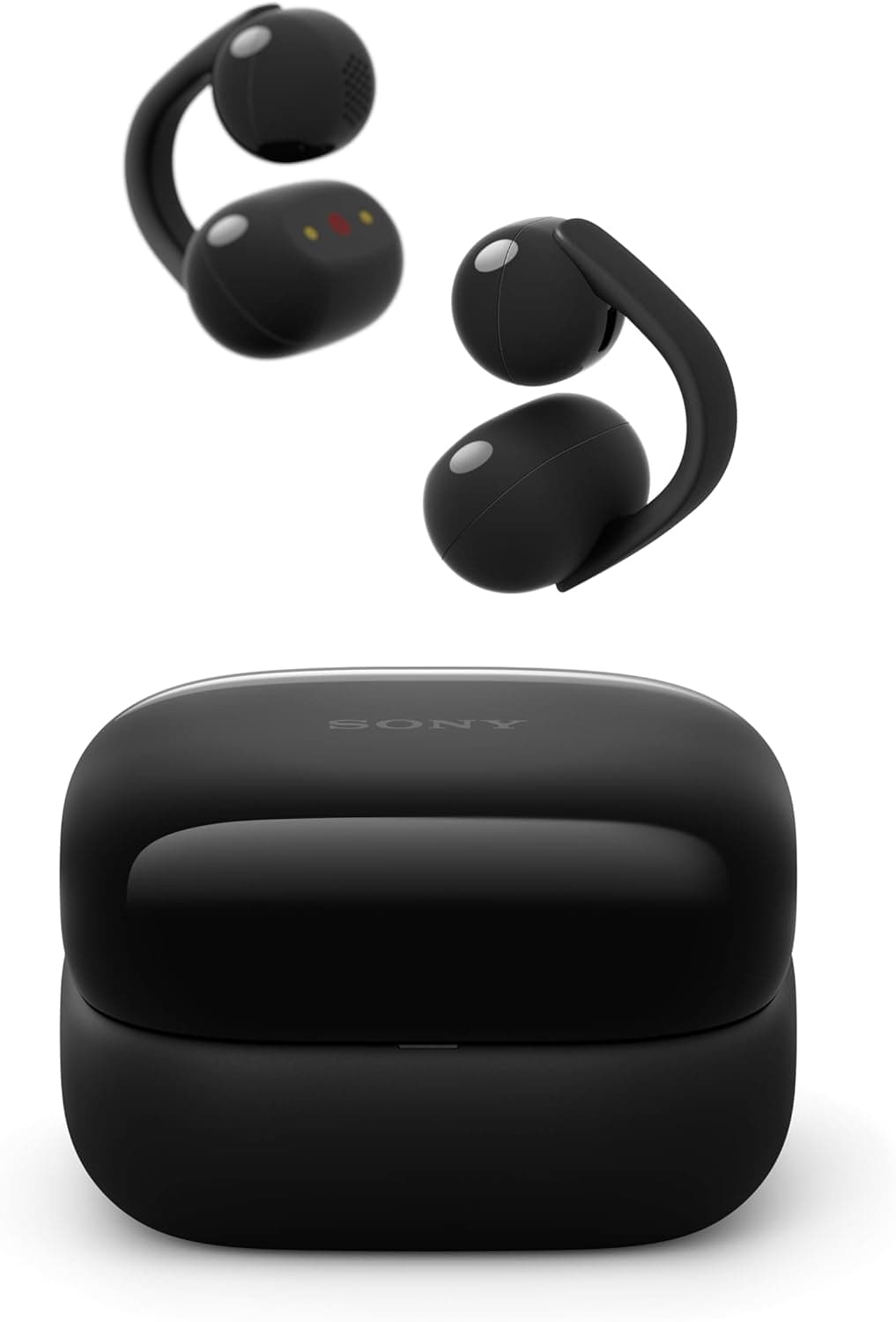
The design of the LinkBuds Clip is genuinely unlike anything else on the market, and it is worth taking the time to understand exactly how it works because the form factor is the defining characteristic of this product. Each earbud consists of two rounded modules connected by a flexible silicone band — the larger module houses the battery while the smaller unit contains a 10mm driver. The wearing process involves slipping the smaller driver piece into the outer ear opening, just resting on the concha rather than inserting it into the ear canal, and then clipping the larger battery module behind the upper ear, with the band wrapping around the helix. It sounds complicated in writing, but in practice the clipping motion becomes second nature after a few attempts, similar to learning to put on a clip-on earring or adjusting glasses for the first time. Sony includes Air Fitting Cushions in the box — small silicone adapters that snap onto the driver module to accommodate smaller ears — and I strongly recommend experimenting with them because fit dramatically affects both comfort and sound quality. Without the right cushions, the earbuds may wobble slightly, which degrades bass response and makes the touch controls more difficult to activate.
The earbuds themselves come in four color options: black, greige (a warm gray-beige that photographs beautifully and looks more premium than you might expect), green, and lavender. The matte finish on the black model I tested looks understated and professional, while the greige and lavender options add personality that helps these unconventional-looking earbuds feel less like medical devices and more like intentional fashion accessories. Sony even offers customizable case covers and Air Fitting Cushions in multiple colors, allowing you to mix and match for a more personalized look — a smart move that acknowledges the reality that open-ear clip earbuds are visible on your ears and should look good, not just function well. The overall build quality is excellent, with tight seams, consistent finish quality, and a premium feel that befits the price point. There is no creaking or flexing when you handle the earbuds, and the silicone band has enough flex to accommodate different ear sizes without feeling flimsy.
Design & Fit
Comfort is one area where opinions diverge sharply depending on who you ask and what kind of ears they have. In my testing, I found the LinkBuds Clip surprisingly comfortable for extended wear, to the point where I would sometimes forget they were on my ears entirely during long work sessions that lasted four or five hours. The lightweight construction — each earbud weighs just a few grams and feels nearly weightless — contributes significantly to this sense of forgettability. During brisk walks and even light jogging, the clip mechanism held the earbuds firmly in place without any wobbling or loosening, which is something that cannot be said for all open-ear designs. However, other reviewers whose opinions I respect have reported discomfort and even pain after about an hour of continuous use, with the clip mechanism pinching the ear carticle in a way that becomes increasingly bothersome over time. This appears to be highly dependent on individual ear shape and size, so your mileage may vary considerably. If you have larger or more pronounced ears, the fit may be more comfortable; those with smaller ears may find the clip exerts too much pressure even with the included cushions. The ear hook design also has a practical advantage over traditional earbuds with hook-style attachments: the LinkBuds Clip does not interfere with eyeglasses at all, which is a genuine benefit for the many people who wear corrective lenses or sunglasses while exercising. This is not a trivial point — many ear buds with over-ear hooks create pressure points where the hook meets the glasses temple, and the Clip's behind-the-ear design sidesteps this issue entirely.
The charging case deserves its own careful discussion because it represents one of the product's more polarizing design elements. Sony went with a rounded, pebble-shaped design that looks sleek on a desk but feels chunky in the pocket — significantly larger than the cases for the WF-1000XM6, AirPods Pro, or even the Bose Ultra Open Earbuds. The matte black finish matches the earbuds, and the Sony logo is subtly embossed on the lid in a light grey that does not draw attention. Inside, the earbuds snap magnetically into their wells, though the orientation is not immediately intuitive and takes practice to get right quickly — you need to position each earbud with the driver module facing up and the battery module facing down into a curved well that matches its shape. The case charges via USB-C, which is standard, but there is no wireless charging support — a frustrating omission for a product at this price point when competitors like Bose's Ultra Open Earbuds and even budget options from Anker include Qi wireless charging. The case lid opens with a satisfying snap but lacks the buttery-smooth hinge action of Apple's AirPods case, and there is no LED indicator on the exterior to show remaining battery at a glance.
Battery life is one of the LinkBuds Clip's strongest attributes and a clear competitive advantage. You get up to 9 hours of continuous playback from the earbuds alone, and the case provides an additional 28 hours, totaling 37 hours of total listening time. That figure puts the Clip well ahead of most open-ear competitors, including the Bose Ultra Open Earbuds which tap out at around 8.5 hours per charge with a case that provides roughly 19 additional hours. Quick charging is also well-implemented — just three minutes plugged in gives you approximately one hour of playback, which is a genuine lifesaver when you realize your earbuds are dead as you walk out the door. However, there is an important caveat that Sony does not prominently advertise: enabling the DSEE (Digital Sound Enhancement Engine) upscaling feature, which restores high-frequency detail lost to audio compression on streaming services, reduces battery life to approximately 6 hours per charge. That is a significant 33% reduction, and it forces you to choose between battery longevity and audio quality in a way that feels unnecessarily punitive.
Audio Quality
Sound quality on open-ear earbuds is always going to be a compromise compared to in-ear or over-ear designs, and the LinkBuds Clip is no exception. The fundamental physics of an open-ear design — where the driver sits outside the ear canal and sound must travel through air to reach your eardrum — means that bass frequencies will always be weaker and overall volume will always be lower than what a sealed earbud can deliver. The 10mm driver produces sound that is reasonably detailed in the midrange and treble frequencies, with crisp vocals and clear instrument separation that exceeded my expectations for an open-ear design. I was pleasantly surprised by the sound staging — I could pinpoint where different instruments were positioned in a mix, which is unusual for this product category. Acoustic guitar recordings benefited from this spatial clarity, with each string pluck registering distinctly and the resonance of the guitar body coming through with more warmth than I anticipated. Vocal-forward music — podcasts, audiobooks, and singer-songwriter tracks — sounds particularly strong on the Clip,making it an excellent choice for spoken-word listening during long commutes or work hours.
However, the bass response is the most obvious casualty of the open-ear approach, and it is the single biggest reason these earbuds will not satisfy every listener. Sub-bass frequencies are nearly absent; Daft Punk's "Doin' It Right" loses its signature low-end rumble entirely, rendering the electronic track flat and lifeless compared to how it sounds on even budget sealed earbuds. Hip-hop and EDM are similarly ill-served, with kick drums and bass synth lines feeling more like suggestions than impacts. The mids fare considerably better — acoustic guitars, vocals, and piano all come through with a clarity and presence that makes mid-centric music genres like jazz, folk, and classical quite enjoyable. Norah Jones' sultry alto on "Come Away With Me" sounded natural and intimate, with the piano accompaniment providing sufficient harmonic foundation even without the sub-bass backbone that sealed earbuds would deliver. The treble can be problematic, however. At higher volumes, high frequencies become piercing and fatiguing, with cymbal crashes and sibilant vocals taking on an almost painful edge. Bo Burnham's "All Eyes On Me" became genuinely uncomfortable during louder passages due to the digitally-altered vocals overwhelming the already-weak sub-bass foundation.
Sony offers three listening modes to help manage these sonic trade-offs, and understanding how they work is essential to getting acceptable performance from the Clip. Standard mode delivers the baseline open-ear experience with full ambient awareness, DSEE support, and equalizer customization. This is the mode you will want for outdoor activities where situational awareness is paramount. Voice Boost mode amplifies midrange frequencies and increases overall volume while simultaneously engaging some noise reduction, making it the most listenable mode for most scenarios. In fact, Voice Boost became my default mode for nearly all listening situations because it is the only mode that produces any perceptible bass response, using digital processing to fill in the low-frequency gaps that the open-ear design cannot physically deliver. Sound Leakage Reduction mode attempts to minimize the sound that escapes from the earbuds to people around you, but it achieves this by compressing the audio and reducing overall volume, resulting in a distinctly degraded listening experience that sounds muffled and dynamically flat. Evan Call's "Evolution of Magic," a piece with sweeping orchestral dynamics that should soar and plunge, sounded like it had been squeezed through a narrow pipe when played in Sound Leakage Reduction mode. I cannot recommend Sound Leakage Reduction mode for anything beyond quiet office use, and even then the audio quality degradation is hard to accept for a product at this price.
Open-Ear Performance
The Sony Sound Connect app is one of the more capable companion apps in this product category, though it has some frustrating limitations. It offers granular equalizer adjustment with a five-band EQ, the ability to select between listening modes, firmware updates, and the aforementioned Find My Equalizer feature that creates a personalized sound profile based on your ear shape. The app also supports scene-based listening — you can configure different EQ profiles and modes for different contexts like the office, commuting, or exercise, and the app will automatically switch between them. The interface is generally intuitive, though some reviewers have found the menu structure cluttered with a confusing number of sub-menus burying important features beneath layers of taps. Multipoint connectivity is supported, allowing simultaneous connection to two Bluetooth devices with automatic switching — play music on your laptop and seamlessly transition to a phone call, then back again. The Bluetooth specification is 5.3, which should provide solid range and stability, though in practice I experienced occasional connectivity issues that undermine the otherwise strong feature set. The case's pairing button was unreliable in my testing, sometimes failing to enter pairing mode at all, and the LED indicator blinked orange for an extended period of over 48 hours without clear explanation of what was happening. Bluetooth range also fell short of expectations, with audio beginning to stutter at around 30 feet, which is below the 33-50 feet range typical of premium wireless earbuds in this price range.
Call quality is an unexpected bright spot and one of the areas where the LinkBuds Clip genuinely outperform expectations. The earbuds employ an AI voice pickup system that combines dual microphones with a speech vibration sensor using bone conduction to isolate your voice from background noise. In practical testing across multiple environments, this system works impressively well. I took calls on a busy street corner with traffic noise, in a crowded coffee shop, and in a moving vehicle, and callers consistently reported that my voice came through loud and clear with minimal background noise. The bone conduction sensor is particularly effective at distinguishing your voice from ambient vibrations, meaning that even near a subway station with a train screeching past, the person on the other end could hear me clearly. This call quality performance rivals dedicated business headsets and surpasses many noise-canceling earbuds that cost significantly more.
IPX4 water resistance provides protection against splashes and sweat, making the Clip suitable for workouts and outdoor exercise in light rain. I wore them during several gym sessions and a run in light drizzle without any issues, and the rating means you can confidently use them for outdoor running, cycling, and general fitness activities. That said, IPX4 is not sufficient for swimming or heavy rain exposure, so you will want to reach for something with a higher rating for water sports. The touch controls on the band and battery module are functional but inconsistent — double-tapping to play, pause, or skip tracks worked most of the time, but I experienced occasional misfires where a single adjustment was registered as a double-tap, or where deliberate taps went unrecognized entirely. Volume adjustment requires swiping along the band, which is even less reliable and frequently resulted in accidental track skips. This inconsistency is frustrating on a product in this price range, and it makes you long for the physical button controls that some competitors offer.
Battery & Charging
The competitive landscape for clip-on and open-ear earbuds has expanded significantly since Bose launched the Ultra Open Earbuds in early 2025. Bose's offering ($299 retail, recently spotted around $229 on Amazon) provides superior tactile controls with their pinch-to-adjust mechanism that is far more reliable than Sony's touch-only approach, and the Bose app experience is more polished. However, the Bose fit is less universally comfortable than the Clip's, and Bose's battery life is shorter. The Shokz OpenDots One ($199) offers bone conduction audio at a lower price point but cannot match the LinkBuds Clip's sound quality — bone conduction inherently produces thinner, less detailed audio because it bypasses the eardrum entirely. Anker's AeroClip ($169) undercuts Sony significantly on price while offering competitive battery life and a similar clip-on form factor, though with less refined sound and fewer features. The Sony LinkBuds Open (WF-L900O) remains in the lineup for those who prefer the donut-style open-ear design, and it is worth considering if the Clip form factor does not appeal to you.
The missing features list is a real sore point that deserves attention. There is no 360 Reality Audio support at launch, despite this being Sony's own spatial audio format and a selling point of other LinkBuds models. There is no Quick Attention mode to temporarily reduce volume when someone speaks to you — a feature that has been standard on Sony's noise-canceling earbuds for years. There are no head gesture controls to answer or reject calls with a nod or shake, another feature that appears on the WF-1000XM6. And the Sound Connect app is a stripped-down version compared to what you get with Sony's flagship products, with fewer customization options and a less intuitive interface. The absence of wireless charging on the case feels particularly stingy given the already-chunky form factor that could easily accommodate a Qi coil. These omissions would be easier to swallow on a budget product, but at $228 they represent real value deficits compared to alternatives that offer more complete feature sets, especially when competitors like Anker and Shokz are undercutting the price by $30-$60.
The Sony LinkBuds Clip occupy a specific and clearly defined niche in the wireless earbud market. They are designed for people who need constant environmental awareness — office workers who need to hear colleagues approaching, delivery drivers navigating traffic, outdoor exercisers who want to stay alert to their surroundings, parents watching children, and anyone who finds in-ear designs physically uncomfortable. For these users, the exceptional battery life, genuinely useful call quality, and lightweight comfort (for compatible ear shapes) make the Clip a compelling choice that delivers real value. For everyone else — including daily commuters seeking noise isolation, bass enthusiasts who want to feel their music in their chest, podcast listeners who prioritize clean mids without needing ambient awareness, and those wanting consistent touch controls and a complete feature set — there are better options at or below this price point that deliver more well-rounded performance. Sony's LinkBuds Clip prove that the open-ear clip concept has genuine utility for specific use cases, and they represent a meaningful improvement over the original LinkBuds design in both comfort and sound quality. But they also demonstrate that the category still needs refinement before it can challenge mainstream earbuds on overall value, and at $228 the value proposition depends entirely on how much you need to hear the world around you.
Final Verdict
Pros
- Innovative clip-on design stays secure during exercise
- Impressive 37-hour total battery life with quick charging
- Excellent call quality with AI voice pickup and bone conduction
- Lightweight and comfortable for extended wear (for compatible ear shapes)
- Good midrange clarity and sound staging for an open-ear design
Cons
- Painful fit for some ear shapes after extended use
- Weak bass response compared to sealed earbuds
- Inconsistent touch controls with frequent misfires
- Missing features: no wireless charging, no 360 Reality Audio, no Quick Attention
- Bluetooth range below average at approximately 30 feet
Final Verdict
The Sony LinkBuds Clip offer innovative open-ear clip design with excellent battery life and call quality, but inconsistent touch controls, missing features, and audio trade-offs make them best suited for users who prioritize situational awareness above all else.