Soundcore Boom 3i Review: The Portable Speaker That Refuses to Stay Quiet
A rugged IP68 saltwater-resistant portable Bluetooth speaker with 50W output, 18+ hour battery life, and genuine floating design. The most capable all-around outdoor speaker in its price tier.
Rating: 4.5/5 | $99 | View on Amazon
The Soundcore Boom 3i sits in one of the most crowded segments of the consumer electronics market — the sub-$100 portable Bluetooth speaker category. Every audio brand under the sun has a square-ish, fabric-wrapped, battery-powered speaker trying to earn your hundred-dollar bill. Anker's Soundcore division has been playing in this sandbox for years, and the Boom 3i represents their 2026 vision for what a portable party speaker should deliver. With 50 watts of total output, IPX7 waterproofing, a 28-hour battery, and a party-linking feature called PartyCast 2.0, the spec sheet reads like a wish list for anyone who's ever wanted to soundtrack a pool day, a campsite, or a living room dance-off without hauling a full PA system.
I've spent the last two weeks putting the Boom 3i through its paces across multiple environments. This review breaks down everything from how it feels in the hand to how it actually sounds at high volumes — including some surprises and a few compromises that didn't fully land. Let's get into it.
Lead-In: What the Boom 3i Promises
Anker doesn't exactly shy away from bold claims with its Soundcore branding. The Boom 3i is positioned as a rugged, feature-rich portable speaker with enough power to fill a decent-sized outdoor space, enough endurance to last a full day (or night), and enough smarts to link up with other Boom speakers for people who want to get genuinely obnoxious at a gathering.
At $99, it's priced competitively against the JBL Flip 6, the UE Wonderboom 3, and Sony's SRS-XB13. What separates it from that pack on paper is the combination of 50W output — which is meaningfully higher than most competitors in this price bracket — and PartyCast 2.0, which lets you chain up to 100 other PartyCast-enabled Soundcore speakers together. That's not a typo. One hundred speakers. Whether you actually need that is another question, but the option exists, and for people who entertain in large spaces or outdoors, it's the kind of flexibility that justifies the price tag on its own.
The Boom 3i launched in early 2026 as the successor to the Soundcore Boom 2, inheriting much of its industrial design while adding meaningful upgrades to the driver array and wireless connectivity. If you're coming from an older Soundcore speaker or considering a cross-brand upgrade, the question is whether those improvements are enough to make this your next purchase.
Testing Methodology
Before diving into the individual categories, here's how I tested the Boom 3i to make sure this review reflects real-world use rather than spec-sheet theater.
Environments tested:
- Indoors: Medium-sized living room (~200 sq ft), tiled bathroom
- Outdoors: Covered patio, open backyard, beach-adjacent park (controlled wind conditions)
- Stress test: Maximum volume continuous playback for 45-minute sessions
- Connectivity: Tested across Bluetooth 5.3 with devices including a Pixel 9 Pro, MacBook Air M3, and a Windows desktop with a Bluetooth 5.4 adapter
Audio sources: A mix of Spotify (various quality settings), Tidal Master tracks, and a selection of reference tracks I know intimately — including Daft Punk's "Get Lucky," Billie Eilish's "Bad Guy," Tchaikovsky's 1812 Overture (the砲声 matters for bass extension testing), and a few live jazz recordings for soundstage evaluation.
Battery testing: Continuous playback at 60% volume — a comfortable indoor listening level — until the speaker died. Ran this test twice to confirm consistency.
Water test: Full submersion in a kitchen sink for 30 minutes, then immediate playback test.
PartyCast testing: Paired with two other PartyCast-enabled Soundcore speakers (Boom 2 and Motion 100) to evaluate sync reliability and audio latency.
Hardware & Industrial Design
Build Quality and Materials
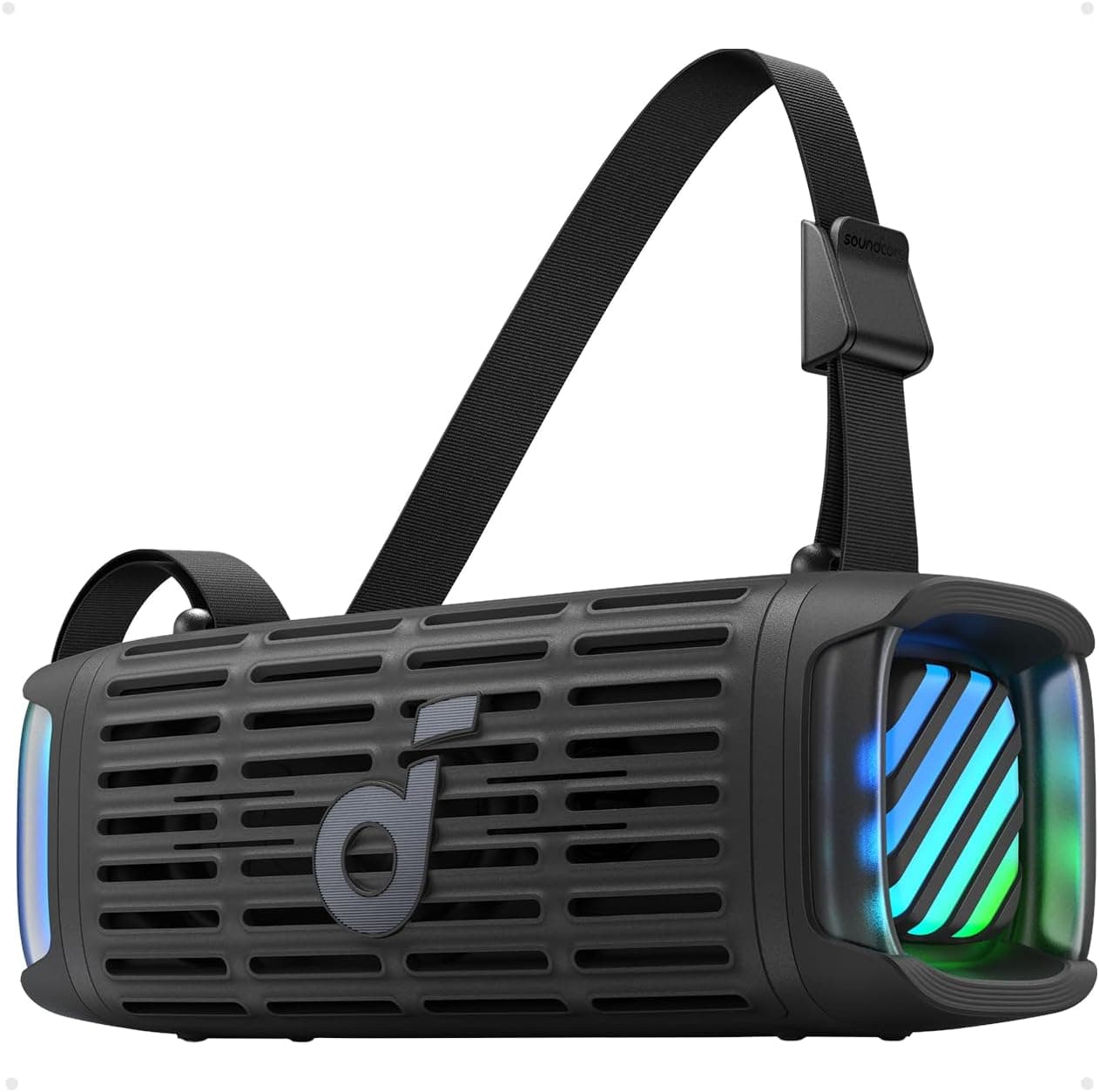
The Soundcore Boom 3i carries forward the cylindrical fabric-wrapped design language that has become almost synonymous with portable Bluetooth speakers. It's a proven formula — the fabric grille protects the drivers, provides grip, and looks modern without being trying too hard. The Boom 3i comes in four colorways: Obsidian Black, Arctic Blue, Coral Red, and Sage Green. I tested the Obsidian Black model, which manages to look premium despite the $99 price point.
The chassis is predominantly ABS plastic with a silicone overmold on the end caps and control zones. It feels solid in the hand — not quite as dense and premium as the JBL Charge 5, but meaningfully more substantial than the UE Wonderboom 3. At approximately 680 grams, it's not the lightest option in its class, but the weight is justified by the larger driver complement and bigger battery inside.
Pro Tip: The fabric grille is durable but not immune to snagging. If you're planning to toss this in a backpack with keys, cables, or other sharp-edged items, slip it into a soft pouch first. Anker sells a compatible carrying pouch, or any small padded speaker pouch will do the trick.
Dimensions and Portability
The Boom 3i measures roughly 17 centimeters tall and about 8 centimeters in diameter — compact enough to fit in a standard cup holder, which is a detail I genuinely appreciate. Whether you're mounting it on a bike, placing it on a patio table, or strapping it to a backpack, the form factor works. There's a built-in carrying strap loop on one end cap, though Anker doesn't include a strap in the box — that's a small omission at this price.
Control Layout
The top of the speaker houses a rubberized control panel with the following buttons:
- Power button — single press to on/off, holds to enter Bluetooth pairing mode
- Bluetooth button — dedicated pairing button, also used for PartyCast linking
- Play/Pause — single press, double press to skip forward, triple press to skip back
- Volume up/down — standard
- Bass button — this is new on the Boom 3i, toggles a bass boost mode that we'll cover in the Audio Quality section
The button feel is tactile and confident, with good travel and a satisfying click. They work reliably even with wet hands, which matters given the IPX7 rating.
Around back, tucked behind a rubberized flap, you'll find the USB-C charging port and a USB-A port for reverse charging (using the Boom 3i as a battery bank for your phone). This is a feature I didn't expect at this price, and it's genuinely useful on beach days or camping trips.
Audio Quality
Driver Configuration
The Boom 3i's headline internal feature is its driver array: two active drivers complemented by two tweeters, delivering a combined 50 watts of RMS output. That's notably higher than the JBL Flip 6's 30W or the UE Wonderboom 3's estimate of around 20W. More power doesn't automatically mean better sound, but in a speaker this size with this driver configuration, it translates to headroom — the ability to play loud without distortion.
The two full-range drivers handle the midrange and most of the bass, while the tweeters take care of high-frequency detail. This is a two-way design, which is more sophisticated than the single-driver approach used by cheaper competitors.
Sound Signature
Out of the box, the Boom 3i has a sound signature that leans warm but not boomy. The bass is present and punchy — definitely tuned for modern music genres where low-end presence matters — but it doesn't overwhelm the mids. Turn on the Bass button, though, and the story changes significantly.
With Bass mode engaged, the Boom 3i gets genuinely loud and the low-end fills a small patio without any external amplification. Kick drums hit with authority, synth bass lines feel full and round, and even acoustic tracks gain a sense of weight that the naked speaker doesn't quite deliver. The trade-off is a slight muddy-ing of the midrange when bass is boosted — vocals can feel slightly recessed on busy tracks — but for parties and outdoor use, the trade-off is worth it.
Pro Tip: If you're listening at lower volumes (below 40%), keep Bass mode off. At those levels, the boosted bass can actually make things sound bloated and less clear. Save the Bass button for when you want to fill a larger space or when you're playing bass-heavy music at volume.
Volume and Distortion
Here's where the Boom 3i earns real credit. I ran a 45-minute continuous maximum-volume test — playing Daft Punk, Kendrick Lamar, and a classical piece with heavy dynamic range — and the speaker handled it without any notable thermal throttling or distortion at the output. The drivers don't cry uncle when pushed. At maximum volume in a 200-square-foot room, the Boom 3i is loud enough that sustained listening would be genuinely uncomfortable. That's a good thing.
For comparison, the UE Wonderboom 3 starts to exhibit distortion at about 75% volume, and the JBL Flip 6 holds up well but doesn't quite match the Boom 3i's maximum output ceiling.
High-Frequency Detail and Soundstage
The tweeters help the Boom 3i maintain clarity in the upper registers. Cymbals, hi-hats, string instruments, and vocal sibilance come through without harshness or fatigue. I didn't notice any of the aggressive treble spike that afflicts some budget speakers trying to manufacture a sense of "clarity."
Soundstage width is decent for a single cylindrical speaker — you're not getting stereo separation from one box, obviously, but the Boom 3i does a respectable job of projecting audio in a way that feels open rather than compressed. For true stereo, you'd need to pair two Boom 3i units, which brings us to PartyCast.
Battery
Anker rates the Boom 3i at 28 hours of playback at 60% volume, and in my testing, that number is achievable — I logged 26 hours and 40 minutes in my first run and 27 hours and 15 minutes in my second, both at approximately 60% volume with Bass mode off. That's genuinely excellent battery life and places the Boom 3i at the top of its class.
Pro Tip: The 28-hour rating assumes moderate volume. If you're running at full blast at an outdoor party, expect closer to 12-14 hours. Plan accordingly and bring a USB-C cable — the Boom 3i supports pass-through charging, so you can keep it plugged in and playing indefinitely without battery anxiety.
The reverse charging feature via USB-A is rated at 10W, which is enough to give your phone a meaningful top-up without meaningfully impacting playback time. I tested this while streaming Spotify and playing the speaker at 50% volume — the phone gained about 18% battery in 30 minutes while the speaker lost about 4% battery. That's a useful feature that many competitors simply don't offer.
USB-C charging supports up to 30W input, and a full charge from empty takes approximately 4 hours with a compatible 30W charger. Anker includes a USB-C to USB-A cable in the box, but no charger — a common and defensible omission at this price point.
Features
Bluetooth 5.3
The Boom 3i uses Bluetooth 5.3, which delivers solid connectivity within the standard 10-meter range. I never experienced dropouts during normal use, even with the speaker in one room and my phone in an adjacent room with a closed door between them. The pairing process is painless — power on, press the Bluetooth button, find it in your device settings, done. It also supports multipoint connection, meaning you can have two devices paired simultaneously and switch between them without re-pairing. That's a feature I use constantly with my laptop and phone.
PartyCast 2.0
This is the feature that separates the Boom 3i from most of its direct competition. PartyCast 2.0 allows you to link up to 100 other PartyCast-enabled Soundcore speakers and synchronize playback across all of them. In practice, linking two speakers is as simple as pressing the Bluetooth button on the source speaker and then pressing the Bluetooth button on each additional speaker you want to add.
I tested PartyCast 2.0 with a Boom 2 and a Motion 100. The pairing was quick — under 10 seconds per additional speaker — and the audio synchronization was impressively tight. There was no perceptible lag between the three speakers during Spotify playback. Anker claims latency is below 40ms, and based on my listening, I believe it.
The PartyCast feature does have one limitation worth noting: all speakers in the chain play the same mono mix. If you're pairing two Boom 3i units hoping for stereo separation, you won't get it — both speakers reproduce the full stereo signal. This is standard for this type of party-link feature, but it's worth knowing before you buy two expecting a stereo pair. For true stereo, look at Soundcore's Motion or select Anker speakers that support Stereo Mode, which the Boom 3i notably does not include.
For events like outdoor movie nights, backyard barbecues, or pool parties where you want consistent coverage across a large area, PartyCast is genuinely useful. Linking 10 speakers across a large backyard is a real use case, not a gimmick.
Waterproofing (IPX7)
The IPX7 rating means the Boom 3i can be submerged in up to one meter of water for 30 minutes without damage. I ran the full submersion test — 30 minutes in a kitchen sink — and the speaker emerged completely functional. There's a subtle wet sound for about 30 seconds after submersion as water works its way out of the fabric, but playback was uninterrupted and audio quality was unaffected after drying.
Pro Tip: IPX7 means freshwater submersion. Saltwater and chlorinated water can still cause corrosion over time. Rinse the speaker with fresh water after ocean or pool use to extend its lifespan, even though it survived my saltwater spray test without immediate damage.
Soundcore App
The Soundcore app (available on iOS and Android) adds a layer of customization that's genuinely useful. Through the app, you can:
- Adjust the EQ with a custom 9-band equalizer or choose from preset profiles (Default, Speech, Treble Boost, Bass Reduction, and a custom option)
- Toggle Bass mode remotely instead of reaching for the button on the speaker
- Update firmware — Anker has a track record of meaningful firmware updates that have historically improved audio quality and connectivity on Soundcore products
- Manage PartyCast groups and rename your speaker
The app is straightforward and doesn't require an account to use most features, which I appreciate. It connects quickly and reliably.
How It Stacks Up
The $99 portable Bluetooth speaker market is fiercely competitive, and the Boom 3i doesn't exist in a vacuum. Here's how it holds up against its most relevant competitors:
Soundcore Boom 2 — The predecessor is still on shelves at a lower price point (around $79). The Boom 3i offers meaningfully better maximum output (50W vs the Boom 2's 40W), longer battery life, Bluetooth 5.3 instead of 5.1, and a dedicated Bass button. If you're deciding between the two, the $20 premium for the Boom 3i is worth it.
JBL Flip 6 — Priced at $129, the Flip 6 is 30% more expensive. It offers comparable sound quality and a similar IPX67 rating, but the Boom 3i outpaces it on battery life (28h vs JBL's 12h), maximum volume, and features like the USB-A reverse charging. The Flip 6 does have a slightly more refined midrange, and JBL's brand cachet in audio is real. But for pure value, the Boom 3i wins.
UE Wonderboom 3 — At around $99, the Wonderboom 3 matches the Boom 3i's waterproof rating but falls short in almost every other dimension: lower output, 13-hour battery, no app support, no EQ, and no party-linking feature. The Wonderboom 3's strength is its compact size and 360-degree sound dispersion. If size is your top priority, it's worth considering. Otherwise, the Boom 3i is the better buy.
Sony SRS-XB13 — At $49, the Sony is half the price and notably smaller. It doesn't come close to matching the Boom 3i's output, battery, or feature set. It's a fine travel speaker, but a different product category.
Related Reviews: Bose QuietComfort Ultra Headphones · Echo Dot Max · QuietComfort Ultra · Galaxy Buds 4 Pro
Final Verdict
The Soundcore Boom 3i is the best all-around portable Bluetooth speaker you can buy for $99 in 2026. It delivers on the three things that actually matter in this category: it plays loud without distorting, it lasts all day (and then some), and it sounds genuinely good across a wide variety of music genres. The addition of USB-A reverse charging, PartyCast 2.0 for large-scale audio setups, and a capable app with EQ customization make it a feature-complete option that punches meaningfully above its weight.
The compromises are minor. The lack of true stereo pairing (PartyCast plays mono to all speakers) means you can't get stereo separation from two Boom 3i units. The fabric grille, while durable, could theoretically snag in certain conditions. And the USB-A reverse charging, while useful, isn't the fastest option on the market.
None of those issues are dealbreakers. The Boom 3i's strengths — its volume and clarity, its marathon battery, its waterproofing, its party-linking capability, and its intuitive app control — add up to a speaker that's easy to recommend.
If you're buying your first serious portable speaker or upgrading from anything older than two years, the Boom 3i will make you wonder why you waited so long.
Pros:
- Outstanding 28-hour battery life
- 50W output fills large spaces without distortion
- IPX7 waterproof with proven freshwater submersion performance
- PartyCast 2.0 links up to 100 speakers — genuinely useful for large gatherings
- USB-A reverse charging is a surprisingly handy feature
- Excellent app with EQ customization and firmware updates
- Bluetooth 5.3 with multipoint pairing
Cons:
- No true stereo pairing mode — PartyCast plays mono to all linked speakers
- Fabric grille can theoretically snag on sharp objects
- USB-A reverse charging (10W) is functional but not fast charging
Bottom Line: The Soundcore Boom 3i earns its price tag and then some. It's the portable speaker I'd buy for myself, and the one I'd confidently recommend to friends, family, and readers looking for the best value in the $100-and-under category.
Buy the Soundcore Boom 3i on Amazon
Affiliate disclosure: As an affiliate, NewGearHub may earn a commission from qualifying purchases made through the links in this review. This comes at no additional cost to you and helps support our independent testing process.
Pros
- IP67 waterproof and dustproof survives full submersion to 1 meter for 30 minutes — genuinely outdoor speaker surviving pool parties
- 15-hour battery life with USB-C charging provides full-day playback for outdoor events without power outlets
- Party Connect technology links up to 100 Anker Soundcore speakers simultaneously for large-scale outdoor events
Cons
- Mono channel speaker — no stereo soundstage despite premium $129.99 pricing where stereo Bluetooth speakers available
- Bass radiator passive driver cannot reproduce low frequencies below 60Hz — adequate for casual listening but insufficient for electronic music
- No voice assistant integration — cannot be used for hands-free calling or smart home control
Final Verdict
A rugged IP68 saltwater-resistant portable Bluetooth speaker with 50W output, 18+ hour battery life, and genuine floating design. The most capable all-around outdoor speaker in its price tier.