Status Pro X Review: Triple-Driver Sound That Challenges the Flagship Earbuds
Status Pro X earbuds pair a hybrid triple-driver system with LDAC hi-res audio, class-leading call quality, and a premium metal design at $249 - the best sound in their price class despite wind-noise and battery compromises.
Every flagship wireless earbud on the market today is built around a compromise. Apple, Sony, Bose, and Samsung all squeeze a single dynamic driver into a tiny shell, tune it aggressively, and rely on digital signal processing to make it sound acceptable. Status Audio, a New York-based company that has spent a decade quietly building a cult following among budget audiophiles, thinks that approach is fundamentally wrong. Its answer is the Status Pro X, a pair of true wireless earbuds that stuff three separate drivers into each bud — a 12mm dynamic driver for bass and two Knowles balanced armatures for mids and treble — along with hybrid noise cancellation, LDAC hi-res audio, and a six-microphone array with AI speech enhancement. At $249, the Pro X undercuts the Sony WF-1000XM6 by $80 and matches the AirPods Pro 3 dollar-for-dollar while making a very different bet: that people who care about sound will notice the difference three drivers make. After extensive listening, I can confirm they do. The Pro X are the best-sounding earbuds you can buy at this price, with a few genuine flaws that keep them from being perfect.
Design, Fit, and Build Quality
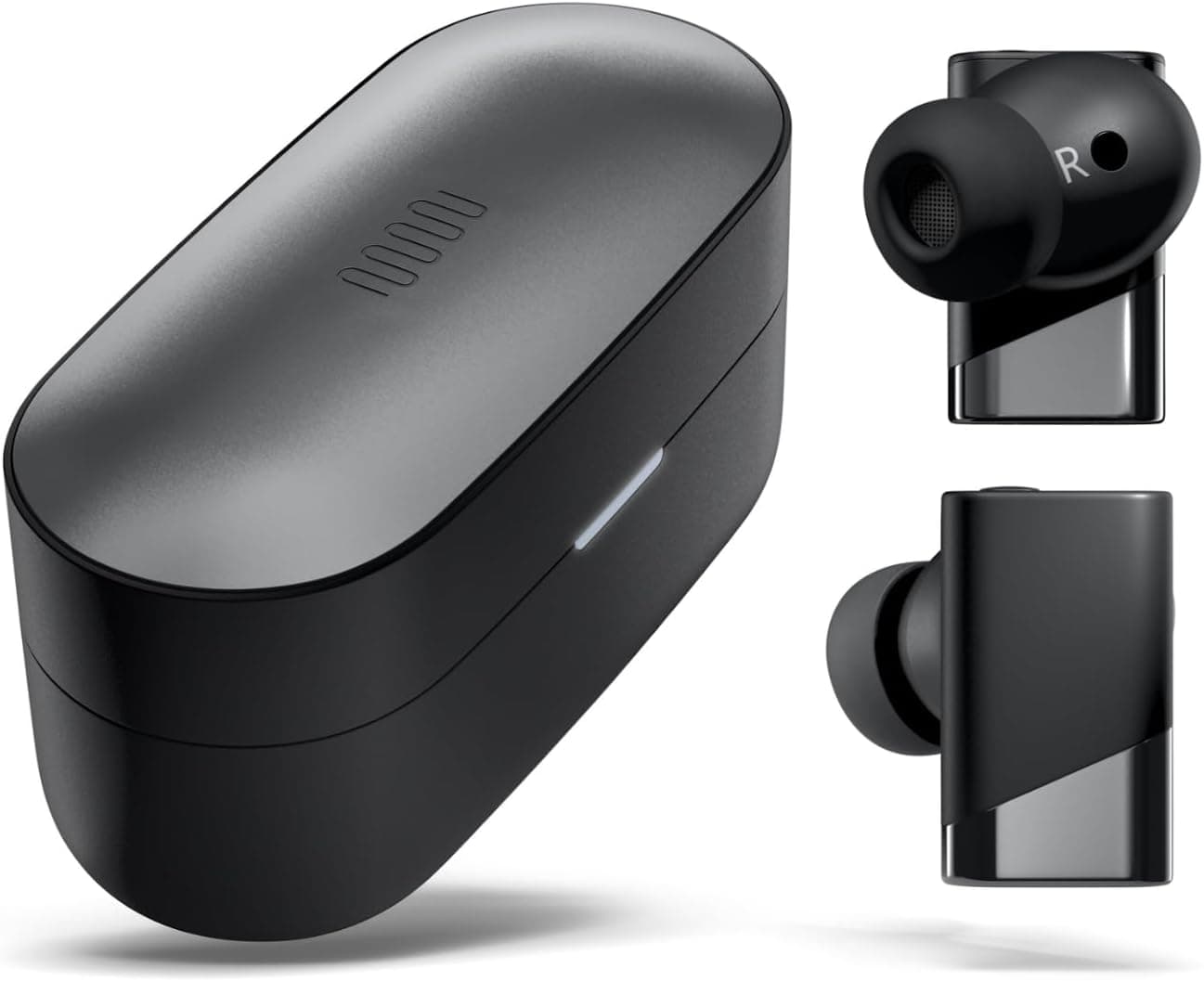
The Pro X look like nothing else in the flagship earbud category, and that is largely a good thing. The buds have a distinctive rectangular, almost jewelry-like profile in either Black Alloy or the lighter Moonbeam finish, with a metal-trimmed exterior that reads far more premium than the glossy plastic shells of the AirPods Pro 3 or the WF-1000XM6. Each bud weighs just 5.5 grams, which is lighter than the Sony's 6.5 grams and right in line with the AirPods Pro 3. The fit is excellent for most ears: SoundGuys, who test comfort rigorously, wore them for four-plus hours without pressure points, and the slight angle of the nozzle makes them sit more naturally than the boxier Between 3ANC predecessors. You get three sizes of silicone tips in the box — small, medium, and large — though no wing tips or stabilizers, and most testers found the medium tips worked fine.
The charging case is a study in good industrial design. It has a rounded plastic base and a sharp-edged metal lid, which means you can tell which way it is oriented in your pocket without looking — a small but genuinely thoughtful detail. The lid closes with a satisfying snap, and the case supports wireless charging as well as USB-C. Build quality overall is solid: the buds carry an IP55 rating, which means they are protected against dust ingress and water jets, so rain and heavy workouts are fine. SoundGuys wore them through Vancouver's famously wet winter weather without concern. The only durability complaint in testing was that the printed text on the bottom of the case rubbed off after a few days in a pocket — cosmetic, but worth noting.
One design quirk deserves mention: the optical in-ear sensor. It detects when a bud is removed and pauses playback, which is standard. But the sensor only measures distance — it cannot tell skin from other objects. If you use a single bud and keep the other in your pocket, the stored bud will intermittently pause and resume your music as it shifts against the fabric. It is a known annoyance documented in SoundGuys' testing, and there is no setting in the app to disable the behavior. It is not a dealbreaker, but it is the kind of small friction you would not expect at this price.
The Triple-Driver Sound
Here is the heart of the Pro X pitch, and it delivers. Each earbud contains a hybrid three-driver system: a 12mm dynamic driver handling the low end, plus two Knowles balanced armature drivers for vocals and high-frequency detail. The balanced armatures are the same type of drivers used in high-end wired IEMs and hearing aids, and they are what separate the Pro X from every single-driver competitor. Where a conventional earbud asks one driver to reproduce the entire frequency range at once, the Pro X divides the work, and you can hear it.
Bass is deep and controlled without being boomy. The 12mm driver produces real sub-bass extension — the 20Hz-to-70Hz region gets rumble and pressure on electronic music and hip-hop that most earbuds roll off entirely. Mids are where the balanced armatures shine: vocals are present, articulate, and natural, with a warmth in the 100Hz-to-350Hz region that flatters both male and female voices. The upper registers have genuine sparkle, with a slight 10kHz-to-13kHz emphasis that adds air and space to cymbals and string instruments, though sensitive listeners may find that peak slightly shrill at high volume. SoundGuys' frequency response measurements showed the default "Status" tuning stays within roughly 3dB of their preference curve, which is excellent for a stock tuning — most manufacturers need 6dB or more of EQ correction.
The Pro X support the full modern codec stack: SBC, AAC, LDAC, and LC3. LDAC is the headline feature, streaming up to 990kbps over Bluetooth — that is hi-res territory, and the earbuds carry Hi-Res Wireless certification from the Japan Audio Society with 24-bit/96kHz support. On Android, where LDAC works natively, the Pro X sound noticeably more detailed and dynamic than AAC-only earbuds. On iPhone, they fall back to AAC, which is still good but blunts the hi-res advantage. Audiophiles will want to know that the Pro X are the rare true wireless earbuds that actually benefit from a lossless source; the three-driver array resolves detail that single-driver buds smear together, and crosstalk between the drivers is well-controlled.
The companion Status Hub app adds an eight-band custom EQ with advanced per-band controls including Q-factor adjustment, plus a dynamic EQ mode that keeps the sound signature consistent as you change volume — a genuinely useful feature that most competitors lack, since earbud sound often changes character at low volume. There are four additional EQ presets beyond the default tuning. If you are not happy with the stock sound, you can reshape it substantially, which is more than the AirPods Pro 3 offer (Apple still provides no EQ at all).
Noise Cancellation and Transparency
The Pro X use a hybrid ANC system that Status rates at up to 52dB of attenuation. Independent testing puts the real-world figure at around 80 percent of ambient noise reduction, which is good — in the same general class as the Bose QuietComfort Ultra 2nd Gen and the Galaxy Buds 4 Pro, if not quite at the level of the WF-1000XM6's class-leading 88 percent or the AirPods Pro 3's 90 percent. On a commute, in a coffee shop, or on a flight, the Pro X will quiet the world effectively, and the passive isolation from a good seal does a lot of the work. The transparency mode has four ambient levels, and the "low" setting is notably natural, with no obvious noise floor — you can hold a conversation or hear announcements without feeling like you are wearing earplugs.
The weakness is wind. This is the Pro X's most documented flaw: in windy conditions, the ANC actually amplifies wind noise, and it can overpower your audio even at a brisk walking pace. SoundGuys called it "a dealbreaker for outdoor use," and their testers found that even the in-app wind noise reduction mode — which is off by default and resets whenever you switch ANC modes — only marginally tames the problem. If you run or cycle outdoors with earbuds, this is a serious consideration. The AirPods Pro 3, WF-1000XM6, and even cheaper buds like the EarFun Air Pro 4 Plus handle wind far better. Indoors, the ANC is a non-issue and performs well; outdoors in the wind, the Pro X are genuinely frustrating.
Call Quality and the VoiceLoom AI
Where the Pro X are unambiguous winners is voice calling. Each bud carries three beamforming microphones — six total — feeding a neural-network speech enhancement system Status calls VoiceLoom AI. The results are the best call quality in this price class, full stop. Background noise is aggressively separated from your voice, and testers consistently found callers could hear them clearly in noisy environments where the AirPods Pro 3 and WF-1000XM6 let more ambient sound through. There is also a sidetone feature that pipes your own voice back through the earbuds during calls so you do not end up shouting, which is a thoughtful touch that few competitors offer. If you spend your workday on calls — Teams, Zoom, or plain old phone calls — the Pro X are arguably the best earbuds you can buy for that single job.
Battery Life and Charging
This is the other significant weakness. Status rates the Pro X at 8 hours per charge with ANC on and up to 24 hours total with the case, and the official spec sheet claims up to 32 hours in some configurations. Real-world testing tells a different story. SoundGuys measured 5 hours 42 minutes at their standard 75dB test volume with ANC enabled — nearly two hours short of the rated figure, and less than a full workday. With both ANC and LDAC active, the Serious Insights review measured around five hours of continuous playback. That is below the category average: the WF-1000XM6 manages around 9 hours 41 minutes, the AirPods Pro 3 around 8 hours 42 minutes, and even budget buds like the CMF Buds 2 Plus hit 10 hours.
The case adds roughly three more full charges, which brings total endurance to a respectable 20-plus hours, and it supports wireless charging plus USB-C fast charging. But the per-charge figure is what you will feel in daily use: you will be reaching for the case before the end of a long day, and if you travel with LDAC enabled, plan for recharges on long flights. For the price, this is a real compromise, and it is the main reason the Pro X trail the class leaders in overall scores despite their sound advantage.
Connectivity and Extras
Bluetooth 5.3 with multipoint pairing means you can connect to two devices simultaneously — laptop and phone, say — and switch between them seamlessly. The Pro X also support Bluetooth LE Audio and Auracast, which future-proofs them for broadcast audio in public venues, and they support both Android Fast Pair and Microsoft Swift Pair for quick setup. Latency is typical for Bluetooth: fine for video and podcasts, noticeable in fast-twitch gaming. Controls are a combination of touch surfaces and a physical button on each bud; the touch controls are fully remappable in the app, while the physical buttons are fixed. There is a "find my earbuds" feature in the app that plays a loud ringtone and shows the last known location, plus voice notifications that can replace the standard tones. Connection stability in testing was excellent — no drops or stutters across a week of mixed phone and laptop use.
Comparison With the Competition
At $249, the Pro X sit in the most competitive price band in audio. Against the AirPods Pro 3, they lose on ecosystem integration, ANC, and battery, but win clearly on sound quality, codec support, EQ control, and call quality — and they are a better fit for Android users, who get LDAC and the full app experience. Against the Sony WF-1000XM6 at $329, they lose on ANC, battery, and fit accessories but undercut the Sony by $80 while delivering comparable-or-better detail for critical listening. Against the Bose QuietComfort Ultra 2nd Gen at $299, Android Central found the Pro X more comfortable and better sounding, though Bose still holds the edge on wind handling and ANC tuning. And against the Bowers & Wilkins Pi8 at $469 — the category's audiophile darling — the Pro X deliver 80 to 90 percent of the sound for nearly half the price. For sound-focused buyers, that value equation is the Pro X's strongest argument.
Real-World Listening Impressions
Numbers and frequency response graphs only tell part of the story, so it is worth describing what the Pro X actually sound like across a week of varied listening. Starting with vocals — the Pro X's home turf — Norah Jones' "Don't Know Why" is a good reference track, and the balanced armatures render the breath and texture in her voice with an intimacy that most wireless earbuds miss entirely. On the AirPods Pro 3, the same track sounds pleasant but slightly veiled; on the Pro X, the vocal sits forward with a tactile quality, like the difference between a photograph and the same scene in person. Move to something dense, like Radiohead's "Everything in Its Right Place," and the three-driver architecture earns its keep: the synth layers, the piano stabs, and Thom Yorke's processed vocal stay separated rather than collapsing into a wall of sound. That separation — the ability to pick individual instruments out of a busy mix — is the single most noticeable upgrade over single-driver competitors.
Bass-heavy music is where the 12mm driver gets to show off. On Daft Punk's "Giorgio by Moroder," the sub-bass pulses with real physical weight, and the low end stays controlled even at high volumes — there is no port noise or driver breakup, which is a common failure mode on cheaper multi-driver designs. Acoustic material benefits too: on a live recording like "Hotel California" from the Eagles' Hell Freezes Over, the audience noise, the guitar harmonics, and the low-end thump of the kick drum all occupy their own space. The stock tuning is slightly warm, with the mid-bass emphasis that SoundGuys measured, but the eight-band EQ in the Status Hub app can pull it toward neutral if you prefer. The dynamic EQ mode is worth experimenting with: it maintains the same tonal balance across volume levels, so quiet late-night listening does not lose the bass the way most earbuds do.
One honest caveat: the Pro X reward quality sources. Over Spotify's default 160kbps streams they sound merely very good; over lossless or high-bitrate LDAC sources they sound exceptional. If you are an Apple Music subscriber on iPhone, you are capped at AAC, and the delta over an AirPods Pro 3 shrinks considerably. The Pro X are at their best in the hands of an Android user with Tidal, Amazon Music Unlimited, or Apple Music in lossless mode. That is a niche, but it is precisely the niche Status is targeting — and for that buyer, no other earbud at this price comes close.
Who Should Buy the Pro X
The Pro X are not for everyone, and it helps to be honest about that. Buy them if you are the kind of listener who notices compression artifacts, who builds playlists around recording quality, who has owned a pair of wired IEMs and mourned the move to wireless. Buy them if you spend hours a day on calls and want people to hear you clearly on a noisy street. Buy them if you are an Android user who has never experienced what LDAC can do, or if you have been priced out of the Bowers & Wilkins Pi8 and want most of that experience for $220 less. Buy them if you value a distinctive, premium-looking product over the anonymous white plastic of the default Apple choice.
Skip them if you live outdoors — runners, cyclists, and anyone in a windy city will be fighting the ANC wind amplification constantly, and there are cheaper buds that handle wind better. Skip them if you need more than six hours of playback per charge, or if you cannot tolerate the single-bud optical sensor quirk. Skip them if you are firmly in the Apple ecosystem and value integration — the seamless switching, the hearing health features, the spatial audio head tracking of the AirPods Pro 3 — over raw sonic fidelity. And skip them if you want the strongest ANC money can buy; the WF-1000XM6 and AirPods Pro 3 still hold that crown.
What's in the Box and First Setup
The unboxing experience is straightforward and pleasant. In the box you get the Pro X earbuds, the wireless charging case, a USB-C cable, three pairs of silicone tips, and the manual. There is no case in the box — Status sells those separately — which is a minor omission at this price. Pairing is simple: open the case, pull out the earbuds, and they appear in your Bluetooth list. There is no dedicated pairing button, so if you need to reset pairing you must remove the device from your previous phone's list first and re-open the case. Android users get Fast Pair, and Windows users get Swift Pair, which makes switching between phone and laptop painless. The Status Hub app walks you through the features on first launch, and firmware updates arrive through the app. The whole setup takes under five minutes, and the multipoint connection means your phone and laptop can both stay connected simultaneously — calls route automatically to whichever device rings.
Durability and Warranty
Status stands behind the Pro X with a 30-day performance guarantee — a full refund, no questions asked, within 30 days of receipt, with free return shipping in the US, Canada, and the UK — plus a one-year warranty covering defects in materials and workmanship. The IP55 rating covers dust and water jets, so sweat, rain, and gym sessions are all within spec. In testing, the buds showed no signs of wear after a week of heavy use, and the metal-trimmed housings should hold up better than glossy plastic over the long haul. The only durability ding is the case's printed text wearing off, and the fact that the optical sensor's quirks are behavioral rather than physical. For a $249 product from a smaller brand, the warranty terms are actually more generous than what the big names offer.
The Verdict in Context
The Status Pro X are a pair of earbuds with an identity, which is increasingly rare in a category where everything converges on the same formula. They are the best-sounding earbuds at their price — CNET named them the best new sound of 2026 with an 8.3 score, Forbes called them the best wireless earbuds overall, Wired gave them 9/10 and called them "a true rival to the best wireless earbuds," and TechRadar said to forget the AirPods Pro 3 entirely. The triple-driver architecture is not marketing: it produces a level of clarity, separation, and low-end authority that single-driver flagships cannot match, and the LDAC support means Android users actually hear it. The call quality is class-leading, the design is distinctive and comfortable, and the app gives you EQ control that Apple and Samsung refuse to offer.
The flaws are real and specific: wind noise that makes ANC unusable outdoors, per-charge battery life that falls short of the rating, an optical sensor with an annoying single-bud quirk, and no way to disable autoplay in the app. If you run outdoors, work 10-hour days away from a charger, or live in a windy city, those are legitimate reasons to look elsewhere. But if your priority is sound — if you want to hear the separation between instruments, the texture in a vocal, the weight of a bassline — the Pro X are the best value in premium earbuds right now, and they make the $249 price feel like a bargain against the $329 Sony and the $469 Bowers & Wilkins. Status Audio's pitch was always that three speakers beat one. For once, the underdog is right.
Pros
- Hybrid triple-driver design delivers class-leading detail and separation
- LDAC hi-res audio up to 990kbps with Hi-Res Wireless certification
- Outstanding call quality thanks to VoiceLoom AI beamforming mics
- Comfortable premium design with metal trim and IP55 rating
- Full 8-band EQ, multipoint, and Auracast support in the Status Hub app
Cons
- ANC amplifies wind noise, making outdoor use frustrating
- Battery life measures well under the 8-hour rating at roughly 5.5-6 hours
- Optical sensor quirks with single-bud use and no autoplay toggle
Final Verdict
Status Pro X earbuds pair a hybrid triple-driver system with LDAC hi-res audio, class-leading call quality, and a premium metal design at $249 - the best sound in their price class despite wind-noise and battery compromises.