Audeze Maxwell 2 Review: Planar Magnetic Dominance Redefined for Gaming
The Audeze Maxwell 2 delivers peerless audio quality with its 90mm planar magnetic drivers, 80-hour battery life, and premium build quality, though its increased weight and lack of simultaneous Bluetooth and 2.4GHz audio hold it back from universal recommendation.
If you have been shopping for a premium wireless gaming headset in 2026, you have almost certainly encountered the Audeze Maxwell 2. The original Maxwell changed the conversation around what a wireless gaming headset could sound like when it launched a few years ago, wielding massive planar magnetic drivers in a category that had grown comfortable with dynamic driver mediocrity. Now Audeze is back with a second generation, and the question on everyone's mind is whether the Maxwell 2 justifies its premium price tag or whether you should hunt down a discounted original instead.
The answer, as it turns out, is more nuanced than a simple yes or no. The Audeze Maxwell 2 is simultaneously the best-sounding wireless gaming headset money can buy and a product that leaves you wondering if Audeze could have done more with the generational update. It is a headset of brilliant highs and frustrating compromises, and whether it is right for you depends entirely on what you value most in a gaming headset.
The Legacy That Precedes It
To understand the Maxwell 2, you have to understand what the original Maxwell accomplished. When Audeze launched the first-generation Maxwell in 2022, it was something of a shock to the gaming audio industry. Here was a company known for reference-grade audiophile headphones that cost thousands of dollars, releasing a sub-$350 wireless gaming headset with genuine 90mm planar magnetic drivers. The response from the gaming community was immediate and emphatic. Reviewers praised its audio fidelity, its 80-hour battery life, and its ability to make even casual games sound spectacular.
The original Maxwell became the gold standard for gaming audio, but it was not without its flaws. The headband design could be uncomfortable during long sessions. The microphone, while serviceable, did not match the quality of the audio drivers. And at roughly 420 grams, it was already one of the heavier headsets on the market. These were the areas where the community hoped Audeze would focus its attention for a second generation.
The Maxwell 2 arrives with a list of improvements that reads well on paper. New SLAM acoustic management technology promises tighter bass and improved spatial precision. The microphone has been upgraded with FILTER AI noise cancellation. The headband has been redesigned for better weight distribution. Bluetooth 5.3 with LDAC and LE Audio support brings it up to modern wireless standards. And the Audeze companion app has been rebuilt from the ground up for better control over EQ and settings.
Design and Build Quality
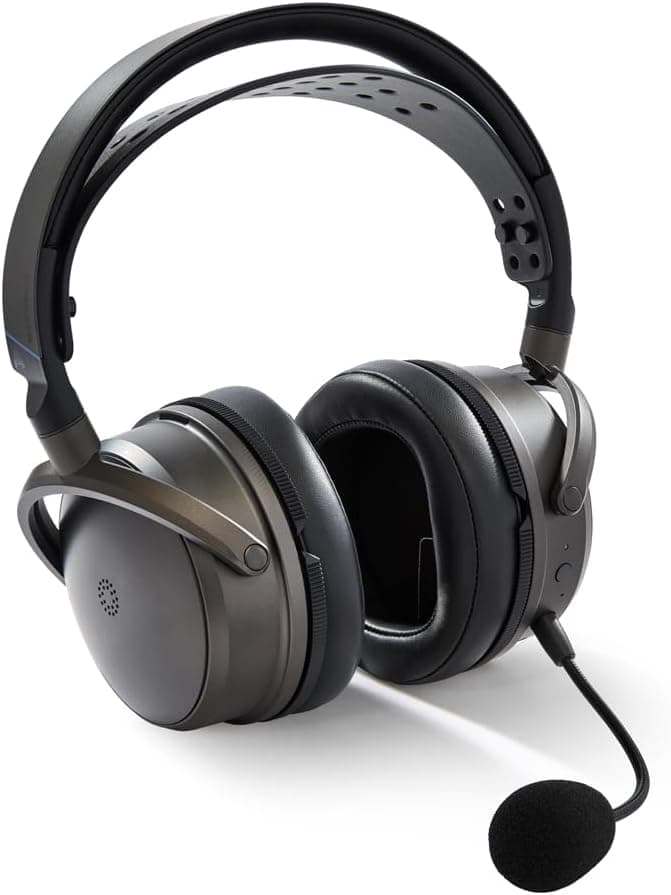
The Audeze Maxwell 2 makes a strong first impression. The headset retains the same general aesthetic as its predecessor, which is to say it looks more like a piece of professional studio equipment than a typical gaming headset. There is no RGB lighting, no aggressive gamer angles, no chrome accents. Instead, you get a brushed gunmetal finish, matte black plastics, and a restrained design language that looks equally at home on a desk in a competitive esports setup or in a living room connected to a console.
The build quality is exceptional. The yoke and hinge mechanism are constructed from metal, and the ear cups rotate and swivel with satisfying precision. The leatherette ear pads are thick and plush, filled with memory foam that conforms to the shape of your head without applying excessive pressure. The headband has been redesigned for the Maxwell 2, switching to a wider suspension strap that better distributes the weight across the top of your head.
That weight is something we need to discuss openly. The Maxwell 2 tips the scales at 490 grams according to TechRadar's measurements, and some independent reviewers have recorded weights as high as 562 grams without the microphone. This is a significant increase over the original Maxwell's already substantial 420 grams. To put that in perspective, the Razer BlackShark V3 Pro weighs roughly 320 grams, and the SteelSeries Arctis Nova Pro Wireless comes in at around 340 grams. The Maxwell 2 is heavier than both by a considerable margin.
The redesigned headband does help. I found that the wider suspension strap does a noticeably better job of distributing weight than the original design, and the clamping force is moderate enough that the headset stays in place without feeling like it is compressing your skull. Nevertheless, this is not a headset you want to wear for marathon six-hour gaming sessions without taking breaks. I found the comfort threshold to be around the two to three hour mark before I started feeling the weight, which is fine for most gaming sessions but worth noting if you are the type of player who settles in for all-day grinds.
The 90mm Planar Magnetic Advantage
The defining feature of the Audeze Maxwell 2 is its 90mm planar magnetic drivers. To understand why this matters, you need to understand how most gaming headsets produce sound. The vast majority of gaming headsets use dynamic drivers, which operate similarly to traditional loudspeaker cones. A voice coil moves a diaphragm to create sound waves, and the design imposes physical limitations on how quickly and accurately the diaphragm can respond to changes in the audio signal.
Planar magnetic drivers work differently. A thin, flat diaphragm is suspended between two arrays of magnets. When electrical current passes through the conductive traces on the diaphragm, the magnetic field causes the entire diaphragm to move uniformly. This design eliminates the breakup modes and distortion that plague dynamic drivers at high volumes, and it allows for much faster transient response. The result is audio that is cleaner, more detailed, and more accurate than equivalently priced dynamic driver headsets.
Audeze has been refining its planar magnetic technology for years, and the 90mm drivers in the Maxwell 2 are among the best they have ever produced for a consumer product. The frequency response spans from 10Hz to 50kHz, which means the headset can reproduce sub-bass frequencies you feel in your chest alongside high-frequency detail that extends well beyond the range of human hearing. The new SLAM acoustic management technology further refines the sound by optimizing the acoustic chamber behind the driver, resulting in tighter, more controlled bass response and improved spatial separation.
Sound Quality That Redefines Expectations
Let me be direct about this: the Audeze Maxwell 2 sounds better than any other wireless gaming headset currently available. It is not a subtle difference. Put on a pair of Razer BlackShark V3 Pro or SteelSeries Arctis Nova Pro Wireless and listen to a well-mastered track, then switch to the Maxwell 2, and the difference is immediately apparent. The Maxwell 2 has a fullness, a richness, and a sense of space that cheaper headsets simply cannot replicate.
The bass response is extraordinary. Unlike the boosted, one-note bass that characterizes many gaming headsets, the Maxwell 2 delivers bass that is both powerful and controlled. The low end extends deep into the sub-bass region, which means explosions in Battlefield, gunshots in Call of Duty, and the rumble of engines in Forza Horizon all have genuine physical weight behind them. But that bass never bleeds into the mids. Kick drums have impact without masking the snare. Bass guitars are present and full without overwhelming the rest of the mix. This is the kind of bass performance that makes you hear details in songs you have listened to a hundred times before.
The midrange is where the Maxwell 2 really separates itself from the competition. Human voices sound natural and present. In-game dialogue, whether it is a teammate calling out enemy positions or a character delivering a dramatic monologue, comes through with clarity and emotion. The upper mids are present enough to give vocals presence without venturing into harshness. Acoustic guitars have the right amount of body and string texture. This is a headset that handles complex musical passages without sounding congested or muddy.
The high frequencies sparkle without being fatiguing. Cymbals have air and shimmer. Hi-hats have the correct metallic texture. Sibilance is controlled, which means you can listen at higher volumes without feeling like someone is stabbing an ice pick into your ears. The overall tonal balance leans slightly warm, which is very characteristic of well-tuned planar magnetic headphones, and it makes the Maxwell 2 enjoyable to listen to for extended periods.
Spatial awareness and imaging are best-in-class. The Maxwell 2 does not have the widest soundstage of any headphone I have tested, which is a consequence of its closed-back design. But the accuracy of its imaging is remarkable. In competitive games like Counter-Strike 2 and Valorant, I could pinpoint enemy locations with precision based on audio cues alone. Footsteps in Rainbow Six Siege were clearly directional, and I could distinguish between sounds coming from above, below, and on the same level. The SLAM technology contributes to a sense of three-dimensional space that makes games feel more immersive.
Microphone Performance
The microphone on the original Maxwell was adequate but unremarkable. It was clear enough for voice chat and Discord calls, but it did not match the exceptional quality of the headset's audio drivers. The Maxwell 2 addresses this with a redesigned hypercardioid boom microphone that offers twice the bandwidth of the original, along with FILTER AI noise cancellation software.
In practice, the microphone is a mixed bag. When used without the AI noise cancellation, the voice quality is noticeably improved over the original. Voices sound fuller and more natural, with better low-frequency presence. Background noise rejection is decent, and the hypercardioid pickup pattern does a good job of focusing on your voice while rejecting sounds from the sides and rear.
The FILTER AI noise cancellation is where things get complicated. When enabled at the low setting, the noise reduction is subtle and generally improves clarity by reducing ambient hum and fan noise. At the high setting, however, the processing becomes aggressive and introduces audible artifacts. Voices can sound slightly muffled or processed, and there is a noticeable pumping effect when background noise fluctuates.
The bigger issue is compatibility with Discord. Discord's own noise suppression algorithms can conflict with FILTER, creating a layered processing effect that degrades voice quality significantly. You can work around this by disabling one or the other, but the fact that you have to troubleshoot mic quality on a $330 headset is frustrating. It feels like a feature that was added to check a box on the spec sheet rather than something that was thoroughly tested in real-world use cases.
Connectivity and Features
The Maxwell 2 supports three connection methods: 2.4GHz wireless via the included USB-C dongle, Bluetooth 5.3, and wired via USB-C or 3.5mm auxiliary. The 2.4GHz connection is rock solid, with no perceptible latency and excellent range. I was able to walk through multiple rooms in my apartment without losing the signal, which is better performance than I have seen from most wireless gaming headsets.
Bluetooth 5.3 brings support for LDAC, which is Sony's high-resolution audio codec, as well as LE Audio and Auracast for improved battery efficiency and multi-point connections. The LDAC support is a nice addition for mobile gaming or music listening, as it allows for higher bitrate streaming than standard AAC or SBC codecs.
The major omission, and it is a significant one, is the inability to use Bluetooth and 2.4GHz wireless simultaneously. You can connect via USB and Bluetooth at the same time, but that requires a wired USB connection, which somewhat defeats the purpose of a wireless headset. This means you cannot take a phone call while continuing to game on your PC without switching connections. Competitors like the SteelSeries Arctis Nova Pro Wireless and the Razer BlackShark V3 Pro offer simultaneous Bluetooth and 2.4GHz audio, and its absence here feels like a deliberate feature segmentation rather than a technical limitation.
Battery life remains exceptional at 80 hours on a single charge. This is genuinely best-in-class performance, and it means you can game for weeks without thinking about charging. When you do need to charge, the USB-C port supports fast charging, and a quick 15-minute charge provides several hours of use.
The Audeze Companion App
The new Audeze companion app is available for Windows, macOS, iOS, and Android, and it represents a significant improvement over the original app. The interface is clean and responsive, and it provides granular control over the headset's EQ, sidetone, and microphone settings.
The EQ section is particularly well implemented. You get a five-band equalizer with preset options for different gaming genres, music styles, and content types. The app also includes a hearing test feature that creates a personalized sound profile based on your individual hearing sensitivity at different frequencies. This is the kind of feature that usually only appears on much more expensive audiophile equipment, and having it available on a $330 gaming headset is genuinely impressive.
Comparisons to Competitors
The natural competitors for the Maxwell 2 are the Razer BlackShark V3 Pro at $249 and the SteelSeries Arctis Nova Pro Wireless at $349. The Razer is lighter, more comfortable for long sessions, and offers simultaneous Bluetooth and 2.4GHz audio. But it does not sound anywhere near as good as the Maxwell 2. The dynamic drivers in the Razer, while competent, lack the detail, separation, and overall fidelity of Audeze's planar magnetic design.
The SteelSeries Arctis Nova Pro Wireless is the closest competitor in terms of price and feature set. It offers simultaneous Bluetooth and 2.4GHz audio, a hot-swappable dual battery system, and a more comfortable weight. But its sound signature, while good, does not match the Maxwell 2's combination of bass extension, midrange clarity, and high-frequency detail. RTINGS' measurements show the Maxwell 2 outperforming the SteelSeries across nearly every audio metric, with particular advantages in bass accuracy, midrange consistency, and imaging precision.
Then there is the elephant in the room: the original Audeze Maxwell. You can still find the first-generation model for around $229 in many retailers, and it offers approximately 90 percent of the Maxwell 2's performance. The original has better weight distribution at 420 grams versus the Maxwell 2's 490 grams. The sound quality is still excellent, even without SLAM technology. And the battery life is identical at 80 hours. For most gamers, the original Maxwell is the smarter purchase, especially at the current discount.
Who Should Buy the Audeze Maxwell 2
The Maxwell 2 is for the gamer who prioritizes audio quality above everything else. If you are the type of player who notices the difference between a competently mixed game soundtrack and a great one, who can hear the texture of a guitar string or the air around a cymbal, who wants to feel the impact of an explosion rather than just hear it, this headset is worth every penny of its $329 price tag.
It is also for competitive gamers who rely on audio cues for positional awareness. The imaging accuracy of the Maxwell 2 is exceptional, and it provides a genuine competitive advantage in games where hearing the direction and distance of footsteps can mean the difference between winning and losing a round.
But the Maxwell 2 is not for everyone. If you prioritize comfort above audio quality, if you need simultaneous Bluetooth and 2.4GHz connectivity, or if you are on a budget, there are better options available. The original Maxwell is a better value proposition, and the Razer BlackShark V3 Pro offers features the Maxwell 2 lacks while still providing good audio quality.
There is also the question of platform compatibility to consider. The Maxwell 2 comes in two variants: one for PlayStation, PC, Mac, and Switch at $329, and one for Xbox, PC, Mac, and Switch at $349. The Xbox version includes a security chip that allows it to connect wirelessly to Xbox consoles, which accounts for the $20 price difference. Make sure you choose the right variant for your primary gaming platform, as the PlayStation version will not work wirelessly with Xbox consoles and vice versa.
For PlayStation 5 owners, the integration is seamless. The headset supports Tempest 3D AudioTech via the USB dongle, and you get the full benefit of Sony's spatial audio implementation. The dial controls on the left ear cup for chat mix and volume work natively with the PS5 interface, which is a nice touch that not all third-party headsets support. On PC, the experience is equally polished, with the Audeze app providing the control surface that console users access through the system menu.
The wired connection options deserve mention as well. The 3.5mm analog cable allows you to use the Maxwell 2 with virtually any device that has a headphone jack, including Nintendo Switch in handheld mode, older controllers, and audio interfaces. The USB-C wired connection supports up to 24-bit, 96kHz high-resolution audio, which is a meaningful step up from the wireless connection quality if you are listening to lossless music sources. This flexibility makes the Maxwell 2 suitable not just for gaming but also for music production, podcast monitoring, and general media consumption.
Final Verdict
The Audeze Maxwell 2 is the best-sounding wireless gaming headset money can buy in 2026. Its 90mm planar magnetic drivers deliver audio fidelity that embarrasses competitors at any price point, and the 80-hour battery life means you rarely have to think about charging. The redesigned headband improves comfort over the original, and the companion app is genuinely useful.
But the Maxwell 2 is also a frustrating product. It is heavier than its predecessor, it lacks simultaneous Bluetooth and 2.4GHz audio, and it costs more while offering incremental improvements over a first-generation model that is available at a significant discount. The microphone noise cancellation needs work, and the weight gain over the original is a step in the wrong direction.
If you are looking for a wireless gaming headset that delivers reference-grade audio quality and you are willing to accept the compromises that come along with it, the Audeze Maxwell 2 is the headset to buy. It is a brilliant piece of audio engineering wrapped in a package that is just flawed enough to keep it from being a universal recommendation.
Pros
- Exceptional 90mm planar magnetic driver sound quality
- Industry-leading 80-hour battery life
- Premium brushed metal build quality
- Excellent spatial imaging for competitive gaming
- Redesigned headband improves weight distribution
Cons
- Very heavy at 490g
- No simultaneous Bluetooth and 2.4GHz audio
- AI microphone noise cancellation conflicts with Discord
- Expensive compared to nearly identical Gen 1
Final Verdict
The Audeze Maxwell 2 delivers peerless audio quality with its 90mm planar magnetic drivers, 80-hour battery life, and premium build quality, though its increased weight and lack of simultaneous Bluetooth and 2.4GHz audio hold it back from universal recommendation.