Beyerdynamic MMX 200 Wireless Review: Studio Sound Meets Exceptional Mic Quality at a Steal
The Beyerdynamic MMX 200 Wireless Gaming Headset delivers studio-derived sound quality and arguably the best microphone in any wireless headset under $150, now available at a compelling $99 price point that transforms it from a niche recommendation into a genuine value champion.
When Beyerdynamic, a company with nearly a century of audio engineering heritage, decided to enter the wireless gaming headset space with the MMX 200, expectations were naturally high. The German manufacturer has long been revered in professional audio circles for studio-grade headphones like the DT 770 Pro and DT 990 Pro — staples in recording studios worldwide. Their gaming-oriented MMX series has maintained that pedigree, but the leap to wireless introduced new challenges: battery life constraints, wireless latency concerns, microphone quality over Bluetooth, and the ever-present question of whether a brand known for wired studio monitors can deliver a compelling wireless gaming experience. After spending extensive time with the Beyerdynamic MMX 200 Wireless Gaming Headset, the answer is nuanced but ultimately positive — especially at its current price point.
Design and Build Quality
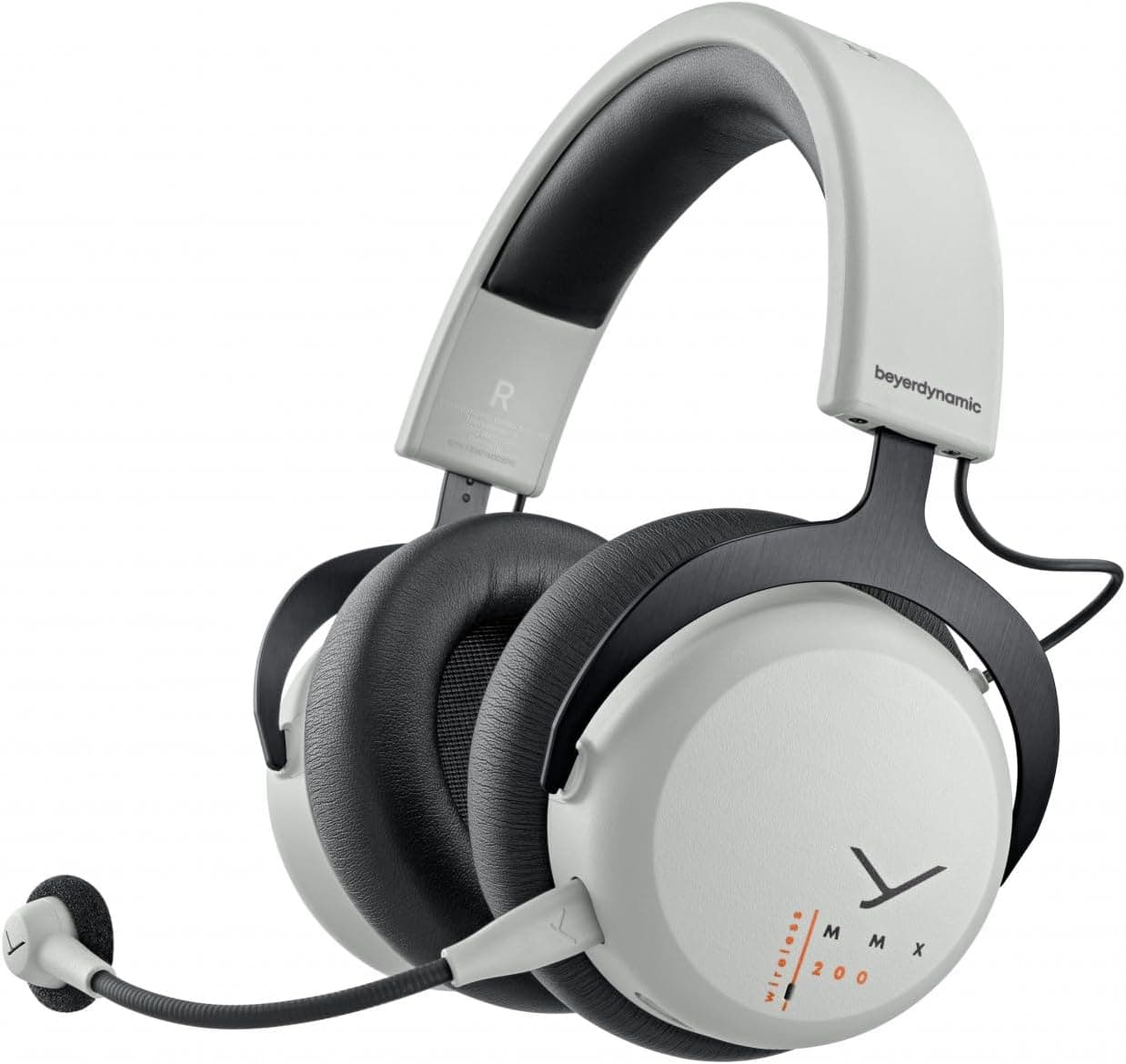
The MMX 200 adopts a design language that is unmistakably Beyerdynamic while making concessions to the wireless gaming audience. The headset is available in two colorways — Black and Grey — both of which feature subtle orange accent stitching on the ear cushions that adds a touch of visual flair without being gaudy. The overall aesthetic is understated and mature, a welcome departure from the aggressive RGB-laden designs that dominate the gaming peripheral market.
Build quality is solid, if not extraordinary. The headset is constructed primarily from high-quality plastic with a matte finish that resists fingerprints and smudges. The headband features generous memory foam padding wrapped in soft leatherette, connected firmly to the aluminum-reinforced yoke structure. The earcups are compact and round, rotating slightly for a better fit but not folding flat for portability — a minor inconvenience for those who travel frequently.
At 360 grams (12.7 ounces), the MMX 200 is reasonably lightweight for a wireless gaming headset, competitive with the SteelSeries Arctis Nova 7W at 348 grams and significantly lighter than the Audeze Maxwell at 490 grams. However, weight distribution matters more than raw numbers, and here the MMX 200 delivers mixed results. The clamping force is noticeable out of the box — on the firmer side compared to the relaxed fit of the Arctis Nova line. Some users may find this reassuringly secure, while others, particularly those with larger head shapes or who wear glasses, may experience pressure points after extended sessions. The leatherette ear cushions are plush but prone to heat buildup, a common issue with non-breathable materials that several reviewers have noted leads to "ear sweats" during longer gaming sessions.
One design criticism worth noting involves the exposed wiring visible where the headband connects to the yoke. While this doesn't affect functionality or durability — Beyerdynamic is known for making replaceable parts available — it gives a slightly unfinished appearance that feels out of place at the original $249 asking price. The adjustment notches are also stiffer than ideal, requiring more force than expected to resize, though this should loosen with use over time.
Wireless Connectivity and Features
The MMX 200 offers three connection methods: a low-latency 2.4GHz wireless connection via the included USB-C dongle (dubbed META LINK CONNECT), Bluetooth 5.3, and traditional analog 3.5mm wired connectivity. The 2.4GHz dongle is the primary mode for gaming, providing the lag-free experience demanded by competitive players. It includes both a USB-C connector and a USB-A adapter, ensuring compatibility across modern and legacy devices. The range is rated at up to 15 meters, which held up well in real-world testing with clear audio even through walls at typical domestic distances.
Bluetooth 5.3 support is a welcome addition, bringing the LC3 codec for improved audio quality at lower bitrates compared to traditional SBC. This makes the MMX 200 functional as a daily driver for music and podcasts on smartphones or tablets when you are away from your gaming setup. The Bluetooth range is generous, easily reaching across a typical home.
A genuinely useful feature is the Hybrid Mode, which allows simultaneous connection via analog cable and Bluetooth. This enables mixing audio from two sources at a 50/50 ratio — for example, game sound from your PC through the analog connection while taking a Discord call or listening to music from your phone via Bluetooth. It is a practical solution for multitaskers, though notably the headset does not support dual wireless mixing (simultaneous 2.4GHz and Bluetooth), which some competitors like the SteelSeries Arctis Nova 7 series offer.
The Augmented Mode is another thoughtful addition. Built-in microphones in both earcups capture ambient sounds and blend them with your audio, effectively transforming the closed-back design into something resembling an open-back experience. This is exceptionally useful for maintaining situational awareness — hearing a doorbell, a conversation behind you, or simply staying alert to your surroundings without removing the headset. The feature is activated via a dedicated button on the earcup and works reliably, though the ambient audio can sound slightly processed compared to natural hearing.
Sound Quality
The MMX 200 is equipped with 40mm dynamic drivers that deliver Beyerdynamic's characteristic sound signature: detailed, neutral, and precise. The frequency response spans 20Hz to 20kHz, which is standard for wireless headsets but narrower than Beyerdynamic's wired offerings — the MMX 150 wired variant extends from 5Hz to 30kHz. Audiophiles may notice the reduced headroom at the extremes, particularly in the sub-bass region, but for gaming and general media consumption, the range is more than adequate.
The soundstage is impressively wide for a closed-back headset. Imaging — the ability to pinpoint the direction and distance of sounds — is excellent, making the MMX 200 a strong choice for competitive shooters where hearing footsteps and gunfire direction is critical. Explosions have satisfying weight, voices are clear and natural, and environmental audio feels immersive without becoming muddy. CNET described the sound as having "solid lows and crisp, clear mids and highs," which aligns well with our testing.
Bass response is controlled and articulate rather than boosted. If you prefer the exaggerated low end found in gaming headsets from Razer or HyperX, the MMX 200's more restrained approach may initially feel understated. However, this tuning pays dividends in clarity — bass notes do not bleed into the midrange, preserving separation between instruments and sound effects. At higher volumes, the drivers remain composed without distortion, a testament to Beyerdynamic's driver engineering.
When connected via the included analog cable rather than wireless, there is a subtle improvement in treble extension and overall clarity. The difference is not night and day — the 2.4GHz wireless implementation is excellent — but purists may prefer the wired connection for critical music listening. For gaming, the wireless performance is indistinguishable from wired in terms of latency, and the audio quality difference is negligible in practice.
Microphone Quality
The META VOICE microphone is arguably the MMX 200's strongest feature and the primary reason to choose this headset over the competition. It uses a detachable 9.9mm condenser cardioid capsule mounted on a flexible gooseneck with an integrated pop filter. The cardioid pickup pattern effectively rejects ambient noise — keyboard clatter, room fans, and background chatter are dramatically reduced — while capturing the user's voice with remarkable fidelity.
Multiple reviewers have called the MMX 200's microphone the best they have ever tested on a wireless gaming headset, and for good reason. Voices sound natural, full-bodied, and detailed, without the thin, hollow quality that plagues so many wireless gaming headsets. The noise suppression is effective enough that your teammates will hear you clearly even in less-than-ideal acoustic environments. TechRadar noted that the microphone "renders voices well, with minimal distortion" and effectively blocks ambient noises such as typing. CNET similarly highlighted it as a "standout mic."
The microphone is fully detachable, which is convenient for when you want to use the headset purely for music or commuting. It connects magnetically to the left earcup via a 3.5mm jack and stays securely in place during use. The gooseneck is flexible enough to position the mic optimally but rigid enough that it stays where you place it.
The only notable limitation is the absence of software-based microphone controls. There is no companion application for adjusting sidetone (mic monitoring), EQ, or noise gate thresholds. What you hear is what you get — which, fortunately, is excellent out of the box. But if you are someone who likes fine-tuning your audio chain, the lack of software support will be a frustration.
Battery Life
Battery life is the MMX 200's most significant compromise. Beyerdynamic rates it at up to 35 hours, and real-world testing largely confirms this figure at moderate volume levels. That is sufficient for several days of mixed use between charges, but it falls short of category leaders. The HyperX Cloud Alpha Wireless offers an astonishing 250 hours of battery life, and the Audeze Maxwell delivers approximately 80 hours. Even the SteelSeries Arctis Nova 7, at 38 hours, marginally exceeds the MMX 200.
For most users, 35 hours means charging once or twice a week under typical usage — hardly a deal-breaker. However, if you routinely forget to charge your peripherals or engage in marathon gaming sessions spanning entire weekends, the MMX 200 will demand more attention to its battery level than many alternatives. Charging is via USB-C and takes approximately 2-3 hours for a full charge. There is no quick-charge feature, so you cannot get several hours of use from a short charging window. The USB-C charging cable included in the box is 2.4 meters long, which provides ample reach from your PC or wall adapter. There is no battery level indicator beyond the LED on the earcup, which changes color as the battery depletes — green for full, amber for medium, red for low — but there is no percentage readout without third-party Bluetooth battery monitoring on your connected device.
Comfort for Extended Sessions
Comfort is the most divisive aspect of the MMX 200, with reviewer opinions ranging from positive to strongly negative. The leatherette memory foam ear cushions are comfortable initially, providing a good seal for passive noise isolation. However, the closed-back design combined with non-breathable materials leads to heat buildup over time. Several reviews note that the earcups become noticeably warm after about an hour of use, which can be uncomfortable in warmer environments or during intense gaming sessions.
The clamping force is firmer than average. While this ensures the headset stays securely in place during movement and creates a consistent acoustic seal, it can cause pressure on the jawbone area for some users. Dexerto was particularly critical, describing the headset as "not comfortable at all" due to the combination of small round earcups and strong clamping force. HowToGeek also noted that "cushioning gets warm — even on a cool day, after wearing for around an hour, I felt them getting warm."
That said, comfort is subjective and highly dependent on head shape and size. Users with smaller to average head sizes are more likely to find the fit acceptable, while those with larger heads or who wear glasses should approach with caution. The 360-gram weight is well-distributed and does not contribute significantly to fatigue on its own.
Platform Compatibility
The MMX 200 is versatile across platforms, though with some important caveats. On PC (Windows and Mac), both the 2.4GHz dongle and Bluetooth work flawlessly, with full audio and microphone support. PlayStation 4 and PlayStation 5 users also benefit from full compatibility via the USB dongle, with chat audio and game audio working without issue. The Nintendo Switch supports all three connection methods — dongle, Bluetooth, and analog — despite Beyerdynamic's documentation only officially listing dongle and analog.
Xbox users face the most significant limitation. The MMX 200 connects to Xbox consoles exclusively through the analog 3.5mm cable connected to the controller, which means no wireless freedom and reliance on the console's built-in DAC for audio processing. There is no Xbox Wireless integration, so if the Xbox is your primary gaming platform, the MMX 200 is not the ideal choice.
The headset has no companion software application — no EQ adjustments, no surround sound virtualization, no firmware update utility, and no microphone monitoring controls. This is a deliberate design choice that aligns with Beyerdynamic's philosophy of delivering optimized sound out of the box, but it places the MMX 200 at a disadvantage compared to competitors with robust software ecosystems like SteelSeries GG, Logitech G Hub, or the Audeze HQ app.
Value Proposition
At its original $249 MSRP, the MMX 200 faced stiff competition and received mixed reviews largely due to its sparse feature set relative to price. The lack of software, mediocre battery life, and comfort concerns were harder to overlook at a price that placed it alongside fully featured competitors like the SteelSeries Arctis Nova Pro and the Logitech G Pro X 2 Lightspeed.
However, the context changes dramatically at the current street price of around $99. At this price point, the MMX 200 becomes a compelling value proposition. You are getting Beyerdynamic's studio-derived sound quality, arguably the best microphone in any wireless headset under $150, solid wireless performance with both 2.4GHz and Bluetooth 5.3, and the build quality and replaceable parts that Beyerdynamic is known for. The compromises — battery life, comfort for some users, lack of software — are more acceptable when you are spending roughly 60% less than launch price.
How It Compares to the Competition
Against the SteelSeries Arctis Nova 7, which typically sells for $179 to $199, the MMX 200 offers superior microphone quality and comparable audio at a significantly lower price. The Arctis Nova 7 counters with better comfort, lighter weight, simultaneous dual wireless (2.4GHz + Bluetooth simultaneously), and the excellent SteelSeries GG software suite. If you game across multiple platforms and value wireless flexibility, the Arctis Nova 7 remains the more feature-rich option. If microphone quality is your priority and you want to save money, the MMX 200 at $99 is the better buy. The Nova 7 also offers 38 hours of battery life, edging out the MMX 200, and its ski-band headband design distributes weight more evenly for users who find the Beyerdynamic clamping force too aggressive.
The HyperX Cloud Alpha Wireless, at around $199, demolishes the MMX 200 in battery life with its class-leading 250-hour endurance. It also features larger 53mm drivers that produce more bass presence. However, its microphone quality is noticeably inferior, and it lacks Bluetooth connectivity entirely. For competitive gamers who never want to think about charging, the HyperX is compelling. For anyone who wants Bluetooth for everyday use and a microphone that makes you sound like a professional streamer, the MMX 200 wins.
The Audeze Maxwell at $299 is in a different class entirely, with planar magnetic drivers that deliver audiophile-grade sound quality, an excellent microphone, and 80 hours of battery life. It is heavier at 490 grams and significantly more expensive. At $99, the MMX 200 offers perhaps 80% of the audio experience at one-third the price, making it the value king for budget-conscious audiophiles who also game.
Who Should Buy the MMX 200
This headset is ideal for streamers and content creators who need broadcast-quality voice capture without investing in a separate USB microphone. The META VOICE microphone delivers results that rival dedicated desktop microphones in the $50 to $100 range, eliminating the need for an additional arm and pop filter setup. For remote workers who spend hours on video calls, the MMX 200 doubles as an exceptional communication headset, providing clear voice transmission and comfortable enough wear for back-to-back meetings — assuming the clamping force suits your head shape.
Competitive gamers who prioritize clear communication with teammates will appreciate the microphone's ambient noise rejection. Keyboard switches, mechanical fan noise, and roommate background sounds disappear from your audio channel, giving your callouts a professional polish that cheaper headsets cannot match. The 2.4GHz low-latency connection ensures your audio syncs perfectly with gameplay, and the imaging accuracy helps you pinpoint enemy positions in tactical shooters.
Budget-conscious audio enthusiasts who want Beyerdynamic's signature sound without paying Beyerdynamic's typical premium will find the MMX 200 compelling at its current price. While it does not match the resolution of the DT 900 Pro X or the AMIRON series, it delivers a genuinely pleasant listening experience for music, movies, and podcasts with the convenience of wireless freedom.
Who Should Look Elsewhere
If your primary gaming platform is Xbox, the MMX 200's analog-only connection means you miss out on the primary wireless benefits. Look at the Xbox Wireless-compatible options from SteelSeries, Razer, or official Xbox accessories instead.
If you suffer from heat sensitivity or wear glasses for extended periods, the leatherette ear cushions and firm clamping force may cause discomfort during sessions longer than two hours. The breathable fabric ear cushions available on competitors like the EPOS H6Pro or the cooler-running Audeze Maxwell may be better choices for your comfort.
If you demand deep software customization — custom EQ curves, surround sound virtualization, adjustable sidetone, or game-specific audio profiles — the MMX 200's absence of any companion application will frustrate you. The SteelSeries Arctis Nova 7 with its Sonar software or the Logitech G Pro X 2 Lightspeed with G Hub offer substantially more control over your audio experience.
The Verdict at $99
At its original $249 MSRP, the MMX 200 faced an uphill battle against established competitors with richer feature sets. At $99, the calculation changes entirely. You are getting roughly eighty percent of the audio quality of headsets costing three times as much, combined with a microphone that genuinely outclasses everything in its weight class, wrapped in a sturdy, serviceable design with replaceable parts that should last for years.
The MMX 200 is not the best wireless gaming headset you can buy at any price. It is, however, arguably the best value in wireless gaming audio available today — assuming the fit works for your head and you do not need software customization. Beyerdynamic took a swing with its first wireless gaming headset and, while the execution was imperfect at launch, the passage of time and a significant price reduction have transformed it from a niche recommendation into a genuine contender.
Related: Looking for other top gaming headsets? Read our reviews of the SteelSeries Arctis Nova Elite and the Audeze Maxwell 2 for premium alternatives.
For streamers, communication-focused gamers, and anyone who believes that a great microphone and great sound are worth more than a suite of software features they may never use, the Beyerdynamic MMX 200 Wireless Gaming Headset at $99 is an easy decision. Studio heritage, wireless convenience, and exceptional voice quality at a price that finally makes sense — that is a combination worth talking about.
Pros
- Exceptional microphone quality rivals dedicated USB mics
- Detailed, balanced studio-derived sound signature
- Versatile connectivity with 2.4GHz low-latency, Bluetooth 5.3, and analog
- Augmented Mode provides useful ambient awareness
- Detachable microphone with excellent noise rejection
- Lightweight design at 360 grams
- Replaceable parts for long-term durability
Cons
- Mediocre 35-hour battery life compared to class leaders
- No companion software for EQ or sidetone adjustment
- Leatherette earpads cause heat buildup over time
- Firm clamping force may not suit all head shapes
- Xbox support limited to analog connection only
- No simultaneous dual-wireless mixing
Final Verdict
The Beyerdynamic MMX 200 Wireless Gaming Headset delivers studio-derived sound quality and arguably the best microphone in any wireless headset under $150, now available at a compelling $99 price point that transforms it from a niche recommendation into a genuine value champion.