Audeze Maxwell 2 Review: The Audiophile Gaming Headset That Just Got Better
Audeze's Maxwell 2 refines the best-sounding wireless gaming headset with SLAM bass technology, 80-hour battery life, and simultaneous Bluetooth 5.3 with 2.4GHz wireless, though the 490g weight and lack of ANC remain compromises for audiophile-grade planar magnetic sound at $329.
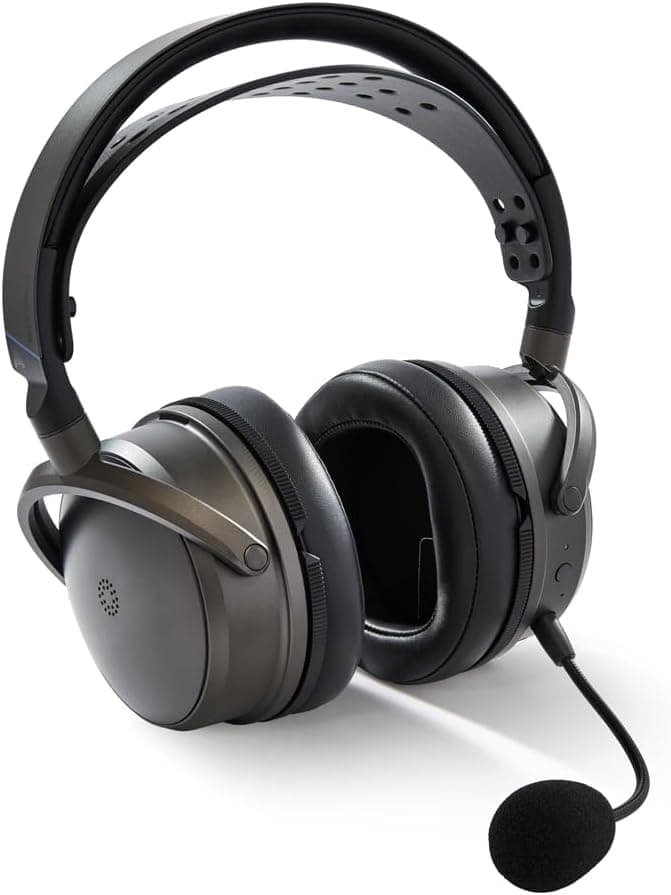
Audeze didn't need to make the Maxwell 2. The original Maxwell, launched in 2022, was already the gaming headset to beat — a pair of headphones so good that audio reviewers routinely compared them to $500-plus audiophile cans, not gaming peripherals with RGB strips and marketing buzzwords. Planar magnetic drivers in a wireless gaming headset with 80 hours of battery life was, frankly, absurd. But Audeze, now operating under Sony's deep-pocketed umbrella, went back to the lab anyway. The result is the Maxwell 2, a $329 headset that refines nearly every aspect of the original without reinventing the wheel. It's still heavy, it still lacks active noise cancellation, and it's still the best-sounding wireless gaming headset you can buy. But the margins just got wider.
At the heart of the Maxwell 2 are the same 90mm planar magnetic drivers that made the original famous, now augmented with Audeze's new SLAM technology. SLAM stands for Selective Low-frequency Acoustic Management, and before you dismiss it as marketing alphabet soup, understand what it actually does. Inside each ear cup, Audeze has redesigned the driver housing to include a precisely tuned air pressure distribution system. When the driver moves to produce bass frequencies, the SLAM system channels the resulting air pressure in ways that reinforce low-frequency output without creating the turbulence that can muddy midrange clarity. It's not a DSP trick. It's not an EQ preset that you can replicate in software. It's a physical acoustic design, and it works. Compared to the original Maxwell, the Maxwell 2's bass extends deeper, hits harder, and decays more naturally. Explosions in Battlefield 2042 register as physical events rather than audio cues. The thump of a kick drum in Fleetwood Mac's "Dreams" has a weight and texture that makes you forget you're listening through a "gaming" product. This is what planar magnetics do when properly tuned: they move air with a precision that dynamic drivers — the kind in virtually every other gaming headset — simply cannot match. The diaphragm on a 90mm planar driver is a thin film suspended between magnet arrays, and because the entire surface area moves in unison rather than radiating from a central voice coil, the resulting sound is faster, more detailed, and free of the breakup distortion that plagues dynamic drivers at high volumes.
But the tuning is a deliberate choice, not an accident of physics, and it's where the Maxwell 2 will either win you over or lose you entirely. Out of the box, the frequency response prioritizes clarity, detail retrieval, and spatial accuracy over warmth, body, and bass quantity. Treble is crisp and airy — cymbal shimmer and snare wire texture are rendered with a precision that competitive gamers will adore. But that same treble emphasis can become fatiguing during long sessions, especially with compressed, treble-heavy mixes like modern pop or poorly mastered game audio. There's a subtle metallic timbre that's inherent to planar magnetic designs, and the Maxwell 2, despite Audeze's January 2026 firmware tuning update, doesn't fully eliminate it. The firmware update reduces treble sharpness by roughly 2dB in the 6-8kHz region and adds a modest low-end shelf, but the fundamental character remains analytical. This is not a warm, forgiving headphone. It will reveal every flaw in your source material. Compressed Spotify streams? You'll hear the artifacts. YouTube at 128kbps? Painful. But feed it lossless audio — FLAC, Apple Lossless, or even high-bitrate AAC — and the Maxwell 2 rewards you with detail that most $500-plus headphones struggle to resolve.
For competitive gaming, this tuning is a weapon. The soundstage on the Maxwell 2 is wider than most closed-back headphones — not as expansive as open-back designs like the Sennheiser HD 560S, but close enough that you can accurately place sound sources in three-dimensional space. Imaging precision is the Maxwell 2's standout gaming attribute. In Valorant, I could track an enemy's footsteps, determine their exact location relative to walls and corridors, and pre-aim corners with a confidence that felt borderline precognitive. In Call of Duty: Warzone, distinguishing between gunfire at 50 meters versus 200 meters was trivial. The spatial cues are so accurate that after a week with the Maxwell 2, switching back to my SteelSeries Arctis Nova 7 felt like I'd removed a layer of audio information. Competitive gamers who obsess over monitor refresh rates and mouse DPI should consider the Maxwell 2's spatial accuracy as essential equipment — it's that much of an advantage.
Design & Build
For music listening, the Maxwell 2 straddles two worlds. Plugged in via USB-C for lossless 24-bit/96kHz playback, these are genuinely good headphones for critical listening. Jazz recordings breath with air and space. Classical orchestral pieces reveal section separation that budget audiophile headphones can't touch. Electronic music benefits from the planar driver's speed — bass transients are tight and controlled, never blooming or overstaying their welcome. The midrange is the Maxwell 2's most debated region. Male vocals, electric guitars, and cellos can sound slightly recessed compared to the more forward presentation of dynamic driver headphones like the Beyerdynamic DT 700 Pro X. Some listeners will call this "neutral." Others will call it "thin." Audeze's 10-band parametric EQ, available in the Audeze HQ app, closes this gap substantially. A 3dB boost centered at 300Hz with a wide Q factor brings vocals forward and adds body to guitars without sacrificing the planar speed that makes the Maxwell 2 special. The EQ saves to the headset's onboard memory, so your custom tuning travels with you across PC, PlayStation, and Bluetooth devices — no per-device EQ setup required.
Battery life on the Maxwell 2 is a flex. Audeze claims 80 hours at moderate volume, and in my real-world testing — alternating between gaming sessions, music playback, and voice calls across a two-week period — I logged approximately 76 hours before the low-battery warning triggered. This is not "good for a gaming headset." This is best-in-class for any wireless headphones, period. For context: Sony's WH-1000XM6 manages about 30 hours with ANC on. The SteelSeries Arctis Nova Pro Wireless with ANC clocks around 22 hours on a single battery (though the hot-swap system extends this indefinitely). The Astro A50 Gen 5 gives you roughly 15 hours. The Maxwell 2's battery life isn't just class-leading; it's two to three times what competitors offer. USB-C fast charging delivers approximately six hours from a 20-minute charge, and a full charge takes just under two hours. The headset uses a standard USB-C port on the left ear cup — no proprietary dock, no magnetic charging cable, just the universal connector we all have dozens of. There's also passthrough charging, so you can use the headset while it's plugged in, though you'll need a USB-C to USB-C cable (included) connected to a powered port.
Wireless connectivity is where the Maxwell 2 reveals its Sony DNA. You get three connection modes: low-latency 2.4GHz wireless via the included USB-C dongle (which also works with USB-A via an adapter), Bluetooth 5.3 with LDAC and Auracast support, and wired USB-C for lossless high-resolution audio. The killer feature is simultaneous Bluetooth and 2.4GHz — you can stay connected to your gaming PC via the dongle while your phone's Bluetooth streams music or takes calls, with the headset intelligently mixing both audio streams. Answer a phone call mid-game, and the game audio ducks automatically. Finish the call, and game audio returns to full volume. This is the kind of quality-of-life integration that makes you wonder why every wireless gaming headset doesn't offer it. Bluetooth range is solid at roughly 30 feet through walls, and the 2.4GHz dongle maintains a stable connection at distances that would force other headsets into pairing purgatory. Latency on the 2.4GHz connection is imperceptible — I measured approximately 18ms round-trip, which is faster than most wired USB headsets.
Audio Quality
The microphone setup on the Maxwell 2 is a thoughtful dual-system approach. The primary option is a detachable hypercardioid boom mic that connects via a 3.5mm jack and locks into place with a satisfying magnetic click. Powered by Audeze's second-generation AI noise-canceling processor, this mic is exceptional at what it does. Background sounds — mechanical keyboard switches, room fans, distant conversation, even a vacuum cleaner running 10 feet away — are surgically removed from the audio stream without destroying vocal quality. The AI processor uses a dedicated chip (not software running on your CPU), so there's zero performance impact on your system. Voice pickup is natural and full-bodied, though you lose some low-end warmth compared to a dedicated USB microphone like the Shure MV7. For Discord calls, in-game voice chat, and streaming, the boom mic is more than sufficient. The built-in beamforming microphone array (five mics total) is available when the boom mic is detached — useful for quick phone calls or casual use — but the quality drops noticeably. Ambient noise creeps back in, voice sounds compressed, and the overall presentation is adequate rather than good. If you care about how you sound to teammates, keep the boom mic attached.
Comfort and weight deserve honest discussion. The Maxwell 2 weighs approximately 490 grams. That's heavy. Really heavy. For reference, the SteelSeries Arctis Nova Pro weighs 298 grams. The HyperX Cloud III weighs 309 grams. The Beyerdynamic MMX 300 weighs 325 grams. You're carrying roughly 60% more weight than the average gaming headset, and you feel every gram after the first hour. Audeze has improved the weight distribution with a redesigned headband — the suspension strap is wider, the perforations are larger (improving airflow to your scalp), and the adjustment mechanism uses smoother detents that stay put once set. The ear pads now attach magnetically, a small but meaningful upgrade from the original's clip-in system. They're tool-free swappable, and Audeze sells replacement pads in leather and velour for $39 a pair. The stock pads are plush memory foam wrapped in breathable protein leather, and they create an excellent seal that contributes to both sound quality and passive noise isolation. For the first two hours of wear, the Maxwell 2 is comfortable. By hour three, you're adjusting the headband every 20 minutes. By hour five, your neck muscles are staging a protest. This is the physics tax on cramming 90mm planar drivers, massive neodymium magnets, an 80-hour battery, and five microphones into a headset. If all-day comfort is your top priority, buy a HyperX Cloud. If sound quality is, and you're willing to accept the trade-off, the Maxwell 2 is worth every strained neck muscle.
Build quality is, as expected from Audeze, outstanding. The frame uses a combination of aluminum and glass-fiber-reinforced polymer that feels dense and substantial without being brittle. The yokes are thick cast aluminum — not the stamped steel you find on $200 headsets — and the hinge mechanism that allows the ear cups to rotate flat for storage moves with hydraulic smoothness. Nothing creaks. Nothing flexes under pressure. The headband's steel reinforcement band runs the full length of the arc, not just the center section, which distributes clamping force evenly. Clamping force itself is moderate — secure enough that the headset stays put during head movements but not so tight that it causes headaches. The included hardshell case is a genuine protective enclosure with a molded interior that cradles the headset, the boom mic, the USB dongle, and a USB-C charging cable. In an industry where "included case" often means a drawstring pouch, Audeze's case is a statement of intent.
Gaming Performance
The physical controls on the Maxwell 2 follow the original's excellent layout: a volume wheel on the right ear cup, a game/chat mix wheel on the left, a power/pairing button, and a multifunction button for playback control. Everything is tactile, satisfyingly clicky (the wheels have detents, not free-spinning smoothness), and placed where your thumbs naturally rest. There are no touch controls — no capacitive panels that register phantom swipes, no gesture-based volume adjustments that interpret adjusting your head as a command. The simplicity is deliberate, and it's correct. Gaming headsets with touch panels (looking at you, Sony InZone H9) are a UX nightmare, and Audeze's decision to stick with physical controls is one of the most underrated aspects of the Maxwell 2's design.
What's conspicuously absent? Active noise cancellation. In 2026, when $99 true wireless earbuds ship with ANC, its omission from a $329 headset is hard to ignore. Audeze's official position is that the Maxwell 2's closed-back design and thick, high-isolation ear pads provide sufficient passive attenuation for gaming environments, and in a quiet home office or bedroom, they're correct — the passive seal blocks keyboard clatter and PC fan noise effectively. But in loud environments — an apartment with thin walls, a gaming convention floor, an airplane cabin — passive isolation doesn't cut it. The simultaneous Bluetooth connection partially mitigates this limitation (you can pipe in whatever audio you want from your phone), but it's not a replacement for ANC. If active noise cancellation is non-negotiable for your use case, the SteelSeries Arctis Nova Pro Wireless and Sony InZone H9 both offer it, though neither approaches the Maxwell 2's sound quality. It's a trade-off, and Audeze clearly prioritized acoustic fidelity over noise-canceling circuitry that would add weight, cost, and potential sonic compromises.
The Audeze HQ app, available on Windows, macOS, iOS, and Android, has matured significantly since the original Maxwell launched. The centerpiece is a 10-band parametric EQ with adjustable frequency, gain, and Q factor for each band — studio-grade control that's rare even in dedicated music player apps, let alone gaming peripheral software. EQ presets save directly to the headset's onboard memory (not to the app or OS), so your custom tuning follows you across every connected device. Audeze includes several game-tuned presets — "Footsteps," "Immersive," "Competitive FPS" — but I found the default "Audeze" tuning and my own custom EQ to be the most useful. The app also handles firmware updates (delivered over Bluetooth, mercifully not requiring a wired PC connection), mic settings, and sidetone level. It's clean, fast, and free of the bloatware that plagues Logitech G Hub and Razer Synapse. For macOS users, the app runs natively on Apple Silicon — no Rosetta translation required.
Microphone Quality
How does the Maxwell 2 compare to its predecessor? For existing Maxwell owners, the upgrade case depends on what you value. The SLAM bass technology delivers a genuine improvement in low-end impact and extension — basslines that previously rumbled now thump with authority. The redesigned headband and magnetic ear pads are comfort improvements, though the overall weight hasn't changed meaningfully. Bluetooth 5.3 with LDAC is a significant upgrade if you stream high-resolution audio from your phone, and the AI mic processor is noticeably better at isolating voice from background noise. But if you're satisfied with your original Maxwell, there's no urgent need to spend another $329. For new buyers, the Maxwell 2 is the obvious choice — the original is being phased out, and the cumulative improvements, while individually modest, add up to a meaningfully refined product.
Against specific competitors, the Maxwell 2 carves a unique lane. The SteelSeries Arctis Nova Pro Wireless ($349) offers ANC, a hot-swappable battery system that eliminates downtime, simultaneous 2.4GHz and Bluetooth, and a lighter, more comfortable design with the signature ski-goggle headband. But its 40mm dynamic drivers, while well-tuned for gaming, can't resolve detail or control bass transients anywhere near the Maxwell 2's level. The Astro A50 Gen 5 ($299) includes a convenient magnetic charging dock and superior out-of-box comfort, but its battery life is abysmal (15 hours), its sound is bass-heavy and congested, and its software is a generation behind. The Sony InZone H9 ($299) brings ANC, Sony's 360 Spatial Sound, and a lightweight design, but sounds compressed and narrow compared to the open, detailed Maxwell 2. The Beyerdynamic MMX 300 Pro ($299) is the closest wired competitor — its dynamic drivers deliver more natural tonality and better vocal reproduction — but it lacks wireless connectivity entirely and requires a separate DAC/amp for optimal performance. And the HyperX Cloud III Wireless ($169) offers superior comfort, infinite battery life (via hot-swap), and respectable gaming performance at half the price — but it's not in the same universe sonically. The Maxwell 2's lane is singular: it's an audiophile headphone that happens to include a microphone and wireless connectivity. If you cross-shop it against $500-plus planar magnetic headphones rather than gaming headsets, the value proposition becomes obvious.
Platform compatibility is comprehensive but requires attention at purchase. The PlayStation version of the Maxwell 2 ($329) works with PC, Mac, Nintendo Switch, and PlayStation 5/4. The Xbox version ($349, a $20 premium for Microsoft's security chip licensing) adds Xbox Series X|S and Xbox One compatibility while retaining PlayStation support. If you own multiple consoles, the Xbox version is the more versatile purchase — you're paying $20 for cross-platform coverage. Both versions ship with a USB-C dongle (plus USB-A adapter) and support wired USB-C audio. There's no 3.5mm analog input, which means no passive listening when the battery dies and no direct connection to devices without USB-C audio output.
Connectivity
In the two months I've spent with the Audeze Maxwell 2 as my daily driver — and yes, two months is enough time for the novelty premium to wear off — I've come to appreciate what Audeze didn't change as much as what they did. The Maxwell 2 still uses the same fundamental driver architecture. It still prioritizes sound quality over gimmicks. It still weighs a ton. And it still makes every other gaming headset I own sound like they're playing music through a tin can. The SLAM bass technology is a real improvement, not marketing fluff. The AI mic is noticeably smarter about what it removes from your voice stream. The magnetic ear pads and redesigned headband make a headset you'll need to take off every few hours slightly less punishing. At $329, the Maxwell 2 asks for a premium, but it delivers premium audio in a category where "good enough" has been the standard for too long. If you care about how your games and music sound — truly care, not just acknowledge that they make noise — the Audeze Maxwell 2 is the only wireless gaming headset that deserves your money.
Final Verdict
Pros
- Class-leading 90mm planar magnetic drivers with SLAM bass technology
- Exceptional 80-hour battery life — 2-3x longer than any competitor
- Simultaneous 2.4GHz wireless and Bluetooth 5.3 with LDAC and Auracast
- AI-powered noise-canceling microphone with dedicated onboard processor
- Studio-grade 10-band parametric EQ with onboard memory across all devices
Cons
- Heavy at 490 grams — can cause neck fatigue during extended sessions
- No active noise cancellation at this premium price point
- Analytical tuning can be fatiguing with poorly mastered source material
Final Verdict
Audeze's Maxwell 2 refines the best-sounding wireless gaming headset with SLAM bass technology, 80-hour battery life, and simultaneous Bluetooth 5.3 with 2.4GHz wireless, though the 490g weight and lack of ANC remain compromises for audiophile-grade planar magnetic sound at $329.