Garmin Instinct 3 Solar Review: The Rugged GPS Watch That Never Needs a Charger
The Garmin Instinct 3 Solar packs multi-band GPS, a built-in flashlight, and Garmin's full health suite into a 53-gram rugged case with battery life measured in weeks, not days. Solar charging makes it effectively unlimited in smartwatch mode, and at $349.99 it is the best adventure watch value Garmin sells.
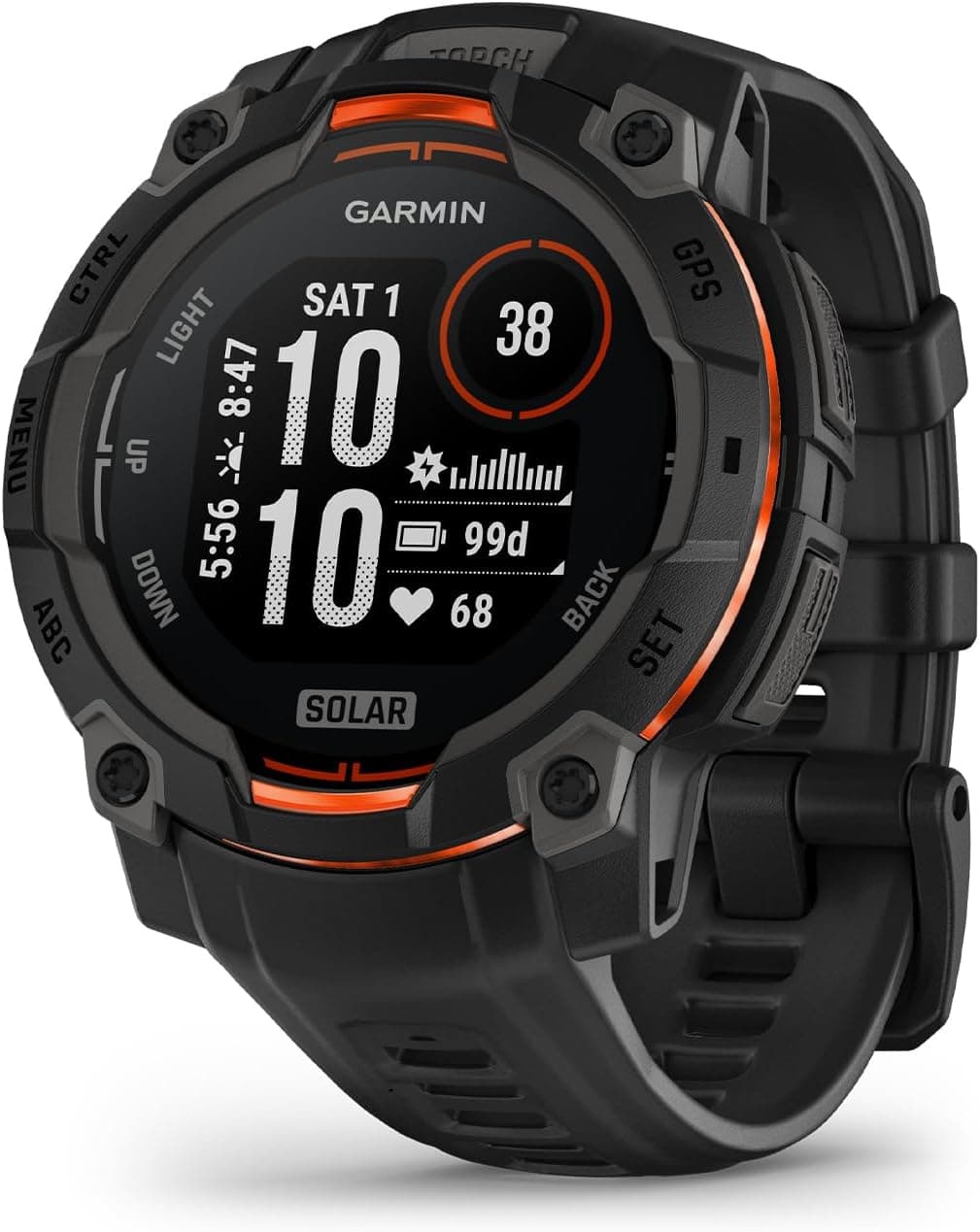
The Garmin Instinct 3 Solar occupies a strange and wonderful position in Garmin's lineup. It is not the flagship. It does not have a gorgeous AMOLED screen, touch controls, or full topographic maps. It does not carry the Fenix name or the price tag that comes with it. And yet, for anyone who spends serious time outdoors, it may be the most compelling watch Garmin sells right now. After several weeks with the 45mm Solar model in black, including long hikes under mixed canopy, a multi-day backpacking trip above the tree line, and plenty of daily wear around town, I can confidently say this: the Instinct 3 Solar is the rare device where the marketing actually undersells the reality. The headline feature, of course, is the battery. Garmin claims up to 28 days of smartwatch mode and an effectively unlimited lifespan when the solar lens gets enough sun, and those numbers are not marketing fiction. But the watch earns its keep in a thousand smaller ways too, from the multi-band GPS that locks onto position in dense forest to the built-in flashlight that I now reach for several times a day. At $349.99 on Amazon at the time of writing, down from the $399 MSRP, this is a watch that asks very little of you and gives back an enormous amount.
Design, Build, and Display
The Instinct 3 Solar looks like what it is: a tool first, a fashion accessory second. The 45mm case measures 45 x 45 x 14.9 millimeters and weighs just 53 grams on the stock silicone strap, which makes it essentially unnoticeable during a full day of wear. The polymer case is reinforced with a metal bezel ring that Garmin describes as metal-reinforced, and the whole assembly carries a 10ATM water rating alongside MIL-STD-810 durability certification. In practical terms, that means it survives the abuse that ends lesser watches: scrapes against granite, rain-soaked trail runs, accidental whacks against door frames, and the general chaos of outdoor life. The Power Glass lens covering the display is scratch-resistant, and the watch face itself sits recessed enough that you rarely worry about impact damage.
The control scheme is pure Instinct DNA: five physical buttons arranged around the case, two on the left and three on the right. There is no touchscreen on the Solar model, and that is a deliberate choice rather than an omission. When your fingers are wet, gloved, muddy, or numb from cold, buttons always work. The button layout is intuitive after about a day of use: the upper-left button cycles through activity profiles, the upper-right starts and stops activities, and the lower buttons navigate menus and confirm selections. Each button has a satisfying tactile click, and Garmin's menu logic, once you learn it, is fast to operate without looking at the screen.
The display itself is a memory-in-pixel (MIP) panel, 0.9 inches across at 176 x 176 pixels in the 45mm Solar model. It is a two-window design with a small secondary window cut into the upper portion of the main display, a nod to the classic Instinct look that also gives you glanceable data like altitude or heart rate while the main window shows something else. MIP screens are the unsung heroes of outdoor watches: they are always on, consume almost no power, and remain perfectly readable in direct sunlight, which is exactly when AMOLED screens struggle. The trade-off is obvious indoors, where the grayscale, low-resolution panel looks dated next to the 390 x 390 AMOLED screens on the pricier Instinct 3 AMOLED models. Text is legible but not crisp, and there is no color to speak of. If you care about watching your watch look pretty, buy the AMOLED. If you care about it working for weeks without a charger, the Solar's MIP panel is precisely what you want.
Solar Charging and Battery Life
Let us talk about the battery, because it is the reason this watch exists and the reason you should consider it. The Instinct 3 Solar uses a significantly improved solar layer that Garmin says captures roughly five times more power than the solar tech in the Instinct 2 Solar. The result is a set of battery figures that would have seemed absurd three years ago: up to 28 days in smartwatch mode without any sun, or unlimited in smartwatch mode with regular daylight exposure. In GPS mode, the 45mm Solar model is rated for 40 hours, extending to 130 hours with solar, and up to 100 hours in the Max Battery GPS mode with solar assistance. The 50mm Solar model pushes those numbers even further, to 60 hours of GPS and 260 hours with solar.
Those are manufacturer claims, so let me tell you what I actually measured. On a three-day backpacking trip in the Sierra with the GPS set to GPS-only mode (not even the power-hungry multi-band setting), I tracked roughly 18 hours of recorded hiking across those days. The battery dropped from 100 percent to 74 percent, and that included a full day of exposure to strong sun while we hiked along exposed ridgelines. In other words, the watch consumed about 26 percent in three days of heavy use while also running 24/7 heart rate, sleep tracking, and notifications. On typical forested trails where the watch dipped in and out of shade, the battery barely moved day to day. HikingGuy, who has stress-tested the Instinct 3 Solar extensively, reported about 75 hours of GPS-only tracking in mixed canopy and roughly 150 hours in full sun above the tree line, where the battery actually climbed instead of dropped. I experienced that same phenomenon: on sunny ridgeline days, I ended with more charge than I started.
The practical upshot is transformative for how you use a watch. You stop thinking about chargers entirely. On a week-long trip, you simply do not bring the charging cable, and you do not worry. The watch supports Garmin's Expedition mode for multi-day navigation, with the 45mm Solar rated for up to 36 days in Expedition mode, unlimited with solar. There are very few consumer electronics you can say this about, and it changes the calculus for anyone who has ever had a smartwatch die on day two of a backcountry trip.
GPS and Navigation
The Instinct 3 Solar ships with Garmin's latest GPS hardware, the same multi-band, dual-frequency chipset found in recent Fenix and Forerunner flagships. That is a serious upgrade over the Instinct 2 line, and it shows. The watch offers four GPS modes: GPS-only, All Satellites, Multi-Band, and UltraTrac. Multi-Band uses both L1 and L5 frequencies to lock onto position even in urban canyons and dense forest, at the cost of battery life. GPS-only is the efficiency king, and SatIQ, Garmin's automatic mode selector, will flip between the various modes on the fly based on your environment, choosing the best accuracy per unit of battery. In practice, I ran the watch in SatIQ mode for most of my testing, and the tracks it produced were excellent. On a hike through a densely forested canyon where my phone's GPS wandered badly, the Instinct 3 held a clean, consistent track that matched the trail exactly. Out in the open, GPS-only mode was more than adequate.
For navigation, the Instinct 3 Solar does breadcrumb-style navigation rather than full mapping. You can upload courses from Garmin Connect, follow a breadcrumb trail to a waypoint, mark waypoints on the fly, and use TracBack to retrace your steps to the trailhead. What you do not get is the full topographic map rendering you would find on a Fenix or an epix, with contour lines and labeled terrain. That is the single biggest feature cut compared to Garmin's premium lines, and it is worth being honest about. The breadcrumb navigation works well for following a pre-planned route, but it will not show you the terrain around you, and if you wander off-route, you will not see cliffs, lakes, or trail junctions on the display. For hikers who navigate by waypoints and route lines, this is fine. For people who want a full map on their wrist, the Instinct 3 is not that watch.
There is one performance quirk worth noting: the Solar model is noticeably slower than the AMOLED version when loading routes and saving long activities. DCRainmaker observed that saving an activity over an hour in duration can take upwards of 30 seconds on the Solar edition, compared to nearly instant on the AMOLED, and I saw the same behavior. It is a minor annoyance rather than a dealbreaker, but if you record very long activities and want instant saves, the AMOLED model is snappier.
Health and Fitness Tracking
The Instinct 3 Solar is not just a navigation tool; it is a full-featured training and health watch, and here Garmin's software maturity shows. The optical heart rate sensor is the Elevate V4, the previous-generation sensor rather than the newer V5 found on the Fenix 8 and the Venu 4, but in my testing it remained accurate during steady-state runs, interval sessions, and daily wear. DCRainmaker's extensive testing found the wrist-based heart rate to be solidly accurate for a wrist sensor, and my own comparison against a chest strap during a tempo run showed the watch tracking within a few beats per minute. During weightlifting and other activities with rapid heart rate spikes, wrist sensors universally lag, and the Instinct 3 is no exception, but for cardio work it is dependable.
The health suite is the full Garmin stack. You get 24/7 heart rate monitoring, heart rate variability (HRV) status, sleep tracking with sleep stages, Body Battery energy monitoring, blood oxygen (Pulse Ox) measurement, stress tracking, and a morning report that summarizes your readiness for the day. Training features include VO2 max estimates, race time predictions, training load and load focus, recovery time, lactate threshold estimation, and Garmin's training readiness score. For runners, there is a built-in race predictor that estimates finish times for common distances, and the watch supports structured workouts, interval training, and Garmin Coach adaptive training plans. The Instinct 3 also added a few welcome upgrades over the Instinct 2, including improved sleep tracking with sleep coach suggestions.
The built-in flashlight deserves its own paragraph, because it is quietly one of the best features on any watch Garmin makes. The LED flashlight is mounted on the case and can be activated with a long press of a button. It is bright enough to light a tent interior, find a dropped item under a car seat, or navigate a dark trail to a campsite, and Garmin added a red light mode that preserves night vision. I found myself using the flashlight several times a day for tasks that previously required pulling out my phone, and on a midnight bathroom run in the backcountry, it was genuinely invaluable. This is the kind of feature that sounds trivial in a spec sheet and turns out to be the one you use more than any other.
Smart Features and Everyday Usability
The Instinct 3 Solar runs the full Garmin smartwatch experience, with some caveats. It delivers smartphone notifications for calls, texts, and apps, and you can respond to messages with canned replies from an Android phone, though iPhone users are limited to viewing. There is Garmin Pay for contactless payments, which worked reliably at the handful of terminals I tried, and the watch supports music playback controls for your phone, though it does not have onboard music storage like some Garmin models. That last point matters: if you want to leave your phone behind and stream music from your wrist, the Instinct 3 Solar cannot do it. The AMOLED version cannot either, so this is a series-wide limitation rather than a Solar-specific one.
Safety features are well covered. The watch supports LiveTrack, which shares your real-time location with contacts during an activity, and Incident Detection, which sends an automatic message with your location if it detects a hard impact or sudden stop during certain activities. These features require your phone to be nearby, but they are the kind of thing you hope never to need and are glad to have in the backcountry. The 24/7 health monitoring also feeds into a surprisingly good sleep tracking implementation, with sleep stages, a sleep score, and coaching insights that help you understand your recovery.
One area where the Instinct 3 Solar genuinely impresses is everyday comfort and wearability. At 53 grams on a flexible silicone strap, it disappears on the wrist. The strap uses a standard quick-release mechanism, so swapping in a nylon or leather band takes seconds, and the watch works fine with third-party 22mm straps. The five-button interface means you can operate it with gloves on, in the rain, or in the pool, and the 10ATM rating means you can swim, snorkel, and even do recreational scuba diving with it. This is a watch you put on and forget about, in the best possible way, because you never have to think about charging it, protecting it, or being careful with it.
Instinct 3 Solar vs. the Competition
The Instinct 3 Solar does not exist in a vacuum, and its biggest competitor is arguably its own sibling. The Instinct 3 AMOLED, at $449 for the 45mm model, swaps the MIP display for a gorgeous 390 x 390 AMOLED panel with double the pixel density, adds richer colors, and is faster at loading routes and saving activities. In exchange, you give up the solar charging and the battery longevity that defines the Solar model: the AMOLED is rated for 18 days of smartwatch mode and 32 hours of GPS, with no unlimited-solar upside. If you want a beautiful screen and charge your watch weekly anyway, the AMOLED is the better everyday companion. If you want a tool that runs for weeks and never asks for a charger, the Solar wins, full stop.
Then there is the budget-friendly Instinct E at $299, which Garmin positions as an entry point to the Instinct line. It lacks the multi-band GPS, the flashlight, Garmin Pay, and the metal-reinforced bezel, making it a noticeably lesser watch that shares the Instinct design language. The $349.99 street price of the Instinct 3 Solar makes the value argument straightforward: for roughly $50 more than the Instinct E, you get the flashlight, multi-band GPS, contactless payments, and the vastly better solar charging. That is an easy $50 to spend.
Looking further afield, the Instinct 3 Solar competes with the Coros Pace Pro at $349 and the Suunto Race S at $349, both of which offer full-color maps and touchscreens that the Instinct lacks. The Coros Pace Pro in particular is a serious value proposition with its AMOLED display and mapping. What neither of those watches offers is the Instinct's solar endurance, its MIL-STD-810 durability pedigree, or the maturity of Garmin's health and training ecosystem. The Amazfit Active 2 at under $100 is a fine budget tracker with maps, but it is a fundamentally different category of device, more fitness band than rugged adventure watch. For hikers, trail runners, mountaineers, and anyone who measures trips in days rather than hours, the Instinct 3 Solar's combination of durability, accuracy, and battery life remains unmatched at this price.
Who Should Buy the Garmin Instinct 3 Solar
The Instinct 3 Solar is for a specific person, and it is refreshingly honest about that. Buy it if you are a hiker, backpacker, trail runner, climber, or outdoor professional who wants a watch that tracks your movement accurately, monitors your health around the clock, and runs for weeks on end without being coddled. Buy it if you have ever been on a multi-day trip with a smartwatch and watched the battery die on day two, or if you have ever hesitated to record a long activity because you were worried about charge. Buy it if you want Garmin's industry-leading GPS accuracy, the full training and health suite, Garmin Pay, and a built-in flashlight, all in a package that weighs less than many rings and shrugs off abuse.
Do not buy it if you want a beautiful screen, because the Solar's MIP display is utilitarian by design and looks it. Do not buy it if you need full mapping on your wrist, because the breadcrumb navigation, while functional, is a generation behind the Fenix's map rendering. Do not buy it if you want touch controls, onboard music, or a watch that looks at home in a boardroom. And do not buy it if you simply will not spend enough time in the sun for the solar panel to matter, in which case the Instinct 3 AMOLED is the better watch for the same money. The 50mm Solar model, at $449, adds a bigger display and even more extreme battery life, and it is worth the premium if you have the wrist for it, but the 45mm is the sweet spot for most people.
There is also the question of whether existing Instinct 2 Solar owners should upgrade. The answer is a qualified yes. The multi-band GPS alone is a meaningful upgrade for anyone who has fought for GPS lock in dense terrain, and the flashlight is a feature you will wonder how you lived without. The fivefold improvement in solar capture and the 40-hour GPS rating, up from 30 on the Instinct 2 Solar, close the deal for anyone who lives on the trail. If your Instinct 2 is still going strong and you mostly hike in open terrain, the upgrade is nice to have rather than essential, but the gap between the two generations is much larger than the price difference suggests.
Final Thoughts
The Garmin Instinct 3 Solar is the best rugged adventure watch Garmin has ever made at this price, and it is one of the most compelling wearables of any kind in 2026. It is not flashy. Its screen is small and grayscale, it refuses to draw you maps, and it will not play music from your wrist. What it does is track your movement with flagship-grade GPS accuracy, monitor your health around the clock with a mature and reliable sensor suite, and then keep running for weeks, or effectively forever with enough sunlight. The solar charging is not a gimmick; it is a fundamental change in how you relate to a smartwatch, and once you have lived with a watch that never asks for a charger, it is hard to go back.
The flashlight is the surprise star, the multi-band GPS is the quiet workhorse, and the durability, comfort, and button-driven usability make it a watch you can wear every day and beat on without worry. At $349.99, it undercuts the AMOLED model while delivering the battery endurance that defines the Instinct line, and it makes the $299 Instinct E look like a false economy. If you spend your weekends on trails and your weekdays at a desk, and you want one watch that does both without compromise, the Instinct 3 Solar is the one to get. It is not the fanciest watch Garmin sells, but it might just be the best tool the company has ever put on a wrist, and for its intended audience, there is nothing else quite like it.
Buy the Garmin Instinct 3 Solar on Amazon — or check current pricing at Best Buy and B&H, where the 45mm Solar model typically matches or beats the $399 MSRP.
Pros
- Near-unlimited battery life with solar charging
- Flagship-grade multi-band GPS accuracy
- Built-in flashlight is genuinely useful
- Tough 10ATM, MIL-STD-810 build
- Full Garmin health and training suite
Cons
- No full topographic maps
- Low-resolution MIP display
- No onboard music storage
- Solar model is slow to save long activities
Final Verdict
The Garmin Instinct 3 Solar packs multi-band GPS, a built-in flashlight, and Garmin's full health suite into a 53-gram rugged case with battery life measured in weeks, not days. Solar charging makes it effectively unlimited in smartwatch mode, and at $349.99 it is the best adventure watch value Garmin sells.