JBL Flip 7 Review: A Portable Powerhouse That Refines a Winning Formula
The JBL Flip 7 builds on the classic Flip formula with IP68 waterproofing, AI Sound Boost, a 7-band EQ, and Auracast multi-speaker support. It delivers punchy, fun sound in a rugged package, though the missing microphone and detachable accessories give us pause.
Portable Bluetooth speakers are a crowded market, but the JBL Flip series has been a consistent favorite for over a decade. With the Flip 7, JBL takes everything that made the Flip 6 a bestseller and refines it with meaningful upgrades — a higher IP68 durability rating, a new AI Sound Boost feature, a 7-band EQ in the companion app, and Auracast support for linking up to 100 speakers. But does it justify the $150 price tag when competitors like the Bose SoundLink Flex and the UE Boom 4 are also vying for your attention? After extensive testing across multiple environments — from quiet home offices to noisy outdoor parties — I can say the JBL Flip 7 is a fantastic portable speaker that gets more right than wrong, though it is not without its quirks.
Design and Build Quality
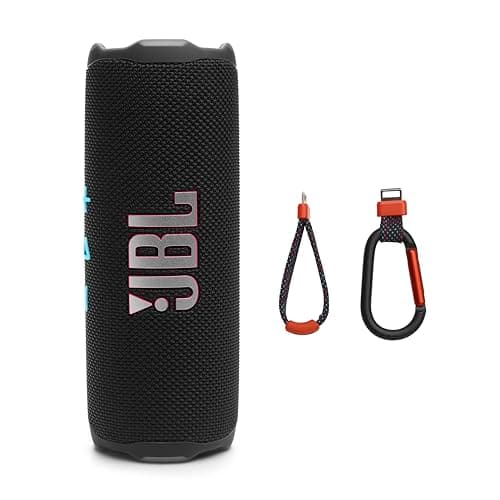
The JBL Flip 7 retains the iconic cylindrical design that has defined the Flip line since the beginning, but JBL has made several notable refinements. The speaker measures 7.3 inches long and 3 inches in diameter, making it roughly the size of a large water bottle. It weighs 1.2 pounds, which is light enough to toss in a backpack without thinking twice but substantial enough to feel premium in hand.
The biggest design change is the inclusion of a removable fabric lanyard loop and a small carabiner, replacing the integrated loop found on previous models. This is a double-edged sword. On one hand, the carabiner makes it easy to clip the speaker to a backpack or belt loop. On the other hand, both accessories are entirely detachable, which means they are incredibly easy to lose. If you take the Flip 7 to a crowded beach party or toss it in a shared bag, do not be surprised if the lanyard walks away on its own.
The button layout has been slightly redesigned compared to the Flip 6. You get the usual volume controls, a play/pause button, and a separate row for power, Bluetooth pairing, and Auracast syncing. All buttons have a satisfying click and light up when active, which is a nice touch for low-light environments. On the bottom, you will find a USB-C port for charging, and JBL has finally included the ability to skip back a track — a feature that should have been there from the start.
The speaker is available in ten colors: Black, Black/Orange, Blue, Pink, Purple, Red, Sand, Squad, Teal, and White. Whether you want something that blends into your living room or a neon blast of personality for the pool, there is an option for you.
Durability That Sets a New Standard
This is where the Flip 7 truly shines. The speaker carries an IP68 rating, which means it is completely dust-tight and can survive submersion in fresh water to a depth of over one meter for 30 minutes. That is a meaningful upgrade over the Flip 6's IP67 rating, which only guaranteed protection against temporary submersion. JBL has also added rubber bumpers at both ends that absorb shock from drops up to one meter. In my testing, I dropped the Flip 7 from about four feet onto concrete, and it emerged completely unscathed.
There is one catch worth noting: the Flip 7 sinks. Unlike some speakers that are designed to float, this one heads straight for the bottom if you drop it in a pool or lake. That is not a dealbreaker by any means — just make sure you are quick to retrieve it, or better yet, keep it secured with the included carabiner when you are near open water.
Sound Quality: Punchy and Fun
The JBL Flip 7 packs a 25-watt woofer and a 10-watt tweeter, along with dual passive radiators that give it surprising bass presence for such a compact speaker. Out of the box, the sound signature is distinctly V-shaped — bass and treble are emphasized while mids take a slight step back. This tuning is designed for maximum fun and energy, and it delivers exactly that. Tracks with heavy bass lines sound thundering, and cymbal crashes have a sparkle that cuts through outdoor ambient noise.
To understand the sound signature more precisely, I ran the Flip 7 through a series of test tracks spanning multiple genres. On electronic music like Daft Punk's "Contact," the bass hits with authority that belies the speaker's size. The dual passive radiators produce an audible thump you can feel in your hands if you are holding the speaker. On acoustic tracks like Tracy Chapman's "Fast Car," the midrange presentation is adequate but not exceptional — vocals sit slightly behind the instrumentation, which can be distracting if you focus on lyrics.
Rock music fares better. The crunch of distorted guitars on Queens of the Stone Age's "No One Knows" comes through with satisfying bite, and the drum transients retain their attack without becoming muddy. Classical and jazz are the weakest genres here. The V-shaped tuning pushes cello and double bass forward while pulling violins and brass into the spotlight, creating an unbalanced presentation that does not reflect how these instruments sound in a live setting. If your library leans heavily toward acoustic and classical genres, you will want to spend time with the EQ app to flatten things out.
In my listening sessions, the Flip 7 reached a measured output of 99.8 dB, which is genuinely loud for a speaker this size. It can fill a medium-sized living room with ease and handles backyard gatherings without breaking a sweat. At moderate volumes, the soundstage is impressively wide, with good instrument separation that makes tracks feel immersive rather than boxed in. This is a notable improvement over the Flip 6, which tended to sound congested when multiple instruments played simultaneously.
The new AI Sound Boost feature is an interesting addition. JBL claims it analyzes music in real-time to deliver maximum acoustic performance with less distortion. In practice, it works reasonably well at higher volumes, helping the speaker maintain clarity when you push it past 80 percent. At lower volumes, the effect is barely noticeable, which is fine — you do not need a computer analyzing your playlist when you are just trying to read a book. I did notice that AI Sound Boost occasionally introduced a slight compression effect on complex tracks, flattening dynamics in a way that reduced impact on crescendos. I ultimately left it disabled for most listening.
The real game-changer for audio tuning is the 7-band equalizer in the JBL app. Previous Flip models offered only basic bass and treble sliders, which was frustrating for anyone who wanted precise control over their listening experience. The new EQ lets you dial in exactly the sound profile you want. I found that cutting the 250 Hz band by about 2 dB and boosting the 4 kHz band by 1.5 dB produced a much more balanced sound that worked well across genres.
Battery Life: A Tale of Two Numbers
Battery life is rated at 16 hours, though that figure comes with the caveat that it uses a feature called Playtime Boost, which cuts bass and shifts the frequency response toward mids and treble to conserve power. With standard EQ at moderate volume, you can expect about 14 hours of real-world use. In my testing, playing at around 60 percent volume with Auracast off, I averaged about 13 hours and 45 minutes before the speaker gave me the low-battery warning. That is respectable for a speaker in this class.
The Playtime Boost feature extends battery life to the advertised 16 hours, but it fundamentally changes the sound signature in a way that most listeners will not enjoy. Bass is significantly reduced, and the overall presentation becomes thin and anemic. It is essentially a "podcast mode" that happens to save battery. I appreciate that JBL gives users the option to trade sound quality for runtime, but I suspect most people will try it once and never use it again.
Charging is via USB-C, and a full charge takes approximately 2.5 hours from empty. JBL does not include a charging cable in the box, which is frustrating for a $150 product. While most households have USB-C cables at this point, the omission still feels like unnecessary penny-pinching. The speaker supports pass-through charging, meaning you can play music while it charges, though the cable location on the bottom of the speaker makes this awkward in practice.
One notable upgrade is that the Flip 7 can now play audio over USB-C in addition to charging. This means you can connect it directly to a laptop or phone for lossless wired playback, bypassing Bluetooth compression entirely. The feature works well — I tested it with a MacBook Pro, and the audio quality improvement over Bluetooth AAC was immediately noticeable, especially on high-bitrate FLAC files. The downside is that wired playback does not simultaneously charge the speaker, so you will need to choose between lossless audio and keeping the battery topped up.
There is one notable omission: the Flip 7 does not have a built-in microphone. That means you cannot take phone calls through the speaker or use voice assistants like Siri or Google Assistant. For a $150 speaker in 2026, this feels like an oversight. If hands-free calling is important to you, the JBL Charge 6 or the Bose SoundLink Flex are better options.
Connectivity and Auracast
The JBL Flip 7 uses Bluetooth 5.4, which is the latest standard and offers improved range and power efficiency. I tested the range in a typical suburban home and got about 130 feet of reliable connection through two walls before audio started cutting out. That is excellent performance and should cover most real-world use cases.
Multipoint pairing is supported, allowing you to connect two devices simultaneously. This worked flawlessly in my testing — I could seamlessly switch from a laptop to a phone without manually disconnecting and reconnecting.
The headline connectivity feature is Auracast support, which allows you to link up to 100 JBL Auracast-compatible speakers for synchronized playback. This is a genuinely impressive party trick. I tested it with two Flip 7 units and the sync was tight enough that I could not detect any latency between them. If you ever host outdoor gatherings where you want music to follow guests from the patio to the pool, Auracast makes that trivially easy.
The downside is backwards compatibility. The Flip 7 uses Auracast for speaker syncing, which means it cannot connect to older JBL speakers that use PartyBoost. If you already own a Flip 6 or Charge 5 and were hoping to pair them with the Flip 7, you are out of luck. You will need to replace your entire fleet of JBL speakers to take advantage of the multi-speaker feature, which feels a bit like planned obsolescence.
How It Stacks Up Against the Competition
The portable Bluetooth speaker market is fiercely competitive, and the Flip 7 faces strong rivals at nearly every price point. To make a truly informed decision, it helps to understand exactly where the Flip 7 excels and where it falls short relative to its main competitors.
Against the Bose SoundLink Flex (2nd Gen), the Flip 7 offers louder maximum volume and deeper bass, but the Bose has a smoother, more balanced sound profile that many listeners will prefer for casual listening. The Bose also floats, which is a genuine advantage for poolside use. The Flip 7 wins on color variety and Auracast multi-speaker support.
Compared to the UE Boom 4, the Flip 7 feels more rugged with its IP68 rating versus the Boom 4's IP67. The Boom 4 has a more neutral sound signature and comes with a built-in strap that is integrated rather than detachable. The Flip 7 gets louder and has the better companion app.
Against its own sibling, the JBL Charge 6, the Flip 7 trades raw power for portability. The Charge 6 is larger, heavier, and significantly louder, with deeper bass extension. It also includes a power bank function that lets you charge your phone from the speaker. If you prioritize sound quality and do not mind the extra bulk, the Charge 6 is the better choice. If you want something you can toss in a daypack without noticing, the Flip 7 is the way to go.
If you need even more power for outdoor gatherings, the JBL Xtreme 5 offers significantly louder volume and deeper bass, though it sacrifices portability.## The JBL App Experience
The JBL Portable app has improved significantly over the years. Setting up the Flip 7 takes about 30 seconds — you open the app, press the Bluetooth button on the speaker, and the app detects it automatically. The main screen shows battery level, volume control, and quick access to the EQ.
The 7-band EQ is the standout feature here. It offers sliders for 50 Hz, 125 Hz, 250 Hz, 500 Hz, 1 kHz, 4 kHz, and 8 kHz, giving you granular control over the sound signature. There are also presets for Jazz, Vocal, Bass, and Club, though I found these to be overly aggressive. The "Flat" preset plus a few dB of bass boost was my preferred configuration.
The app also handles firmware updates, which is important because JBL has been shipping feature improvements via firmware throughout the product's lifecycle. You can also configure Auracast groups and manage multipoint connections from the app.
Real-World Usage Scenarios
I used the JBL Flip 7 across a variety of settings over two weeks to get a complete picture of its capabilities. This is a speaker that is designed to move with you, so I evaluated it in as many real-world contexts as possible rather than confining it to a single listening room.
Around the house, the Flip 7 is an excellent all-day speaker. I placed it in the kitchen during cooking sessions and found it had more than enough volume to overcome the noise of a vent hood and running water. Podcasts and audiobooks came through clearly, though the V-shaped sound signature means spoken word content can sound slightly recessed in the mids. Switching to the Podcast preset in the app helped significantly.
On a patio during a small gathering of six people, the Flip 7 performed admirably. At about 70 percent volume, it provided a comfortable background listening level with room to spare when someone requested a favorite song and we wanted to turn it up. The 360-degree sound dispersion means everyone gets roughly the same experience regardless of where they are sitting relative to the speaker.
For outdoor adventures, I took the Flip 7 on a day hike and clipped it to my backpack using the included carabiner. The IP68 rating gave me peace of mind when a sudden drizzle started, and the speaker kept playing without issue. At 1.2 pounds, it is noticeable on a backpack but not burdensome.
At the beach, the Flip 7 faced its toughest test. Sand, salt spray, and direct sunlight are a lethal combination for most electronics, but the Flip 7 handled it all without complaint. The rubber bumpers picked up some sand in the crevices, but a quick rinse under fresh water cleaned it up completely. The only downside was that the black color variant got noticeably hot in direct sunlight, though the speaker continued functioning normally.
The Value Proposition
At $149.95, the JBL Flip 7 sits in the upper-middle tier of the portable speaker market. It is more expensive than the Flip 6 (which still sells for around $100) and the UE Boom 4 ($129), but it offers meaningful upgrades in durability, sound customization, and future-proofing with Bluetooth 5.4 and Auracast.
Is it worth the premium over the Flip 6? For most people, probably not. The Flip 6 is still an excellent speaker, and the differences in sound quality are incremental. But if you value the IP68 rating, the 7-band EQ, and the ability to participate in Auracast multi-speaker setups, the Flip 7 justifies its price.
What Could Be Better
Nothing is perfect, and the Flip 7 has a few shortcomings worth mentioning.
The lack of a microphone is the most obvious omission. For $150, expecting the ability to take hands-free calls or use a voice assistant is reasonable, and the Flip 7 simply does not offer it.
The detachable accessories, while nice in theory, are too easy to lose. JBL should have made the lanyard loop integrated or at least included a storage slot for the carabiner on the speaker itself.
The Playtime Boost feature, which extends battery life by reducing audio quality, feels like a gimmick. Most users will want to listen to music at full quality all the time, and reducing bass to save battery is a compromise that undermines the core purpose of a speaker.
USB-C charging cable is not included in the box. In 2026, most people have USB-C cables lying around, but it still feels like a cost-cutting measure on a premium product.
Final Thoughts
The JBL Flip 7 is a refinement of an already excellent formula. It takes everything that made the Flip 6 a classic and adds better durability, more audio customization, and genuinely useful features like Auracast multi-speaker sync. The sound profile is fun and energetic, the build quality is outstanding, and the IP68 rating means you can take it just about anywhere without worrying about the elements.
It is not the speaker for everyone. Audiophiles looking for a neutral, reference-grade listening experience should look at the Bose SoundLink Flex. Budget-conscious buyers will find better value in the Flip 6 or the Anker Soundcore Boom 2. And anyone who frequently takes phone calls on speakerphone will be frustrated by the missing microphone.
But for the vast majority of people who want a portable, durable, great-sounding Bluetooth speaker that can keep up with their lifestyle, the JBL Flip 7 is an easy recommendation. It is the speaker you grab when you are heading out the door, the one that lives in your bag just in case, the one that turns an ordinary afternoon into a mini dance party. And that is exactly what a portable speaker should do.
Pros
- IP68 dust and waterproof rating with 1m drop protection
- Powerful, fun V-shaped sound with deep bass for the size
- 7-band EQ in app gives precise audio customization
- Auracast support for linking up to 100 speakers
- Bluetooth 5.4 with multipoint and excellent range
Cons
- No built-in microphone for calls or voice assistants
- Detachable lanyard and carabiner are easy to lose
- Playtime Boost kills sound quality for extra runtime
- USB-C charging cable not included in the box
Final Verdict
The JBL Flip 7 builds on the classic Flip formula with IP68 waterproofing, AI Sound Boost, a 7-band EQ, and Auracast multi-speaker support. It delivers punchy, fun sound in a rugged package, though the missing microphone and detachable accessories give us pause.