JBL Go 4 Review: Pocket-Sized Audio That Punches Well Above Its Weight
The JBL Go 4 delivers surprisingly punchy bass, IP67 ruggedness, and app-powered customization in a truly pocketable 190-gram package, making it one of the best ultra-portable Bluetooth speakers under $50.
The ultra-portable Bluetooth speaker category has evolved dramatically over the past decade. What began as novelty toys producing tinny, distorted sound have matured into genuinely capable audio devices that can fill a room, survive a pool party, and slip into a pocket without a second thought. JBL has been a dominant force in this space since the original Clip and Go series, and the JBL Go 4 represents the latest refinement of the company's smallest, most affordable speaker. At $49.95, it faces fierce competition from budget-focused rivals like the Tribit StormBox Micro 2, Anker Soundcore Select 4 Go, and Sony SRS-XB100. After spending considerable time with the Go 4, it is clear that JBL has made thoughtful, meaningful upgrades over its predecessor while maintaining the core formula that made the Go series a best-seller. The question is whether those upgrades are enough to justify choosing the Go 4 over increasingly capable alternatives.
Design and Build Quality
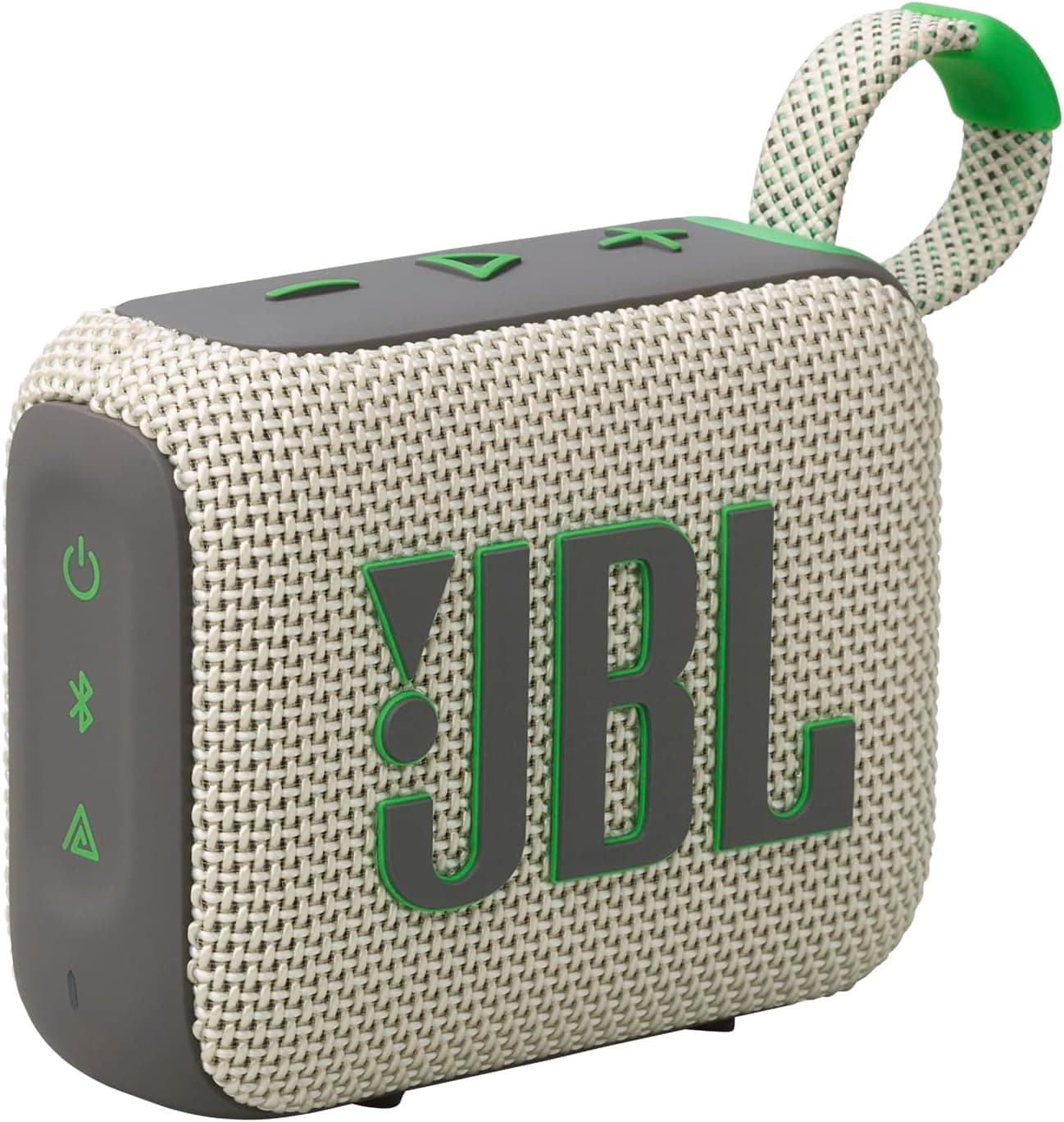
The JBL Go 4 is immediately recognizable as a JBL product, sharing the same rectangular prism form factor as its predecessor but with several meaningful refinements. Measuring just 94.3 by 75.7 by 42.2 millimeters and weighing a mere 190 grams (6.7 ounces), it is genuinely pocketable — it fits comfortably in a jeans pocket, a jacket pocket, a backpack side pocket, or a bicycle saddlebag without adding noticeable bulk. For context, it is roughly the size of a thick smartphone and lighter than most flagship phones on the market today.
The exterior is constructed from hard plastic with a soft-touch matte finish, surrounded by a full perimeter rubberized bumper that provides drop protection and grip. The rubber edging is noticeably more substantial than on the Go 3, wrapping completely around the device rather than just accenting the corners. This gives the Go 4 a more premium feel in hand and better impact protection when inevitably knocked off a picnic table or dropped during a hike.
Six colorways are available at launch: Black, Blue, Red, Purple, Grey, and Camo. The colors are vibrant and saturated, consistent with JBL's typically youthful aesthetic. The finish resists scratches reasonably well, though lighter colors may show dirt more readily over time — the Black and Grey variants are the most practical for daily carry.
The redesigned integrated carrying strap deserves special mention. JBL has widened the loop significantly compared to the Go 3, making it far easier to thread a carabiner through, clip to a backpack loop, or simply hook onto a finger. The strap is molded from the same rubberized material as the bumper and feels durable enough to support the speaker's full weight without concern. This might seem like a minor detail, but for a device designed to be taken everywhere, the carrying solution is a critical touchpoint, and JBL has demonstrably improved it.
Button layout on the top edge is straightforward: power, Bluetooth pairing, play/pause, and volume up/down. The buttons are raised with distinct tactile feedback, making them usable by feel without looking. A multi-color LED indicates battery status and Bluetooth pairing state. There is no 3.5mm auxiliary input — the Go 4 is Bluetooth-only, a decision that aligns with the trend toward fully wireless operation but may frustrate users who want to connect non-Bluetooth sources like older MP3 players or airplane entertainment systems.
Sound Quality
For a speaker that costs under $50 and fits in the palm of your hand, the JBL Go 4 produces genuinely impressive audio. It is powered by a single 45mm full-range active driver pushing 4.2 watts RMS, paired with a passive radiator that extends low-frequency response. The result is a sound signature that is warm, forward, and engaging — characteristics that JBL has refined across multiple generations of portable speakers.
Bass response is the most surprising aspect of the Go 4's performance. For its size, there is real punch and presence in the low end. Obviously, you should not expect subwoofer-like extension — frequencies below 90Hz roll off steeply, and there is no physical way to produce deep sub-bass from a driver this small. But for pop, rock, acoustic music, podcasts, and YouTube content, the Go 4 delivers a satisfyingly full-bodied presentation. The passive radiator adds noticeable weight to kick drums and bass guitars, giving the music a foundation that many speakers in this price range lack entirely.
The midrange is clear and well-defined, with vocals sitting naturally in the mix without being pushed forward or recessed. This makes the Go 4 excellent for spoken-word content — podcasts, audiobooks, and YouTube commentary — where vocal clarity is paramount. Notably though, the Go 4 has no built-in microphone for speakerphone use, a significant omission for a portable speaker in 2026. You cannot take calls through the Go 4, which means if you want a speaker that doubles as a conference call device, you will need to look at competitors like the Anker Soundcore series or the UE Wonderboom that include mic functionality. Treble is crisp without crossing into harshness, and there is no audible distortion even at maximum volume, which reaches approximately 83 decibels. That is loud enough for a small room, a campsite, or a beach towel but will struggle to project in a large outdoor space or a noisy party environment.
What Hi-Fi awarded the Go 4 a full five stars, describing its sound as "forward, cohesive" and praising its "pocketable power." Tom's Guide noted that audio "remained distortion-free even with the volume turned up, with most frequencies audible save the very lowest." These sentiments align with our experience: the Go 4 punches well above its weight class for casual listening but will not satisfy bass heads or those seeking room-filling volume for large gatherings.
The JBL Portable app adds significant value through its five-band custom EQ, which allows you to tune the sound to your preferences. Presets include Signature, Chill, Energetic, and Vocal, plus a fully customizable five-band equalizer. This is a meaningful upgrade over the Go 3, which had no app support at all. The ability to boost bass slightly or tame treble depending on content transforms the Go 4 from a one-trick pony into a genuinely versatile speaker that can adapt to different genres and listening environments.
Connectivity and Features
The JBL Go 4 is well-equipped for modern wireless use. Bluetooth 5.3 provides stable, energy-efficient connectivity with a range tested at up to 60 feet line-of-sight — more than enough for typical use cases like leaving your phone on the picnic table while you walk to the grill or keeping your laptop on the desk while you move around the room.
Codec support includes SBC and, according to several reviewers including Tom's Guide, AAC — though SoundGuys and some other sources list SBC only. This discrepancy may be explained by firmware updates that added AAC support after initial release. AAC support is beneficial for iPhone users, as it provides better audio quality at equivalent bitrates compared to SBC. Android users with AAC support in their devices will also benefit. The absence of aptX, LDAC, or LC3 is not surprising at this price point but means that audiophiles seeking the highest possible wireless audio quality will need to spend significantly more.
Multipoint Bluetooth is a welcome inclusion, allowing the Go 4 to maintain connections to two devices simultaneously. This means you can watch a video on your tablet and seamlessly switch to an incoming phone call without manually disconnecting and reconnecting — assuming the Go 4 had a microphone, which it does not. Still, multipoint is useful for managing audio sources without the hassle of constant re-pairing.
Auracast support is the headline connectivity feature. Auracast is a Bluetooth LE Audio broadcast technology that enables connecting multiple compatible speakers for synchronized audio playback. You can pair two JBL Go 4 speakers for true stereo separation, creating a left-right channel setup that dramatically improves the listening experience for music. You can also connect the Go 4 to other Auracast-enabled JBL speakers like the Clip 5 or Xtreme 4 for multi-room or party mode audio. This is a genuinely useful feature that few competitors at this price point offer, and it future-proofs the Go 4 as Auracast adoption grows across the industry.
The JBL Portable app (available for both iOS and Android) is the control center for these features. Beyond EQ, it provides firmware updates, PlaytimeBoost toggling, Auracast speaker configuration, and battery level monitoring. The app is well-designed and responsive, though some users may object to needing a smartphone app to access the full feature set — there is no on-device EQ control.
Battery Life
Battery life is the JBL Go 4's most significant compromise relative to its competitors. JBL rates it at up to 7 hours of continuous playback, and real-world testing tells a more modest story. At moderate volume levels (around 50 percent), most reviewers measured between 5 and 6 hours of actual use. The 7-hour claim is achievable at lower volumes, but the typical user listening at conversation-friendly levels will see closer to 5.5 hours.
This places the Go 4 at a distinct disadvantage compared to key rivals. The Tribit StormBox Micro 2 delivers 12 hours. The Sony SRS-XB100 offers an impressive 16 hours. Even the Anker Soundcore Select 4 Go manages 10 hours. For a device designed to be taken on day trips, beach outings, and hikes, 5 to 6 hours of real-world battery life feels tight — you will need to recharge if you plan to use the speaker throughout a full day of activities.
The PlaytimeBoost feature partially addresses this by extending battery life to approximately 9 hours at the cost of dramatically reduced bass response. When activated via the JBL Portable app, the speaker's DSP reduces low-frequency output to conserve power, producing a thinner, brighter sound signature. This trade-off may be acceptable for podcast listening or background audio in quiet environments but significantly degrades the music listening experience. It is a useful emergency option rather than a daily driver feature.
Charging takes approximately 2.5 to 3 hours via USB-C, and the speaker supports charging while playing. There is no fast charging capability, and no power adapter is included in the box — just a USB-C cable. This is standard practice at this price point but worth noting if you do not already have a USB charging brick.
Durability and Portability
The IP67 rating is a highlight feature that makes the Go 4 genuinely carefree to use in outdoor and wet environments. The 6 in IP67 means complete dust protection — sand, dirt, and debris will not penetrate the speaker's internals. The 7 means it can be submerged in fresh water up to one meter depth for up to 30 minutes without damage. This makes the Go 4 poolside-safe, beach-safe, shower-safe, and rain-safe.
It is worth noting that the USB-C port must be fully dry before charging, as with all IP67-rated devices. Attempting to charge a wet speaker can cause damage. The rubber port cover on the Go 4 seals securely, but users should be diligent about drying the speaker before plugging it in after pool or beach use.
The 190-gram weight combined with the integrated strap makes the Go 4 exceptionally portable. It clips easily to a backpack, belt loop, or carabiner and is light enough to forget you are carrying it. The rubber bumper provides genuine drop protection — we would not recommend throwing it down a mountainside, but it will survive accidental drops from table height onto grass, carpet, or even concrete with minimal risk.
JBL Go 4 vs JBL Go 3: What's New
If you already own a JBL Go 3, the question of whether to upgrade to the Go 4 depends heavily on which features matter most to you. The Go 4 shares the same basic form factor and IP67 rating as its predecessor but improves in several meaningful ways.
Battery life increases from 5 hours to 7 hours claimed, though real-world gains are closer to an additional 1 to 1.5 hours. The Go 4 adds the JBL Portable app with custom EQ, PlaytimeBoost, and Auracast configuration — the Go 3 had no app support at all. Multipoint Bluetooth is new, enabling simultaneous dual-device connections. The redesign adds a more durable integrated strap and full-perimeter rubber bumper. The driver and passive radiator tuning deliver JBL's claimed 10 percent stronger bass and 20 percent higher maximum volume. The Go 4 is also slightly lighter at 190 grams versus 209 grams for the Go 3.
If you are happy with the Go 3's performance and do not need app EQ or multipoint, the incremental improvements may not justify the upgrade cost. However, if you want modern connectivity features and the ability to customize your sound, the Go 4 is a worthwhile step up.
How It Compares to the Competition
The ultra-portable speaker market under $60 is fiercely competitive, and the JBL Go 4 faces strong challengers from multiple directions.
The Tribit StormBox Micro 2 is probably the Go 4's most direct competitor at a similar price point of around $39 to $49. It offers substantially louder output with a 10-watt driver (versus 4.2 watts), significantly longer battery life at 12 hours, and an integrated strap-and-clip system for mounting on backpack straps or belt loops. The StormBox Micro 2 sounds fuller and louder, making it better for outdoor use. The Go 4 counters with app-based EQ, Auracast multi-speaker support, a more refined design, and slightly smaller and lighter build. If raw volume and battery life are your priorities, the Tribit wins. If app features and brand ecosystem matter more, the JBL takes the lead.
The Anker Soundcore Select 4 Go undercuts the JBL on price at around $35 to $39 while offering 10 hours of battery life, Bluetooth 5.4, IP67 rating, and Soundcore's own app with EQ presets. It is slightly less refined in build quality but offers better value for budget-focused buyers. SoundGuys noted that while the Soundcore "offers good sound in a compact, grab-and-go design," it "doesn't quite match the JBL Go 4 in build quality."
The Sony SRS-XB100 is the battery life champion at this size class, delivering an industry-leading 16 hours of playback from a single charge. It also offers a multi-way strap that can be used as a stand or hanging hook. However, at $59.99, it is more expensive than the Go 4, and its sound signature is less bass-forward, with Sony's X-Balanced speaker driver prioritizing clarity over punch. The XB100 also weighs 274 grams compared to the Go 4's 190 grams, making it noticeably heavier for pocket carry. Sony wins for all-day listening and included microphone; JBL wins for portability, bass presence, and price.
Against the larger UE Wonderboom 4 at $99, the Go 4 offers a more compelling value proposition at half the price, though the Wonderboom delivers 360-degree sound, 14-hour battery, and a floating design for pool use. The Wonderboom is in a different size and price class entirely.
Who Should Buy the JBL Go 4
The JBL Go 4 is an easy recommendation for several specific use cases. If you need an ultra-portable speaker for daily carry — something that lives in your bag and comes out for impromptu listening sessions, hotel room background music, or quick podcast catch-ups — the Go 4's combination of size, sound quality, and app features is hard to beat at this price.
If you are invested in the JBL ecosystem and want Auracast compatibility for linking with other JBL speakers, the Go 4 is the most affordable entry point into multi-speaker setups. The ability to pair two Go 4 units for stereo sound or to sync with a Clip 5 or Xtreme 4 for party mode adds real value for JBL loyalists.
If you prioritize app-based EQ customization over raw battery life, the Go 4's five-band equalizer gives you control that most competitors in this price range do not offer. Being able to tune the sound to your preferences — boosting bass for workouts, flattening the response for podcasts — makes the Go 4 more versatile than speakers without app support.
However, if battery life is your primary concern, the Sony SRS-XB100 or Tribit StormBox Micro 2 will serve you significantly better. If you need a speakerphone for calls, the Go 4's lack of a microphone eliminates it from consideration entirely — look at the Anker Soundcore series or the UE Wonderboom instead. And if you want maximum volume for outdoor parties, the larger JBL Clip 5 or Flip 6 will fill a space more effectively.
Final Verdict
The JBL Go 4 is a thoughtful, well-executed evolution of the ultra-portable speaker formula. It improves on its predecessor in every meaningful way — better battery life, app support, multipoint Bluetooth, Auracast, refined design, and punchier sound — while maintaining the core attributes that made the Go series a global best-seller: genuine pocketability, rugged IP67 durability, and JBL's characteristic warm, engaging sound signature.
It is not the perfect budget portable speaker. The real-world battery life of around 5 to 6 hours is merely adequate in a segment where 10 to 16 hours is becoming standard. The lack of a microphone for calls is a frustrating omission for a device designed to be your constant companion. The Bluetooth-only connectivity limits compatibility with older devices. These are real compromises that matter depending on your use case.
Related: For more compact audio options, check out our reviews of the Sony WF-1000XM6 wireless earbuds and the Sony WH-1000XM6 over-ear headphones.
But at $49.95, the Go 4 delivers a polished, cohesive experience that justifies its price. The sound quality is genuinely impressive for the size, the app support adds meaningful functionality, and the build quality inspires confidence that this speaker will survive the adventures you take it on. What Hi-Fi's five-star rating is not hyperbole — for its intended purpose as an affordable, portable, worry-free audio companion, the JBL Go 4 is one of the best options available today.
If your priorities are battery life or call functionality, look at the alternatives we have discussed. But if you want the best-sounding ultra-portable speaker under $50 with the features and build quality to back it up, the JBL Go 4 is an easy choice. It is small, it is tough, and it sounds better than it has any right to. That is the definition of a winning formula.
Pros
- Genuinely pocketable at 190 grams with integrated carrying strap
- IP67 dustproof and waterproof for worry-free outdoor use
- App-based 5-band EQ transforms sound customization
- Auracast support for multi-speaker stereo and party mode
- Bluetooth 5.3 with multipoint for dual-device connectivity
- Surprisingly punchy bass for its size from 45mm driver
- Distortion-free audio even at maximum volume
Cons
- Real-world battery life of 5-6 hours trails competitors significantly
- No built-in microphone for speakerphone calls
- No 3.5mm auxiliary input — Bluetooth only
- PlaytimeBoost extends battery but kills bass response
- SBC-only codec (AAC unconfirmed) limits wireless audio quality
- Slow 2.5-3 hour charging time for modest battery capacity
Final Verdict
The JBL Go 4 delivers surprisingly punchy bass, IP67 ruggedness, and app-powered customization in a truly pocketable 190-gram package, making it one of the best ultra-portable Bluetooth speakers under $50.