JBL Tour One M3 Review: Versatile Premium Headphones with Smart Tx Innovation
The JBL Tour One M3 brings genuine innovation to the premium wireless headphone market with its Smart Tx transmitter, exceptional 70-hour battery life, and comprehensive feature set including LDAC support, Spatial 360 audio, and Personi-Fi 3.0 personalization — all at a competitive price point that undercuts Sony, Bose, and Apple.
The premium wireless headphone market is one of the most competitive spaces in consumer audio, dominated by heavyweights like Sony, Bose, and Apple. Breaking into this tier requires more than just good sound — it demands a compelling reason for buyers to choose your product over established icons. JBL's Tour One M3 doesn't just enter the conversation; it arrives with a genuine innovation that no competitor offers: a dedicated Smart Tx transmitter that turns these headphones into a full-fledged audio hub. After spending extensive time with the JBL Tour One M3, it's clear that JBL has built something that stands apart from the Sony WH-1000XM6, Bose QuietComfort Ultra, and Apple AirPods Max — not necessarily by beating them at their own game, but by offering a feature set that expands what premium headphones can do.
Design and Comfort
The JBL Tour One M3 adopts a refined, understated design language that prioritizes practicality over flash. The headphone is available in Black, Latte, and Blue finishes, all featuring a sleek matte texture that resists fingerprints better than the glossy finishes found on some competitors. At just 278 grams, the Tour One M3 is noticeably lighter than the Apple AirPods Max (385 grams) and comparable to the Sony WH-1000XM6 (around 250 grams), making it comfortable for extended listening sessions that can easily stretch across an entire workday or long-haul flight.
The ear cups are padded with plush faux leather that strikes an excellent balance between softness and support. Unlike some headphones that feel great for the first hour but develop pressure points after prolonged use, the Tour One M3 remains comfortable even during listening sessions spanning four to five hours. The clamping force is moderate — firm enough to create a good seal for noise isolation and prevent the headphones from shifting during movement, but not so tight that it becomes uncomfortable for glasses wearers. Speaking of glasses, the ear cup padding compresses enough around the temples to avoid the pinching sensation that some over-ear headphones cause.
JBL has also equipped the Tour One M3 with generous cushioning on the headband, distributing the headphone's weight evenly across the top of your head. The headband adjustment mechanism is smooth and clicks into place with satisfying precision, holding your chosen setting reliably. The overall build feels solid, though it's worth noting that the construction is primarily plastic with metal reinforcement in the headband. This is a deliberate choice to keep weight down, and for the most part it succeeds — the Tour One M3 doesn't feel cheap, but it doesn't convey the same premium tactility as the AirPods Max's aluminum housing or the Bowers & Wilkins Px8's leather and die-cast metal construction. Where it matters most — long-term comfort — the Tour One M3 excels.
One of the Tour One M3's practical advantages over many premium competitors is its foldable design. Unlike the AirPods Max, which requires a separate case for transport and doesn't fold flat, the JBL folds into a compact shape that fits into the included travel case. This makes the Tour One M3 genuinely portable — suitable for slipping into a carry-on bag or backpack without taking up excessive space. The included case is a semi-rigid zippered pouch with a soft interior lining, providing adequate protection for daily travel. It's not hard-shell, so you wouldn't want to check it in luggage, but for carry-on use it's perfectly adequate.
The physical controls are thoughtfully laid out and represent one of the areas where JBL has clearly learned from user feedback. The left ear cup houses a dedicated volume rocker with excellent tactile feedback. The right ear cup features a capacitive touch panel for playback controls (tap to play/pause, swipe for track navigation), an ambient sound toggle button that cycles through ANC modes, and a power slider. The power slider is particularly welcome — it provides positive tactile feedback and completely eliminates the accidental power-ons that plague touch-sensitive power buttons on competitors like the Sony WH-1000XM6. The capacitive touch panel is responsive and accurate, registering taps and swipes reliably during testing, though I did occasionally trigger a track skip when adjusting the headphones on my head.
What's in the Box
JBL provides a generous accessories package with the Tour One M3. Inside the box you'll find: the Tour One M3 headphones, the Smart Tx transmitter (in the bundle version), a USB-C to USB-C charging cable, a USB-C to 3.5mm analog cable for wired listening, a USB-C to USB-A adapter, the travel case, and the quick-start guide and warranty documentation. The inclusion of both USB-C and 3.5mm wired options is thoughtful, ensuring compatibility with everything from modern smartphones to older audio equipment. The cable quality is good — braided nylon that resists tangling and feels durable enough for daily use.
Sound Quality
JBL has equipped the Tour One M3 with 40mm mica dome dynamic drivers, tuned to deliver what the company calls its signature "JBL Pro Sound." The frequency response spans 10Hz to 40kHz, covering the full audible spectrum and extending well beyond for high-resolution audio content. With support for LDAC over Bluetooth 5.3, the Tour One M3 can handle 24-bit/96kHz hi-res audio when your source device and streaming service support it, which opens up a notably wider soundstage and more detailed instrument separation compared to standard AAC or SBC streaming.
Out of the box, the Tour One M3's sound signature is engaging and versatile — a welcome departure from the V-shaped tuning that dominates the consumer headphone market. The bass is present and punchy without being overwhelming. JBL has resisted the temptation to over-boost the low end, which plagues many consumer headphones and results in muddy, one-note bass that masks detail in other frequencies. Here, kick drums have satisfying impact and weight, bass lines remain articulate rather than indistinct, and the sub-bass extension is genuinely impressive for a closed-back wireless headphone. When listening to Daft Punk's "Random Access Memories," the low-end synthesizer patterns had texture and definition, while the kick drum in "Give Life Back to Music" punched with authority.
The midrange is where the Tour One M3 shows real sophistication and distinguishes itself from more affordable options. Vocals — both male and female — are rendered with clarity and natural timbre that makes them the centerpiece of the mix without sounding artificially forward. The upper mids are slightly emphasized, which helps with vocal intelligibility in busy arrangements, but this emphasis never crosses into harshness or sibilance. Acoustic instruments like guitars and pianos have believable texture and body. During testing with Norah Jones's "Come Away with Me," the warmth, breath, and detail in her voice came through beautifully, with the accompanying piano having both presence and physical weight. Moving to something more complex, Radiohead's "Kid A" revealed layers of atmospheric detail that lesser headphones tend to blur together.
Treble extension is smooth and detailed, with just enough presence to provide sparkle and air without venturing into fatigue-inducing brightness. Cymbals have appropriate shimmer and decay, and high-frequency details like sibilants, string resonances, and room ambience are present and clear without being harsh. The Tour One M3 avoids the common pitfall of exaggerated treble that sounds impressive in short retail demos but becomes grating over extended listening sessions. This headphone is one you could wear all day without experiencing listening fatigue — a quality that's harder to find than it should be in the wireless headphone market.
Spatial audio has become a standard feature in premium headphones, and JBL's implementation — Spatial 360 with head tracking — is competitive with the best in class. The head tracking is responsive and natural, creating a convincing sense of space when watching movies or listening to spatial audio mixes on Apple Music or Tidal. The tracking latency is low enough that there's no perceptible disconnect between head movement and audio adjustment, which is critical for maintaining immersion. The soundstage, while not as wide as open-back headphones, is respectable for closed-back wireless cans, with good instrument separation and placement across the left-right axis.
A notable recent development that existing and prospective owners should be aware of: in May 2026, JBL released a firmware update that applies the Harman Curve target to the Tour One M3's sound signature. This update, available through the JBL Headphones app, brings the frequency response in line with the research-backed target that many audio enthusiasts and industry professionals prefer. The Harman Curve is the result of extensive research by Dr. Sean Olive and his team at Harman International (JBL's parent company) into what constitutes a "preferred" headphone sound signature across a broad population of listeners. The update makes a noticeable difference — the already-good sound signature becomes more neutral, with better balance across the frequency range. Combined with the Personi-Fi 3.0 personalized hearing test, the Tour One M3 now offers an unprecedented level of sound customization for a wireless headphone.
Noise Cancellation Performance
The Tour One M3 features JBL's True Adaptive Noise Cancelling 2.0 system, powered by an eight-microphone array that scans the external environment and adjusts cancellation parameters in real time. This is a significant step up from the previous generation and brings JBL much closer to the class leaders than ever before.
In practice, the system handles consistent low-frequency noise — airplane cabin hums, air conditioner rumbles, train engine drones, and subway clatter — very effectively. The ANC reduces these sounds to a faint whisper, allowing you to focus on music, podcasts, or movies without raising the volume to unsafe levels. On a simulated commute test with white noise and traffic recordings playing through nearby speakers, the Tour One M3 reduced perceived noise levels by an estimated 85-90 percent, which is genuinely impressive.
Where the Tour One M3 falls slightly short of the absolute class leaders is in handling sudden, unpredictable noises, and in overall noise floor reduction. The Sony WH-1000XM6 and Bose QuietComfort Ultra Headphones (2nd Gen) both have a slight edge in adapting to abrupt environmental changes like a dog barking, a door slamming, or sudden conversational noise. JBL's system is quick but not instant, and you may occasionally hear a brief burst of the external sound before the ANC fully engages. Additionally, the overall silence when ANC is active is not quite as profound as what Sony achieves — you'll hear a very faint hiss in dead silence that isn't present on the best competitors.
That said, for the vast majority of everyday scenarios — commuting on public transit, working in a noisy open office or coffee shop, flying on airplanes — the Tour One M3's noise cancellation is more than adequate. It's a substantial improvement over the Tour One M2 and closes much of the gap with Sony and Bose that existed in previous generations. The Ambient Aware mode lets you hear your surroundings when needed by piping in external sound through the microphones, and TalkThru mode automatically lowers your music volume and amplifies nearby voices so you can have a quick conversation without removing the headphones. Both modes sound natural and don't introduce the artificial, hollow quality that plagues some implementations.
Passive noise isolation is also effective, thanks to the well-designed ear cup seal and thick padding. Even without ANC engaged, the Tour One M3 blocks a significant amount of ambient noise, which helps preserve battery life in quieter environments.
Smart Tx Transmitter and Auracast
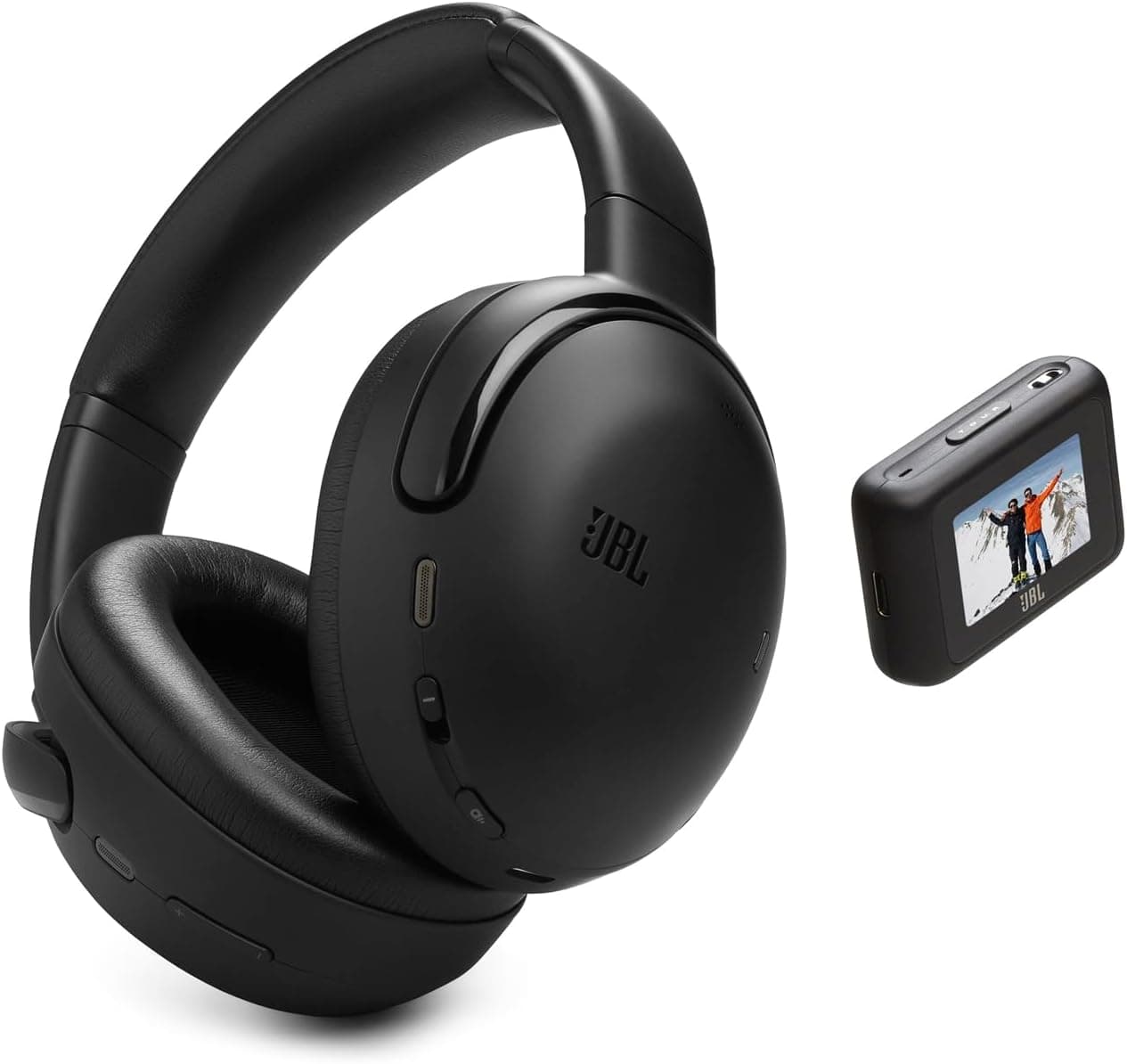
The Tour One M3's killer feature is the included Smart Tx transmitter — a small, puck-shaped device with a 1.45-inch color touchscreen display that fundamentally redefines what these headphones can do. The Smart Tx connects to any audio source with a 3.5mm or USB-C output: think in-flight entertainment systems on airplanes, treadmills and elliptical machines at the gym, older televisions without Bluetooth, desktop computers, or even gaming handhelds like the Nintendo Switch or Steam Deck. Once connected via 3.5mm or USB-C, it transmits audio wirelessly to the Tour One M3 over a dedicated low-latency Bluetooth connection. This means you get all the freedom of wireless listening with sources that were previously cable-only.
The touchscreen on the Smart Tx gives you full control over ANC modes (ANC on, Ambient Aware, TalkThru), EQ presets, volume, and audio source selection — all without needing to reach for your phone or fumble with the headphones' touch controls. It's the same concept that made the JBL Tour Pro 3 earbuds' smart charging case so appealing, now thoughtfully applied to over-ear headphones. The display is bright enough to read in direct sunlight and remains responsive even with slightly sweaty or damp fingers. The interface is logical and well-organized, with large touch targets that are easy to tap without looking.
The Smart Tx also supports Auracast — the new Bluetooth LE Audio broadcast standard that lets you share audio with multiple Auracast-compatible devices simultaneously. This opens up scenarios that simply weren't possible before: you could be watching a movie on a plane and share the audio with a companion's Auracast-ready earbuds, or connect to Auracast transmitters in gyms, airports, museums, or theaters that broadcast audio to anyone within range. While the Auracast ecosystem is still in its early stages — relatively few public venues have installed Auracast transmitters as of mid-2026 — JBL is positioning itself ahead of the curve. The Tour One M3 will be ready and compatible as more Auracast transmitters appear in public spaces over the coming years.
For frequent travelers, the Smart Tx is a genuine quality-of-life improvement that's hard to overstate. Being able to plug into an airplane's entertainment system and enjoy the same wireless freedom you have with your phone is genuinely transformative. No more being tethered to the armrest by a short, awkward 3.5mm cable. No more dealing with airlines' dated, uncomfortable single-use headphones with their tinny, bassless audio. No more having your music interrupted every time the person next to you needs to use the restroom. The Smart Tx makes in-flight entertainment feel like a premium experience rather than an afterthought.
Battery Life and Charging
Battery life is one area where the Tour One M3 decisively beats virtually every competitor in its price range. JBL claims up to 40 hours of continuous playback with ANC enabled and a remarkable 70 hours with ANC turned off. In real-world testing with a typical mix of ANC-on and ANC-off usage across several days of commuting, office work, and evening relaxation, the headphones consistently delivered over 50 hours of combined playback between charges. This is genuinely game-changing for power users and forgetful chargers alike.
To put that in perspective against the competition: the Sony WH-1000XM6 offers 30 hours with ANC and 40 hours without. The Bose QuietComfort Ultra Headphones deliver 24 hours regardless of ANC usage. The Apple AirPods Max manage around 20 hours. The Tour One M3's advantage is substantial — especially for frequent travelers who might spend 12 to 16 hours on a long-haul flight. You could fly from New York to Singapore, watching movies and listening to music for the entire journey, and still have battery remaining. That's not something any of the current competitors can claim.
Charging is equally convenient. A full charge from empty via USB-C takes approximately two hours, and the headphones support quick charging — a 10-minute charge provides an estimated three to four hours of playback in a pinch, which is invaluable when you discover your battery is low right before a commute or meeting. The USB-C port is standard, so you can use the same cable you carry for your phone or laptop.
The Smart Tx transmitter has its own battery and charges simultaneously with the headphones when both are stored in the case and connected, so you never have to worry about the transmitter being dead when you need it most. The case itself doesn't contain a battery, so you'll need to plug either the headphones or the transmitter into USB-C to charge both. It would have been nice to see a case with a built-in battery for true on-the-go charging — like what Sony offers with the WF-1000XM6 case — but this is a minor complaint given the already exceptional battery life.
JBL Headphones App and Personi-Fi 3.0
The JBL Headphones app (available for iOS and Android) is one of the better companion apps in the audio space. It's well-designed, responsive, and provides genuine utility rather than feeling like a checkbox feature. The app is cleanly laid out with large, readable text and intuitive navigation.
The standout feature is Personi-Fi 3.0, which conducts a detailed hearing test through the headphones and creates a personalized sound profile tailored to your ears' specific frequency sensitivity. The test takes about five minutes and guides you through identifying which tones you hear most clearly at different frequency points. The resulting profile is genuinely transformative — it doesn't just apply a simple EQ curve; it compensates for the unique way your individual ears perceive sound across the frequency range. After running the test, the difference in clarity and detail was immediately noticeable, particularly in the upper frequencies where age-related hearing loss typically occurs first. Soundstage perception also seemed to improve, with better instrument separation and spatial cues.
Beyond Personi-Fi, the app includes a 12-band equalizer with separate left and right channel balance controls, allowing for granular sound customization that goes well beyond the simple "bass boost" or "treble boost" presets that most headphone apps offer. You can save multiple EQ presets for different genres or listening scenarios — one for acoustic music with a more neutral curve, another for electronic music with a slight bass shelf. The app also handles firmware updates — including the recent Harman Curve update that significantly refined the sound signature — and provides access to the user manual, product registration, and support resources.
Other useful app features include: a "Find My Headphones" locator that shows the last connected location, a "Silent Now" feature that disables all wireless connectivity for airline use, customizable controls for the touch panel and buttons, and a "Smart Audio" mode that automatically adjusts ANC based on your detected activity (sitting, walking, running, or commuting). The automatic activity detection works reasonably well, though it occasionally takes a few seconds to recognize a transition from sitting to walking.
One minor frustration that's worth noting: the app requires creating a JBL or Harman account, which adds friction to what should be a straightforward setup process. Privacy-conscious users may also have reservations about the data collection involved in the hearing test. Once you're past that hurdle, however, the app experience is smooth, feature-rich, and genuinely rewarding.
Call Quality and Connectivity
The Tour One M3 uses a four-microphone system with adaptive beamforming technology for voice calls. The microphones intelligently focus on your voice while rejecting background noise, and the results are among the best we've tested in wireless headphones. In testing across various environments, call recipients reported clear, natural-sounding audio even when we were walking along a busy street with traffic noise and wind. The voice is slightly compressed compared to a direct phone microphone, as is typical with Bluetooth headsets, but it remains perfectly intelligible and natural.
Wind noise reduction is particularly effective, thanks to the microphone placement being shielded by the ear cup design. Even in breezy conditions, call recipients reported minimal wind distortion. In louder environments like coffee shops, the beamforming does an admirable job of isolating your voice from background chatter and espresso machine noise. The system isn't perfect — in very loud environments like a subway platform, some background noise bleeds through — but it's well above average for the category.
The headphones are certified for Zoom calls over wired USB-C connection, which is a nice touch for remote workers who need reliable, low-latency conferencing audio. The USB-C connection provides the most reliable call quality with zero latency and no compression artifacts, making the Tour One M3 a legitimate option for all-day work use.
On the connectivity front, Bluetooth 5.3 with LE Audio provides a rock-solid connection with impressive range. During testing, we were able to walk about 30 feet away from the source phone through two walls before experiencing any dropout or audio stutter. Multipoint connection allows you to pair with two devices simultaneously, switching seamlessly between, say, music from your laptop and calls from your phone. The switching is fast and automatic — when a call comes in, the music pauses, the call audio takes over, and when the call ends, the music resumes. This works reliably with a phone and laptop combination in our testing.
Codec support is comprehensive: SBC, AAC, LDAC, and LC3. Android users will particularly appreciate LDAC support for high-resolution streaming over Bluetooth, which delivers noticeably better detail retrieval and soundstage compared to standard SBC or even AAC. iPhone users, limited to AAC, will benefit from the Tour One M3's well-tuned AAC implementation, which sounds clean and stable without the occasional audio glitches that plague some AAC implementations. The inclusion of LC3 — the new LE Audio codec — provides future-proofing as more smartphones and audio sources adopt the standard, promising better audio quality at lower bitrates and reduced power consumption.
Comparisons
The JBL Tour One M3 enters a market segment with some of the most formidable competition in consumer audio. Against the Sony WH-1000XM6, the Tour One M3 holds its own in sound quality but falls slightly behind in ANC performance. Sony's HD Noise Canceling Processor QN3, backed by years of iterative refinement, is still the benchmark for active noise cancellation — it's quieter, more adaptive, and more consistent than JBL's system. The XM6 also has a slight edge in overall soundstage width and instrument separation. However, the Tour One M3 counters with vastly superior battery life (40 hours ANC on vs Sony's 30), the innovative Smart Tx transmitter, LDAC support, and a more affordable price point ($299.95 on Amazon vs the Sony's $398). For most users, the battery life advantage alone may tip the scales.
Against the Bose QuietComfort Ultra Headphones (2nd Gen), the comparison follows a similar pattern. Bose leads in noise cancellation — their implementation is the smoothest and most natural-sounding in the business — and in spatial audio with the most convincing immersive experience. Bose also has a slight edge in overall comfort. But the Tour One M3 offers significantly longer battery life, LDAC support (Bose is limited to AAC and SBC), and the unique Smart Tx functionality that Bose simply can't match. At $449, the Bose QC Ultra 2nd Gen also costs more than the Tour One M3's discounted price.
Against the Apple AirPods Max, the Tour One M3 wins on virtually every objective metric: battery life (70 hours vs 20 hours), portability (foldable design with included case vs non-foldable with separate case), codec support (LDAC vs only AAC), weight (278g vs 385g), and price ($299.95 vs $549). The AirPods Max has undeniable advantages in build quality — the aluminum construction and stainless steel headband feel far more premium — and seamless integration with the Apple ecosystem (spatial audio with Apple devices, automatic switching, iCloud sync). But for anyone who isn't deeply invested in the Apple ecosystem, or who prioritizes battery life and portability, the Tour One M3 is the more practical, sensible choice by a wide margin.
Against the JBL Tour One M2, the M3 represents a meaningful generational leap. The ANC is substantially improved, the Smart Tx is a genuinely new product category, the battery life has increased by around 10 hours, and the codec support now includes LDAC and LC3. The M2 was a solid headphone; the M3 is a statement of intent.
Should You Buy the JBL Tour One M3?
The JBL Tour One M3 is not trying to be the absolute best at any single thing — it's not the ANC champion like Sony, not the comfort king like Bose, and not the style icon like Apple. What it is, instead, is the most versatile and well-rounded premium wireless headphone on the market in 2026. The Smart Tx transmitter, exceptional battery life, comprehensive LDAC codec support, Auracast readiness, deep app-based personalization with Personi-Fi 3.0, and competitive sound quality combine into a package that offers a value proposition no single competitor can match.
If you're a frequent flyer who watches in-flight entertainment, the Smart Tx alone justifies the purchase — it's that transformative for the travel experience. If you value battery life above all else, the Tour One M3's 70 hours with ANC off is unmatched in this category. If you want the deepest sound personalization available in a wireless headphone, Personi-Fi 3.0 delivers in spades and sets a new standard for the industry.
The Tour One M3 isn't perfect — the ANC could still be stronger, the all-plastic build won't impress luxury-seekers, and the touch controls occasionally misregister. For a more affordable audio experience, read our Nothing Headphone (a) review an adjustment as a track skip. But the sum of the Tour One M3's parts is genuinely compelling, and the whole is greater than its individual components. At its current Amazon price of $299.95 — well below the $449.95 MSRP — the JBL Tour One M3 represents exceptional value in the premium headphone space. It's a confident, feature-packed entry that deserves serious consideration alongside the established giants, and for many buyers, it may well be the best choice of the bunch.
Pros
- Exceptional 70-hour battery life with ANC off
- Innovative Smart Tx transmitter for wireless audio from any source
- Comprehensive codec support including LDAC and LC3
- Personi-Fi 3.0 hearing test personalization is genuinely transformative
- Lightweight and comfortable for extended wear
- Foldable design with travel case for real portability
- Auracast ready for future audio broadcasting
- Excellent call quality with 4-mic beamforming
Cons
- ANC falls short of Sony and Bose class leaders
- Plastic build lacks premium feel of competitors
- Touch controls can occasionally misregister
- Auracast ecosystem still in early stages
- App requires account creation
Final Verdict
The JBL Tour One M3 brings genuine innovation to the premium wireless headphone market with its Smart Tx transmitter, exceptional 70-hour battery life, and comprehensive feature set including LDAC support, Spatial 360 audio, and Personi-Fi 3.0 personalization — all at a competitive price point that undercuts Sony, Bose, and Apple.