The Logitech G512 X 75 Makes Analog and Mechanical Switches Coexist — and It Works Brilliantly
The Logitech G512 X 75 is the first keyboard that lets you mix TMR analog and mechanical switches on a per-key basis, combining rapid trigger performance with traditional mechanical feel in a single 75-percent board.
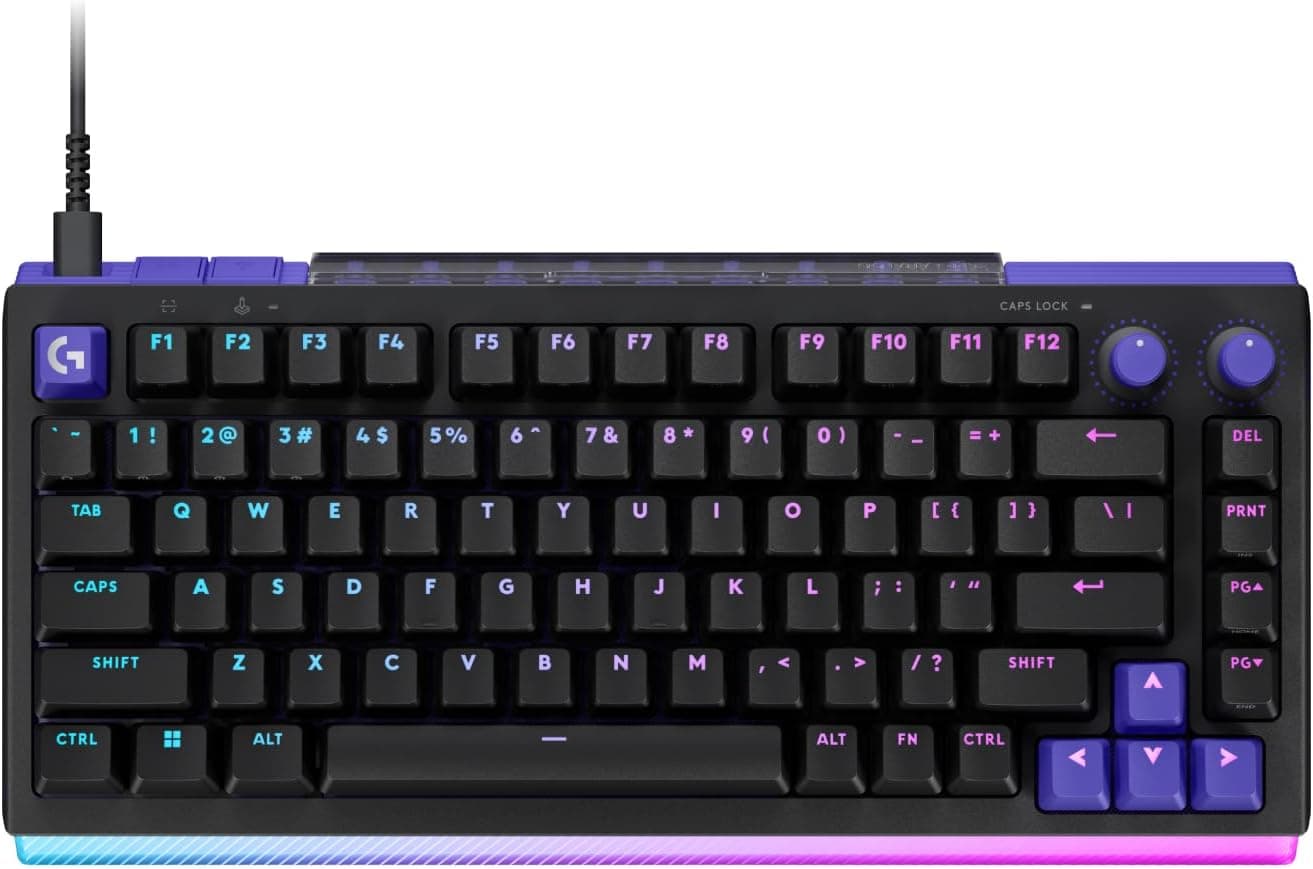
Logitech has never been shy about pushing the boundaries of gaming peripherals, but the G512 X 75 represents something genuinely different. This is not just another mechanical keyboard with RGB lighting and fancy software. It is the first keyboard to ship with Dual Swap technology — a system that lets you mix analog and mechanical switches on the same board, swapping between them on a per-key basis. That alone would make it noteworthy. But when you add in True 8K polling, rapid trigger support, customizable actuation from 0.1mm to 4.0mm, PBT keycaps, and a design that manages to feel both substantial and purposeful, the G512 X 75 starts to look like one of the most interesting keyboards Logitech has ever produced.
The core innovation here is Tunnel Magnetoresistance, or TMR. Unlike traditional mechanical switches that rely on physical contact between metal leafs, TMR sensors detect keystrokes through magnetic fields. This means no physical wear at the contact point, which theoretically translates to greater longevity — Logitech rates the TMR switches for 100 million keystrokes. More importantly for gamers, TMR enables analog input — the ability to register varying levels of keypress depth, not just a binary on/off state. The Wooting brand popularized this concept with its Hall Effect keyboards, and Razer followed with the Huntsman V3 Pro. But Logitech takes a different approach with the G512 X 75 by allowing you to actually mix analog and mechanical switches in the same keyboard rather than forcing you to commit to one type entirely.
Out of the box, the G512 X 75 ships with a full set of mechanical switches — available in linear, tactile, or clicky variants — plus nine Gateron KS-20 TMR analog switches. The 75-percent layout features 39 Dual Swap switch beds, each one capable of accepting either a TMR analog switch or any standard 3-pin or 5-pin mechanical switch. This means you could put analog switches on your WASD cluster for analog movement in racing games, keep mechanical tactile switches on your modifier keys for that satisfying bump, and use linear mechanicals everywhere else. The flexibility is remarkable, and it speaks to Logitech understanding that different keys serve different functions during gameplay and productivity alike.
Switching between analog and mechanical modes on a given key is straightforward but not instant. You pull the keycap, remove the mechanical switch, slot in the TMR analog switch, add the appropriate SAPP ring if you want a second actuation point, and replace the keycap. The keyboard stores the analog switches and SAPP rings in a compartment at the top, behind a removable cover. This is clever industrial design — instead of fumbling with a separate container, everything you need lives inside the keyboard itself. The bundled key pullers, which are chunky purple pieces, double as the keyboard's feet when not in use, which is either resourceful or slightly absurd depending on your perspective.
Design & Build
In practice, the analog experience is impressive. Setting a custom actuation point to 0.4mm makes keypresses feel almost telepathic — the moment your finger touches the keycap, it registers. This is borderline too sensitive for typing, where accidental presses become a real issue, but for competitive gaming, it is a measurable advantage. Rapid trigger support means you can set the reset point independently from the actuation point, allowing for faster repeated inputs. In fast-paced shooters like Valorant or Counter-Strike 2, the difference is tangible. You can strafe and stop on a dime, and the lower reset point means you waste less time between directional changes. The ability to fine-tune actuation in 0.1mm increments gives you a level of granular control that most keyboards simply cannot match.
The Second Actuation Pressure Point, or SAPP, feature adds another dimension entirely. With SAPP rings installed, a single key can trigger two different actions depending on how far you press. A light tap could be walk, while a full press could be sprint. In a racing game, a light press could be brake while a deep press could be emergency brake. In a MOBA, a shallow keypress on Q could be a regular ability cast while pressing through activates a quick-cast version. In practice, this takes some adjustment, and not every game scenario benefits from it, but for players who want every possible input advantage, it is there. Logitech includes five SAPP rings in the box, which is enough to cover your core movement keys and a couple of ability keys. Additional rings can be purchased separately.
The mechanical switch experience is classic Logitech quality. The linear switches are smooth with minimal wobble, the tactile variant offers a noticeable but not overwhelming bump, and the clicky option delivers that unmistakable auditory feedback that some typists crave. All three use Logitech's in-house switch design, and they feel consistent from key to key. Hot-swappability via standard 3-pin and 5-pin sockets means you are not locked into Logitech switches. Want to drop in some Cherry MX Brown switches for a more muted tactile feel? Gateron Yellows for a buttery linear? Outemu Lime switches for a light tactile? The G512 X 75 accommodates them all without complaint, which gives it an enthusiast-level flexibility that most mainstream gaming keyboards lack.
Switch Options
The physical design of the G512 X 75 is a mixed bag. On one hand, the build quality is excellent — an aluminum top plate gives the keyboard a rigid, premium feel, and at roughly 870 grams without the cable, it stays planted on the desk even during intense gaming sessions. The 75-percent layout strikes a smart balance between compact and functional, preserving function keys, arrow keys, and a small navigation cluster while ditching the number pad that most gamers never use. On the other hand, the keyboard is thick. Real thick. The design language is old-school Logitech, with a high profile that feels more 2018 than 2026. Next to something like the Wooting 80HE or the HyperX Alloy Origins, the G512 X 75 looks almost aggressively chunky. The optional acrylic palm rest helps mitigate the height, but it is sold separately, which feels like a nickel-and-dime approach on a $180 keyboard that should arguably include it.
Speaking of pricing, the G512 X 75 comes in at $179.99 for the tactile and linear versions. The 98-percent G512 X 98 variant costs $199.99. That puts the G512 X 75 at a compelling price point relative to the competition. The Razer Huntsman V3 Pro, which offers analog switches but no mechanical swappability, retails for $250. The Wooting 80HE starts at $175 but lacks the dual-switch concept entirely. The SteelSeries Apex Pro Mini Gen 3 with its OmniPoint adjustable switches rings in at $180 as well. So the G512 X 75 is priced competitively — not cheap, but not outrageous given what it offers. The value proposition becomes even more compelling when you consider that you are effectively getting two keyboards in one: a fully mechanical board and an analog board, configurable on a per-key basis.
The LIGHTSYNC RGB system returns, running along the top of the keyboard as a light bar and through individual per-key illumination. It is bright, customizable through G HUB, and reacts to in-game events in supported titles. The light bar along the bottom edge is a nice touch — it casts a warm glow across your desk and illuminates the optional wrist rest, which has a translucent acrylic design that diffuses the light beautifully. You can set per-key colors, reactive lighting effects that ripple outward from each keypress, or synchronized effects that sweep across the entire board. RGB is deeply subjective, but Logitech's implementation remains one of the better ones in the industry, with smooth color transitions and vivid saturation that never feels garish unless you want it to.
Typing Experience
Connectivity is wired USB-C only, which may disappoint those who have grown accustomed to wireless freedom from other Logitech peripherals like the G915 or the MX Keys. Logitech's reasoning is sound, though — the True 8K polling rate, processing up to 8,000 reports per second at 0.125ms, and analog processing demand a stable, high-bandwidth connection. A wireless version at this polling rate with this level of processing would require a substantial battery, driving up both size and cost. For a keyboard squarely aimed at competitive gamers who typically play tethered anyway, the wired-only approach is a reasonable trade-off. The cable itself is detachable and braided, with a USB-C connection on the keyboard end and USB-A on the PC end. A USB-C to USB-C option would have been more future-proof, but the included cable is quality — stiff enough to hold its shape for cable management, not so stiff that it fights you.
The G HUB software is where you configure actuation points, rapid trigger thresholds, SAPP ring behavior, and RGB lighting. It is the same software that Logitech has used for years, which means it is functional but not exactly beloved. The interface has improved over time, but it can still be clunky when navigating advanced features. Setting up per-key actuation profiles requires several clicks and some trial and error, especially if you are switching between analog and mechanical modes on different keys. The software also handles firmware updates, profile management, and integration with other Logitech peripherals through the G HUB ecosystem. On-device memory saves up to three profiles, so once you have dialed in your settings, you can take the keyboard to a tournament without needing G HUB installed. This is a crucial feature for competitive players who frequently game on different setups at LAN events.
Typing on the G512 X 75 depends entirely on which switches you have installed. With mechanical linear switches, it is a smooth, consistent experience that feels similar to other quality linear boards. The tactile mechanical option provides a good bump, though it is not as refined as some enthusiast tactile switches like the Holy Panda or the Glorious Panda. Clicky is clicky — love it or hate it. When you switch to TMR analog, the feel changes noticeably. Analog switches have a very different character because there is no physical contact point. The keypress is smooth throughout the entire travel, with no bump or tactile event to signal that you have hit the actuation point. Some people love this; others find it disorienting. The ability to set actuation points as low as 0.1mm essentially means you can configure the analog keys to actuate before you even feel like you have pressed them, which is great for reaction time but terrible for accidental presses. Finding the sweet spot between responsiveness and unintentional inputs takes experimentation, and most users will likely settle somewhere between 0.3mm and 0.6mm for competitive play.
Gaming Performance
For gaming, the G512 X 75 excels in ways that purely mechanical or purely analog keyboards cannot. The analog keys give you that instant response and rapid trigger advantage for movement and core actions, while the mechanical keys provide the tactile feedback you need for secondary bindings. In a game like Apex Legends, having analog WASD with mechanical shift, space, and ability keys creates a best-of-both-worlds experience. In Valorant, analog movement keys with mechanical utility keys feels natural and effective. The crossover takes some getting used to — switching between the two feel types mid-game can be momentarily jarring — but after a few sessions, muscle memory adapts, and you start to appreciate why this hybrid approach is superior to going all-in on either analog or mechanical.
PBT keycaps come standard, which is a welcome inclusion at this price point. PBT plastic resists shine and wear far better than ABS, and the legends are dye-sublimated rather than pad-printed, meaning they will not fade over time even with heavy daily use. The keycap profile is Logitech's proprietary shape, which is comfortable but limits third-party keycap options if you like to customize your look — aftermarket sets designed for Cherry profile will fit the switches but may not match the height curve of the stock caps. The font on the keycaps is clean and modern, avoiding the overly aggressive gamer aesthetic that plagues some competitors. The stabilizers on larger keys like the spacebar, shift, and enter are pre-lubed and produce minimal rattle, which is a significant improvement over some earlier Logitech boards where stabilizer rattle was a common complaint among enthusiasts.
The keyboard also features a dedicated gaming mode toggle that disables the Windows key and other interruptions, which is a small but appreciated touch. Dip switches or hardware toggles for game mode are increasingly rare on gaming keyboards, with most shifting this function to software, so having a physical toggle is welcome. There is also a key travel of approximately 4.0mm on the mechanical side, which is standard for mechanical keyboards and provides a satisfying bottom-out feel without being excessively deep.
Software
Looking at the broader market, TMR and Hall Effect keyboards are still relatively new, and the technology is evolving rapidly. Logitech's entry with the G512 X 75 is not just a me-too product — the Dual Swap concept is a genuine innovation that addresses a real desire among players who want analog advantages for specific keys but mechanical feel for others. Whether this becomes a standard feature across gaming keyboards remains to be seen, but Logitech has put down a credible marker. The company's distribution network and brand recognition also mean the G512 X 75 will reach far more players than smaller analog-focused brands, potentially accelerating mainstream adoption of analog keyboard technology across the industry.
The build quality extends beyond the top plate. The entire chassis has been designed to minimize flex, and the keyboard passes Logitech's standard durability tests including keycap impact resistance and frame torsion testing. The USB-C port feels solid and well-reinforced, and the keycaps sit tight on their switches with minimal wobble even on the edges of larger keys like the spacebar and shift keys. Sound damping material inside the case helps reduce the ping and hollowness that plagues some aluminum-plate keyboards, giving the G512 X 75 a more muted, pleasant sound profile during extended typing sessions. The overall assembly feels tight, with no creaks or rattles when you pick up the keyboard or press down on the frame.
For productivity use, the G512 X 75 is a perfectly competent keyboard. The 75-percent layout preserves enough functionality for most office work, and the PBT keycaps feel great for extended typing sessions lasting hours. The analog features are largely irrelevant for productivity — you are unlikely to set up rapid trigger for typing documents — but the hot-swappable mechanical switches let you tailor the typing experience to your preferences. The RGB can be toggled off entirely or set to a subdued single-color mode that would not look out of place in a professional environment, and the solid build quality means the keyboard will withstand years of daily use without complaint.
RGB & Features
The competitive gaming scenario is where this keyboard truly shines. The combination of analog rapid trigger for movement and mechanical switches for ability keys creates a hybrid experience that no other single keyboard currently offers. You could achieve something similar by running two separate keyboards, but that is obviously impractical. The G512 X 75 packages this flexibility into a single, cohesive device. Tournament players will appreciate the onboard profile storage, the tournament-grade 8K polling, and the USB-C detachable cable that makes transport easy. For streamers who game and type simultaneously, the mechanical keys provide satisfying feedback for chat interaction while the analog keys deliver competitive performance where it matters most.
Who should buy the Logitech G512 X 75? The answer depends heavily on what kind of gamer you are. If you are a competitive first-person-shooter player who has been curious about analog switches but reluctant to abandon mechanical feel entirely, this is exactly the keyboard you have been waiting for. The ability to put analog on your movement keys while keeping mechanical feel on everything else solves a real problem that no other product addresses. If you are a casual gamer who types a lot for work, the mechanical side of the G512 X 75 delivers everything you would expect from a quality board at this price, and the analog features become a bonus you can explore at your leisure. If you are a keyboard enthusiast who enjoys swapping switches and experimenting with different configurations, the hot-swappable mechanical sockets and TMR analog beds give you an enormous sandbox to play in. The only group that might want to look elsewhere is players who want a low-profile keyboard for ergonomic reasons — the G512 X 75 is anything but low, and its height may cause wrist strain during extended sessions without the optional palm rest.
In terms of long-term value, the G512 X 75 is positioned well. Logitech has committed to supporting the product with firmware updates through G HUB, and the hot-swappable nature of the switches means you can replace individual switches that wear out or try new options as they become available. The TMR analog switches are rated for 100 million keystrokes, which should outlast the mechanical switches — but even those are easily replaceable. The aluminum top plate and PBT keycaps are built for years of use, and the overall construction quality suggests this keyboard will serve you well through multiple upgrade cycles of other peripherals.
Final Verdict
The bottom line is that the Logitech G512 X 75 offers something no other keyboard on the market can: the ability to mix analog and mechanical switches on a single board. That flexibility, combined with True 8K polling, rapid trigger, customizable actuation, hot-swappable mechanical switches, PBT keycaps, and solid build quality, makes it one of the most compelling gaming keyboards of 2026. The thick profile, the learning curve for analog switches, and the G HUB software are real drawbacks, but they are outweighed by the sheer versatility of the platform. If you are a competitive gamer who has been waiting for analog switches without giving up mechanical feel, the G512 X 75 is the keyboard that finally delivers on that promise — and it does so at a price that undercuts most of the analog-only competition.
Pros
- Dual Swap technology lets you mix analog and mechanical switches on the same board
- True 8K polling rate for competitive responsiveness
- Hot-swappable mechanical switches (3-pin and 5-pin compatible)
- PBT keycaps with dye-sublimated legends resist wear
- Competitively priced at $179.99 versus $250 for analog-only competitors
Cons
- Thick, high-profile design requires a wrist rest for comfortable extended use
- Only nine TMR analog switches included out of the box
- G HUB software remains clunky and resource-heavy
- Wired USB-C only — no wireless option
Final Verdict
The Logitech G512 X 75 is the first keyboard that lets you mix TMR analog and mechanical switches on a per-key basis, combining rapid trigger performance with traditional mechanical feel in a single 75-percent board.