Nothing Phone (3) Review: A Flagship That Refuses to Blend In
The Nothing Phone (3) delivers a distinctive design, triple 50MP cameras, and strong Snapdragon 8s Gen 4 performance at an aggressive $599 price point on Amazon. A truly unique flagship that mostly delivers on its promise.
The Nothing Phone (3) is a peculiar creature in a smartphone market dominated by iterative refinements from Apple and Samsung. After spending two weeks with Nothing's first true flagship, I've come to appreciate—and occasionally be frustrated by—a device that refuses to blend in. Priced at a highly competitive $599 on Amazon, it undercuts flagships like the Oppo Find X9 Ultra while delivering a specs sheet that reads like it belongs in the $800+ club. But does the Nothing Phone (3) deliver where it actually matters, or does its unconventional approach come at the cost of fundamental smartphone excellence?
Design: Love It or Leave It
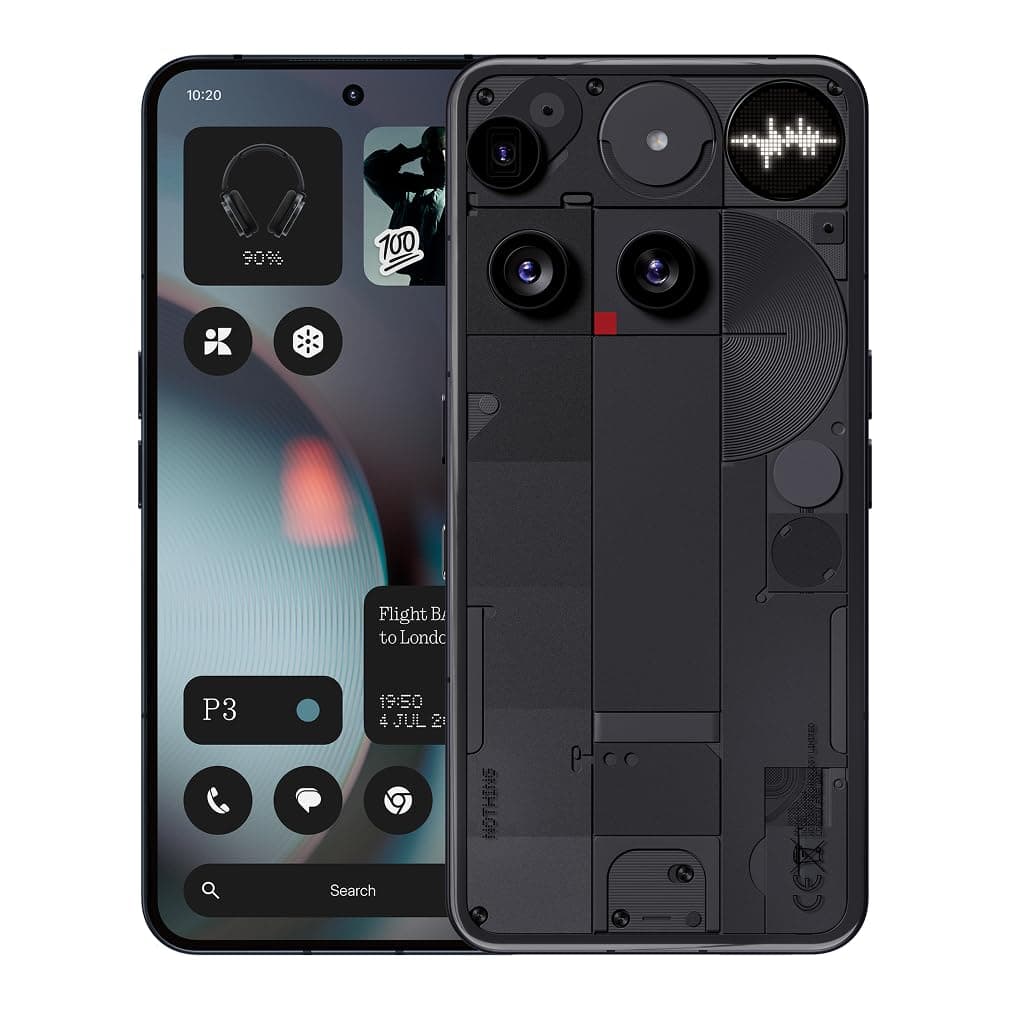
Nothing has never been afraid of bold design choices, and the Phone (3) doubles down on that philosophy with a vengeance. The device measures 160.6 x 75.6 x 9mm and weighs 218 grams, making it thicker and heavier than the Galaxy S25 or Pixel 9. It feels dense and solid in the hand—almost like holding a well-machined block of aluminum and glass. The flat edges recall the iPhone design language, but the rear panel is where things get genuinely interesting.
The back features a semi-transparent finish that reveals some of the internal components, a Nothing signature since the Phone (1). But the big news is the Glyph Matrix: a 489-pixel grid of individual LED lights arranged in a circular pattern, replacing the strip-based Glyph Interface of previous models. It's like Nothing decided the back of a phone should double as a low-resolution screen, and honestly, they kind of pulled it off.
The camera island is intentionally asymmetrical—the telephoto lens sits slightly offset from the other two sensors, creating an abstract geometric look that's either brilliant or maddening depending on who you ask. I found myself in the former camp. In a sea of identical rectangular camera bumps, the Phone (3)'s rear panel is refreshingly distinct.
Durability has seen a meaningful upgrade. The Phone (3) carries an IP68 rating, up from the IP54 of its predecessor, meaning it can survive submersion in fresh water. The front uses Gorilla Glass 7i while the rear employs Gorilla Glass Victus, both significant improvements over the Gorilla Glass 5 used previously. The aluminum frame feels premium and has held up well against daily wear.
Available in White and Black, the Phone (3) ships with a pre-applied screen protector—a thin plastic film that picks up scratches faster than I'd like. You'll want to replace it with a tempered glass option fairly quickly. The phone also includes an IP68 rating, so rain, splashes, and accidental dunks won't send you into a panic.
Display: Bright, Smooth, and Capable
The 6.67-inch AMOLED panel is a highlight of the Nothing Phone (3) experience. It runs at 1260 x 2800 resolution with a 120Hz adaptive refresh rate, delivering 10-bit color depth for smooth gradients and rich color reproduction. Nothing claims a peak brightness of 4,500 nits—a figure that's more marketing than reality in day-to-day use—but independent testing by PhoneArena measured around 1,500 nits at 20% APL, which is still plenty bright enough for comfortable outdoor viewing.
The display is slightly smaller than the Phone 2's 6.7-inch panel, but the resolution bump and improved brightness more than compensate. HDR content looks excellent, with deep blacks characteristic of AMOLED and punchy highlights that make movies and games pop. The 120Hz refresh rate is adaptive, meaning it scales down to save battery when you're reading static content and ramps up for smooth scrolling and animations.
Color accuracy is good out of the box, though Nothing's default calibration leans slightly cool. You can adjust the color temperature in the display settings if you prefer warmer tones. The bezels are uniform and reasonably thin, giving the phone a modern, premium look from the front.
One area where the display falls short of the absolute best is peak brightness in direct sunlight. The Galaxy S25 Ultra and iPhone 17 Pro can push higher sustained brightness, making them slightly more legible on the brightest summer days. For most users, in most conditions, the Nothing Phone (3)'s display is more than adequate—vibrant, sharp, and smooth.
Cameras: Triple 50MP Ambition
The headline camera feature of the Nothing Phone (3) is its triple 50MP rear setup: a main wide camera with an f/1.68 aperture, a 114-degree ultrawide with f/2.2, and a new 3x telephoto periscope with f/2.68. The front-facing camera also jumps to 50MP at f/2.2. On paper, this is flagship-class hardware that rivals phones costing significantly more.
Main Camera
The 50MP main sensor captures 12.5MP binned images by default, combining pixels for improved light sensitivity. In good lighting, photos are sharp with pleasing color science that leans toward natural rather than oversaturated. Nothing's processing has improved dramatically since the Phone 2—there's better dynamic range, more consistent white balance, and less of the over-aggressive sharpening that plagued earlier models.
Low-light performance is respectable but not class-leading. The main camera captures usable images in dim conditions, but there's noticeable noise in shadow areas, and detail takes a hit compared to what the Pixel 9 or iPhone 17 can muster. Night mode helps, requiring a few seconds of steady holding, and the results are solid for social media sharing.
Ultrawide Camera
The 50MP ultrawide is a capable performer with decent color matching to the main sensor. The 114-degree field of view is wide enough for dramatic landscape shots without introducing excessive distortion at the edges. Detail is good in the center but softens noticeably toward the corners, which is typical for ultrawide sensors at this price point. Macro mode via the ultrawide is functional—it captures close-up shots with reasonable detail, though the Galaxy S25 Ultra's dedicated macro lens produces sharper results.
Telephoto Camera
The 3x telephoto is the most exciting addition to the Nothing Phone 3's camera arsenal, and it's genuinely good. At 3x zoom, images are detailed with excellent color reproduction. In a side-by-side comparison with the Galaxy S25 Ultra's 3x zoom, the Nothing Phone (3) held its own, even producing slightly more natural-looking images in some scenarios. The telephoto also doubles as a macro lens, and it's surprisingly effective—capturing detailed close-ups of flowers, textures, and small objects with natural-looking depth of field that ultrawide macro modes can't replicate.
Beyond 3x, results degrade quickly. Digital zoom up to 10x is usable for social media in good light, but don't expect to read distant signs or capture sharp moon shots. This is a 3x optical zoom system, and it performs best within its native range.
Selfie Camera
The 50MP front camera is a significant upgrade over the Phone 2's 32MP sensor. Selfies are detailed with accurate skin tones in good lighting. Portrait mode handles edge detection reasonably well, though it occasionally struggles with fine hair details—a common issue even on much more expensive phones. The selfie camera supports 4K video recording at 30fps, which is appreciated for video calls and content creation.
Camera Software Quirks
The camera app itself has some rough edges. I experienced occasional delays when switching between lenses, and the viewfinder would sometimes stutter in low light. The processing pipeline can produce inconsistent results between shots taken seconds apart—one photo might look great, while the next has slightly off white balance or less dynamic range. These are software issues that Nothing can address with updates, but they're noticeable when you're trying to capture fleeting moments.
Performance: The Snapdragon 8s Gen 4 Experience
The Nothing Phone (3) uses Qualcomm's Snapdragon 8s Gen 4 chipset—a tier below the 8 Elite found in the Galaxy S25 series, but still a very capable processor. In Geekbench 6, the phone scores approximately 2,159 single-core and 6,800 multi-core. These numbers trail the Galaxy S25's 2,916 / 9,886 but comfortably beat the Pixel 9's 1,758 / 4,594. In GPU-focused 3DMark Wild Life Extreme, the Phone (3) manages 4,153 points at 24.87 fps, again landing between the S25's 5,841 and the Pixel 9's 2,550.
What do these numbers mean in real-world use? Daily tasks like scrolling social media, browsing the web, switching between apps, and streaming video are buttery smooth. The 120Hz display combined with the capable chipset ensures zero perceptible lag in normal operation. Gaming is where the 8s Gen 4 shows its strengths—I played Genshin Impact at high settings and maintained solid frame rates, and more demanding titles like Ex Astris ran at a steady 60fps without noticeable drops.
The phone does get warm under sustained gaming loads, particularly in the top-left corner near the camera housing. It's noticeable but not uncomfortable, and I never encountered thermal throttling that impacted performance during my testing sessions. For a phone in this price bracket, the gaming performance is genuinely impressive.
Nothing OS 3.5, based on Android 15, is clean, responsive, and well-optimized. The dot-matrix aesthetic carries through the entire interface—icons, widgets, and menus all share a cohesive visual language. Nothing promises 5 major OS updates and 7 years of security patches, which matches the commitment from Samsung and Google. That's excellent long-term value for a phone at this price.
Battery Life and Charging
The Nothing Phone (3) packs a 5,150 mAh battery (5,500 mAh in India), which is a meaningful increase over the Phone 2's 4,700 mAh. In my testing, the phone comfortably lasted a full day of moderate to heavy use—roughly 5-6 hours of screen-on time with a mix of social media, messaging, camera use, video streaming, and some light gaming. Heavy users will need to top up before bed, but average users should have no trouble getting through a day.
The real star of the show is charging speed. The Phone (3) supports 65W wired charging, and it's fast. Using Nothing's own charger, the company claims 50% charge in 19 minutes. In my testing with a generic 50W PD charger, I got 39% in 15 minutes and 68% in 30 minutes, with a full charge from empty taking about 52 minutes. That's significantly faster than the Galaxy S25's 25W charging and roughly on par with the OnePlus 13's 80W system.
Wireless charging is supported at 15W, and reverse wireless charging at 5W lets you top up earbuds or a smartwatch in a pinch. The 15W wireless charging speed is competitive with the iPhone's MagSafe charging but slower than the fastest wireless solutions from Xiaomi and Huawei.
Battery efficiency is one area where the Snapdragon 8s Gen 4 doesn't quite match the 8 Elite. In a 3-hour YouTube streaming test, the Nothing Phone (3) drained 22% of its battery, compared to about 15% on the Galaxy S25 Ultra. This difference adds up over a full day, and it's worth considering if battery longevity is your top priority.
Glyph Matrix and Essential Key: Gimmick or Game-Changer?
The Glyph Matrix is the most talked-about feature of the Nothing Phone (3), and for good reason—there's nothing else like it on the market. The 489-pixel LED grid on the rear can display various pieces of information: battery level as a progress bar, music playback visualization, a stopwatch, a flashlight toggle, and even play simple games like Spin the Bottle and Magic 8 Ball.
In practice, the Glyph Matrix is cool more often than it's useful. The music visualizer is genuinely fun to watch, and the battery level indicator is handy for a quick glance. The stopwatch widget is frustrating—it requires a long press to start and stop, which defeats the purpose of a quick-access timer. The flashlight toggle works well and is arguably the most practical Glyph feature.
The Essential Key is a new hardware button on the right side of the phone, placed where you'd normally find a power button on other devices. This is a deliberate design choice that I found endlessly frustrating. I accidentally pressed it constantly when picking up the phone, adjusting my grip, or putting the phone in my pocket. Functionally, a single tap takes a screenshot, a long press activates a voice memo with screen recording, and a double-press opens the Essential Space—a repository for notes, screenshots, and voice memos.
The Essential Space concept is solid: it's a unified inbox for things you want to remember. Voice memos are transcribed automatically, screenshots are organized by context, and you can search across everything. The execution needs work, though. The accidental Essential Key presses filled my Essential Space with unwanted screenshots and voice memos, and there's no easy way to bulk-delete them. Nothing needs to reconsider the key's placement or add better accidental press prevention.
Software: Nothing OS 3.5
Nothing OS 3.5 is one of the most distinct Android skins on the market. The monochrome-plus-retro-aesthetic design language is consistent throughout the system, and Nothing includes tools to convert third-party app icons to the dot-matrix style. It doesn't always work perfectly—some apps resist the icon conversion—but when it does, the result is a uniquely cohesive visual experience that makes the phone feel like nothing else on the market.
The notification system is well-implemented with Glyph Matrix integration. When a notification arrives, specific LED patterns light up on the rear panel, letting you know which app is calling without flipping the phone over. You can assign custom Glyph ringtones to individual contacts, and the visual patterns are distinctive enough to recognize calls from family, work, or delivery services at a glance. It's a genuinely thoughtful touch that adds personality to the notification experience without being intrusive.
The Recorder app is another standout. It offers two recording modes: Voice Focus, which isolates the speaker's voice in a noisy environment, and Environmental Focus, which captures the full soundscape for lectures or meetings. Transcriptions are generated locally on-device, preserving privacy, and the results are impressively accurate even with accented speech.
Performance is excellent. Nothing OS is lightweight compared to Samsung's One UI or Xiaomi's HyperOS, with minimal bloatware and fast animations. The phone feels snappy and responsive, and the 120Hz optimization is among the best I've seen on an Android device.
Special features include ChatGPT integration for AI-powered writing assistance and image generation, both fully optional and turned off by default. The Recorder app offers voice focus and environmental focus modes for better audio capture. The Nothing community also contributes widgets through the Nothing Playground platform, adding to the phone's personality over time.
Nothing's update commitment of 5 OS upgrades and 7 years of security patches is on par with the industry leaders. The Phone (3) launched with Android 15 and is expected to receive Android 16 in Q3 2026, followed by Android 17 through 20. That's excellent long-term support for a phone at this price.
Competition: How the Nothing Phone (3) Stacks Up
At $599 on Amazon, the Nothing Phone (3) competes in a crowded field. Here's how it compares to the main alternatives:
The Samsung Galaxy S25 ($799) offers a more polished camera system, a brighter display, and the Snapdragon 8 Elite chipset with better performance. But the S25 starts at $200 more with only 128GB of base storage. The Nothing Phone (3) offers 256GB at $599, making it the better value proposition for storage-conscious buyers.
The Google Pixel 9 ($799) has the best camera software processing in the business, hands down. If photography is your priority, the Pixel 9 is the better choice despite its weaker Tensor G4 chipset. But the Pixel 9's design is far more conventional, and its 128GB base storage at $799 feels stingy compared to the Nothing's 256GB standard.
The OnePlus 13 ($899) offers faster charging (80W), a better chipset, and a more refined camera system. It's also significantly more expensive. The Nothing Phone (3) undercuts it by $300 while still delivering a flagship-level experience.
The iPhone 17 ($799) offers deeper ecosystem integration, better video recording, and longer software support. But iOS isn't for everyone, and the Nothing Phone (3) offers more customization and individuality at a lower price.
Final Thoughts
The Nothing Phone (3) asks you to meet it halfway. It offers a unique design, a capable triple-camera system, strong performance, fast charging, and a software experience that genuinely stands apart from the Android crowd. At a price that undercuts every other flagship by a meaningful margin—$200 less than the Galaxy S25 and Pixel 9, and $300 less than the OnePlus 13—the value argument is compelling. But it also asks you to accept a camera system that doesn't quite match the Pixel or Galaxy in computational photography, a chipset that's a tier below the absolute best, and software quirks that range from charming to frustrating.
The audio experience on the Nothing Phone (3) deserves mention. The stereo speakers are loud and reasonably well-balanced, with clear mids and adequate bass for a phone. They won't replace a dedicated Bluetooth speaker, but they're good enough for casual music listening, podcast playback, and hands-free calls. The phone supports Qualcomm's aptX HD and LDAC Bluetooth codecs for high-quality wireless audio, and the 3.5mm headphone jack is notably absent—you'll need USB-C or wireless headphones. Call quality is excellent thanks to the improved microphone array with AI noise cancellation, and I had no issues being heard clearly even in moderately noisy environments.
For $599 on Amazon, the value proposition is hard to ignore. You're getting 256GB of storage, a beautiful 120Hz AMOLED display, a Snapdragon 8s Gen 4 chipset that handles everyday tasks and gaming with ease, and a design that will turn heads. The Glyph Matrix is genuinely innovative, even if it needs more practical applications. The Essential Key is a misstep that Nothing should rethink in a future software update.
Who should buy the Nothing Phone (3)? Anyone who values individuality in their smartphone choice, who wants flagship-level specs without paying flagship pricing, and who appreciates thoughtful design and software aesthetics. If you're tired of the same rectangular slabs from the usual suspects, the Nothing Phone (3) offers something genuinely different—and mostly excellent.
Who should skip it? Photography enthusiasts who want the absolute best camera processing (consider the Samsung Galaxy S25 Edge instead), power users who need the Snapdragon 8 Elite's extra performance headroom, and anyone who wants a phone that just works without quirks or compromises. The Nothing Phone (3) has character, and character always comes with edges.
At $599, it's one of the best values in the smartphone market today. Nothing has delivered a first flagship that mostly sticks the landing—and at this price, the few rough edges are easy to forgive.
Pros
- Distinctive, conversation-starting design with IP68 durability
- Excellent value at $599 for 256GB base storage
- Versatile triple 50MP camera system with capable 3x telephoto
- Fast 65W charging reaches full in under an hour
- Clean Nothing OS 3.5 with 5-year OS update commitment
- Glyph Matrix adds genuine personality to notifications
Cons
- Camera processing software lags behind Pixel and Galaxy
- Essential Key placement leads to constant accidental presses
- Display brightness trails class leaders in direct sunlight
- Battery efficiency modest compared to Snapdragon 8 Elite rivals
Final Verdict
The Nothing Phone (3) delivers a distinctive design, triple 50MP cameras, and strong Snapdragon 8s Gen 4 performance at an aggressive $599 price point on Amazon. A truly unique flagship that mostly delivers on its promise.