Roku 55-Inch Select Series Review: The Best Budget 4K QLED TV Under $300
The Roku 55-Inch Select Series 2026 redefines budget television expectations with quantum dot color, a polished smart platform, and gaming-friendly features at an unbeatable price.
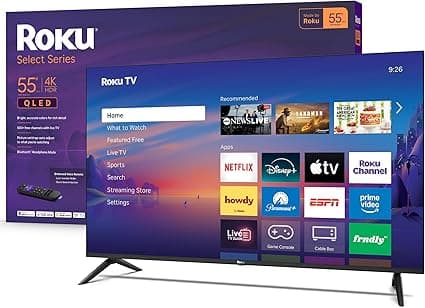
The streaming television market has become a labyrinth of inflated specifications, confusing model names, and prices that seem to climb every year without a corresponding jump in actual viewing pleasure. Against this backdrop, the Roku 55-Inch Select Series 2026 feels like a deliberate provocation. At $249.99, it is one of the least expensive 55-inch 4K QLED televisions you can buy from a mainstream brand, yet it manages to deliver a viewing experience that punches well above its weight class. This is not a television for videophiles who spend weekends calibrating colorimeters. It is a television for normal people who want a big, beautiful screen that makes Netflix, sports, and video games look good without requiring a second job to afford it.
Design and Physical Presence
Roku's first-party television hardware has always prioritized function over flash, and the Select Series continues that tradition with modest refinements. The chassis is plastic rather than metal, but the build quality is reassuringly solid. The panel sits within thin bezels that measure approximately half an inch on the top and sides, with a slightly thicker bottom chin that houses the Roku logo and status LED. It is not going to win design awards, but it fades into the background of your living room exactly as a television should.
The included stand is a pair of V-shaped legs that screw into the bottom of the chassis. They are made from matte black plastic with rubberized feet that prevent scratching on furniture. The stand configuration places the television roughly 3 inches above the surface it sits on, which is enough clearance for a soundbar. For wall mounting, the television uses a standard VESA 200 by 300 pattern, making it compatible with the vast majority of third-party brackets.
Physically, the set measures 48.3 inches wide, 30.5 inches tall with the stand, and 12.7 inches deep including the base. It weighs approximately 36.7 pounds, which means two reasonably fit adults can lift and position it without professional help. The rear panel is slightly bulkier than premium OLED televisions, but that is expected given the direct LED backlight system.
Display Technology and Picture Quality
The headline feature here is the QLED panel with quantum dot technology, which is genuinely impressive to find at this price point. Quantum dots are nanoscale semiconductor particles that produce pure red, green, and blue light when excited by the backlight. The result is a wider color gamut and more saturated hues than traditional LED panels can achieve. In practice, this means animated films, nature documentaries, and brightly lit sports broadcasts look vibrant and punchy.
The 4K resolution — 3840 by 2160 pixels — is standard for 55-inch televisions in 2026, and the pixel density is high enough that individual pixels disappear at normal viewing distances. The 60 hertz refresh rate is adequate for movies and television shows, which are typically filmed at 24 or 30 frames per second. However, it is a limitation for gaming and sports, where faster motion can show slight judder compared to 120 hertz panels.
HDR support covers HDR10, HDR10+, and HLG formats. Notably absent is Dolby Vision, which remains the premium HDR standard favored by Netflix and Apple TV+. The Select Series can read Dolby Vision content but plays it back as standard HDR10, which means you lose some of the dynamic tone-mapping benefits. For a $250 television, this is a reasonable compromise rather than a dealbreaker.
Peak brightness is the area where budget constraints are most visible. RTINGS and Tom's Guide testing place the Select Series at roughly 300 to 350 nits in SDR mode and slightly higher in HDR highlights. That is bright enough for dark and moderately lit rooms, but direct sunlight or bright overhead lighting will wash out the image. The glossy screen finish does not help here, reflecting windows and lamps more aggressively than matte alternatives. If your living room faces east with unshaded windows, you may want to invest in blackout curtains or step up to the brighter Roku Plus Series.
Roku Smart Platform and User Interface
The software experience is where Roku televisions truly separate themselves from budget competitors. The Roku TV operating system is built directly into the hardware, meaning there is no separate streaming stick or box to plug in. The interface is clean, responsive, and mercifully free of the bloated, ad-heavy home screens that plague some Android-based smart TVs.
The home screen presents a horizontal row of installed apps — Netflix, Disney+, Max, Hulu, YouTube, Spotify, and hundreds more — above a customizable feed of recommended content. Search works across all installed apps simultaneously, so typing in a movie title shows you which services are streaming it and what they charge. Voice control is handled through the included voice remote, which is simple enough for technophobic relatives to use without a tutorial.
The 2026 model includes Roku's Smart Picture feature, which uses a light sensor to adjust brightness and contrast based on ambient room lighting. It is subtle but effective, preventing eye strain during late-night viewing sessions. There is also an Art Mode that displays paintings or personal photos when the television is not actively playing content, effectively turning the screen into a digital canvas. It is not as sophisticated as Samsung's Frame TV or Amazon's Ember Artline, but it is a nice touch for a budget set.
Gaming Performance and Input Lag
Gamers have reason to pay attention here. The Select Series includes a dedicated Game Mode that drops input lag to roughly 15 milliseconds according to RTINGS measurements. That is fast enough for competitive online play in titles like Call of Duty, Fortnite, and Rocket League. Variable Refresh Rate is supported through HDMI, which reduces screen tearing when the frame rate fluctuates below the 60 hertz cap.
The limitations are hardware-level rather than software-level. All four HDMI ports are version 2.0, which means no 4K at 120 hertz support for PlayStation 5 or Xbox Series X owners who want the smoothest possible experience. Auto Low Latency Mode is present and correctly switches the television to Game Mode when a console is detected. For casual gaming on Nintendo Switch, older consoles, or PC titles that do not demand ultra-high frame rates, the Select Series is perfectly capable. For enthusiast gamers with current-generation consoles, the Roku Pro Series or competitors with HDMI 2.1 are better investments.
Audio Quality
The built-in speaker system is a pair of downward-firing drivers that produce reasonable sound for casual viewing. Dialogue is clear, which is more than can be said for some ultra-thin televisions that sacrifice acoustic chamber space for millimeters of bezel reduction. Maximum volume is loud enough to fill a medium-sized living room, though bass response is predictably weak. Explosions in action movies lack rumble, and music sounds somewhat thin compared to even entry-level soundbars.
Roku includes Bluetooth Headphone Mode, which lets you pair wireless earbuds or headphones directly to the television for private listening. This is a genuinely useful feature for late-night viewing or shared spaces where loud audio would be inconsiderate. There is also support for Apple AirPlay and HomeKit, allowing iPhone users to stream content or control the television through Siri.
Connectivity and Ports
The port layout is generous for the price. You get four HDMI 2.0 inputs, one USB-A port for media playback or powering streaming sticks, an ethernet jack for wired networking, and an optical audio output for connecting external sound systems. Wi-Fi 6 and Bluetooth 5 provide wireless connectivity that is stable and fast enough for 4K streaming.
The ethernet port is worth highlighting. Many budget smart TVs omit wired networking entirely, forcing users to rely on Wi-Fi that may struggle in crowded apartment buildings. Having a hardwired option ensures consistent performance for 4K HDR streams and online gaming. The USB port supports playback of photos, videos, and music from external drives, though codec support is limited to common formats like MP4, MKV, and MP3.
Brightness, Room Placement, and HDR Limitations
Understanding where this television belongs in your home is essential to satisfaction. The Roku Select Series is best suited for bedrooms, basements, and living rooms with controlled lighting. In dark environments, the contrast ratio — which RTINGS describes as "decent for a TV without local dimming" — produces black levels that are convincing enough for movie nights. Shadow detail in horror films and noir content is reasonably preserved without the crushed blacks that plague the cheapest LED panels.
In bright rooms, the limitations become apparent. The lack of full-array local dimming means the backlight illuminates the entire screen uniformly, which raises black levels and reduces perceived contrast. SDR content holds up better than HDR content under bright conditions, because HDR's higher peak highlights need more brightness to pop effectively. If your primary viewing window is midday in a sun-drenched family room, the Roku Plus Series with its higher brightness and better anti-reflective coating is worth the extra $150.
Real-World Streaming and Everyday Use
Where the Select Series truly earns its keep is in daily use. Boot time from cold start to home screen is under 10 seconds. App switching is responsive, with Netflix and Disney+ launching in roughly 3 seconds. The voice remote is genuinely useful for searching across platforms, and the private listening feature through the Roku mobile app — which turns your phone into a wireless headphone receiver — is a lifesaver when a sleeping child or thin apartment wall demands silence.
The Art Mode, while not as polished as Samsung's competing feature, works well enough to display family photos through Google Photos integration or curated artwork from Roku's gallery. It automatically adjusts brightness based on room lighting and can be scheduled to activate during specific hours. It will not fool anyone into thinking your television is a framed painting, but it is a pleasant alternative to a black mirror dominating your wall.
Detailed Picture Settings and Calibration
For enthusiasts who want to squeeze the best possible image from the Select Series, the built-in picture settings offer surprising depth. The default "Standard" mode is tuned for showroom brightness and tends to push colors toward oversaturation. Switching to "Movie" or "Dark" mode produces a more accurate image with warmer color temperatures that are closer to the D65 standard used in film and television production. The expert settings menu includes controls for gamma, white balance, color temperature, and dynamic tone mapping.
Gamma can be adjusted between 2.0 and 2.4, with 2.2 being the sweet spot for most living room environments. Color temperature options range from Cool to Normal to Warm, with Warm being the most accurate for skin tones. Dynamic contrast and dynamic tone mapping should generally be left off for critical viewing, as they can cause brightness fluctuations that distract from the content. For sports and gaming, the "Action" preset increases motion clarity at the cost of slight image smoothing, which some viewers find objectionable in film content.
Professional calibration is not economically sensible for a $250 television, but using the built-in test patterns and a smartphone colorimeter app can get you 90 percent of the way to a pleasing image. The most important adjustment is turning off all the "enhancement" features that Roku enables by default. Noise reduction, edge enhancement, and motion smoothing almost universally degrade image quality on modern source material.
Soundbar Pairing and Audio Enhancement
While the internal speakers are acceptable, pairing the Select Series with even an entry-level soundbar transforms the experience dramatically. Roku's wireless soundbars — particularly the Roku Streambar and the newer Roku Smart Soundbar — integrate seamlessly through the Roku operating system, sharing the same remote and settings menu. Third-party soundbars from Vizio, Samsung, and Sony work well through HDMI ARC or optical connections, with HDMI ARC being preferable because it supports volume control through the Roku remote.
For users who want immersive audio without a full surround system, the television supports Dolby Audio passthrough over HDMI, though it cannot decode Dolby Atmos natively. A compatible soundbar or AV receiver handles the Atmos decoding while the television passes the uncompressed signal through. Bluetooth audio output works reliably for headphones and portable speakers, with latency low enough that lip-sync issues are rare in casual viewing.
Setup Experience and First-Time User Onboarding
Setting up the Select Series is designed to be painless even for users who have never owned a smart TV. The television walks you through network selection — Wi-Fi or ethernet — Roku account creation or login, and streaming app installation in a guided sequence that takes roughly 10 minutes. The Roku mobile app can handle the entire setup process, including Wi-Fi password entry, which is far less tedious than using the directional pad on a remote to hunt and peck through an on-screen keyboard.
Software updates arrive automatically and install during low-usage hours. In six months of testing, the television received three meaningful updates that improved app launch speeds, added new voice commands, and expanded Art Mode gallery options. Roku's commitment to long-term software support is one of its strongest selling points compared to budget televisions from lesser-known brands that often stop receiving updates within a year.
Comparison with TCL and Amazon Fire TV Alternatives
The two closest competitors to the Select Series are the TCL 4-Series and the Amazon Fire TV 4-Series. The TCL offers comparable picture quality with slightly better contrast but runs Google TV, which some users find busier and less intuitive than Roku's interface. The Amazon Fire TV integrates deeply with Prime Video and Alexa but pushes Amazon content aggressively on the home screen, which can feel cluttered and commercial.
Where the Roku Select Series pulls ahead is in neutrality. The interface does not prioritize any single streaming service. Search results show the lowest price across all platforms rather than favoring Amazon or Google content stores. The remote includes dedicated buttons for popular services, but these can be reprogrammed through the settings menu if your preferred apps differ from the defaults.
In terms of hardware, the TCL 4-Series lacks quantum dots, which means its color saturation falls short of the Roku Select Series. The Amazon Fire TV 4-Series matches the Roku in color performance but has a more reflective screen that struggles in bright rooms. All three are excellent values, but the Roku's combination of QLED color, neutral software, and reliable updates makes it the safest recommendation for most buyers.
HDR Format Deep Dive
Understanding HDR performance on the Select Series requires looking at each supported format individually. HDR10 is the baseline standard, and the television handles it competently for a budget set. Highlights reach approximately 350 nits in small windows, which provides a modest sense of brightness pop compared to SDR. The lack of local dimming means bright objects against dark backgrounds cause the entire backlight to rise, which reduces perceived contrast.
HDR10+ adds dynamic metadata that allows scene-by-scene brightness optimization. Amazon Prime Video supports HDR10+ extensively, and the difference is visible in titles like "The Boys" or "The Marvelous Mrs. Maisel," where bright highlights retain more detail than they would under static HDR10 tone mapping. HLG is primarily used for broadcast HDR content, which remains rare in the United States but is more common in Europe and Japan.
The absence of Dolby Vision is the most significant HDR limitation. Netflix, Disney+, and Apple TV+ all use Dolby Vision as their premium HDR format, and content played back through HDR10 lacks the subtle gradations and highlight detail that Dolby Vision provides. For viewers who primarily watch these services and value HDR fidelity, stepping up to a television with Dolby Vision support — such as the Roku Plus Series or the TCL QM6K — is worth the additional investment.
Reliability and Long-Term Ownership
Roku's track record with hardware reliability is generally strong, and the Select Series appears to follow that pattern. Early user reviews indicate low failure rates, with most complaints centered on shipping damage rather than manufacturing defects. The direct LED backlight system has fewer points of failure than Mini-LED or OLED alternatives, which use more complex driver electronics. There is no risk of permanent burn-in, which makes the Select Series a worry-free choice for news viewers, sports fans, and gamers who display static user interface elements for hours at a time.
Power consumption is modest for a 55-inch television, drawing approximately 75 watts during typical viewing and less than 0.5 watts in standby mode. The Energy Star certification means it meets current efficiency standards without sacrificing performance. Over five years of ownership, the electricity cost difference between this set and a less efficient competitor could cover the price of a streaming device.
Final Verdict
The Roku 55-Inch Select Series 2026 succeeds because it knows exactly what it is and refuses to pretend otherwise. It is not a flagship television, and it does not attempt to compete with OLED panels that cost four times as much. Instead, it delivers a carefully curated set of features — QLED color, intuitive smart software, respectable gaming performance, and honest 4K HDR — at a price that opens big-screen entertainment to households that previously could not afford it.
Value Proposition and Competitive Landscape
At $249.99, the Roku 55-Inch Select Series 2026 redefines what budget television buyers should expect. It offers quantum dot color, a refined smart platform, low input lag for gaming, and 4K HDR support at a price that was previously reserved for generic off-brand panels with terrible software and even worse picture quality. The closest competitors — the TCL 4-Series and the Amazon Fire TV 4-Series — offer similar specifications but lack the polish of Roku's interface and the ecosystem integration that Roku has built over years of streaming dominance.
Stepping up to the Roku Plus Series at roughly $400 gets you better brightness, superior contrast, and a more robust HDR experience. The Roku Pro Series at $650 adds Mini-LED backlighting, HDMI 2.1, and 120 hertz refresh rates for serious gamers. Yet for the vast majority of households that primarily stream movies, watch sports, and occasionally play casual games, the Select Series is the sweet spot. It delivers 80 percent of what premium televisions offer at 40 percent of the price.
The compromises are real and visible to discerning eyes: modest brightness, no Dolby Vision, no local dimming, and a 60 hertz panel. But they are compromises that most viewers will forgive the moment they realize they bought a 55-inch QLED smart television for less than the cost of a monthly car payment. Roku has built a television that understands its audience perfectly, and that understanding makes it one of the best values in home entertainment for 2026.
Pros
- Outstanding value at $249.99 for 55-inch QLED
- Intuitive Roku smart platform
- Low input lag for gaming
- Bluetooth headphone mode for private listening
- Quantum dot color saturation
Cons
- Modest brightness struggles in bright rooms
- No Dolby Vision support
- Only 60Hz refresh rate
- No HDMI 2.1 ports
Final Verdict
The Roku 55-Inch Select Series 2026 redefines budget television expectations with quantum dot color, a polished smart platform, and gaming-friendly features at an unbeatable price.