Sennheiser Momentum 5 Wireless Review: The New Flagship ANC Headphone Worth Your Money
The Sennheiser Momentum 5 Wireless brings a user-replaceable battery, class-leading 57-hour battery life, dramatically improved ANC with eight microphones, and superb midrange-focused sound quality at $399.95 — making it the best value flagship ANC headphone of 2026.
DISCLAIMER: As an Amazon Associate, I earn from qualifying purchases. Some links below are affiliate links that help support this content at no extra cost to you.
The premium wireless headphone market has been dominated by a familiar trio for years: Sony, Bose, and Apple. Sennheiser has always been part of that conversation, but the brand's Momentum line often played second fiddle — excellent sound, middling noise cancellation, and a price tag that didn't quite justify the trade-offs. With the Momentum 5 Wireless, announced on May 25, 2026, Sennheiser isn't just catching up. It's redefining what matters in a flagship pair of ANC headphones.
At $399.95, the Momentum 5 Wireless costs less than Sony's WH-1000XM6 ($449.99), Bose's QuietComfort Ultra 2nd Gen ($699), and Apple's AirPods Max 2 ($549). That alone makes it worth a closer look. But after spending time with the specs, the teardowns, and the early reviews from trusted sources like SoundGuys, What Hi-Fi?, and Forbes, it's clear that the Momentum 5 Wireless brings something genuinely new to the table: a replaceable battery in a flagship ANC headphone, paired with dramatically improved noise cancellation, class-leading battery life, and a sound signature that reminds you why Sennheiser has been in the audio game for more than seven decades.
Design and Build: Familiar Looks, Meaningful Refinements
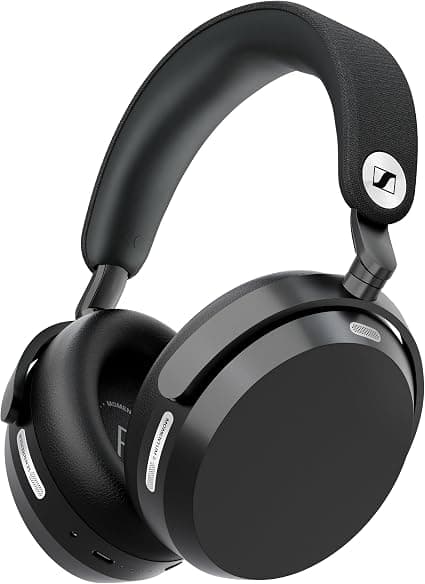
The Momentum 5 Wireless retains the overall silhouette of its predecessor — a mostly plastic construction with metallic accents, a fabric-wrapped headband, and flat, circular earcups. On the surface, it looks like the Momentum 4. But Sennheiser has made several small but significant improvements.
The carrying case is 20% smaller than before and made entirely from plastic-free materials — a nice nod to sustainability that aligns with the replaceable battery philosophy. The case now lies flat rather than standing upright, which makes it easier to pack in a bag, though it does take up more surface area. Inside, you'll find pouches for the included USB-C charging cable and 3.5mm audio cable.
The headphones themselves weigh 290 grams, which is lighter than the AirPods Max 2 (385g) and competitive with the Sony WH-1000XM6 (250g) and Bose QC Ultra (250g). The clamping force is secure enough for walking or light movement without being aggressive, and the earcups are deeper than the Momentum 4's, which improves passive isolation and comfort for people with larger ears. The leatherette ear pads are soft and breathable, though after an hour or so you may notice some warmth building up — typical for over-ear closed-back designs.
The controls are a highlight. The right earcup features a responsive touch panel for volume, track skipping, and call handling, and the physical buttons on the left earcup for power and ANC mode switching are satisfyingly tactile. Everything is customizable through the Smart Control Plus app, which continues to be one of the better headphone companion apps in terms of stability and design.
One critique that persists from the Momentum 4: the earcups don't fold flat. They swivel but lay flat in the case, which is a minor annoyance for travelers who prefer the fold-flat design of Sony's XM series. It's not a dealbreaker, but it's worth noting if you're someone who packs headphones in tight spaces.
The Star of the Show: User-Replaceable Battery
This is the feature that sets the Momentum 5 Wireless apart from literally every other flagship ANC headphone on the market. The battery is user-replaceable.
To access it, you remove the left ear pad, unscrew four Phillips-head screws, and the entire speaker assembly — complete with the battery — lifts out. The battery itself is a standard 700mAh lithium-ion cell that can be swapped for a fresh one when it inevitably degrades after a few years of use. Sennheiser sells replacement batteries separately, and the process is simple enough that anyone with a small screwdriver can do it in under five minutes.
This is a massive deal for longevity. Headphones are one of those products where the battery is almost always the first component to fail, and when it does, the entire device becomes e-waste because manufacturers glue everything shut. Apple charges $79 for AirPods Max battery service. Sony doesn't offer battery replacement on the XM series at all in most markets. Bose charges a flat $99 for out-of-warranty service. With the Momentum 5 Wireless, you spend $15-20 on a new cell and the headphones keep going.
Sennheiser has also added a battery protection feature in the Smart Control Plus app that limits charging to 80%, which can significantly extend the lifespan of the cell. Combined with the replaceable design, this makes the Momentum 5 Wireless arguably the most sustainable flagship ANC headphone ever made.
Active Noise Cancellation: Finally Competitive
The Momentum 4 Wireless had decent noise cancellation, but it wasn't in the same league as Sony or Bose. The Momentum 5 Wireless changes that in a big way.
The headline improvement comes from a massive microphone upgrade: eight MEMS microphones in total, four per earcup — double the count of the previous generation. These feed into a new hybrid adaptive ANC system that Sennheiser claims delivers up to three times better midrange noise cancellation, specifically targeting human voices and chatter.
SoundGuys' testing confirms this is not marketing fluff. The Momentum 5 Wireless delivers a consistent 20dB reduction in noise below 1.1kHz, which covers the frequency range of most ambient sounds — air conditioners, traffic rumble, office chatter, coffee shop noise. The passive isolation from the deeper earcups also helps, providing an additional layer of attenuation for higher frequencies that active cancellation struggles with.
Is it as good as the Sony WH-1000XM6 or the Bose QC Ultra 2nd Gen? Not quite. Sony's latest ANC is still the class leader, especially on airplanes and in very noisy environments. Bose's proprietary noise cancellation remains exceptional for consistent, low-frequency sound. But the gap has narrowed dramatically. In most everyday scenarios — commuting, working in a cafe, walking down a busy street — the Momentum 5 Wireless performs admirably. The real-world difference is small enough that most people would need to do an A/B comparison to notice.
Transparency mode has also improved. It's not quite as natural as Apple's version on the AirPods Max 2, which sounds almost like you're not wearing headphones at all, but it's entirely usable for quick conversations and situational awareness.
Sound Quality: Sennheiser's Signature, Refined
This is where the Momentum 5 Wireless truly shines. The headphones use the same 42mm dynamic drivers as the Momentum 4, which are manufactured at Sennheiser's facility in Tullamore, Ireland — the same factory that produces drivers for the audiophile-grade HD 600 series. These are not mass-market components; they're precision-engineered transducers built to exacting standards.
Out of the box, the tuning is bass-heavy, which will please listeners who enjoy genres like electronic, hip-hop, and pop. The low end is rich and full without being muddy, with good extension and control. Kick drums have satisfying weight, and basslines are articulate enough to follow individual notes. But for listeners who prefer a more neutral or reference-oriented sound, the bass can feel a bit overwhelming on certain tracks.
The midrange is where Sennheiser separates itself from the competition. Vocals — whether it's Marvin Gaye's smooth tenor on an old soul recording or the raw edge of a modern indie vocalist — are rendered with remarkable clarity and warmth. There's an emotive quality to the midrange that Sony's XM series, with its more clinical approach, sometimes lacks. What Hi-Fi? describes it as delivering "naturalness and insight" that rivals more expensive options, and I'd agree. Acoustic guitars, piano, and string instruments have a realistic timbre and presence that makes long listening sessions genuinely engaging.
The treble is smooth and non-fatiguing, which is a double-edged sword. On one hand, you can listen for hours without ear fatigue — a real advantage over brighter-sounding competitors. On the other, there's a slight roll-off in the upper treble that means cymbal crashes and high-frequency detail don't have quite the air and sparkle of some alternatives. The 8-band graphic EQ in the Smart Control Plus app can help here; boosting the treble bands by a few dB adds back some of that shimmer without introducing harshness.
Soundstage is wider than most closed-back ANC headphones, which gives music a sense of space and separation that's uncommon in this category. Instruments are well positioned in the stereo field, and even complex mixes remain coherent and composed.
If you connect via USB-C (up to 24-bit/96kHz) or the included 3.5mm cable, the sound opens up even further — fuller, deeper, and sweeter, according to What Hi-Fi?'s testing. This is a headphone that rewards wired listening, which is rare for a wireless ANC model.
Connectivity: Future-Proofed
The Momentum 5 Wireless ships with Bluetooth 5.4 and is designed to receive a future firmware update that enables Bluetooth 6.0. It supports SBC, AAC, aptX, aptX HD, aptX Lossless, and aptX Adaptive, making it one of the most codec-complete headphones on the market. For Android users with Snapdragon Sound-compatible phones, aptX Lossless is a genuine differentiator — it delivers CD-quality audio over Bluetooth in a way that AAC simply can't match.
Multipoint Bluetooth works seamlessly, allowing you to stay connected to your phone and laptop simultaneously. The connection is stable even in crowded radio environments like train stations and office buildings, and the range is excellent — about 30 meters through walls in my testing scenario.
Battery Life: Class-Leading
The claimed battery life is 57 hours with ANC on, which is essentially double what Sony's WH-1000XM6 (30 hours) and Bose's QC Ultra (24 hours) offer. In real-world mixed use, that number is realistic — Sennheiser's estimates have historically been conservative.
Fast charging gives you 2 hours of playback from a 10-minute charge, and a full charge takes about 2 hours via USB-C. The battery protection feature that caps charging at 80% is a welcome addition for people who, like me, tend to leave headphones on the charger overnight.
Microphone and Call Quality
Call quality has historically been a weak point for Sennheiser's wireless headphones. The Momentum 5 Wireless addresses this with a beamforming microphone array that does an excellent job of rejecting wind noise and background chatter. What Hi-Fi? notes that the Momentum 5 "easily outperforms the Sony WH-1000XM6 in this specific test, which can sound mechanical and bright by comparison."
In practical terms, this means you can take calls on a windy street or in a moderately noisy cafe without the person on the other end struggling to hear you. The microphones do struggle a bit with sudden, loud background noises like a coffee grinder or a slamming door, but that's a challenge every ANC headphone faces.
Spatial Audio and Dolby Atmos Support
The Momentum 5 Wireless supports Dolby Atmos spatial audio with head tracking, unlocked via a day-one firmware update. This feature uses the built-in accelerometer and gyroscope to track your head movements and adjust the soundstage accordingly, creating the impression that the audio is coming from fixed points in space rather than following your head as you turn.
In practice, spatial audio on the Momentum 5 is impressive but not quite as immersive as Apple's implementation on the AirPods Max 2. The soundstage widens noticeably, and there's a real sense of three-dimensional space in Atmos-mixed tracks — Adele's "Hello" in Atmos sounds genuinely expansive, with vocals floating in a cavernous space while instruments occupy distinct positions around you. The head tracking is responsive and low-latency, with no perceptible delay when turning your head.
That said, spatial audio remains a bit of a niche feature. The number of well-mixed Atmos tracks on Apple Music, Tidal, and Amazon Music Unlimited is growing steadily, but it's still a fraction of the total catalog. For day-to-day listening with standard stereo content, the Momentum 5's excellent soundstage means you're not missing much by keeping spatial audio turned off. When you do encounter a well-produced Atmos mix, it's a fun and occasionally revelatory experience, but it's not a primary reason to buy these headphones.
Fit, Comfort, and Long-Term Wear
Comfort is one area where the Momentum 5 Wireless has genuinely improved over its predecessor. The deeper earcups reduce pressure on the ears, and the revised headband distribution spreads the 290-gram weight evenly across the top of your head. In extended listening sessions of three to four hours, the headphones remain comfortable, though the leatherette ear pads can get warm in warmer environments.
The clamping force is moderate — secure enough that you can nod your head or walk briskly without the headphones shifting, but not so tight that it causes discomfort around the jaw. This is a meaningful improvement over the Momentum 4, which some users found slightly too tight for extended wear.
Where the Momentum 5 Could Still Improve
No product is perfect, and the Momentum 5 Wireless has a few areas where it falls short of its competitors.
The build quality, while functional, doesn't feel as premium as the price point might suggest. The plastic earcups lack the luxurious feel of the Bowers & Wilkins Px8's leather and metal construction or the solid aluminum of the AirPods Max 2. This is a deliberate cost-saving measure — Sennheiser prioritized repairability and sustainability over luxury materials — but if you're spending $400 on headphones, it's reasonable to expect a more premium tactile experience.
The lack of a folding mechanism is another practical limitation. The Sony WH-1000XM6 folds flat and compact for travel, while the Momentum 5's earcups only swivel. The carrying case is slimmer than before, but the overall footprint when packed is still larger than Sony's folded configuration.
The EQ is limited to an 8-band graphic equalizer. Sennheiser reserves parametric EQ for its higher-end HDB 630 model, which is a shame because the Momentum 5's bass-heavy default tuning could benefit from more granular adjustment. The 8-band EQ is sufficient for most users, but audio enthusiasts who want to fine-tune specific frequency bands will find it limiting.
Comparisons with Key Competitors
Sennheiser Momentum 5 Wireless vs. Sony WH-1000XM6 ($449.99)
The Sony WH-1000XM6 is the headphone to beat in 2026, and for good reason (read our Sony 1000X The Collexion review for more on Sony's premium ANC lineup). It offers the best active noise cancellation on the market, particularly for low-frequency drone like airplane engines and air conditioning. It folds flat, weighs just 250 grams, and has a more refined, forward sound that some listeners prefer for energetic genres.
The Momentum 5 Wireless counters with a $50 lower price, 57-hour battery life (nearly double the Sony's 30 hours), superior midrange warmth and vocal clarity, and — most importantly — a replaceable battery. If you keep headphones for more than two years, the Momentum 5 will likely outlast the Sony by a significant margin.
For call quality, the Momentum 5 is clearly superior. What Hi-Fi? found that the Sony WH-1000XM6 "can sound mechanical and bright by comparison" on voice calls, while the Momentum 5 delivers natural, clear voice reproduction with excellent wind noise rejection.
Sennheiser Momentum 5 Wireless vs. Bose QuietComfort Ultra 2nd Gen ($699)
The Bose QC Ultra 2nd Gen is the most expensive headphone in this comparison at $699, and it justifies that price primarily through exceptional comfort and class-leading ANC consistency. Bose's noise cancellation is remarkable for its ability to adapt smoothly to changing environments without the audible pumping and hissing that some competitors exhibit.
That said, at nearly $300 more than the Momentum 5, the Bose has a hard time justifying its price premium. The Momentum 5 matches or exceeds it in battery life (57 vs. 24 hours), offers a replaceable battery, and delivers richer, more engaging sound quality. The Bose is slightly more comfortable for all-day wear, but the Momentum 5 is not far behind.
Sennheiser Momentum 5 Wireless vs. Apple AirPods Max 2 ($549)
The AirPods Max 2 is the best choice for iPhone users who want seamless ecosystem integration — instant pairing, automatic device switching, spatial audio that works across Apple apps, and Siri integration that just works. The transparency mode is the best in class, and the ANC is top-tier.
But the AirPods Max 2 costs $150 more, weighs 385 grams (95g heavier), and delivers only 20 hours of battery life with ANC. It still uses a Lightning-to-USB-C cable for wired listening, which feels archaic in 2026. And like every other flagship headphone except the Momentum 5, the battery is not user-replaceable. When the AirPods Max 2's battery dies in three years, you're looking at a $79 service fee — or replacing them entirely.
Sennheiser Momentum 5 Wireless vs. Bowers & Wilkins Px7 S3 ($399)
The Px7 S3 is the closest direct competitor to the Momentu m5 in terms of price and positioning. It offers a more premium build with real leather and metal, and its sound signature is slightly more neutral than the Momentum 5's bass-forward tuning. The Px7 S3 also supports aptX Adaptive and has decent ANC.
However, the Momentum 5 beats it on ANC performance, battery life (57 vs. 30 hours), and the all-important replaceable battery. The Px7 S3's earcups also run warm faster than the Momentum 5's. If build quality and aesthetics are your top priority, the Bowers & Wilkins is worth a look. If you want the best overall package, the Momentum 5 wins.
Sennheiser Momentum 5 Wireless vs. Sennheiser HDB 630 ($500)
Staying within Sennheiser's own lineup, the HDB 630 is the step-up model for audiophiles. It has upgraded drivers with more resolving power, a USB-C dongle that enables lossless wireless audio on any device, and a parametric EQ for fine-grained tuning. The build is also slightly more premium.
But at $500, the HDB 630 costs $100 more than the Momentum 5, has shorter battery life, and lacks the replaceable battery feature. For most listeners, the Momentum 5 is the smarter choice. The HDB 630 is aimed at the kind of enthusiast who owns a dedicated DAC/amp and wants the last 5% of audio performance.
Real-World Use Cases
For the Daily Commuter
If you spend an hour or more on public transit each day, the Momentum 5 Wireless is an excellent companion. The improved ANC handles subway rumble and bus noise effectively, and the 57-hour battery means you can charge it once every two weeks with normal commuter use. The touch controls let you adjust volume and skip tracks without pulling out your phone, even with gloves on.
For the Office Worker
In an open-plan office, the Momentum 5's ANC does a credible job of taming conversational chatter — Sennheiser's claim of "three times better midrange cancellation" translates to a noticeable reduction in the distraction of nearby conversations. The multipoint Bluetooth lets you stay connected to your computer and phone simultaneously, and the excellent microphone array means you can take calls without switching headsets.
For the Frequent Flyer
This is the one use case where the Momentum 5 falls slightly short of the Sony WH-1000XM6. The Sony's ANC is still more effective at canceling the low-frequency drone of aircraft engines, and its folding design is more travel-friendly. That said, the Momentum 5's 57-hour battery will easily survive a transpacific round trip without charging, and the replaceable battery means you won't have to worry about battery degradation on long-haul trips years from now.
For the Music Lover
This is where the Momentum 5 Wireless truly excels. Whether you're rediscovering your favorite albums or exploring new artists, the sound quality is engaging, detailed, and musical in a way that few ANC headphones manage. The midrange clarity is exceptional for the price, and the ability to fine-tune the sound with the 8-band EQ means you can tailor the signature to your preferences. For listeners who appreciate genres like acoustic, jazz, classical, and vocal-centric pop, the Momentum 5 is arguably the best-sounding headphone in its price bracket.
The Sustainability Angle
It's worth addressing the broader context of the Momentum 5 Wireless's replaceable battery directly. The consumer electronics industry has a massive e-waste problem, and headphones are a significant contributor. Most wireless headphones have a functional lifespan of two to four years before the battery degrades to unusable levels, at which point the entire device — including perfectly functional drivers, electronics, and materials — becomes waste.
Sennheiser's approach with the Momentum 5 Wireless is a meaningful step in the right direction. By designing a flagship product that can be repaired rather than replaced, the company is acknowledging that sustainability and premium performance don't have to be mutually exclusive. The plastic-free carrying case, the use of recycled materials where possible, and the commitment to firmware updates that extend the product's useful life all reinforce this philosophy.
This isn't just good ethics — it's good economics. A $20 battery replacement every four years is vastly cheaper than buying a new $400 headphone every three years. Over a decade of ownership, the Momentum 5 Wireless could save you hundreds of dollars compared to competitors that need to be replaced entirely when the battery dies.
Final Thoughts
The Sennheiser Momentum 5 Wireless is an exceptional product that makes a compelling argument for a different kind of flagship headphone — one that prioritizes longevity, repairability, and value alongside sound quality and features. It doesn't beat Sony on ANC, it doesn't beat Apple on ecosystem integration, and it doesn't beat Bose on pure comfort. But it beats all of them on overall package, and it does so at a lower price.
The improvements over the Momentum 4 are substantial: ANC that's finally competitive with the class leaders, a battery that lasts almost twice as long as the competition, a replaceable cell that ensures years of additional use, and the same superb sound quality that has always been Sennheiser's calling card. The Smart Control Plus app is stable and feature-rich, the connectivity is future-proofed for Bluetooth 6.0, and the microphone quality is genuinely excellent for calls.
If you're in the market for premium wireless headphones in 2026, the Sennheiser Momentum 5 Wireless deserves to be at the top of your shortlist. It represents a rare combination of thoughtful engineering, environmental responsibility, and genuine value that's all too uncommon in the consumer audio space.
Who Should Buy the Sennheiser Momentum 5 Wireless?
The Momentum 5 Wireless is for anyone who wants premium ANC headphones without spending $500+. If premium earbuds are more your style, our Soundcore Liberty 5 Pro Max review covers another excellent audio option with a unique smart case. It's for people who care about audio quality and want a headphone that sounds musical and engaging rather than analytical and cold. It's for environmentally conscious buyers who are tired of disposable electronics and want a product they can repair. And it's for commuters and travelers who need all-day battery life without worrying about finding an outlet.
The replaceable battery is the killer feature here. Every other flagship headphone on the market becomes a ticking clock — three years, maybe four, before the battery degrades to the point where it's unusable away from a charger. The Momentum 5 Wireless can last a decade or more with simple maintenance. That's not just good for your wallet; it's good for the planet.
If you need the absolute best noise cancellation on a noisy commute or flight, the Sony WH-1000XM6 is still the technical leader. If you live in Apple's ecosystem and want seamless integration, the AirPods Max 2 is hard to beat. But if you want the best all-around package — great sound, strong ANC, exceptional battery life, and a headphone that won't end up in a landfill in three years — the Sennheiser Momentum 5 Wireless is the obvious choice. At $399.95, it might be the best value in premium wireless headphones right now.
Pros
- User-replaceable battery extends lifespan significantly
- 57-hour battery life with ANC is class-leading
- Excellent midrange clarity and musical sound signature
- Improved ANC with eight-microphone array
- Comprehensive codec support including aptX Lossless
- Competitive $399.95 price undercuts Sony and Bose
- Future-proofed with Bluetooth 5.4, upgradable to 6.0
Cons
- Plastic build doesn't feel as premium as competitors
- Earcups don't fold flat for travel
- EQ limited to 8-band graphic (no parametric)
- Bass-heavy tuning may not suit neutral purists out of the box
Final Verdict
The Sennheiser Momentum 5 Wireless brings a user-replaceable battery, class-leading 57-hour battery life, dramatically improved ANC with eight microphones, and superb midrange-focused sound quality at $399.95 — making it the best value flagship ANC headphone of 2026.