Sennheiser Momentum True Wireless 4 Review: Audiophile Sound Meets Future-Proof Connectivity
The Sennheiser Momentum True Wireless 4 deliver class-leading sound quality with aptX Lossless, LE Audio, Auracast, and adaptive ANC in a premium package. Outstanding audio performance and future-proof features offset disappointing microphone quality and a finicky fit.
If you are shopping for premium true wireless earbuds in 2026, the Sennheiser Momentum True Wireless 4 are almost certainly on your shortlist. They sit at the top of Sennheiser's earbud lineup, carrying a legacy of audiophile-grade sound quality that the German audio company has been building for decades. With Bluetooth 5.4, aptX Lossless support, LE Audio, Auracast readiness, and adaptive ANC, the MTW4 arrive packed with features that look toward the future of wireless audio. But after spending significant time with them — including daily commutes, work-from-home sessions, and dedicated critical listening — I have mixed feelings that potential buyers need to understand before hitting the buy button. The sound quality is genuinely exceptional, the build quality is solid, and the feature set is impressively forward-looking. Microphone performance is disappointing, the fit is not for everyone, and the high price tag demands scrutiny. In this review, I will cover every aspect of the MTW4 — the design, sound quality, ANC performance, battery life, connectivity, and how they compare to rivals like the Sony WF-1000XM5, Bose QuietComfort Ultra Earbuds, and Apple AirPods Pro 3.
Design and Comfort
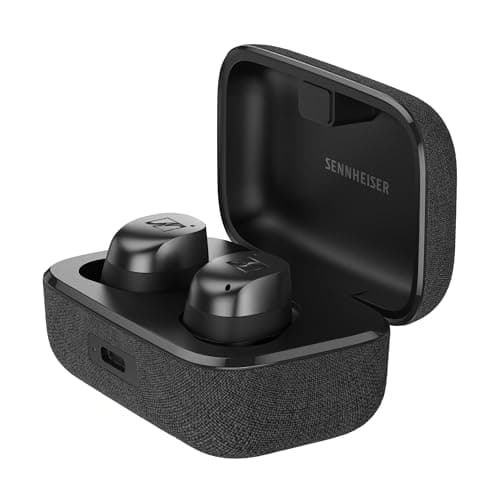
The Momentum True Wireless 4 look almost identical to their predecessors, the Momentum True Wireless 3. That is not necessarily a bad thing — the design is distinctive, with metallic accents and a shape that resembles earrings more than conventional earbuds. They are available in Black Graphite, White Silver, Black Copper, and a special Black Graphite variant. The charging case retains the same fabric-wrapped design with a metallic Sennheiser logo on top, giving it a premium feel that stands out among the sea of glossy plastic cases from competitors.
The case measures 70.1 by 44.6 by 34.8 millimeters and fits comfortably in a pocket. The fabric covering is a fingerprint magnet, but it adds grip and character that glossy plastic alternatives lack. The USB-C charging port is located on the front of the case, which is an unusual placement that took some getting used to — most cases have the port on the back or bottom. The case supports Qi wireless charging, which is convenient if you already have a charging pad on your desk or nightstand.
Each earbud weighs 6.2 grams, which puts them on the heavier side of the true wireless spectrum. The extra weight is distributed well enough that I did not experience fatigue during two-hour listening sessions, but the earbuds protrude noticeably from the ears. If you have smaller ears, this could be a significant problem. The nozzle is 6 millimeters in diameter, which is average, and Sennheiser includes four sizes of silicone ear tips and three sizes of concha fins (stabilizers) to help you find a secure fit.
I strongly recommend using the fit test in the Sennheiser Smart Control app. Without the right combination of tips and fins, the earbuds can feel loose, and the ANC performance suffers significantly. Once I found the right configuration — medium tips with small fins — the fit was secure enough for walking and light jogging, though I would not trust them for intense workouts.
Build Quality and Durability
The MTW4 carry an IP54 rating, which means they are protected against dust ingress and water splashes from any direction. This is a meaningful step up from the MTW3's IPX4 rating and means you can use them confidently in the rain or during sweaty workouts. However, IP54 is not full waterproofing — you should not submerge them or rinse them under a tap. For comparison, the Sony WF-1000XM5 and the Jabra Elite 10 both carry IPX4 or IP55 ratings, so the MTW4 are competitive but not class-leading in this regard.
Build quality is excellent overall. The earbuds feel dense and well-assembled, with no creaking or flexing when handled. The charging case hinge is tight with no wobble, and the magnetic closure is strong enough that the case will not open accidentally in a bag. The fabric covering on the case is more durable than it looks — after two weeks of daily use, including being tossed into a pocket with keys, I saw no visible wear or fraying.
Sound Quality: The Star of the Show
This is where the Sennheiser Momentum True Wireless 4 earn their keep. Each earbud houses a 7mm TrueResponse dynamic driver, the same transducer technology found in Sennheiser's higher-end wired IEMs. The result is a sound signature that is rich, detailed, and effortlessly musical in a way that few true wireless earbuds can match.
Out of the box, the tuning is bass-forward. The low end is elevated by about 3 dB relative to a neutral target, giving kick drums and basslines a warm, full-bodied presence that drives energetic genres exceptionally well. On electronic tracks like Rüfüs Du Sol's "Innerbloom," the bass hits with a tactile quality that makes the listening experience genuinely engaging. The mid-bass is particularly well-executed, providing punch without bleeding into the lower mids and clouding vocal clarity.
The midrange is where the MTW4 truly distinguish themselves. Vocals and instruments are rendered with a natural timbre that feels lifelike rather than processed. On Norah Jones's "Don't Know Why," the texture of her voice — the subtle breathiness and vibrato — comes through with a level of detail that rivals wired IEMs in the same price range. Acoustic guitar strums have a woody resonance that sounds correct, not artificially enhanced.
The treble is slightly relaxed compared to a neutral target, with about 4 dB of roll-off above 8 kHz. This prevents sibilance and listener fatigue during long listening sessions, but it also means that cymbal crashes and hi-hats lack some of the air and sparkle that treble-heads might crave. If you are coming from a brighter-sounding earbud like the Sony WF-1000XM5, the MTW4 will sound darker and more laid-back in the top end. This tuning preference is a deliberate choice by Sennheiser, and it works well for the target audience — people who want to listen to music for hours without ear fatigue.
The soundstage is wide and well-defined for a closed-back in-ear design. Instrument separation is excellent, with each element occupying its own space in the stereo field. On orchestral recordings, the string section is spread across a convincing soundstage, and individual instruments can be picked out with ease. This spatial awareness makes the MTW4 a great choice for movie watching and gaming, though the wireless latency means competitive gamers will want to use a wired connection.
The aptX Lossless capability deserves special attention. When paired with a compatible smartphone — essentially any Android device with Qualcomm's Snapdragon Sound platform — the MTW4 can transmit CD-quality 16-bit/44.1 kHz audio without lossy compression. In a blind A/B test between aptX Lossless and standard AAC on the same hardware, I could consistently identify the lossless stream on tracks with complex high-frequency content like cymbal washes and string harmonics. The difference is subtle but real, and for anyone who maintains a local FLAC library, it is a genuinely meaningful advantage over conventional Bluetooth earbuds.
Codec support is best-in-class. The MTW4 support SBC, AAC, aptX, aptX Adaptive, and aptX Lossless, making them one of the few true wireless earbuds capable of lossless audio transmission over Bluetooth. After a firmware update, they also gain LC3 and LE Audio support, along with Auracast compatibility. If you are an Android user with a compatible smartphone, you can stream CD-quality audio wirelessly, which is a tangible step up from the compressed AAC or SBC streams that most earbuds deliver. iPhone users are limited to AAC, which still sounds excellent on these earbuds but does not take full advantage of the hardware's capabilities.
Active Noise Cancellation
The adaptive ANC on the MTW4 is good but not class-leading. In my testing, it reduced ambient noise by approximately 83 percent overall, which is competitive with the Sony WF-1000XM5 and Bose QuietComfort Ultra Earbuds but not quite at their level. Low-frequency noise like airplane rumble and HVAC hum is effectively neutralized. Mid-frequency noise like conversation and office chatter is attenuated but not completely blocked — you will still hear muffled voices in a coffee shop, though they will not distract you from your music.
The passive isolation is actually the star here. The combination of a deep insertion depth and high-quality silicone ear tips provides excellent physical noise blocking across the frequency range, with up to 50 dB of attenuation in some bands. This means that even with ANC turned off, the MTW4 do a respectable job of sealing out the world. When you combine passive isolation with ANC, the total attenuation is sufficient for most everyday environments, including air travel and open-plan offices.
The transparency mode is quite good. It pipes in ambient sound through the external microphones with natural processing that avoids the "hollow" or "metallic" quality that some earbuds exhibit. The level of ambient sound passthrough is adjustable in the app, which is a thoughtful touch — you can dial in exactly how much of the outside world you want to hear. I found the default transparency level to be well-calibrated for walking on city streets, providing enough awareness of traffic and pedestrian sounds without overwhelming the music.
Where the ANC falls short is with sudden, transient noises. A door slamming or a dog barking will punch through the cancellation in a way that is more jarring than on the Bose or Sony flagships. The adaptive algorithm is slower to respond to rapid changes in ambient noise compared to the competition. If you work in a noisy open-plan office or commute on a loud train, the MTW4 will serve you well, but they are not the absolute best in class for noise cancellation.
Microphone and Call Quality
This is the MTW4's weakest area, and it is a significant one for earbuds that cost nearly $300 at MSRP (though street prices are significantly lower). The six-microphone system should, on paper, deliver excellent call quality with advanced beamforming and noise rejection. In practice, the results are inconsistent and often disappointing.
In quiet environments, calls sound acceptable. Your voice comes through clearly, and background noise is reasonably well controlled. The "voice virtualization" feature, which simulates a face-to-face conversation by positioning your voice in the center of the stereo field, works as advertised and makes calls feel more natural.
The problems start when conditions are less than ideal. In windy conditions, the microphone performance degrades dramatically. Wind noise is poorly handled, with gusts creating loud bursts of distortion that make your speech unintelligible on the other end. In office environments, loud transient noises like keyboard clacking or nearby conversation bleed through the noise reduction in a way that sounds unnatural. If you take frequent calls from noisy environments, the MTW4 are not the right choice — look at the AirPods Pro 3 or the Anker Soundcore Liberty 5 Pro instead.
Battery Life and Charging
Battery life is a mixed bag, as is often the case with feature-rich true wireless earbuds. Sennheiser rates the earbuds at 7.5 hours of playback with ANC off and 7 hours with ANC on. In my testing with ANC enabled at approximately 70 percent volume, I averaged 7 hours and 15 minutes before the low-battery warning sounded. That is solid for this category — the Sony WF-1000XM5 also manages around 7 hours, and the Bose QuietComfort Ultra Earbuds achieve about 6 hours.
The charging case provides an additional 22.5 hours of playback, bringing the total to approximately 30 hours. That is competitive with the rest of the premium earbud market. The case charges via USB-C or Qi wireless charging. A full charge of the case takes about 1.5 hours over USB-C, and the quick-charge feature gives you one hour of playback from just eight minutes of charging, which is genuinely useful when you are rushing out the door.
The case also features a battery protection mode in the app that slows charging to preserve long-term battery health. This is a thoughtful addition for anyone who plans to keep these earbuds for several years, as lithium-ion battery degradation is one of the primary reasons wireless earbuds need to be replaced.
Connectivity and Features
Bluetooth 5.4 provides excellent range and stability. I tested the connection in a typical suburban home and got about 10 meters of range through two walls before audio started glitching, which is solid performance for the Bluetooth 5.4 standard. Multipoint connection allows you to connect two devices simultaneously, and switching between them is seamless — I regularly switched between a laptop and a phone without needing to manually reconnect or fiddle with settings.
The headline feature is Auracast support, enabled via a firmware update. Auracast is a broadcast audio standard that allows you to share audio from a single source to multiple sets of earbuds or speakers. At launch, the ecosystem of Auracast transmitters is limited, but the feature has genuine potential for public spaces like gyms, airports, and museums. If you travel frequently, Auracast-ready earbuds may become increasingly useful over the next few years.
The Sennheiser Smart Control app is one of the better companion apps in the audio space, in my experience. It offers a 5-band equalizer with several presets, a personalized sound profile feature that tunes the earbuds to your hearing, and geofencing that adjusts settings based on your location. The "Sound Check" feature walks you through a listening test to create a custom EQ curve tailored to your ears, and the results are genuinely effective — after running the test, I found the custom profile more enjoyable than any of the stock presets.
How They Compare to the Competition
The premium true wireless earbud market in 2026 is more competitive than ever, with strong contenders from Sony, Bose, Apple, and Anker all vying for your attention. Understanding how the MTW4 fit into this landscape is essential for making an informed buying decision.
Against the Sony WF-1000XM5, the MTW4 offer better sound quality and more advanced codec support, but the Sony earbuds have superior ANC and a more compact design. Sony also has the advantage of LDAC support, which offers higher bitrates than aptX Adaptive on compatible Android devices. The MTW4's Auracast support is the major differentiator, but it is not yet a compelling reason to choose them over Sony if ANC is your priority.
Against the Bose QuietComfort Ultra Earbuds, the MTW4 sound significantly better and offer more features, but Bose dominates on comfort and noise cancellation. The Bose earbuds are also more reliable for calls, with microphone performance that handles wind and noise far better than the MTW4.
Against the AirPods Pro 3, the comparison depends entirely on your smartphone. If you use an iPhone, the AirPods Pro 3 offer seamless integration, better call quality, and comparable ANC — they are the better choice for iOS users. If you use Android, the MTW4 offer codec flexibility and sound quality that the AirPods cannot match.
Value Proposition
At $179.95 (down from an MSRP of $349.95), the Sennheiser Momentum True Wireless 4 offer compelling value for audiophiles who prioritize sound quality above all else. The combination of aptX Lossless support, excellent driver tuning, and future-proof connectivity standards makes them a strong long-term investment for Android users who plan to keep their earbuds for several years.
At full MSRP of $349.95, the value proposition is significantly weaker. The microphone performance is simply not acceptable at the $300 price point, and ANC is good but not great. The Sony WF-1000XM5, which can often be found for around $250, offers better ANC and a more refined overall package at a lower price. The Anker Soundcore Liberty 5 Pro, at around $149.99, delivers 90 percent of the sound quality and better microphone performance for nearly half the price.
The good news is that the MTW4 frequently go on sale. Amazon has listed them for as low as $179.95, and at that price, the value calculation shifts dramatically in their favor. At $180, the sound quality is genuinely competitive with anything in the market, and the future-proofing features become a bonus rather than a premium you are paying extra for.
The Bottom Line
The Sennheiser Momentum True Wireless 4 are earbuds for people who care deeply about sound quality and are willing to make compromises in other areas to get it. The audio performance is genuinely class-leading, with a natural timbre, excellent instrument separation, and support for lossless Bluetooth codecs that audiophiles will appreciate. The build quality is solid, the battery life is respectable, and the Auracast support future-proofs your investment.
But the microphone quality is disappointing, the ANC is good rather than great, and the fit may not work for everyone. These are not the earbuds for frequent callers, for people who work in noisy environments, or for iOS users who are better served by AirPods. They are earbuds for music lovers who want the best possible sound quality in a true wireless form factor and are willing to accept the trade-offs that come with that focus.
If you are an Android user who prioritizes sound quality above everything else, and you can find the MTW4 on sale for under $200, they are an easy recommendation. The combination of aptX Lossless, Sennheiser's excellent driver tuning, and forward-looking connectivity standards makes them one of the most satisfying true wireless earbuds for pure music listening available today. Just go into the purchase with realistic expectations about the microphone, the ANC, and the fit, and you will likely be very happy with what you get.
If you need better call quality, stronger ANC, or a more reliable fit, consider the Sony WF-1000XM5, the Bose QuietComfort Ultra Earbuds, or the AirPods Pro 3 instead. Each of those products makes different trade-offs, and depending on your priorities, any of them could be the better choice for your specific needs. The Sennheiser Momentum True Wireless 4 are a specialist tool for a specific kind of listener — and for that listener, they are among the best earbuds money can buy.
Pros
- Class-leading sound quality with aptX Lossless support
- Bluetooth 5.4, LE Audio, and Auracast ready for future-proofing
- Strong ANC performance with excellent passive isolation
- Qi wireless charging and quick charge (8 min = 1 hour playback)
- IP54 sweat and splash resistance
Cons
- Microphone and call quality is sub-par for the price point
- Large housing may not fit smaller ears comfortably
- ANC falls short of Sony and Bose flagships
- iOS users limited to AAC codec, losing lossless advantage
Final Verdict
The Sennheiser Momentum True Wireless 4 deliver class-leading sound quality with aptX Lossless, LE Audio, Auracast, and adaptive ANC in a premium package. Outstanding audio performance and future-proof features offset disappointing microphone quality and a finicky fit.