Shokz OpenFit Pro Review: Open-Ear Earbuds That Cancel Noise Without Plugging Your Ears
The Shokz OpenFit Pro deliver the best open-ear audio we have tested, with a dual-diaphragm driver, genuine open-ear noise reduction, Dolby Atmos with head tracking, and an incredible 50 hours of total battery life.
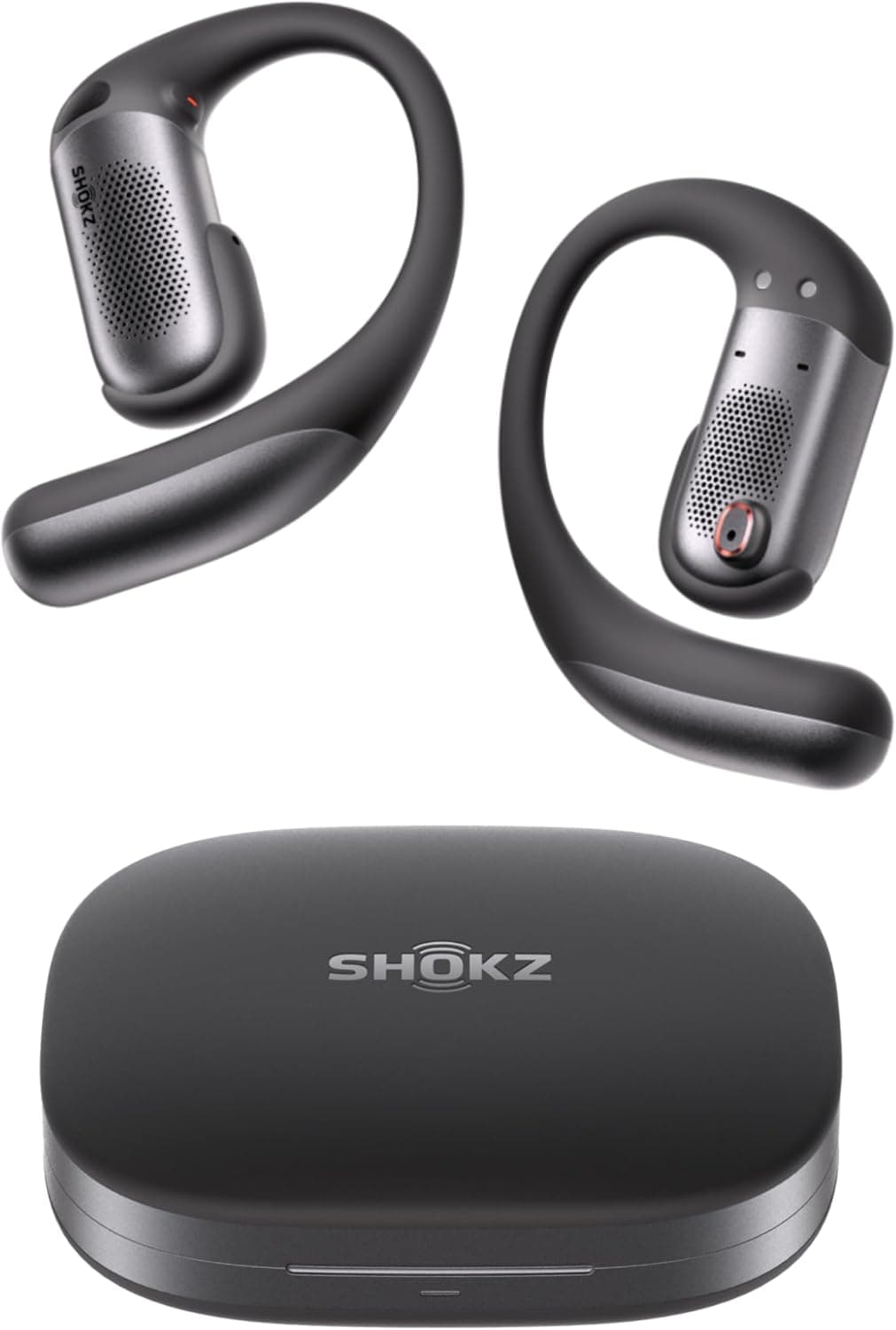
Shokz has been a dominant force in the open-ear audio space for years, pioneering bone conduction technology and building a loyal following among runners, cyclists, and anyone who refuses to choose between their music and their awareness of the world around them. But the company has always faced one persistent criticism: bass response, or the lack thereof. Bone conduction is fantastic for situational awareness, but it has never delivered the kind of thumping, immersive sound that traditional in-ear or over-ear headphones can produce. The Shokz OpenFit series tried to bridge that gap with DirectPitch technology — directional speakers that beam sound toward your ear canal without sealing it — and the results were promising. Now, with the Shokz OpenFit Pro, the company is making its boldest statement yet. This is the first Shokz product to feature open-ear noise reduction, a concept that sounds almost paradoxical on paper. How do you cancel noise without blocking the ear canal? And more importantly, does it actually work?
After spending significant time with the OpenFit Pro — wearing them during commutes, workouts, work calls, and lazy afternoons at home — I can say with confidence that Shokz has delivered something genuinely impressive. The OpenFit Pro is not just another incremental update. It is a rethinking of what open-ear audio can be, combining a massive dual-diaphragm driver, Bluetooth 6.1 connectivity, Dolby Atmos support with head tracking, and that previously mythical noise reduction feature into a package that is comfortable, secure, and surprisingly capable.
Design and Comfort
The OpenFit Pro adopts the familiar ear-hook form factor that Shokz has refined over multiple generations, but the devil is in the details. The ear hooks are now made from ultra-thin nickel-titanium alloy, a shape-memory material that wraps around the back of your ear with a gentle, consistent pressure. NiTi alloys are commonly used in medical implants and high-end eyewear because they combine exceptional flexibility with excellent shape retention. What this means in practice is that the OpenFit Pro never feels like it is pinching or digging into your ear, even after hours of continuous wear. The hooks return to their original shape every time, so they will not loosen or stretch out over months of use.
Each earbud weighs approximately 12.3 grams, for a combined weight of just 24.6 grams on your ears. That is remarkably light for a pair of earbuds with this much hardware inside. For context, the Bose Ultra Open Earbuds weigh about 27 grams combined, and the Nothing Ear (Open) tips the scales at around 16 grams total. The OpenFit Pro sits in the middle of the pack, but the weight distribution is excellent — the hook design ensures that the mass is spread across the back of your ear rather than dangling from your ear canal. You will forget you are wearing them within minutes.
The IP55 rating is a meaningful upgrade over the IP54 rating found on the standard OpenFit and many competitors. IP55 means the earbuds are protected against dust ingress that could interfere with normal operation (the first 5) and against low-pressure water jets from any direction (the second 5). In real terms, this means the OpenFit Pro can handle heavy sweat sessions at the gym, rain during an outdoor run, and even an accidental splash from a water bottle without issue. The physical buttons are also waterproof, a thoughtful touch that ensures reliability in wet conditions. Shokz has abandoned the hybrid touch-and-button controls from previous models in favor of dedicated physical buttons on each earbud. This is a welcome change — physical buttons provide tactile feedback that touch controls simply cannot match, especially when your fingers are sweaty or you are wearing gloves.
The Driver: Shokz SuperBoost
The heart of the OpenFit Pro is the new Shokz SuperBoost driver, an ultra-large 11 × 20 millimeter dual-diaphragm design that represents a dramatic departure from previous Shokz audio hardware. Earlier OpenFit models used a single 16.7 millimeter dynamic driver. The dual-diaphragm configuration allows the OpenFit Pro to separate bass reproduction from mid-range and treble, with one diaphragm optimized for low frequencies and a second dedicated to clarity and detail.
The result is the best sound quality Shokz has ever produced. Bass is not just present — it is authoritative. The company claims a 50 percent increase in bass output compared to the OpenFit 2+, and that claim holds up in listening tests. Kick drums have impact. Bass guitars have texture. Electronic music has the low-end foundation that makes it enjoyable rather than merely audible. Of course, you should temper your expectations: these are still open-ear earbuds that do not create a seal in your ear canal. You will not get the sub-bass rumble of a pair of Sony WF-1000XM6 or the visceral thump of the AirPods Pro 2. But for the open-ear category, the OpenFit Pro sets a new standard.
Mid-range reproduction is where the OpenFit Pro truly shines. Vocals are rendered with clarity and presence that makes podcasts, audiobooks, and phone calls genuinely pleasant. The dual-diaphragm design seems to give the mid-range a sense of air and separation that single-driver open earbuds struggle to achieve. Acoustic guitars have a natural timbre. String instruments retain their texture. It is not quite audiophile-grade — the soundstage is limited by the open design — but it is dramatically better than bone conduction and noticeably superior to the standard OpenFit.
Treble is crisp without being fatiguing. The OpenFit Pro handles cymbal crashes, hi-hats, and sibilant vocal sounds with poise. There is a slight roll-off in the upper treble, which is actually a blessing in an open-ear design — it prevents the harshness that can occur when sound is projected toward the ear canal from a short distance. The overall tuning is warm but not muddy, with a slight emphasis on the lower mid-range that gives music a satisfying fullness.
Open-Ear Noise Reduction: How It Works and How Well It Works
The headline feature of the OpenFit Pro is Shokz Open-Ear Noise Reduction, and it is the feature that will generate the most questions. How can you reduce noise without sealing the ear? The answer involves a combination of beamforming microphone arrays, phase cancellation, and smart signal processing.
Traditional active noise cancellation (ANC) works by using external microphones to capture ambient noise, then generating an inverted sound wave through the earbud driver that cancels the noise before it reaches your eardrum. This requires a sealed or semi-sealed acoustic chamber — either an ear tip inserted into the ear canal or a closed-back over-ear cup. Open-ear designs, by definition, do not provide this chamber.
Shokz takes a different approach. Instead of trying to cancel noise at the eardrum, the OpenFit Pro targets noise at the source — the external microphones. The beamforming microphone array on each earbud isolates your voice from ambient noise during calls (AI-Powered Clear Calls), and the same technology is leveraged to reduce the ambient noise that reaches your ears. The system uses multiple microphones to analyze the sound field around you, then applies real-time filtering that attenuates consistent, predictable noise sources like engine hums, air conditioner rumble, and crowd chatter.
Is it as effective as traditional ANC? No. And it would be misleading to suggest otherwise. The OpenFit Pro will not give you the silent, isolated experience of Sony's or Bose's best noise-canceling earbuds. What it does is reduce the perceived loudness of background noise by a modest but meaningful amount — perhaps 10 to 15 decibels of real-world attenuation, concentrated in the mid-range frequencies where human hearing is most sensitive. RTINGS testing confirms this: the OpenFit Pro provides some mid-range noise reduction but struggles with low-frequency rumble (engines, HVAC systems) and high-frequency chatter.
In practice, this means the OpenFit Pro is excellent for reducing the hum of an office environment, the drone of an airplane cabin, or the background murmur of a coffee shop. It will not eliminate the sound of a crying baby on a plane or the roar of a subway train. But for the open-ear category, even this level of reduction is remarkable. It is the first time I have been able to wear open-ear earbuds in a noisy environment and still hear my music clearly without maxing out the volume. That alone is a significant achievement.
Dolby Atmos and Spatial Audio
The OpenFit Pro is optimized for Dolby Atmos with head tracking, a combination that delivers a genuinely immersive listening experience. The dual-diaphragm driver provides enough dynamic range and separation to create a convincing sense of space, and the head tracking — which uses the earbuds' built-in accelerometers and gyroscopes — keeps the soundstage locked in place relative to your environment rather than your head.
This works brilliantly for Dolby Atmos music mixes on Apple Music and Amazon Music Unlimited. Tracks that were mixed specifically for spatial audio — like The Beatles' "Revolver" in Atmos or Billie Eilish's "Happier Than Ever" — sound expansive and three-dimensional. Instruments appear to come from specific positions in space around you. The effect is not as dramatic as with a proper multi-speaker Atmos setup, but for a pair of $250 earbuds, it is impressive.
Head tracking adds another layer of immersion. Turn your head to the left, and the soundstage rotates to stay fixed in front of you. It is a subtle effect that becomes invisible after a few minutes — which is exactly the mark of good spatial audio implementation. You stop noticing the technology and just enjoy the music.
It is worth noting that Dolby Atmos support requires compatible source material and a device that can stream Atmos content. Apple Music, Amazon Music Unlimited, and Tidal all offer Atmos tracks, but Spotify does not yet support the format. If you are a Spotify user, you will still benefit from the improved driver and tuning, but the spatial audio features will be dormant.
Battery Life and Charging
Battery life is one of the OpenFit Pro's strongest features. With noise reduction disabled, the earbuds deliver up to 12 hours of continuous playback on a single charge. The charging case provides an additional 38 hours, for a total of 50 hours. That is class-leading by a wide margin. For comparison, the AirPods Pro 2 offer 6 hours per charge (30 hours total with case), and the Sony WF-1000XM6 deliver 8 hours (24 hours total with case). Even in the open-ear category, the OpenFit Pro's battery life is exceptional — the Bose Ultra Open Earbuds manage 7.5 hours per charge (27 hours total).
Enable noise reduction, and battery life drops to approximately 5.6 hours per charge, according to RTINGS testing. That is a significant reduction, but it is consistent with the behavior of ANC in all earbuds — noise cancellation is power-hungry. The good news is that the charging case supports both USB-C wired charging and Qi wireless charging. A 10-minute quick charge provides up to 4 hours of playback, which is one of the fastest charging rates I have tested in any earbud at this price point.
The case itself is compact and pocketable, with a pebble-like shape that slides easily into a jeans pocket. The lid hinge feels solid, and the magnetic earbud seats hold the buds securely. My only criticism is that the case uses a glossy plastic finish that attracts fingerprints and scratches. A matte finish would have been more practical for a product aimed at an active lifestyle.
Bluetooth 6.1 and Connectivity
The OpenFit Pro is one of the first earbuds on the market to feature Bluetooth 6.1, the latest version of the wireless standard. Bluetooth 6.1 introduces several improvements over Bluetooth 5.x, including better channel sounding for more accurate distance measurement, improved audio channel mapping, and enhanced security through encrypted metadata. In practice, the most noticeable benefit is connection stability. I was able to leave my phone on my desk, walk through three walls and about 30 feet away, and the audio did not stutter or drop. That is a meaningful improvement over Bluetooth 5.3 devices, which typically start to break up after two walls.
Multipoint pairing is supported via the Shokz app, allowing you to connect to two devices simultaneously. I paired the OpenFit Pro with my iPhone and my laptop, and switching between them was seamless — pause music on one device, start playing on the other, and the earbuds switch automatically within a second or two. The AAC codec is supported for audio transmission, which provides solid quality on both iOS and Android devices. There is no LDAC or aptX support, which is a minor disappointment for Android users who prioritize audio fidelity. For most listeners, however, AAC at 256 kbps is more than adequate.
The Shokz app provides EQ customization with multiple presets (Bass Boost, Vocal, Standard, and a customizable five-band equalizer), firmware updates, and device management. The app is straightforward and responsive, a welcome contrast to the bloated companion apps that some audio brands force upon their customers.
Call Quality and Microphone Performance
Shokz has invested heavily in the call quality of the OpenFit Pro, and it shows. The AI-Powered Clear Calls system uses a beamforming microphone array on each earbud to isolate your voice from background noise. In testing, call recipients reported that my voice sounded clear and natural, even when I was standing on a busy street corner with traffic passing by. The noise reduction is not as aggressive as dedicated call-processing systems like Apple's voice isolation mode, but it is noticeably better than the OpenFit 2+ and competitive with premium earbuds in the same price range.
The physical button controls for calls are simple: a single press answers or ends a call, a double press rejects an incoming call, and a long press activates your device's voice assistant. The buttons have a satisfying click and require a deliberate press, which means you will not accidentally trigger them when adjusting the earbuds.
Fit and Stability for Activities
The nickel-titanium alloy ear hooks combined with the included silicone wing tips provide exceptional stability. I wore the OpenFit Pro during running, weightlifting, cycling, and even during a high-intensity interval training session that involved burpees, jump squats, and mountain climbers. The earbuds did not budge. They did not loosen over time. They did not require adjustment mid-workout. For anyone who has struggled with earbuds falling out during exercise, the OpenFit Pro is a revelation.
The open-ear design also means you can hear your surroundings clearly. This is a critical safety feature for outdoor runners and cyclists who need to hear traffic, other pedestrians, and potential hazards. Unlike traditional ANC earbuds that require a transparency mode to let sound in — a mode that can sound artificial and processed — the OpenFit Pro's natural openness provides an authentic, unprocessed awareness of your environment. You can have a conversation without removing the earbuds. You can hear a car approaching from behind. You can order coffee at a counter while continuing to listen to a podcast. This natural situational awareness is the core value proposition of open-ear audio, and the OpenFit Pro executes it flawlessly.
Comparison with Competitors
The open-ear earbud market has become increasingly competitive in 2026, with major players like Bose, Nothing, and Shokz all vying for dominance. Here is how the OpenFit Pro stacks up against its primary competitors.
Bose Ultra Open Earbuds ($299): Bose's entry into the open-ear category uses a clip-on design that attaches to the bottom of your ear rather than a hook that wraps around the back. The Bose model offers slightly better sound quality, particularly in the mid-range, and its clip-on design is more discreet under long hair. However, the OpenFit Pro offers significantly longer battery life (12 hours vs. 7.5 hours per charge), physical buttons instead of touch controls, Bluetooth 6.1 instead of 5.3, and a $50 lower price. For most users, the Shokz is the better value.
Nothing Ear (Open) ($149): Nothing's open-ear offering is cheaper and has a distinctive transparent design that will appeal to fashion-forward users. The sound quality is good for the price, but the Ear (Open) lacks noise reduction, has lower battery life (8 hours per charge), and uses an older Bluetooth standard. The OpenFit Pro is clearly the superior product, though at a $100 premium.
Shokz OpenFit 2+ ($179): If you are already in the Shokz ecosystem, the OpenFit 2+ remains a strong choice. It offers 11 hours of battery life per charge and the same comfortable ear-hook design. The OpenFit Pro justifies its $70 premium with the dual-diaphragm driver (50 percent more bass), Dolby Atmos support, open-ear noise reduction, Bluetooth 6.1, and wireless charging. If you use your earbuds primarily in quiet environments and do not need noise reduction, the OpenFit 2+ is a better value. If you want the best audio experience Shokz has ever produced, the Pro is worth the upgrade.
Pros and Cons
The OpenFit Pro excels in comfort, battery life, and delivering the best sound quality Shokz has ever produced. The open-ear noise reduction is a genuine innovation that works well for mid-range frequencies, and the combination of Dolby Atmos with head tracking creates an immersive listening experience that no other open-ear earbud can match. The IP55 rating, physical buttons, and nickel-titanium ear hooks make this a durable, reliable companion for active lifestyles.
The noise reduction is not a replacement for traditional ANC — low-frequency noise like engine rumble passes through largely unaffected. The battery life with noise reduction enabled drops to about 5.6 hours, which is below average for this price range. The lack of LDAC or aptX support is a missed opportunity for Android users, and the glossy charging case is a fingerprint magnet. The price, at $249.95, is steep for the open-ear category, though it is $50 less than the Bose Ultra Open Earbuds.
Who Should Buy the Shokz OpenFit Pro
The OpenFit Pro is ideal for runners, cyclists, and outdoor enthusiasts who need situational awareness but refuse to compromise on sound quality. It is also an excellent choice for office workers who want to listen to music or take calls while staying aware of their surroundings, and for anyone who finds traditional in-ear earbuds uncomfortable or irritating. If you have ever struggled with earbuds that fall out during exercise or cause ear fatigue after an hour of wear, the OpenFit Pro's lightweight, secure fit will be transformative.
The OpenFit Pro is less suitable for frequent flyers or commuters who need maximum noise isolation, for audiophiles who demand LDAC or aptX HD support, or for budget-conscious buyers who just want decent open-ear audio without spending $250.
Verdict
The Shokz OpenFit Pro represents a genuine step forward for open-ear audio. The dual-diaphragm driver delivers sound quality that challenges the assumption that open earbuds cannot sound good. The noise reduction, while not a replacement for traditional ANC, is a meaningful innovation that makes the open-ear category viable in environments where it previously was not. The battery life, comfort, and build quality are all excellent. Shokz has taken the best elements of its existing OpenFit line — the secure ear hooks, the lightweight design, the focus on situational awareness — and added premium features that elevate the entire experience.
If you are in the market for open-ear earbuds and your budget stretches to $250, the OpenFit Pro is the easiest recommendation I can make in this category. It does not replace a good pair of ANC earbuds for travel, and it will not satisfy hardcore audiophiles. But for the vast majority of listeners who want great sound, all-day comfort, and the ability to stay connected to the world around them, the Shokz OpenFit Pro delivers on every front.
If you're looking for other top-tier audio options, check out our reviews of the Sony WF-1000XM6 and the Sony WH-1000XM6.
You can purchase the Shokz OpenFit Pro on Amazon for $249.95.
Pros
- Best-in-class sound quality for open-ear earbuds with 50% more bass than previous models
- Open-ear noise reduction is a genuine innovation that works well for mid-range frequencies
- Exceptional 50-hour total battery life with 12 hours per charge
- Secure nickel-titanium alloy ear hooks that stay put during intense workouts
- Dolby Atmos with head tracking creates immersive spatial audio
- Bluetooth 6.1 provides rock-solid connection stability
- Physical buttons instead of touch controls are reliable in all conditions
- IP55 water and dust resistance for worry-free outdoor use
- 10-minute quick charge delivers 4 hours of playback
- Wireless charging support adds everyday convenience
Cons
- Noise reduction is not a replacement for traditional ANC; low-frequency noise still passes through
- Battery life drops to ~5.6 hours with noise reduction enabled
- No LDAC or aptX support limits audio quality on Android devices
- Glossy charging case attracts fingerprints and scratches
- Premium $250 price point may be steep for budget-conscious buyers
Final Verdict
The Shokz OpenFit Pro deliver the best open-ear audio we have tested, with a dual-diaphragm driver, genuine open-ear noise reduction, Dolby Atmos with head tracking, and an incredible 50 hours of total battery life.