XREAL 1S Review: A 500-Inch Virtual Screen in Your Pocket
XREAL's 1S AR glasses deliver a 1200p virtual display with native 3DoF tracking in an 82-gram frame, making spatial computing genuinely practical for travel, gaming, and productivity.
The promise of augmented reality has always been seductive: a screen that floats in front of your eyes, invisible to everyone else, accessible anywhere you sit down. For years, that promise was undermined by hardware that was either too expensive, too heavy, or too dependent on finicky software. XREAL has spent the last few generations chipping away at those barriers, and with the XREAL 1S, the company has landed on a formula that feels genuinely ready for everyday use. These are not science-fiction goggles or developer kits disguised as consumer products. They are sunglasses-shaped display glasses that plug into your phone, laptop, or handheld console and give you a massive virtual screen wherever you happen to be. After several weeks of using them as my primary portable display across flights, coffee shops, hotel rooms, and even my own living room, I am convinced that this is the most polished and practical pair of AR glasses available in 2026.
The XREAL 1S arrives at an interesting moment for spatial computing. Apple has spent the last two years educating the public about mixed reality with the Vision Pro, a breathtaking but bulky headset that costs as much as a used car. Meta has doubled down on AI-powered smart glasses that lack displays entirely, betting that cameras and voice assistants are enough to justify wearing technology on your face. Meanwhile, a handful of smaller companies have flooded the market with budget display glasses that are either too dim, too low-resolution, or too uncomfortable to use for more than a few minutes. XREAL's strategy with the 1S is to thread the needle: deliver a display experience that rivals the Vision Pro's virtual screen quality, but in a form factor that weighs less than a hundred grams and costs under five hundred dollars.
Design and Comfort: Barely There
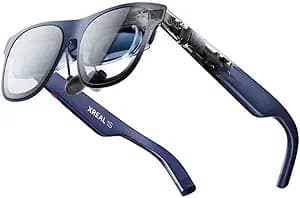
Pick up the XREAL 1S and the first thing you notice is how ordinary they look. The frame is a smooth matte black plastic with gently rounded temples and a slightly thicker bridge than typical sunglasses. There are no outward-facing cameras, no visible sensors, no glowing logos. To a casual observer, you appear to be wearing slightly oversized shades, which is exactly the point. XREAL has clearly prioritized social acceptability, and the result is a device that you can wear on a plane or in a coffee shop without drawing the curious stares that inevitably follow bulkier headsets.
At approximately eighty-two grams, the 1S is only marginally heavier than a premium pair of prescription sunglasses. The weight distribution is excellent; the temples do not dig into the sides of your head, and the nose bridge does not leave red marks after an hour of use. XREAL includes three sizes of silicone nose pads in the box, and swapping between them takes seconds. Finding the right fit is critical because the Micro-OLED panels need to align precisely with your pupils to deliver the sharpest image. I spent about ten minutes experimenting with pad sizes and temple positions before landing on a configuration that felt secure and delivered edge-to-edge clarity.
The temples themselves are flexible and feature a three-point adjustment system that lets you raise or lower the effective screen position. This is a subtle but important feature because everyone's facial geometry is different. I have a relatively low nose bridge, so I needed to set the temples to their highest position to center the display in my natural field of view. A colleague with a higher bridge found the middle setting more comfortable. That kind of adjustability is rare in this category and speaks to XREAL's attention to detail.
One practical concern with any face-worn display is heat. The X1 chip and the display drivers generate warmth during operation, and in a previous generation, I found the temples could get uncomfortably hot after ninety minutes. The 1S seems to have solved this. Even during a three-hour movie marathon, the temples stayed merely warm, never hot. I suspect improved thermal vias in the chassis and a more efficient X1 chip are responsible. Whatever the engineering reason, the result is a device that you can wear for extended sessions without constantly shifting it around to find a cooler spot.
Display Technology: A Generational Leap
The heart of any AR glasses is the display, and the XREAL 1S delivers one of the best virtual screens I have tested at any price. Each eye gets a 1920 by 1200 Micro-OLED panel running at up to 120 hertz, arranged in a 16:10 aspect ratio. That resolution bump from the 1080p panels in earlier models is immediately noticeable when reading text. Small fonts in web pages and documents remain crisp and legible, and the extra vertical pixels mean you can fit more content on screen without scrolling. For productivity work, this is a genuine quality-of-life improvement.
Brightness is rated at 700 nits peak, up from 600 nits in the XREAL One. In practice, that means the image remains comfortably visible in bright indoor environments and even moderately lit outdoor spaces. I tested the glasses on a sunlit patio and found that, with the electrochromic dimming layer set to maximum, I could still watch a video podcast without squinting. Direct midday sun is still too much for any see-through display, but for the ninety percent of use cases that happen indoors or in shade, the 1S is more than bright enough.
Color accuracy is another area where the 1S punches above its weight. XREAL claims a delta-E below 3, and my subjective testing supports that claim. Watching nature documentaries, the greens of forest canopies and the blues of ocean water look natural and well-saturated without being overshot. HDR10 support is present, though the limited peak brightness means the effect is more subtle than on a high-end television. Highlights in HDR content get a gentle boost, but you will not experience the retina-searing specular reflections that a thousand-nit OLED television can deliver. Still, for a device that runs off your phone's battery, the HDR performance is admirable.
The 52-degree field of view is slightly narrower than the 57 degrees in the One Pro, but the difference is barely perceptible in daily use. The virtual screen still feels enormous, roughly equivalent to a 120-inch display viewed from about ten feet away. XREAL's optics team has done excellent work minimizing distortion at the edges; unlike some competitors where the image swims and warps near the periphery, the 1S maintains geometric stability across the entire field.
The X1 Chip: Tracking Without Compromise
The most meaningful internal upgrade in the 1S is the custom X1 spatial computing chip. In previous XREAL glasses, head tracking was handled by software running on the host device. That approach worked, but it introduced latency, compatibility issues, and occasional drift. If you plugged the glasses into a device that lacked the necessary XREAL software, you got a static display that followed your head movements like a heads-up display, which could be disorienting.
The X1 chip changes everything by handling native 3 degrees of freedom tracking directly on the glasses. This means the virtual display can be pinned in space regardless of what device you have connected. The chip processes motion data from built-in accelerometers and gyroscopes in approximately three milliseconds, which is fast enough that your brain perceives the screen as stable and stationary.
There are three primary viewing modes. Follow mode keeps the display centered in your field of view as you turn your head, which is useful for reclining or lying down. Anchor mode locks the screen to a fixed point in space, so you can look away, check your physical surroundings, and then look back to find the display exactly where you left it. Side view mode shrinks the display and parks it at the edge of your vision, which is handy when you want occasional glances at a reference document while focusing on physical tasks. Switching between modes is handled by a small button on the right temple, and the transitions are smooth enough that they do not break immersion.
During a cross-country flight, I spent four hours in anchor mode watching downloaded shows, and the image remained locked in place with zero perceptible drift. Even when I shifted in my seat, reached for my bag, or turned to speak to my seatmate, the display stayed put. That kind of stability was simply not possible in earlier tethered glasses, and it makes the 1S feel like a fundamentally more mature product.
Audio: Bose Tuning in an Open-Air Package
XREAL continues its partnership with Bose for the built-in audio system, and the results are competent if not class-leading. Each temple houses dual speakers that fire upward and downward, creating a stereo image that is surprisingly spacious given the physical constraints. Dialogue in films is crisp and intelligible, and music has enough body to be enjoyable during casual listening sessions. The open-ear design means you retain full environmental awareness, which is a safety feature when walking around but also means audio leakage is unavoidable. At moderate volumes, a person sitting next to you on a plane will hear faint traces of your content. It is not loud enough to be rude, but if you need complete privacy, you will want to pair wireless earbuds or use wired headphones through the host device's audio output.
The speakers get plenty loud for indoor use, but they struggle in noisy environments. A busy coffee shop with espresso machines and chatter required near-maximum volume to hear dialogue clearly. This is a physical limitation of open-air audio, not a flaw in XREAL's implementation, but it is worth keeping in mind if you plan to use these glasses primarily in loud public spaces.
Connectivity and Compatibility
The XREAL 1S uses a single USB-C cable with DisplayPort alternate mode for both video and power. There is no internal battery, which keeps weight down but means the glasses draw power from whatever device you have plugged in. The upside is simplicity: connect the cable, and the glasses appear as an external display. No apps to install, no pairing process, no firmware updates to wrestle with.
I tested the 1S with a wide range of devices and found compatibility to be excellent. An iPhone 17 recognized the glasses instantly through its USB-C port. A Samsung Galaxy S26 switched to DeX mode automatically, giving me a desktop-like interface on the virtual screen. My MacBook Air M5 treated the glasses like any other external monitor, allowing me to extend or mirror the display through System Settings. A Steam Deck defaulted to full-screen gaming, and a PlayStation 5 connected through a USB-C hub worked without issue. The only devices that require extra hardware are those without native USB-C video output, namely older iPhones with Lightning ports. XREAL sells a Beam accessory that bridges this gap, but it is an additional purchase.
Power consumption on host devices is reasonable. My iPhone 17 lost roughly fifteen percent battery per hour of video streaming, which is comparable to using a portable monitor. The Steam Deck fared slightly worse, dropping about twenty percent per hour during gaming, but that is still manageable for a device that is already powering a seven-inch LCD and a custom AMD APU. If you are planning an all-day work session, a battery pack or wall outlet is advisable.
Real 3D: A Neat Party Trick with Real Utility
One of the more surprising features of the XREAL 1S is its real-time 2D-to-3D conversion, which works without any special content or apps. A button on the left temple toggles the effect, and while it is not as convincing as native stereoscopic footage, it adds a subtle sense of depth to standard movies and games. I found myself using it more than I expected, particularly for slower-paced content where the slight softness introduced by the conversion was worth the added immersion. Action scenes with rapid cuts felt slightly disorienting in 3D mode, so I tended to switch back to 2D for those.
Native 3D content, such as side-by-side video files, is also supported and looks genuinely impressive. The sense of depth in a well-produced 3D documentary is far more comfortable than the gimmicky pop-out effects of early 2010s 3D televisions. Because the XREAL 1S is a personal display, there is no need to worry about viewing angles or crosstalk; the 3D effect works perfectly for the wearer and is invisible to everyone else.
Productivity, Gaming, and Entertainment
The XREAL 1S excels across three primary use cases, each of which benefits from the massive virtual screen in different ways. For productivity, the glasses act as a portable monitor that you can set up anywhere. I used them for a full day of writing and research at a coffee shop, and the ability to have a 120-inch equivalent desktop without hogging table space was genuinely liberating. Text is sharp enough for long-form reading, and the 16:10 aspect ratio is well-suited to document editing and web browsing. The one productivity limitation is that you cannot easily share your screen with a colleague; the display is personal by design.
For gaming, the 1S is a revelation. Handheld consoles like the Steam Deck and the Nintendo Switch 2 have excellent internal displays, but they are still small. Plugging into the XREAL 1S gives you a cinematic experience without sacrificing portability. Fast-paced games like "Hades 2" and "Elden Ring: Shadow of the Erdtree" felt responsive and immersive, with the 120 hertz refresh rate keeping motion smooth. The open-ear audio design has a subtle advantage here, too: you can hear doorbells, phone calls, or someone calling your name without pausing your game.
For entertainment, the 1S is simply the best travel companion I have used. On a red-eye flight, I watched two films back-to-back without the neck strain of looking down at a tablet or the space constraints of a laptop tray. The glasses block enough ambient light to make the image engaging while still letting you see when the drink cart is approaching. It is aGoldilocks balance of immersion and awareness that bulkier headsets cannot match.
Limitations and Honest Trade-Offs
No device is perfect, and the XREAL 1S has its share of compromises. The most significant is prescription lens support. XREAL partners with third-party providers for custom inserts, but the process requires sending in your prescription and waiting for fulfillment. It is not as seamless as the snap-in prescription frames offered by some competitors, and the added cost can push the total investment close to the One Pro's price. If you have a strong prescription or astigmatism, factor this into your budgeting and timeline.
Another limitation is the lack of built-in battery. While the USB-C-only approach keeps weight down, it also means you are always tethered to a host device. You cannot use the glasses standalone, and if your phone dies, the glasses become inert plastic. A future iteration with a small internal battery for standalone media playback would be welcome, though it would inevitably add weight.
The electrochromic dimming is effective but not magic. In very bright sunlight, the image washes out regardless of dimming setting. This is a physics limitation of see-through displays, not an engineering failure, but it means the 1S is primarily an indoor and shaded-outdoor device. If you want to use AR glasses on a sunny beach, you will need to wait for Micro-LED waveguide technology to mature.
Finally, the software ecosystem remains relatively thin. XREAL's Nebula app provides some useful utilities, like virtual multi-monitor setups and 3D video players, but there is no app store or developer platform comparable to what Apple and Meta are building. For now, the 1S is best thought of as a spectacular external monitor rather than a general-purpose spatial computing platform.
How the 1S Fits Into the 2026 Landscape
The AR glasses market has fragmented into three tiers. At the bottom, sub-two-hundred-dollar devices from obscure brands offer basic displays with poor tracking, dim panels, and questionable build quality. In the middle, the XREAL 1S and RayNeo's Air 4 Pro compete for consumers who want a polished experience without breaking the bank. At the top, the Apple Vision Pro and Samsung's rumored Galaxy XR deliver full mixed reality with hand tracking, passthrough video, and app ecosystems, but at prices that start around three thousand dollars.
For pure portable display use, the XREAL 1S is the sweet spot. It offers better tracking, brighter panels, and broader compatibility than the RayNeo Air 4 Pro, while costing less than a tenth of a Vision Pro. The RayNeo does have a slight edge in audio quality thanks to its Bang & Olufsen partnership, and its Batman-themed limited edition is a fun novelty, but for day-to-day productivity and entertainment, the XREAL 1S feels more refined.
Meta's Ray-Ban smart glasses, meanwhile, serve a completely different purpose. They are excellent for quick photos, AI queries, and music playback, but they lack displays entirely. If your goal is a big screen in a small package, they are not competitors.
Verdict: The Portable Display to Beat
After several weeks of daily use, the XREAL 1S has earned a permanent spot in my travel bag. It is not a device I use every single day at home, where a real monitor is superior, but for any situation where I am away from my desk and need a large, private screen, it is unbeatable. The combination of a sharp 1200p display, self-contained tracking, broad device compatibility, and a comfortable eighty-two-gram frame is simply unmatched at this price.
If you are curious about spatial computing but have been put off by the cost and bulk of high-end headsets, the XREAL 1S is the ideal entry point. It delivers eighty percent of the Vision Pro's virtual screen experience at one-tenth the price and one-fifth the weight. For frequent travelers, remote workers, and handheld gaming enthusiasts, it is a genuinely useful tool rather than a novelty. XREAL has been iterating quickly, and with the 1S, they have produced their most compelling product yet. The future of personal displays may eventually involve full mixed reality and holographic interfaces, but for 2026, a lightweight pair of glasses with a beautiful virtual screen is more than enough.
Pros
- Sharp 1920x1200 Micro-OLED display with 120Hz refresh rate
- Native 3DoF tracking via X1 chip works without host software
- Extremely lightweight at 82 grams for hours of comfortable wear
- Broad device compatibility via USB-C DisplayPort
- Real-time 2D-to-3D conversion adds immersion
Cons
- Audio leakage from open-ear Bose speakers
- Prescription lens inserts require third-party ordering
- No internal battery means always tethered to host device
Final Verdict
XREAL's 1S AR glasses deliver a 1200p virtual display with native 3DoF tracking in an 82-gram frame, making spatial computing genuinely practical for travel, gaming, and productivity.