Canon EOS R6 Mark III Review: The All-Rounder That Justifies the Upgrade
The Canon EOS R6 Mark III delivers a meaningful upgrade with its new 32.5MP sensor, 40fps burst shooting, internal 7K RAW video, and improved stabilization, making it one of the most well-rounded enthusiast full-frame cameras available.
The full-frame mirrorless camera market has reached a fascinating inflection point. With Sony's a7 V setting new standards for dynamic range, Nikon's Z6 III pushing video capabilities forward, and Panasonic's S1 II delivering compelling hybrid performance, Canon needed to respond with something that would reestablish the EOS R series as the go-to choice for enthusiast photographers. The Canon EOS R6 Mark III is that response, and after extensive testing, it's clear that Canon has created one of the most well-rounded cameras in its class. With a new 32.5-megapixel sensor, impressive 40fps electronic burst shooting, internal 7K RAW video recording, and 8.5 stops of in-body image stabilization, the R6 III makes a compelling case for itself. But does it do enough to stand out in this incredibly competitive segment?
Sensor and Image Quality
The biggest headline feature of the Canon EOS R6 Mark III is its new 32.5-megapixel full-frame CMOS sensor. This marks a substantial upgrade from the 24.2-megapixel sensor found in the R6 Mark II, offering a 16 percent linear resolution increase that translates to noticeably more detail in your images. The 32.5MP sensor first appeared in Canon's EOS C50 cinema camera released in September 2025, and it's a welcome addition to the stills lineup.
The additional resolution is immediately apparent in real-world shooting. Landscape photographers will appreciate the extra cropping headroom, allowing for tighter compositions without sacrificing print quality. Portrait photographers gain the ability to extract more detail in skin textures and clothing patterns. Event shooters will find the flexibility to crop out distracting elements at the edges of the frame while maintaining publication-quality resolution.
Image quality out of the camera is excellent. Canon's JPEG engine produces bold, punchy colors with the warm and saturated look that the brand is known for. The default Standard Picture Style delivers pleasing results for most situations, while the Portrait and Landscape modes fine-tune color and sharpness appropriately for their respective subjects. The HEIF format offers improved color depth over standard JPEGs, though compatibility with editing software varies.
RAW files from the R6 III are impressive, offering substantial latitude for post-processing. The 14-bit losslessly compressed RAW files retain excellent detail in highlights and shadows, giving you plenty of room to recover exposure mistakes or creatively grade your images. The standard CRAW compressed format is a space-saving alternative, though it can introduce artifacts in very deep shadow areas when pushed aggressively, so use standard RAW for critical tonal work.
ISO performance is very strong, with minimal degradation from ISO 100 through ISO 3200. At ISO 6400, noise becomes visible but remains fine-grained and film-like, responding well to noise reduction in post processing. ISO 12,800 is still usable with AI-powered noise reduction tools like DxO PureRAW or Adobe Denoise, producing clean images that would have been unthinkable at this sensitivity just a few years ago. ISO 25,600 marks the practical limit of usability, with noise becoming more intrusive and color saturation beginning to fade.
Dynamic range is good but not class-leading. The R6 III captures approximately four stops of additional usable shadow detail, compared to roughly five stops from the Sony a7 V or Nikon Z6 III. In practical terms, this means you have room to recover underexposed shadows but need to be more careful with extreme tonal adjustments than you would with the best competitors. For most real-world shooting scenarios, the dynamic range is more than adequate, but landscape photographers who regularly push shadows by five or more stops may prefer the Sony or Nikon alternatives.
Autofocus Performance
The Dual Pixel CMOS AF II system in the R6 III is exceptional, building on Canon's already excellent autofocus pedigree. With 6097 AF points covering virtually the entire frame, the camera can acquire and track subjects with remarkable speed and confidence.
Subject detection has been refined to handle people, animals, and vehicles with equal proficiency. Eye detection for humans is sticky and reliable, maintaining focus on a subject's eye even as they turn their head or move erratically through the frame. Animal detection works well for dogs and cats, as well as birds and other wildlife. The eye detection for animals is particularly impressive, locking onto a bird's eye even when partially obscured by foliage.
The vehicle tracking mode can identify cars, motorcycles, trains, and airplanes, making it useful for motorsports and aviation photography. During testing at a local airshow, the R6 III tracked aircraft against a clear blue sky without hesitation, maintaining focus lock even as planes performed high-speed maneuvers.
One area where the R6 III falls short of Canon's top-tier bodies is the absence of eye-control autofocus, which is found on the flagship EOS R1 and EOS R5 Mark II. This feature allows you to select focus points simply by looking at them through the viewfinder, and it's genuinely transformative for certain types of shooting. Its absence on the R6 III is understandable given the price difference, but it's a feature that enthusiast photographers who shoot action may miss.
In continuous shooting, the autofocus system maintains remarkable consistency. I shot a series of 40fps bursts of a pigeon flying directly toward me at speed, and the camera maintained focus on the bird's eye through nearly every frame. This level of reliability would have been unthinkable in a camera at this price point just two or three years ago.
The AF system also performs excellently in low light, with a rated sensitivity down to -6.5 EV. In practice, the camera can lock focus in conditions that are too dim for the human eye to see clearly, making it an capable tool for nighttime photography, concert shooting, and astrophotography.
Handling and Ergonomics
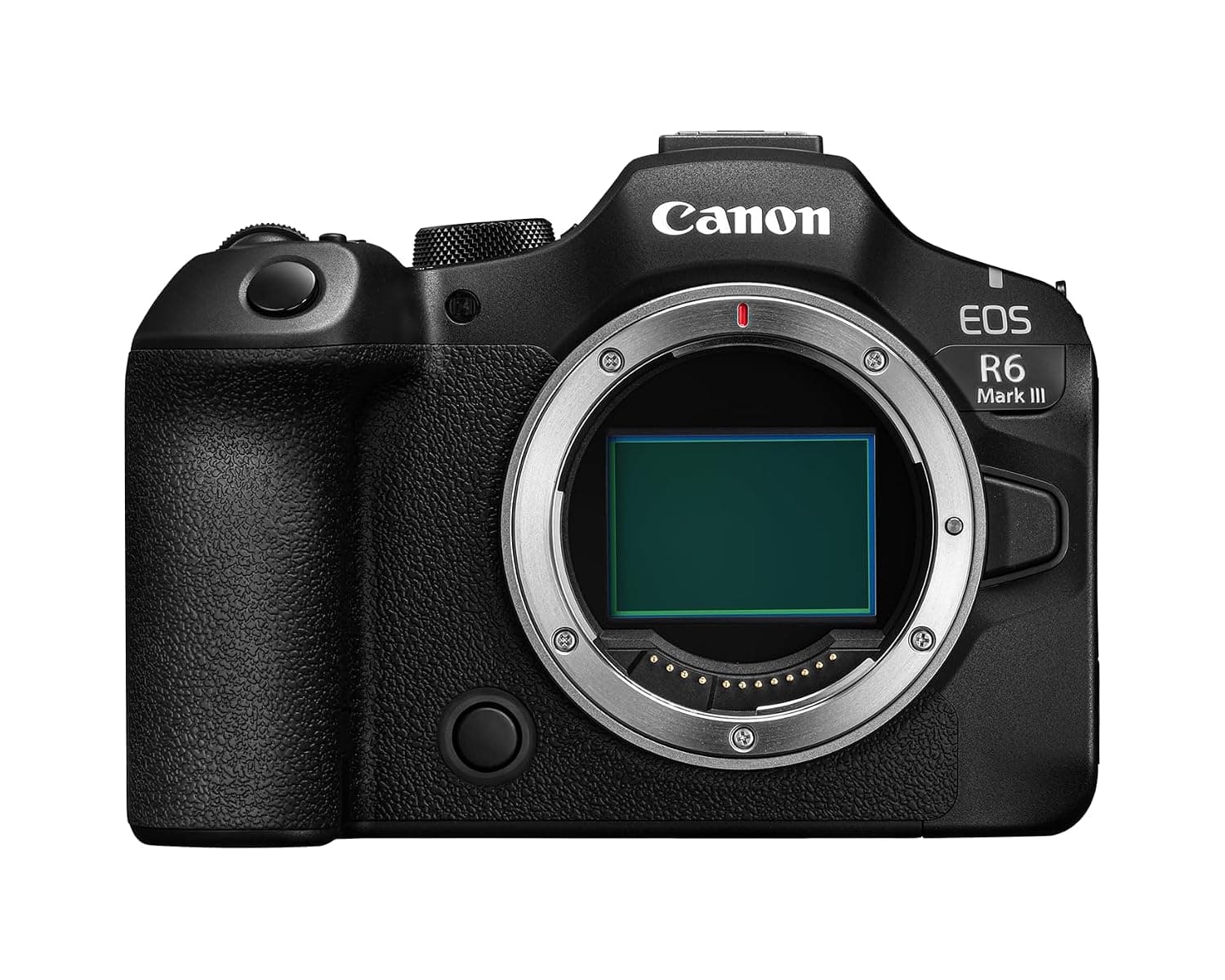
The Canon EOS R6 Mark III is externally almost indistinguishable from its predecessor, the R6 Mark II. The same controls occupy the same positions, and the overall form factor is unchanged. For Canon shooters upgrading from any recent EOS R body, the transition will feel completely natural.
The grip is large and sculpted, providing a secure hold even with heavy telephoto lenses attached. The deep finger groove and textured surface give you confidence when shooting one-handed or in precarious positions. The camera weighs 699 grams with battery and a CFexpress Type B card installed, which is reasonable for a full-frame camera with these capabilities.
The controls are comprehensive but can be overwhelming for new users. You get a front dial, rear dial, top LCD panel, mode dial with lock button, M-Fn button, record button, ISO dial, exposure compensation dial, and a multi-controller joystick, plus numerous customizable buttons. That's approximately ten controls for your right thumb alone, each performing different functions depending on the shooting mode. For experienced photographers who understand the logic behind the layout, this is empowering. For newcomers, it can feel like piloting a spacecraft.
The top ISO dial is a welcome addition, providing direct access to ISO settings without diving into menus. It features an Auto ISO shift function that lets you quickly override the Auto ISO setting, which is useful when lighting conditions change unpredictably. The exposure compensation dial is similarly convenient, though its position can lead to accidental adjustments when pulling the camera out of a bag.
The fully articulating 3.0-inch touchscreen is excellent for both high-angle and low-angle shooting, as well as vlogging and self-recording. The 1.62-million-dot resolution provides a clear, vivid image that's usable even in bright sunlight, though it could be brighter for extreme conditions. The touch response is fast and accurate for menu navigation, focus point selection, and touch shutter operation.
The 3.69-million-dot OLED electronic viewfinder is good but not great. It's bright and provides adequate detail for composition and focus confirmation, but it falls short of the higher-resolution EVFs found in competitors like the Sony a7 V and Nikon Z6 III. The 0.76x magnification is acceptable, though a larger viewfinder would enhance the shooting experience, particularly for manual focus work.
One thoughtful addition is the repurposed Rate button, which now cycles through Picture Styles on the fly. This is a small change but genuinely useful for photographers who switch between color profiles regularly. The mandatory 6-digit PIN on first startup is a security feature that will annoy most users, though it can be disabled in the menu.
Stabilization
The R6 III features Canon's latest in-body image stabilization system, delivering up to 8.5 stops of correction at the center of the frame. This is a meaningful upgrade over the R6 Mark II's 8-stop system, and in practice, the difference is noticeable.
Handheld shooting at shutter speeds that would have required a tripod just a few years ago is now routine. I shot sharp images at 1/2 second with a 24mm wide-angle lens, and usable results at 1 second with careful technique. With a 500mm telephoto lens, I could consistently get sharp results at 1/50 second, eliminating the need for a monopod in many situations.
The stabilization is particularly valuable for video shooting, where handheld gimbal-like smoothness is achievable with practice. The combination of IBIS and lens-based stabilization from RF lenses with IS creates a rock-solid image that minimizes the need for stabilization in post-production.
The system also includes specialized modes for specific shooting scenarios. The panning mode only corrects vertical movement while preserving horizontal motion, which is useful for motorsports and action photography. The IS Mode 3 for telephoto lenses stabilizes during shooting while allowing natural framing through the viewfinder.
Video Capabilities
The video features on the R6 III represent a significant leap forward. The camera can record internal 7K 60fps RAW video, which provides exceptional detail and flexibility for color grading. The 7K resolution allows for oversampled 4K output with noticeably better detail and reduced artifacts compared to native 4K capture.
Open Gate 7K recording at 30fps uses the full width of the sensor and is ideal for content that will be cropped to different aspect ratios for different platforms. You can extract vertical 4K clips for social media from the same footage you're using for a horizontal edit, which is enormously valuable for content creators who publish across multiple platforms.
4K recording at up to 120fps is full-width, meaning you don't get the crop factor that many cameras impose at higher frame rates. The 120fps slow-motion footage is smooth and detailed, perfect for action sequences and B-roll. Full HD recording at 180fps provides even higher frame rates for dramatic slow-motion effects.
The inclusion of a full-size HDMI port is a welcome change from the micro-HDMI ports that plague most mirrorless cameras. Full-size HDMI is more durable and doesn't require a dongle for external monitoring, making the R6 III a more practical tool for professional video work.
Clog2 and CLog3 profiles provide excellent dynamic range for color grading, with the enhanced CLog3 profile offering improved shadow detail and reduced noise compared to standard Log profiles. False color and waveform monitoring make exposure management straightforward, even for videographers who are new to Log shooting.
The camera's continuous recording limit is approximately 30 minutes for internal RAW recording at 7K 60fps, limited by heat management. Standard 4K recordings can run for much longer, with the camera managing heat effectively during extended shooting sessions. The USB-C charging is picky about power sources, requiring 3V output for reliable charging during operation.
Burst Shooting and Buffer
The R6 III offers impressive burst shooting capabilities that put it among the fastest cameras in its class. With the mechanical shutter, you get 12 frames per second with an essentially unlimited buffer when using a fast CFexpress Type B card. The electronic shutter pushes this to an eye-watering 40 frames per second, though the buffer fills after approximately three seconds of continuous shooting at this rate.
The 40fps mode requires a menu dive to enable, which is a friction point during fast-paced shooting. I strongly recommend setting up a Custom shooting mode on the mode dial that pre-configures 40fps electronic shutter, pre-capture, and your preferred autofocus settings. This way, you can switch to action mode instantly when the moment demands it.
One frustration is the lack of a frame rate indicator on the screen. When you're shooting at 40fps, you need to know that you're actually hitting that speed, particularly if battery is low or conditions are affecting performance. A simple frame rate readout would be a welcome addition via a future firmware update.
The pre-capture feature buffers up to 20 frames when you half-press the shutter button, ensuring you don't miss the decisive moment. This replaces the older Pre-Burst Shooting system from the R6 II, and it works better because it's always ready rather than requiring you to hold the shutter halfway before the action begins. The buffer clears relatively quickly with a fast CFexpress card, allowing you to resume shooting within a few seconds after a burst.
Connectivity and Media
The dual card slots are one of the most significant upgrades over the R6 Mark II. The R6 III features a CFexpress Type B slot and a UHS-II SD slot, replacing the R6 II's dual UHS-II SD configuration. CFexpress Type B cards offer dramatically faster read and write speeds, enabling the high-speed burst modes and high-bitrate video recording that the camera is capable of.
The flexibility of having one CFexpress and one SD slot is excellent. You can use the CFexpress slot for primary recording where speed matters most, and the SD slot for overflow, backup, or general-purpose shooting. CFexpress Type B cards remain expensive compared to SD cards, so the option to use SD for everyday shooting is appreciated.
The camera supports USB-C tethering for direct connection to computers and tablets, as well as USB-C charging and power delivery. The USB-C implementation is functional but not flawless, as mentioned earlier, with some power sources refusing to charge the camera during operation.
Wi-Fi 6 and Bluetooth 5.0 provide fast wireless connectivity for image transfer and remote control via the Canon Camera Connect app. The app is functional but not best-in-class, with occasional connection drops and a somewhat clunky interface. The Bluetooth connection allows for always-on GPS tagging via your phone, which is useful for travel photographers.
Battery Life
The R6 III uses the LP-E6P battery, the same battery found in the R6 Mark II and several other Canon bodies. Rated life is approximately 390 shots using the EVF and 620 shots using the rear LCD. In mixed real-world use, I found these estimates to be reasonably accurate, getting around 500 shots per charge with a combination of EVF and LCD shooting.
This battery life is adequate for a day of enthusiast shooting but falls short of what some competitors offer. The Sony a7 V's larger battery provides significantly more runtime, and the Nikon Z6 III also outperforms the Canon in this regard. For heavy shooters, carrying a spare battery is essential.
USB-C charging is supported but, as mentioned, finicky about power sources. Many USB-C power banks and chargers work fine, but some don't provide the right voltage for reliable charging. Canon's own charger works perfectly, and third-party replacements from brands like Wasabi Power are reliable alternatives at a lower price.
The RP-E6P battery is shared across multiple Canon bodies, which is convenient for shooters who own multiple Canon cameras. The battery grip accessory doubles the shooting capacity and improves handling with large lenses.
Who Should Buy the Canon EOS R6 Mark III
The Canon EOS R6 Mark III is designed for serious enthusiast photographers who want a versatile, capable camera that can handle virtually any shooting scenario. It's a genuine all-rounder that excels at portraits, events, travel, wildlife, action, and video work without demanding a second mortgage.
You should buy this camera if you're a Canon enthusiast looking to upgrade from an older EOS R body or a DSLR like the 5D Mark IV. The 32.5MP sensor provides a meaningful resolution increase that improves cropping flexibility and print quality. The autofocus system is best-in-class for most situations, and the video capabilities are genuinely impressive for a stills-focused camera.
You might want to look elsewhere if you're invested in another system and happy with it. The Sony a7 V offers better dynamic range for landscape work, the Nikon Z6 III has a more polished video implementation, and the Panasonic S1 II delivers outstanding value for hybrid shooters. But if you prefer Canon's color science, ergonomics, and lens ecosystem, the R6 III is the best enthusiast-level camera Canon has ever made.
For professional photographers who need the absolute best autofocus or the highest resolution, the EOS R1 or EOS R5 Mark II are better choices, though they come with significantly higher price tags. The R6 III sits in a sweet spot that delivers 90 percent of the capability at roughly two-thirds the price.
Lens Ecosystem and RF Mount Advantages
One of the strongest arguments for choosing the Canon EOS R6 Mark III is access to Canon's growing RF lens lineup. The RF mount has matured significantly since its introduction, now offering an extensive range of lenses that covers virtually every focal length and aperture requirement.
For portrait photographers, the RF 85mm f/1.2 L USM delivers stunning subject separation and bokeh quality that rivals the best lenses ever made. The RF 50mm f/1.2 L USM and RF 28-70mm f/2 L USM are equally exceptional, providing the kind of optical performance that makes shooters wonder how they ever managed with DSLR-era glass.
Landscape photographers will appreciate the RF 14-35mm f/4 L IS USM for its combination of wide coverage, image stabilization, and reasonable size. The RF 24-105mm f/4 L IS USM is the ideal walk-around lens for the R6 III, providing a useful zoom range in a weather-sealed package that balances well on the camera body without feeling front-heavy.
The availability of RF-S lenses for the APS-C crop mode adds flexibility for wildlife and sports photographers who need extra reach. While the crop mode reduces the effective resolution to approximately 9 megapixels, this is still sufficient for web publication and smaller prints.
The EF-to-RF adapter works flawlessly with Canon's extensive EF lens lineup, making the R6 III an excellent upgrade path for existing Canon DSLR users. Autofocus performance with adapted EF lenses is virtually indistinguishable from native RF lenses, and image stabilization works in concert with the body's IBIS for impressive handheld results.
Third-party lens support has improved significantly, with manufacturers like Sigma, Tamron, and Samyang now offering RF-mount lenses that provide excellent performance at lower price points than Canon's L-series glass. The Sigma 14-24mm f/2.8 DG DN Art and Tamron 35-150mm f/2-2.8 Di III VXD are particularly compelling options that expand the system's versatility without requiring L-series investment.
Real-World Shooting Scenarios
To give a complete picture of what it's like to shoot with the Canon EOS R6 Mark III, I used it extensively across several different shooting scenarios over a two-week period.
For event photography at a indoor corporate function with mixed lighting, the camera performed admirably. The autofocus locked onto subjects reliably even in challenging tungsten and fluorescent light, and the high ISO performance meant I could shoot at usable shutter speeds without flash. The 32.5-megapixel sensor provided enough resolution for both full-frame and tightly cropped images, and the JPEG colors were pleasing enough to deliver to the client with minimal post-processing.
For outdoor portrait sessions during golden hour, the eye-detection AF locked onto subjects consistently even when shooting into the sun with backlit subjects. The stabilization system allowed me to shoot at 1/15 second with the RF 85mm f/1.2 L USM, achieving critically sharp results handheld that would have required a tripod with earlier camera systems.
During a weekend hiking trip, the camera's weather sealing gave me confidence shooting in light rain and dusty conditions. The battery life was adequate for a full day of moderate shooting, though I did need to top up via USB-C power bank during lunch. The camera's weight of 699 grams was noticeable but manageable for a day of hiking with a 24-105mm lens attached.
For a quick wildlife outing at a local nature preserve, the 40fps burst mode with pre-capture proved invaluable for capturing birds in flight. The buffer filled after about three seconds at full speed, but the CFexpress card cleared it quickly enough that I rarely missed a shot. The animal eye detection tracked birds reliably even against complex backgrounds like tree branches and water reflections.
For video recording, I shot a short documentary-style piece using CLog3 with the RF 24-105mm f/4 L IS USM. The 4K 60fps footage was sharp and detailed, with enough dynamic range to grade the footage to match the mood I wanted. The full-size HDMI port made external monitoring simple, and the waveform monitor ensured accurate exposure throughout the shoot.
Compared to the Competition
The Canon EOS R6 Mark III competes directly with three main rivals: the Sony a7 V, Nikon Z6 III, and Panasonic Lumix S1 II. Each has distinct strengths that may sway buyers depending on their priorities.
The Sony a7 V offers superior dynamic range for landscape and architectural photography, and its 33-megapixel sensor matches the Canon in resolution. Sony's lens ecosystem is the most extensive of any full-frame mirrorless system, and the a7 V's video features are broadly comparable. However, Sony's menu system remains less intuitive than Canon's, and the ergonomics don't suit every shooter's preferences.
The Nikon Z6 III matches the R6 III in resolution and offers excellent video capabilities with its own flavor of Log recording. Nikon's Z lens lineup has grown impressively and includes some of the best optics available. The Z6 III's viewfinder is superior to the R6 III's, and Nikon's autofocus has closed the gap significantly. However, Canon's Dual Pixel AF still has a slight edge in consistency and subject tracking.
The Panasonic Lumix S1 II is the value leader in this segment, offering similar specs at a lower price point. Panasonic's video features are comprehensive, and the L-Mount alliance provides access to lenses from Sigma, Leica, and Panasonic. However, Panasonic's phase-detect autofocus, while much improved, doesn't quite match Canon's speed and reliability, particularly for fast action shooting.
For existing Canon shooters, the R6 III is the obvious choice, offering a familiar interface and full compatibility with RF and EF lenses. For new buyers entering the full-frame market, the choice is less clear-cut and depends on which system's strengths align with their shooting priorities.
The Canon EOS R6 Mark III is not a revolutionary camera, but it doesn't need to be. It's a thoughtful, comprehensive evolution of an already excellent platform, addressing the key limitations of its predecessor while adding meaningful new capabilities. For anyone looking for a do-everything full-frame mirrorless camera that prioritizes reliable performance over spec-sheet bragging points, the R6 III is an easy recommendation.
Pros
- New 32.5MP sensor delivers excellent detail and cropping flexibility
- 40fps electronic burst shooting with pre-capture buffer
- Internal 7K 60fps RAW video with full-size HDMI port
- Best-in-class Dual Pixel CMOS AF II with reliable subject tracking
- 8.5-stop IBIS enables sharp handheld shots at slow shutter speeds
Cons
- Dynamic range trails Sony a7 V and Nikon Z6 III
- EVF resolution lags behind key competitors
- No eye-control AF found on higher-end Canon bodies
- Battery life is adequate but not class-leading
- USB-C charging is picky about power sources
Final Verdict
The Canon EOS R6 Mark III delivers a meaningful upgrade with its new 32.5MP sensor, 40fps burst shooting, internal 7K RAW video, and improved stabilization, making it one of the most well-rounded enthusiast full-frame cameras available.