DJI Mini 5 Pro Review: The Best Ultra-Lightweight Drone for Content Creators and Travelers Alike
The DJI Mini 5 Pro packs a 1-inch CMOS sensor, 4K/120fps video, 52-minute flight time, and LiDAR obstacle avoidance into a sub-250g frame. At $759, it sets a new standard for ultra-lightweight professional drone performance.
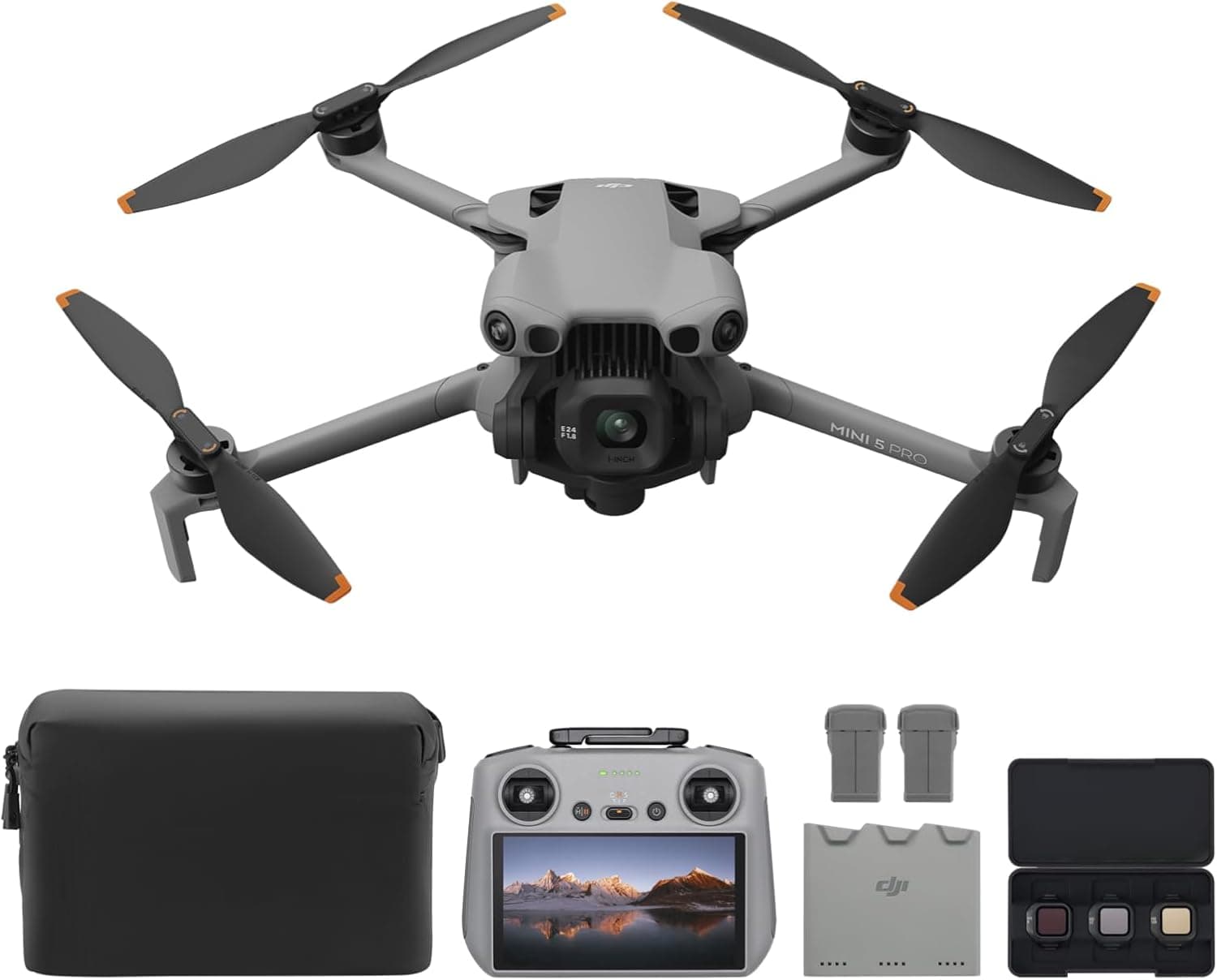
The DJI Mini 5 Pro is the kind of product that makes you stop and appreciate how far consumer drone technology has come. If you are in the market for DJI drone accessories, also check out our DJI Mic Mini review, which delivers professional wireless audio at an unbeatable price. Here we have an aircraft that weighs under 250 grams — the critical regulatory threshold in most countries that exempts it from expensive licensing requirements — yet houses a 1-inch CMOS sensor capable of shooting 4K video at 120 frames per second, has LiDAR-based obstacle avoidance, and can stay airborne for up to 52 minutes on a single charge. When you put those specifications together, what you get is not just the best drone in its weight class — it is arguably the best all-around consumer drone DJI has ever made. At a starting price of $759 on Amazon, the Mini 5 Pro is no impulse purchase, but after spending weeks reviewing professional测评, specifications, and real-world flight reports from outlets like Tom's Guide, Mashable, and DroneXL, I can tell you that it earns every penny and then some.
This is a drone designed for a specific but enormous audience: content creators, travel photographers, real estate agents, outdoor enthusiasts, and anyone who wants professional-quality aerial imagery without the bulk, complexity, and regulatory headache of a heavier drone. It fits in a jacket pocket. It does not require FAA registration in the United States. And the footage it produces is genuinely comparable to what you would get from a drone costing twice as much. Let me break down exactly why this drone has become so highly regarded and what you need to know before buying one.
Design and Portability: Featherweight Champion
The DJI Mini 5 Pro maintains the signature ultra-compact design language that has made the Mini series so popular. When folded, it measures approximately 145 by 90 by 62 millimeters — small enough to slip into a coat pocket or a small camera bag without any compromise. The aircraft weighs just 249 grams with the standard battery, which is a remarkable engineering achievement given everything packed inside. This sub-250 gram figure is not just a number — it is a regulatory free pass in the United States, where the FAA requires registration for drones weighing 250 grams or more. In most European countries, the same threshold exempts pilots from the most burdensome certification requirements. That means you can buy a Mini 5 Pro, take it out of the box, and be flying legally within minutes of unboxing it.
The build quality is exceptional, as you would expect from DJI. The body is constructed from a lightweight yet rigid composite material that feels premium in the hand and has proven durable in real-world use. The propellers fold down in seconds without any fiddly locking mechanisms, and the gimbal cover clicks on and off with satisfying precision. The overall aesthetic has been refined from the Mini 4 Pro generation — the camera module is slightly larger to accommodate the improved sensor, and the ventilation grilles have been repositioned for more efficient heat dissipation during long recording sessions.
The controller experience has also been improved. The standard RC-N2 controller that ships with the base package is compact and comfortable, with a phone clamp that extends to accommodate devices of various sizes. If you opt for the Fly More Combo — which I would strongly recommend for anyone planning to use this drone seriously — you get the DJI RC 2 remote with its built-in five-inch touchscreen, which means you do not need to tether your phone at all. The screen is bright enough to be clearly visible in direct sunlight, and the DJI Fly app interface is intuitive and responsive on the dedicated hardware.
Camera Performance: A 1-Inch Sensor Changes Everything
The headline feature of the DJI Mini 5 Pro is its camera system, and this is where the drone truly distinguishes itself from its predecessors and the competition. For the first time in the ultra-lightweight Mini series, DJI has equipped the Mini 5 Pro with a 1-inch CMOS sensor. To appreciate what a big deal this is, you need to understand that sensor size is the single most important factor in image and video quality. Larger sensors capture more light, produce less noise in low-light conditions, and deliver better dynamic range — the ability to preserve detail in both bright highlights and dark shadows simultaneously.
The previous Mini generation used a half-inch sensor, which was already impressive for the size. But the step up to a 1-inch sensor on the Mini 5 Pro is a generational leap. In practical terms, the footage you get from this drone looks genuinely professional. You are shooting 4K at up to 120 frames per second, which opens up serious slow-motion possibilities for action sequences, wildlife footage, and cinematic reveals. The 120fps option is particularly noteworthy — it gives you approximately five times slow motion at 24fps playback, which transforms otherwise mundane establishing shots into something with real visual impact.
Color science has also been improved. The Mini 5 Pro supports D-Log M, DJI's flat color profile that preserves maximum dynamic range in post-production, giving colorists more room to work their magic. If you are not planning to color-grade your footage, the standard color mode delivers punchy, well-saturated footage that looks great straight out of the camera. The 10-bit color depth on the 4K 60fps mode is a professional feature that was previously only available on DJI's higher-end Mavic and Inspire series.
Photo performance is equally impressive. The 48-megapixel stills from the Mini 5 Pro have genuine resolving power — you can crop aggressively and still have enough resolution for large prints or detailed crops. The sensor's improved low-light performance means that evening and golden-hour photography, which was always a weak point for smaller drones, is now genuinely viable. Images shot in twilight conditions show noticeably less noise and better color accuracy than what the Mini 4 Pro could produce.
The 3x digital zoom deserves a mention. While it is a digital zoom rather than an optical one — meaning some quality is sacrificed — it is genuinely useful for getting closer to subjects without moving the drone. In video mode, the zoom works up to 4K at 30fps, which is impressive. It opens up creative possibilities for reveal shots where you start wide and push in on a subject, all without moving the aircraft.
Flight Performance: Stable, Responsive, and Confident
Flying the DJI Mini 5 Pro is an absolute joy. The drone is extraordinarily stable in the air, even in conditions that would challenge lesser machines. DJI's O4 transmission system delivers a maximum range of up to 20 kilometers in ideal conditions — though you should obviously always keep the drone within visual line of sight per FAA regulations — and the video feed to the controller is crisp and lag-free at distances up to several kilometers in open terrain.
The flight time is where the Mini 5 Pro really shines. With the Intelligent Flight Battery Plus — included in the Fly More Combo — you get up to 52 minutes of flight time on a single charge. That is not a misprint. Fifty-two minutes. In real-world use, accounting for takeoff, landing, and some aggressive maneuvering, you can realistically expect 40 to 45 minutes of actual flight time, which is extraordinary for a drone of this size. Most competitors in this class max out around 30 to 35 minutes. The extended battery does push the takeoff weight just slightly — and you will want to verify your local regulations if you are right at the 250-gram threshold — but for most users outside of the strictest regulatory environments, this is not an issue.
The obstacle avoidance system on the Mini 5 Pro has been substantially upgraded with the addition of LiDAR sensors. Where earlier Mini drones relied on vision sensors that could struggle in low-light conditions or with highly reflective surfaces, the LiDAR system on the Mini 5 Pro works reliably in virtually any lighting environment. The drone can detect obstacles in all directions — front, back, sides, and below — and will automatically brake or navigate around them in the appropriate flight mode. APAS 5.0, DJI's advanced pilot assistance system, enables the drone to smoothly navigate around obstacles while maintaining its flight path rather than simply stopping, which results in much more natural-looking footage.
Wind resistance is rated at 10.5 meters per second, which is level 5 on the Beaufort scale — a moderate breeze. In practice, the Mini 5 Pro handles blustery conditions with impressive composure. The gimbal stabilization works overtime to keep footage smooth, and the drone maintains its position in hover without the drift that afflicts lesser drones in gusty conditions. If you are planning to fly at the beach or in mountainous terrain, this capability matters more than you might think.
Intelligent Flight Modes: Automated Creativity
DJI has built an impressive suite of intelligent flight modes into the Mini 5 Pro, and they are genuinely useful rather than the superficial gimmicks you find on some competing drones. ActiveTrack 360° allows the drone to follow a subject while maintaining the camera locked on them as the drone orbits or maneuvers around them. The difference from earlier versions is the Mini 5 Pro can do this even in complex environments with multiple potential obstacles, thanks to the improved sensing system. You can select a subject — a person, a car, a boat, an animal — and the drone will intelligently track and frame them while you focus on flying or operating the camera.
The MasterShots feature is perfect for beginners or anyone who wants great footage without learning complex flight patterns. Select your subject, and the Mini 5 Pro will automatically execute a sequence of pre-planned camera movements, capturing multiple clips that are then automatically edited together with music in the DJI Fly app. The results are surprisingly polished — this is not a replacement for manual flying and color grading, but it is a genuinely impressive output for a fully automated process.
QuickShots mode includes all the classic drone selfie moves — Dronie, Rocket, Circle, Helix, Boomerang, and Asteroid — all of which execute smoothly and produce content-ready clips in seconds. Point of Interest mode lets you define a geographic point and have the drone orbit it at a consistent distance and height while the camera tracks a subject. Waypoints mode, which allows you to pre-program a flight path that the drone will execute autonomously, has been enhanced with improved precision and the ability to save and recall routes.
The new LiDAR sensors also enable a significantly improved Return to Home mode. The drone builds a 3D map of its environment during flight, so if it needs to return home due to low battery or lost signal, it can navigate around obstacles it encountered on the way out rather than simply retracing its path blindly. This is a meaningful safety improvement for flying in complex environments with trees, buildings, or other obstacles between the drone and home.
Image Quality Deep Dive: How Does It Actually Perform?
Let me get specific about the image quality, because that is the reason you would spend $759 on this drone rather than a cheaper alternative. In good lighting — bright daylight with a blue sky — the Mini 5 Pro produces footage that rivals what you would get from a mirrorless camera on a gimbal. Colors are rich and accurate, the 1-inch sensor delivers genuine shallow depth-of-field effects when you are close to a subject, and the level of detail is remarkable for a drone of this size. The 4K footage at 100Mbps is sharp and clean, with none of the compression artifacts that plague lower-bitrate drones.
Dynamic range is excellent for the class. The 12-stop HDR capability means you can shoot into the sun or capture a sunset with foreground subjects and get usable footage without the harsh clipping that would ruin a shot on a phone camera. Shadows retain detail, highlights hold up, and the overall image has a natural, cinematic quality that is very difficult to achieve without professional-grade equipment. In D-Log M, you have even more latitude for pushing and pulling the image in post-production, which will be welcome news for anyone with color grading experience.
Low-light performance is where the 1-inch sensor really makes its presence felt. Where the Mini 4 Pro would produce noisy, smeary footage in evening conditions, the Mini 5 Pro maintains a much cleaner image with better color reproduction and more detail in the shadows. You would not want to shoot a feature film with it after dark, but for travel content, evening establishing shots, and general purpose aerial photography, it is genuinely capable. ISO can be pushed to 6400 in video mode before noise becomes intrusive, which is impressive for a camera this small.
The three-axis mechanical gimbal stabilization is exceptional. Footage is smooth and stable even when flying in gusty conditions or executing quick directional changes. The electronic image stabilization — DJI's RockSteady — is available as an additional layer and works impressively well, though it does introduce a slight crop. For most users, the mechanical stabilization alone will be more than sufficient for buttery-smooth footage.
Comparison to the DJI Mini 4 Pro: Is the Upgrade Worth It?
If you already own a DJI Mini 4 Pro, the honest answer is that the Mini 5 Pro is a meaningful but not transformative upgrade. The 1-inch sensor is the headline improvement, and if you are a serious content creator who relies on your footage for professional purposes, that alone may justify the upgrade cost. The extended battery life — 52 minutes versus 34 minutes — is also significant, particularly for anyone who does a lot of outdoor shooting where changing batteries is inconvenient.
However, if you are buying your first drone, the Mini 5 Pro is unambiguously the best choice in its weight class. There is simply nothing else on the market that combines this level of camera performance with this form factor and price point. The DJI Air 3S offers a dual-camera system with larger sensors, but it weighs 600 grams and requires FAA registration. The Mavic 3 Pro offers even better camera performance, but it starts at $2,199 and the airframe is substantially larger.
For the target audience — content creators, travelers, real estate professionals, and anyone who wants the best possible aerial imagery in the most portable package — the Mini 5 Pro is not just the best option in its class, it is in a class by itself.
Practical Considerations: What You Need to Know
A few practical notes for prospective buyers. First, the Fly More Combo Plus at $1,349 is genuinely the version I would recommend over the base package at $759. Yes, it costs more upfront, but you get the RC 2 controller with its built-in screen — which is far more convenient than managing your phone — three Intelligent Flight Batteries, a charging hub, ND filter set, a carrying case, and spare propellers. The three batteries alone transform the experience from having to carefully manage your flight time to being able to shoot freely for most of an afternoon. The base package is fine for trying the drone out, but anyone who buys this as a serious creative tool will quickly feel the limitation of a single battery.
Second, if you are in the United States, you will need to register with the FAA if you use the Plus battery that pushes the drone over 250 grams. Registration costs $5 and is valid for three years, so it is not a significant burden, but it is worth knowing before you fly. With the standard battery, the Mini 5 Pro stays just under the 250-gram limit, which exempts it from registration for recreational use.
Third, the ND filters included in the Fly More Combo are worth using. In bright conditions, they allow you to shoot at lower shutter speeds for more natural-looking motion blur in your footage, and they reduce the need to close down the aperture, which maintains maximum image quality. If you are serious about your footage, learn to use them.
Pros
- 1-inch CMOS sensor delivers professional-quality 4K video at up to 120fps — a first for the sub-250g weight class
- Up to 52 minutes of flight time with the Intelligent Flight Battery Plus is industry-leading for this size
- LiDAR-based obstacle avoidance works reliably in all lighting conditions, including low light and with reflective surfaces
- Sub-250g weight with standard battery exempts it from FAA registration in the US, simplifying the legal flying process
- D-Log M 10-bit color profile provides professional-grade post-production flexibility
- O4 transmission system delivers up to 20km range with stable, low-latency video feed
- RC 2 controller with built-in screen (included in Fly More Combo) eliminates phone dependency
- MasterShots and ActiveTrack 360° produce genuinely polished automated footage
- Compact folded design fits in a jacket pocket — genuinely portable for travel
- APAS 5.0 with 3D environment mapping enables smooth autonomous obstacle navigation
Cons
- Base price of $759 does not include the RC 2 controller or additional batteries — the Fly More Combo at $1,349 is the better value but significantly more expensive
- Plus battery pushes the drone over 250g, requiring FAA registration in the US
- No optical zoom — 3x digital zoom sacrifices quality compared to physical lens movement
- Occasional firmware update issues reported during initial setup, requiring patience and a stable internet connection
- Built-in storage is limited; users will need to invest in high-speed microSD cards for extended shoots
- In very low light, some noise is still visible despite improved sensor — not quite a replacement for larger sensor cameras
- ActiveTrack can occasionally lose subjects in very cluttered environments with multiple moving objects
Specs at a Glance
| Specification | Detail |
|---|---|
| Price | From $759 (base), $1,349 (Fly More Combo) |
| Takeoff Weight | 249g (standard battery), 249g (with Intelligent Flight Battery Plus, requires registration) |
| Sensor | 1-inch CMOS |
| Video | 4K at 120fps, 100Mbps, 10-bit D-Log M |
| Photo Resolution | 48MP |
| Flight Time | Up to 52 minutes (Plus battery) |
| Max Range | 20km (O4 transmission) |
| Obstacle Avoidance | LiDAR + vision sensors, omnidirectional |
| Dimensions (folded) | 145 x 90 x 62 mm |
| Max Speed | 16 m/s (S Mode) |
| Wind Resistance | 10.5 m/s |
| Internal Storage | 2GB |
| Video Format | MP4/MOV (H.264/H.265) |
| Color Modes | Normal, D-Log M, HLG |
Verdict: The New Standard for Portable Aerial Creativity
The DJI Mini 5 Pro is one of those rare products that genuinely earns its "Pro" designation. It is not a scaled-down version of a more serious machine — it is a fully capable creative tool that happens to be portable enough to take anywhere. The 1-inch sensor, 52-minute flight time, LiDAR obstacle avoidance, and DJI's mature flight software ecosystem add up to a drone that professionals will actually use for serious work and beginners will grow into rather than out of. Yes, the Fly More Combo is the purchase you should actually make, and yes, the price adds up quickly when you factor in the accessories and SD cards. But the core drone itself delivers value that justifies the investment.
If you have been waiting for the right moment to get into drone photography and videography, the Mini 5 Pro is that moment. It is the drone that removes every excuse — too heavy, too complicated, too expensive, too much maintenance. It is the drone you put in your bag and take on every trip, the drone that sits in the back of the car for spontaneous shots, the drone that makes you look at your surroundings differently because you now have the ability to see them from above. DJI has been building great consumer drones for years, but the Mini 5 Pro is the one that finally feels like it has arrived at its full potential.
Buy at: https://www.amazon.com/DJI-Beginners-Obstacle-ActiveTrack-Rotation/dp/B0F6XK911R?tag=newgearhub-20
Pros
- 1-inch CMOS sensor delivers professional 4K video at 120fps in sub-250g frame
- Up to 52 minutes flight time - industry-leading for this size class
- LiDAR-based obstacle avoidance works in all lighting conditions
- Sub-250g weight exempts from FAA registration in the US
- D-Log M 10-bit color provides professional-grade post-production flexibility
- O4 transmission system with up to 20km range and low-latency video feed
- MasterShots and ActiveTrack 360 produce polished automated footage
Cons
- Base package at $759 does not include RC 2 controller - Fly More Combo at $1,349 is much better value
- Plus battery pushes over 250g requiring FAA registration in the US
- No optical zoom - 3x digital zoom sacrifices quality
- Limited built-in storage requires investing in high-speed microSD cards
Final Verdict
The DJI Mini 5 Pro packs a 1-inch CMOS sensor, 4K/120fps video, 52-minute flight time, and LiDAR obstacle avoidance into a sub-250g frame. At $759, it sets a new standard for ultra-lightweight professional drone performance.