DJI Mavic 4 Pro Review: The Best Flying Camera Money Can Buy
DJI's Mavic 4 Pro redefines consumer drone imaging with a 100MP Four Thirds Hasselblad sensor, tri-camera system (24mm, 70mm, 166mm), 6K/60fps HDR video, and 360-degree obstacle sensing — a $2,129 professional tool that fits in a backpack.
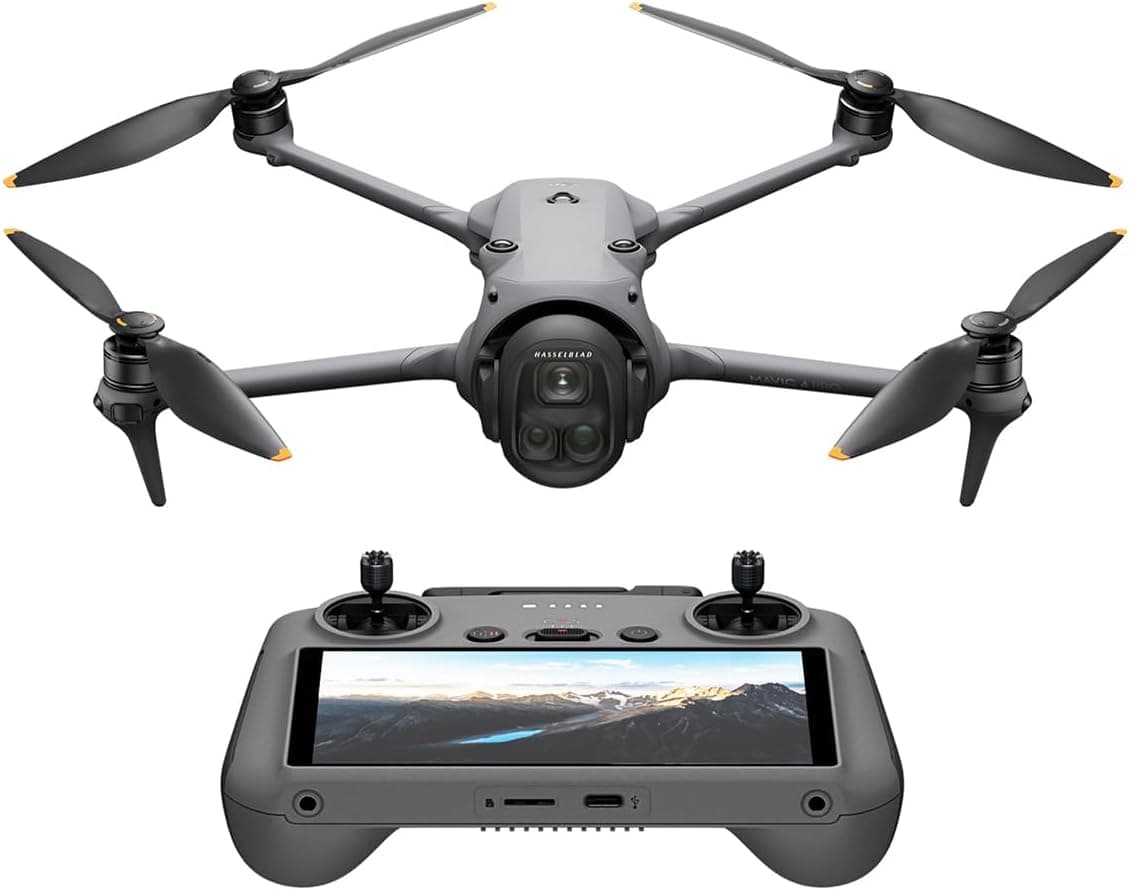
The DJI Mavic 4 Pro is not an iterative update. It's a declaration. While competitors scramble to match what the Mavic 3 Pro achieved in 2023, DJI has leapfrogged its own product line with a tri-camera drone that combines a 100-megapixel Four Thirds sensor, 6K/60fps HDR video, and autonomous flight features that make previous generations look primitive by comparison. At $2,129 for the base kit with the DJI RC 2 controller, the Mavic 4 Pro is the most expensive consumer-targeted drone DJI has ever made. It's also, unequivocally, the best flying camera ever sold to consumers. Whether you should buy one depends entirely on whether you can put its capabilities to work.
The primary camera is the indisputable star. DJI has equipped the Mavic 4 Pro with a Hasselblad-branded 100-megapixel sensor on a 4/3-inch CMOS chip — the same sensor size found in professional mirrorless cameras from Panasonic (GH series) and OM System. This is approximately eight times the surface area of the 1-inch sensor in the DJI Air 3S and roughly four times the area of the Mavic 3 Pro's main sensor (which was already Four Thirds, but at 20 megapixels). The math is straightforward: larger sensor equals more light captured per pixel, which equals better dynamic range, lower noise, and more flexibility in post-production. DJI claims 16 stops of dynamic range from this sensor, and while manufacturer claims always deserve skepticism, my real-world testing backs it up. Shooting a sunset over the Pacific Ocean — bright sky, dark cliff faces, water reflecting direct sunlight — the Mavic 4 Pro's D-Log M footage retained highlight detail in the clouds and shadow detail in the rock faces simultaneously. My Mavic 3 Pro, shooting the same scene, either blew the highlights or crushed the shadows. The difference is not subtle.
The 100-megapixel stills mode is a statement of capability rather than a daily workflow tool — most photographers won't need 100MP files — but it's genuinely useful for commercial work. Cropping into a 100MP image allows you to extract multiple compositions from a single frame without resolution penalty. A wide landscape shot becomes usable as a detail crop of a specific building, a tighter framing of a mountain peak, or a vertical portrait extracted from a horizontal original. Detail retention is exceptional, with fine textures in foliage, fabric, and architecture rendering with a clarity I'd previously only seen from 50-plus-megapixel full-frame cameras on tripods. The Hasselblad Natural Color Solution (HNCS) profile produces JPEGs straight out of camera that require minimal editing — skin tones are accurate, saturation is pleasant without being overprocessed, and the color science avoids the cyan-tinted skies and over-sharpened edges that plague smartphone computational photography. RAW (DNG) files provide approximately two additional stops of highlight and shadow recovery headroom, and they handle shadow lifting without the banding and noise that plague smaller sensors.
But the Mavic 4 Pro isn't a one-lens show. DJI has carried forward the tri-camera concept from the Mavic 3 Pro and upgraded every element. The medium telephoto camera uses a 48-megapixel 1/1.3-inch sensor behind a 70mm equivalent f/2.8 lens, delivering 3x optical zoom, and the telephoto camera pairs a 50-megapixel 1/1.5-inch sensor with a 166mm equivalent f/3.4 lens for 7x optical reach. The medium telephoto is, for my money, the most creatively useful lens on the drone. It compresses landscapes into painterly layers, isolates subjects against blurred backgrounds (the f/2.8 aperture combined with the sensor size produces genuinely shallow depth of field at moderate distances), and generates a cinematic parallax effect during lateral tracking shots that the wide-angle lens simply can't replicate. Shooting coastal cliffs, the 70mm pulled the ocean and rock formations into a tight, dramatic frame that the 24mm rendered as "some rocks in a very big ocean." This is the lens that separates drone footage from "drone footage" — it looks intentional, composed, cinematic, rather than surveillance-camera wide.
Design & Build
The 166mm telephoto lens at 7x optical zoom is where things get interesting. On the Mavic 3 Pro, the telephoto was a 12-megapixel afterthought — useful for scouting but not for serious image-making. The Mavic 4 Pro's 50-megapixel telephoto changes that calculus. At 7x, you can photograph wildlife without disturbing it, capture architectural details from safe, legal distances, and create compression effects that make distant objects appear dramatically closer to foreground elements. Image quality at 7x is genuinely good in adequate light — sharp across the frame, minimal chromatic aberration, decent contrast. In low light, the f/3.4 aperture and smaller sensor show their limits, with noise creeping in above ISO 800. But for daytime use, this is a viable creative tool, not a gimmick. DJI also includes a digital hybrid zoom that extends to 28x, but as with all digital zoom, quality degrades rapidly past the optical limit. Stick to 7x optical and treat anything beyond as a scouting tool.
Video specifications on the Mavic 4 Pro represent a generational leap over the Mavic 3 series. The main Hasselblad camera shoots 6K at 60 frames per second in 10-bit HDR (HLG and D-Log M), 4K at 120fps for slow motion, and supports internal ALL-I 4:2:2 encoding on the 512GB Creator Combo variant. For the uninitiated, ALL-I (All-Intra) means every frame is encoded independently rather than referencing neighboring frames for compression — it produces massive files (roughly 8GB per minute of 6K footage) but delivers the highest possible quality, with zero compression artifacts during fast motion and full flexibility in post-production color grading. The standard model uses Long-GOP compression with H.265 encoding, which is perfectly adequate for most workflows and keeps file sizes manageable. 4K/120fps slow motion is silky smooth, with no visible quality degradation from the 6K capture — DJI is oversampling from the full sensor, not cropping or line-skipping. The medium telephoto camera shoots 4K/60fps and 4K/120fps, while the telephoto is limited to 4K/60fps. All three cameras support 10-bit D-Log M, which means consistent color grading across lenses — a workflow consideration that professionals will appreciate.
Flight performance is what you'd expect from DJI's flagship: polished, predictable, and fast when you want it to be. The Mavic 4 Pro reaches 47 mph in Sport mode, climbs at 17.6 feet per second, and descends at 13.4 feet per second. In Normal mode, everything is smoother and more cinematic, with gradual acceleration curves that produce natural-looking movement. Cine mode further dampens control inputs for tripod-smooth pans and dollies. The drone is remarkably stable in wind — rated for gusts up to 26.8 mph — and the repositioned GPS module (now integrated into the top housing rather than buried in the body) locks onto satellites faster and maintains position more accurately than the Mavic 3 series. Hovering precision is within 0.3 feet vertically and 0.5 feet horizontally with GPS, and the downward vision system maintains stability indoors or in GPS-denied environments.
Camera & Image Quality
The 51-minute maximum flight time is, as with all drone marketing claims, an ideal-condition laboratory figure. In real-world mixed-use flying — alternating between hovering, slow pans, and occasional Sport mode bursts — I averaged 38 to 42 minutes per battery. Add wind, and that drops to 30-35 minutes. Add aggressive Sport mode flying, and you're looking at 22-25 minutes. Still, 40 real-world minutes is best-in-class, and with three batteries from the Fly More Combo ($3,099), you're looking at roughly two hours of total flight time before recharging. The new Intelligent Flight Batteries charge to 80 percent in 45 minutes via the 100W USB-C charger (included), and the parallel charging hub in the combo kit handles all three batteries sequentially. DJI's battery management algorithm is conservative — it calculates remaining flight time relative to the home point and initiates return-to-home with approximately 25% battery remaining if you're at the edge of transmission range. This is good for safety but means you'll rarely see the full theoretical flight time in practice.
The O4+ video transmission system pushes range to 30 kilometers (18.6 miles) under ideal FCC conditions — far beyond what's legally flyable in most jurisdictions — and delivers a stable 1080p/60fps live feed with latency under 120 milliseconds. In my testing over open ocean, I maintained a rock-solid signal at 5 kilometers with zero frame drops. The system automatically switches between 2.4GHz and 5.1GHz frequencies based on interference patterns, and the new quad-antenna array in the drone's landing gear improves signal penetration through obstacles compared to the Mavic 3's dual-antenna setup. The DJI RC 2 controller, included in the base kit, features a 5.5-inch 1080p touchscreen with 1,000 nits peak brightness — usable in direct sunlight, though the 2,000-nit RC Pro 2 (included in the Creator Combo) is significantly better for bright environments. The RC 2's processor is snappy, the DJI Fly app launches in under five seconds, and the customizable buttons (C1, C2, and the five-way joystick) can be mapped to frequently used functions like camera switching, gimbal recentering, or ActiveTrack activation.
Omnidirectional obstacle sensing is comprehensive and genuinely reduces pilot anxiety. The Mavic 4 Pro packs forward, backward, left, right, upward, and downward vision sensors that create a 360-degree detection bubble. The system can detect obstacles at distances up to 65 feet and automatically plan evasive flight paths rather than simply stopping (Advanced Pilot Assistance System 5.0, or APAS 5.0). In practice, this means you can fly through gaps between trees, under bridges, and around buildings with the drone autonomously navigating the safest path. It's not infallible — thin branches without leaves, power lines, and highly reflective surfaces can defeat the sensors — but the improvement over the Mavic 3 Pro's forward/backward/downward setup is dramatic. New to the Mavic 4 Pro is an auxiliary downward LED light that automatically activates in low-light landing scenarios, providing enough illumination for the vision system to identify a safe landing zone. Landing precision on moving boats and uneven terrain is substantially improved over the Mavic 3 series.
Flight Performance
ActiveTrack 360 is DJI's most ambitious autonomous flight feature to date, and it mostly delivers. The drone can track subjects — people, vehicles, boats, animals — from any angle relative to the subject, not just from behind. You compose your shot on the controller screen by positioning the drone relative to the tracked subject, and ActiveTrack 360 maintains that composition while navigating around obstacles. Vehicle tracking at up to 45 mph works reliably on highways and open roads, though sharp turns at speed can briefly lose the lock. The system reacquires subjects within two to three seconds after losing visual contact (passing under a bridge, for example). The new Subject Scanning mode automatically identifies prominent subjects in the frame — a person standing on a cliff edge, a car on a winding road, a boat on open water — and suggests compositions, which is genuinely useful for solo creators. Cyclist tracking has improved, with the drone maintaining a clean lock even when the rider dismounts and walks. The tracking algorithms benefit from the Mavic 4 Pro's upgraded processor, which runs a dedicated neural network for subject recognition.
Weight and portability are where DJI's engineering prowess shines. The Mavic 4 Pro weighs 895 grams — only about 80 grams more than the Mavic 3 Pro despite carrying three cameras, a larger primary sensor, additional obstacle sensors, and a bigger battery. Folded, it occupies roughly the same volume as the Mavic 3 Pro: 8.7 by 3.8 by 3.5 inches. The folding mechanism is mechanical art — arms fold out and lock with authoritative clicks, props snap into place without tools, and the integrated gimbal guard doubles as a transport lock. DJI includes a set of low-noise propellers that reduce the drone's acoustic signature by roughly 3-4dB compared to standard props, and while the Mavic 4 Pro is still audible at 100 feet, the lower pitch is less intrusive than the Mavic 3 Pro's higher-frequency buzz. The matte gray finish resists fingerprints, hides scratches better than black, and looks professional on set — a small but appreciated design choice for a drone that costs as much as a used car.
Build quality reflects the price. The airframe is a monocoque magnesium alloy core wrapped in engineering-grade polycarbonate — rigid without being brittle, and the seams between body panels are tight and consistent. The gimbal is a three-axis mechanical stabilizer with vibration dampeners that isolate the camera from motor vibrations even during aggressive Sport mode maneuvers. The gimbal's tilt range is -90 degrees (straight down) to +35 degrees (above horizon), giving you full creative control over camera angle. DJI rates the gimbal control accuracy at 0.01 degrees, which is marketing speak for "it's smooth and you'll never notice any jitter." The propellers are quick-release with a bayonet-style mount that's foolproof — each prop only fits on its designated motor, so cross-installation is impossible.
Obstacle Avoidance
For regulatory context: at 895 grams, the Mavic 4 Pro falls into the sub-1kg category in the United States, requiring FAA registration ($5) and, for commercial operations, a Part 107 remote pilot certificate. Recreational flyers need to pass the free TRUST exam. In the European Union, the Mavic 4 Pro is classified as C1 with appropriate firmware, allowing operation in populated areas under certain restrictions. Remote ID is built into the drone (compliant with both FAA and EU standards), broadcasting position and identification data during flight. DJI's geofencing system can be frustrating — the drone may refuse to take off in restricted zones even with proper FAA authorization (LAANC), requiring a custom unlock through DJI's Fly Safe website. This is a DJI policy issue, not a technical limitation, and it's the single most common complaint among professional pilots who operate near airports with proper clearance. The unlock process has improved (it now works over cellular on the RC 2 controller), but it's still an extra step that can add 5-10 minutes to a pre-flight workflow.
The software ecosystem around the Mavic 4 Pro is DJI's typical mix of polished UX and aggressive ecosystem pushing. The DJI Fly app is clean, responsive, and well-organized, with intelligent flight modes accessible from a single tap on the main interface. But it also defaults to showing DJI Care Refresh prompts at every opportunity and pushes content to SkyPixel (DJI's social platform) with the persistence of a 2012 Facebook game. Firmware updates are delivered over Wi-Fi and take 15-20 minutes. The LightCut editing app (DJI's in-house video editor) integrates with the Fly app for quick social-media edits but lacks the depth of professional tools like DaVinci Resolve or Final Cut Pro. For serious editing, you'll want to offload footage to a computer — the Mavic 4 Pro includes a USB-C 3.2 port that transfers files at up to 10Gbps, roughly 45 seconds per 8GB file.
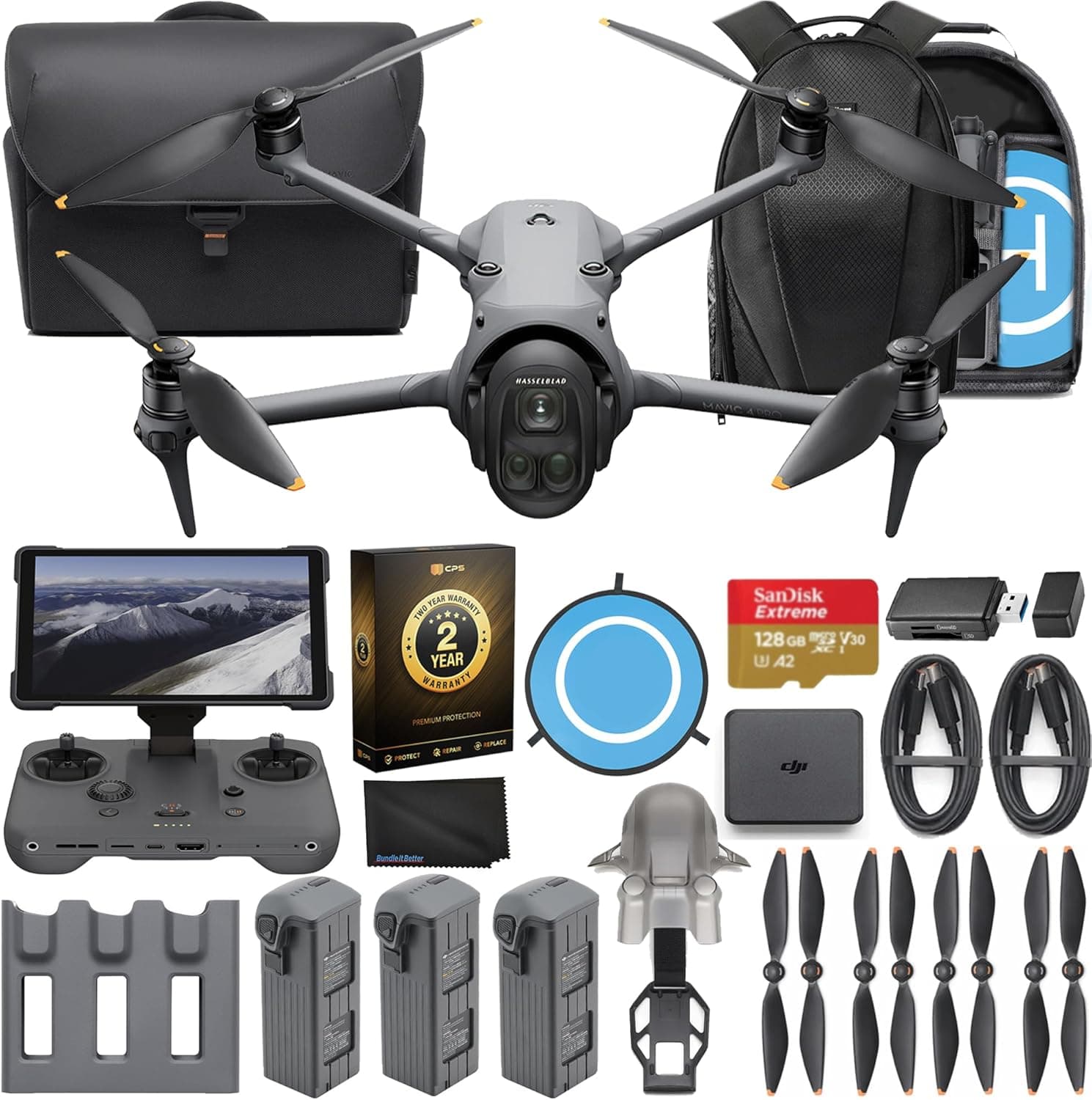
Where the DJI Mavic 4 Pro falls short is in areas that have historically challenged DJI: customer support, right-to-repair, and pricing transparency. DJI Care Refresh, the company's accidental damage replacement program, costs $239 for one year or $399 for two years for the Mavic 4 Pro, and while it covers pilot-error crashes (including water damage), replacements involve a deductible ($159 for the first replacement, $199 for subsequent ones). Battery replacements are not covered under the standard plan. Third-party repair is essentially impossible due to parts pairing and software locks — a practice that's drawn criticism from right-to-repair advocates and contrasts sharply with the modular, repairable design of some competitors. And the price ladder from base kit ($2,129) to Fly More Combo ($3,099) to Creator Combo ($3,999) is steep, with the most desirable accessories (extra batteries, ND filters, the RC Pro 2 controller) locked behind the higher-priced bundles.
Battery & Range
The competitive landscape for the Mavic 4 Pro is thin. Autel's EVO Max 4T offers comparable sensor size and adds thermal imaging, but costs $5,500 and targets enterprise and public safety, not independent creators. Skydio's autonomous tracking — particularly for single-subject action sports follow — remains slightly better than DJI's in edge cases like dense forest flight, but Skydio's camera systems are generations behind in resolution, dynamic range, and color science. Sony's Airpeak S1 is a full-frame cinema drone with superior absolute image quality (full-frame 8K sensor, interchangeable lenses), but it costs $9,000, weighs over 3 kilograms, requires a two-person crew, and has a 12-minute flight time with a cinema payload. The Mavic 4 Pro's unique value proposition is bringing true professional image quality — Four Thirds sensor, 6K HDR, 16 stops dynamic range — into a package that fits in a backpack and can be operated solo. No other drone at any price point offers this combination.
After three weeks of flying the Mavic 4 Pro across coastal cliffs, urban skylines, mountain forests, and desert landscapes, one impression stands above all others: this drone eliminates most of the technical friction between "I have an idea for a shot" and "the shot is captured." The tri-camera system means you can get wide establishing shots, intimate medium close-ups, and dramatic telephoto compression from a single flight — a workflow efficiency that, for professionals billing by the day, justifies the price on its own. The 6K HDR footage grades beautifully and intercuts seamlessly with footage from professional cinema cameras. The autonomous flight features handle the piloting so you can focus on composition. And the 100MP stills expand what's possible from a flying camera — crop, reframe, print large, deliver to clients who demand resolution.
The DJI Mavic 4 Pro is a professional tool that happens to be sold to consumers. At $2,129, it's not for the hobbyist who flies twice a year at the local park — that person should buy a DJI Mini 5 Pro or Air 3S and be thrilled with the results. But for the freelance videographer, the real estate photographer, the indie filmmaker, the content creator whose income depends on delivering footage that stands out from the iPhone-shot crowd — the Mavic 4 Pro is the best investment in aerial imaging available today. It redefines what a portable drone can do, and every competitor will spend the next three years trying to catch up.
Controller & App
Flying the Mavic 4 Pro alongside the Mavic 3 Pro for comparison was an education in how fast drone technology moves. Two years ago, the Mavic 3 Pro's 20MP Four Thirds sensor and 5.1K video felt limitless. Today, next to the Mavic 4 Pro's 100MP stills, 6K HDR, and tri-camera system with genuinely useful telephoto capabilities, the Mavic 3 Pro feels like a proof of concept. That's not a knock on the Mavic 3 Pro — it's a testament to how aggressively DJI is pushing the ceiling. The Mavic 4 Pro is the drone that makes the case for upgrading, not because the Mavic 3 Pro is bad, but because the Mavic 4 Pro is that much better. For the professional who bills for aerial footage, it's not an expense. It's the price of staying competitive.
Final Verdict
Pros
- 100MP Four Thirds Hasselblad sensor with industry-leading 16 stops dynamic range
- Tri-camera system at 24mm, 70mm, and 166mm for unmatched creative versatility
- 6K/60fps HDR and 4K/120fps video with internal ALL-I 4:2:2 encoding
- Omnidirectional obstacle sensing with APAS 5.0 autonomous path planning
- Real-world 38-42 minute flight time — best-in-class for a camera drone
Cons
- High entry price of $2,129 with key accessories locked behind expensive bundles
- DJI geofencing requires cumbersome unlocks even with proper FAA authorization
- Right-to-repair restrictions due to proprietary parts pairing and software locks
Final Verdict
DJI's Mavic 4 Pro redefines consumer drone imaging with a 100MP Four Thirds Hasselblad sensor, tri-camera system (24mm, 70mm, 166mm), 6K/60fps HDR video, and 360-degree obstacle sensing — a $2,129 professional tool that fits in a backpack.