DJI Osmo Pocket 4 Review: The Best Vlogging Camera You Can Slip in a Pocket
DJI's Osmo Pocket 4 refines the pocket gimbal formula with a brighter low-light sensor, 4K/240fps slow motion, 107GB of built-in storage, and smarter ActiveTrack 7.0 tracking — the best pocket camera for vloggers and travel creators.
The DJI Osmo Pocket 4 is the kind of upgrade that rewards patience. When the Pocket 3 landed in late 2023, it basically invented the modern pocket gimbal camera category — a one-inch sensor, a rotating touchscreen, and three-axis stabilization all packed into something that slips into a jeans pocket. It became the default recommendation for vloggers, travel creators, and anyone who wanted better footage than a phone without carrying a mirrorless rig. For more than two years, DJI sat on that formula. Now, with the Pocket 4, the company has returned with a refined version of the same idea: the same 20mm equivalent f/2.0 lens, the same rotating 2-inch screen, the same one-inch sensor class — but nearly every subsystem underneath has been reworked. The result is a camera that looks almost identical to its predecessor yet behaves meaningfully better in the places that matter: low light, slow motion, storage, audio, and tracking. I spent two weeks shooting with the Creator Combo on city streets, hiking trails, and in dimly lit interiors, and this is the review I wish I'd had before buying one.
Design and Build Quality
Let's get the obvious out of the way: the Osmo Pocket 4 looks like the Osmo Pocket 3. From across a room you would struggle to tell them apart. The dimensions have grown by about five millimeters in height and the weight is up by roughly 11 grams, but you would never notice either without a spec sheet. The chassis is still a machined aluminum body with a grippy, rounded profile, and the whole unit folds into a compact L-shape when you rotate the screen flat, protecting the glass when it's stuffed into a pocket or bag.
The headline hardware change is hidden until you need it: flick the screen 90 degrees into landscape mode and two new physical buttons emerge beneath the display. On the left is a dedicated zoom rocker, and on the right is a customizable function button. This is a genuinely thoughtful addition, because one of the recurring complaints about the Pocket 3 was that zooming required either digging into the touchscreen menu or relying on the digital slider in the DJI Mimo app. The new physical zoom button supports single and double taps to jump straight to 2x or 4x magnification, and a press-and-hold ramps smoothly through the range. It makes one-handed shooting dramatically more practical, and it's the kind of small quality-of-life change that adds up over a long day of filming.
The 2-inch touchscreen is the same rotating OLED panel as before but brighter, now rated at 1,000 nits. That's a meaningful bump over the Pocket 3's 700-nit panel, and it was the first thing I noticed when shooting outdoors on a bright afternoon — the viewfinder stayed readable where the older camera washed out. The screen still rotates 90 degrees in either direction, which means you can shoot vertical video for TikTok and Instagram Reels, flip into landscape for YouTube, or tilt the screen up for low-angle selfie shots. The articulation mechanism feels just as tight as it did on the Pocket 3, with no wobble after weeks of use.
Around the body you get a USB-C port for charging and data, a microSD slot, and the new battery handle connector at the bottom of the Creator Combo unit. DJI also moved to a 5D joystick on the left edge that doubles as the power control, and it remains the fastest way to nudge the gimbal for a pan or tilt correction. There's a 1/4-inch tripod thread integrated into the battery handle, which is included with the Creator Combo and screws on magnetically — it adds welcome heft for handheld stability and gives you a standard mount for any tripod or selfie stick.
One design note worth flagging: the Pocket 4 does not carry an official IP rating, just like its predecessor, so you'll want to keep it out of heavy rain and protect it with a waterproof housing for underwater work. DJI sells a dedicated diving case, and the standard waterproof case from the Pocket 3 generation carries over. For drizzle and light spray, the camera survived my testing without issue, but this is not a camera you treat like an action cam.
The Gimbal and Stabilization
The three-axis gimbal is the heart of this product line, and the Pocket 4's is the best DJI has put in this form factor. The motors feel snappier and quieter than the Pocket 3's, and the active stabilization does serious work. I filmed walking shots through crowded markets, jogged with the camera at chest height, and shot from the window of a moving car, and the footage stayed locked and level in every scenario. DJI's RockSteady-style electronic stabilization on action cameras can introduce a slight jelly effect in fast pans; the mechanical gimbal here avoids that entirely, producing genuinely smooth motion that needs little or no correction in post.
The gimbal head rotates 360 degrees on the roll axis, which lets you pull off the signature "reveal" transition where the camera flips from a selfie to a forward-facing shot in one continuous move. It also handles tilted horizons automatically — the camera self-levels when you shoot at an angle, which is a small touch that saves real time in editing.
ActiveTrack is where the Pocket 4 makes its biggest leap. Version 7.0 adds Face Lock, Registered Subject Priority, and Dynamic Framing on top of the already-strong subject tracking. In practice, Face Lock keeps a person dead-center even when they move around the frame unpredictably, which is a godsend for solo vloggers who walk and talk. Registered Subject Priority lets you "teach" the camera a specific person — after a one-time registration, it will prefer that subject over anyone else who wanders into the shot. That's a genuinely useful feature for family travel videos or interviews where you want to hold on a specific speaker.
Dynamic Framing is the cleverest addition. It uses the full sensor area to crop digitally while the gimbal physically pans, which means the camera can keep a moving subject centered with much larger headroom for fast motion. The result is smoother tracking in dynamic scenes — running, cycling, dancing — because the camera has both mechanical and digital range to work with. Tracking reliability is excellent in good light; in dim conditions the subject lock is less aggressive but still usable, which is more than most competitors can claim.
Image Quality: Sensor and Low Light
Under the hood sits a new one-inch CMOS sensor. It's the same physical class as the Pocket 3's, but DJI claims a meaningful sensitivity gain — two additional stops of dynamic range, bringing the total to about 14 stops, with better high-ISO performance. In real-world terms, the difference is visible the moment the sun goes down. Where the Pocket 3's footage got noisy and muddy past ISO 3200, the Pocket 4 stays clean and detailed at 6400, and even 12,800 is usable for social media with light denoising. The lens stays at 20mm equivalent with an f/2.0 aperture, which is a sensible compromise for a pocket camera — wide enough for selfie framing, fast enough to gather light.
The improvement is especially obvious in mixed lighting. Shooting a dinner scene with warm table lamps and cool window light, the Pocket 4 held highlight detail in the windows while keeping shadow detail in faces, with noticeably less color banding than the Pocket 3 in the same situation. For creators who film indoors, at golden hour, or in any scenario that isn't a sunlit park, this is the single most important upgrade in the whole package. The 10-bit D-Log M profile is still there for colorists, and the new in-camera film tone feature applies a subtle, filmic color grade directly in the camera — a nice option for creators who want a finished look without touching a color grading suite.
Detail in good light is excellent for the category. The one-inch sensor outresolves any smartphone sensor in the same pocketable form factor, and the 20mm lens is sharp across the frame with pleasing, natural contrast. There's no optical zoom — you get 2x lossless crop and up to 4x digital — but the quality at 2x is very good and the dedicated zoom button makes it easy to compose tighter shots without moving.
Video Modes and Slow Motion
The Pocket 4 records 4K at up to 240 frames per second — double the Pocket 3's 120fps ceiling. That unlocks true 10x slow motion at 4K resolution, and it looks fantastic. I shot a dog mid-jump, water splashing from a glass, and a skateboarder rolling through a manual, and the footage retained sharpness and color at high frame rates in a way that genuinely surprised me. This is the headline spec, and it doesn't disappoint.
The camera supports 4K at 24, 25, 30, 48, 50, 60, 120, and 240 fps, plus 1080p up to 240 fps, with a full range of standard color profiles alongside D-Log M and the new film tone mode. The 48 and 50 fps options are a nice addition for European creators shooting PAL content without frame-rate conversion. There's also a dedicated slow-motion mode that automatically records at the high frame rate and plays back at a chosen speed, so you don't need to remember the menu gymnastics.
Motion lapse (timelapse on a moving gimbal) returns, along with the usual hyperlapse and regular timelapse modes, all controllable from the Mimo app. The 4K/240fps mode does have a crop — about 1.4x compared to the full sensor readout — and the rolling shutter is more pronounced at the highest frame rate, but that's an acceptable trade for 10x slow motion from a device this small.
Photography: The 37MP Super Photo Mode
The Pocket 4 is primarily a video camera, but DJI has pushed the stills side further than any previous Pocket model. The new 37-megapixel Super Photo mode uses multi-frame processing to produce stills that comfortably beat what the Pocket 3 could manage. In practice, the camera captures a burst of frames and combines them for improved dynamic range and detail, similar to smartphone computational photography. The results are genuinely shareable — clean 37MP JPEGs with good color and enough detail for light cropping.
Shutter speeds range from 1/8000 second to 1/4 second, sensitivity runs from ISO 50 to 12,800, and there are auto and full manual exposure modes plus exposure compensation of plus or minus three stops. The one-inch sensor gives you real depth-of-field control at f/2.0 for close subjects — backgrounds blur pleasantly in portrait-style shots — and the gimbal makes handheld low-light stills far steadier than a phone at the same shutter speed.
Nobody is buying this camera to replace a dedicated stills camera, and it won't. But the Super Photo mode closes the gap enough that you can leave your phone in your pocket for casual photography while shooting video, which is exactly the use case this product serves.
Storage, Connectivity, and Workflow
This is the upgrade that working creators will appreciate most: the Pocket 4 has 107GB of built-in storage. That's enough for roughly four hours of 4K/60 footage or a full day of mixed shooting, which means you can stop carrying a stack of microSD cards and stop worrying about running out of space mid-shoot. There's still a microSD slot for overflow and archival, and DJI kept the card slot accessible without tools.
Transfer speeds got a serious boost, too. The USB-C port runs at USB 3.1-class speeds, and DJI quotes up to 800MB/s transfers, which makes offloading a full day of footage a matter of minutes rather than an evening. Wi-Fi 6 support also arrived with this generation, which speeds up wireless file transfer to the Mimo app and improves the reliability of using the phone as a remote viewfinder. In my testing, a 4GB clip transferred to a MacBook Pro over USB-C in well under a minute, and wireless transfers to a phone were fast enough to use in the field.
Audio: Spatial Sound and the Creator Combo
Audio has always been a weak point of tiny cameras, and DJI attacked it from two directions. The built-in microphones now record four channels with spatial audio capture, and there's an Audio Zoom feature that tightens the mic pattern as you zoom in — so if you punch in on a subject, their voice gets relatively louder in the mix. It's a clever piece of software processing that works noticeably better than I expected in a crowded room.
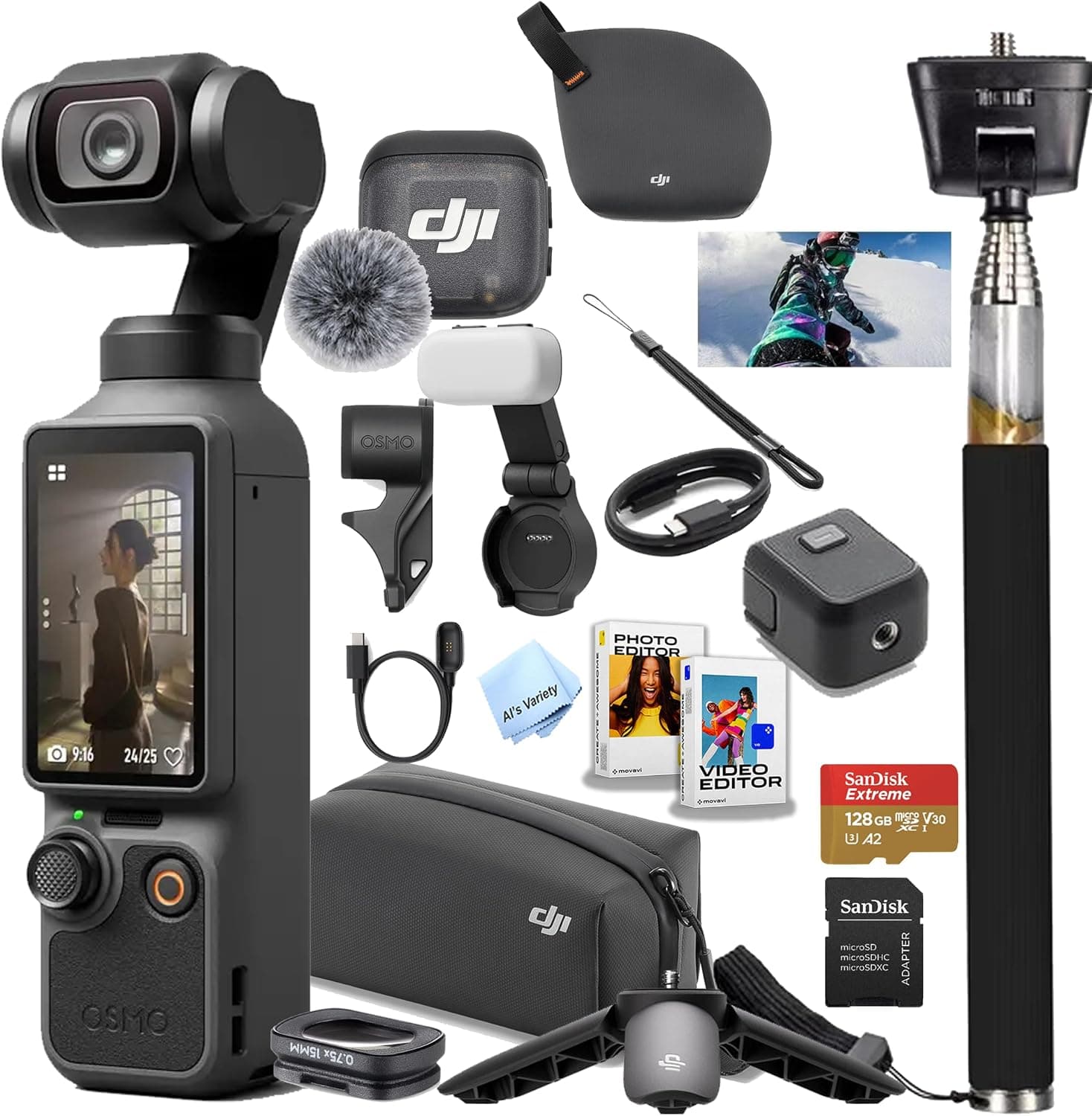
The real answer for serious creators remains the Creator Combo, which bundles the Pocket 4 with a DJI wireless microphone, a magnetic fill light, a wide-angle lens, the battery handle, and a protective case. The wireless mic pairs instantly with the camera — no receiver dongle needed on this generation — and records to its own internal storage as a backup while transmitting to the camera. That dual-channel recording is a genuine safety net: if the wireless link drops, you still have the audio on the mic itself.
The magnetic fill light clips onto the top of the camera and runs off the camera's battery, adding a soft, adjustable LED for close-up selfie shots. It's not a substitute for a proper lighting kit, but for indoor vlogging and evening street shots it makes a real difference to skin tones. The wide-angle lens adapter threads onto the front and turns the 20mm lens into roughly 14mm equivalent, which is useful for group selfies and tight interior shots. DJI sells the standard Pocket 4 as a bare kit, but the Creator Combo is where the product makes the most sense — the accessories are all designed to work together, and buying them separately costs more.
Battery Life
The battery is a 1,545 mAh cell, up from 1,300 mAh in the Pocket 3. DJI rates it for about 2.5 to 3 hours of continuous 4K recording, and up to around 4 hours at 1080p/24. In my mixed testing — short clips, gimbal moves, occasional Wi-Fi transfers, the screen on most of the time — a single charge lasted through roughly a full day of casual vlogging, which is a solid improvement over the Pocket 3's more anxious battery behavior.
The Creator Combo's battery handle is the insurance policy. It magnetically attaches to the bottom, adds a 1/4-inch tripod thread, and roughly doubles the total runtime. It also makes the camera easier to hold for long stretches and improves balance when you're shooting one-handed. If you're buying the standard kit, a spare battery or the handle is a worthwhile addition for full-day shoots.
Software and the DJI Mimo App
The Pocket 4 pairs with the DJI Mimo app, which has grown into a genuinely capable editing suite. You can use your phone as a wireless viewfinder and remote control, adjust gimbal and camera settings, transfer files, and cut a finished video with templates, transitions, and music without ever touching a desktop editor. The app experience is stable on both iOS and Android, and the connection over Wi-Fi 6 is fast enough that the phone-as-monitor experience is actually usable, not just a demo feature.
For desktop workflows, the Pocket 4 presents as a standard UVC webcam over USB-C — plug it in and it works as a high-quality, gimbal-stabilized webcam for calls and streams. That's a genuinely useful secondary function that makes the camera easier to justify if you do any video calls or live streaming. DJI's desktop tools handle the 10-bit D-Log M files cleanly, and the 800MB/s transfer speed means no waiting around.
How It Compares
Against the Pocket 3, the Pocket 4 is a clear upgrade for anyone who shoots in low light, wants 4K/240fps slow motion, or finds themselves fighting with storage and transfer speeds. The two hidden buttons, brighter screen, bigger battery, and faster processor make it a better daily driver. Pocket 3 owners who shoot mostly outdoors in daylight and never touch slow motion could reasonably skip a generation, but everyone else will feel the difference within the first hour.
Against an iPhone 16 Pro or a Galaxy S26 Ultra, the Pocket 4 wins on stabilization, audio, and the dedicated form factor. Phones have caught up in raw image quality — and their computational photography still edges out the Pocket 4 in stills — but no phone can match a mechanical gimbal for smooth walking footage, and no phone records four channels of spatial audio with a wireless mic backup. For creators whose phone is their everything device, the Pocket 4 is a companion, not a replacement. For creators who want a dedicated capture device that disappears into a pocket, it's the best option at any price.
Against action cameras like the GoPro Mission 1 Pro or the DJI Osmo Action 6, the trade is obvious: action cams are waterproof, rugged, and mount anywhere, but they have tiny sensors, no mechanical stabilization, and mediocre audio. The Pocket 4 is the opposite — delicate by comparison, but dramatically better image quality, stabilization, and sound. Most creators who own both reach for the Pocket for anything that isn't extreme sports. At $849 for the Creator Combo on Amazon, it's priced above the Pocket 3's launch and above most action cameras, but the capability justifies the premium for serious creators.
Who Should Buy the Osmo Pocket 4
The Pocket 4 is for anyone who regularly shoots video of themselves or the world around them and is tired of phone footage that looks like phone footage. Solo vloggers get the best-in-class stabilization, Face Lock tracking, and wireless mic audio. Travel creators get a camera that fits in a pocket, survives a full day of shooting, and offloads footage in minutes. Families get a point-and-shoot that produces dramatically better birthday-party and vacation footage than a phone, with zero learning curve beyond pointing it and pressing record. Content creators who monetize video get the slow motion, the D-Log M color space, and the dual-channel audio that separate this from phone footage in post.
The people who should not buy it are the ones who already own a Pocket 3 and shoot only in good light, and the ones who need waterproofing, interchangeable lenses, or serious telephoto reach. If you need those, the action cam or mirrorless route is still the right path.
The pocket gimbal camera category has had exactly one serious player for three years, and with the Pocket 4, DJI has raised the bar again rather than resting on its lead. The low-light sensor, the 240fps slow motion, the 107GB of internal storage, and the smarter tracking add up to the most capable camera that fits in a pocket — and for most creators, it's the only camera they'll need to carry at all.
Pros
- Outstanding 4K/240fps slow motion
- Excellent low-light performance from the new sensor
- 107GB built-in storage with fast 800MB/s transfers
- ActiveTrack 7.0 tracking with Face Lock and Dynamic Framing
- Bright 1,000-nit rotating touchscreen
- Four-channel spatial audio with Audio Zoom
Cons
- No official waterproof rating
- 4K/240fps mode crops the sensor
- Price has climbed versus the Pocket 3
Final Verdict
DJI's Osmo Pocket 4 refines the pocket gimbal formula with a brighter low-light sensor, 4K/240fps slow motion, 107GB of built-in storage, and smarter ActiveTrack 7.0 tracking — the best pocket camera for vloggers and travel creators.