Nothing Ear (3) Review: Style Meets Substance in a Polarizing Package
The Nothing Ear (3) delivers premium build quality and distinctive design at $179, but average battery life and noise cancellation keep it from competing with the class leaders.
When Nothing first burst onto the scene with the Ear (1) back in 2021, the company established a design language that was unmistakably its own — transparent panels, exposed components, and a stark industrial aesthetic that made everything else look boring by comparison. Fast forward four generations and the Nothing Ear (3) arrives at a curious inflection point for the London-based brand. The earbud market has never been more competitive, with Sony, Samsung, Anker, and Google all serving up compelling options at every price tier. At $179, the Nothing Ear (3) sits squarely in premium territory — within striking distance of the Sony WF-1000XM6 and the Samsung Galaxy Buds 4 Pro — which means Nothing can no longer coast on looks alone. The Ear (3) needs to deliver across the board: sound quality, noise cancellation, battery life, and call performance. Having spent several weeks with these earbuds as my daily drivers across commutes, work calls, workouts, and late-night listening sessions, I have a pretty clear picture of where they excel and where they fall short. This is the full story.
Design and Build Quality: A Masterclass in Premium Materials
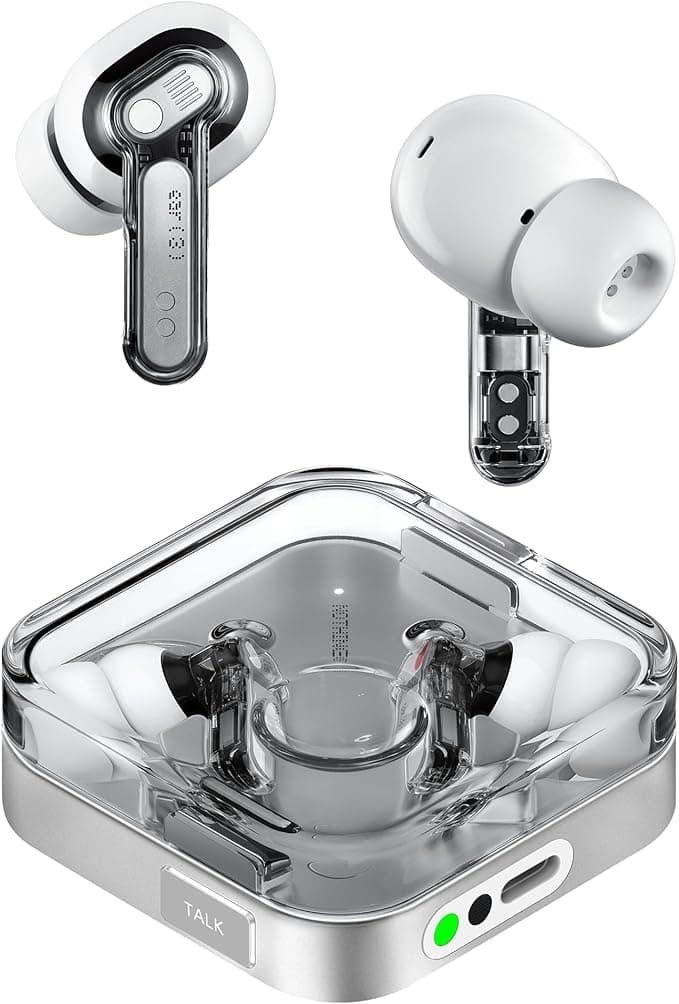
The Nothing Ear (3) charging case is the most visible upgrade over its predecessor, and it makes an immediate impression. Where the Ear (2) case was all transparent polycarbonate, the Ear (3) swaps in a machined recycled aluminum bottom half that gives the whole package a reassuring heft and a significantly more premium feel. The transparent upper lid remains, offering that signature view of the earbuds nestled inside, and the contrast between cold metal and clear plastic works beautifully. It weighs 62.4 grams total — slightly heavier than the Ear (2) — but that extra weight translates directly to build quality confidence. This is a case that won't flex or creak in your pocket.
A notable addition is the lanyard loop on the right side of the case, a detail borrowed from the CMF Buds Pro 2 that adds a practical touch for those who like to clip their earbuds to a bag or keychain. The front of the case now houses a large physical Talk button, which activates the Super Mic system — more on that later. The button has a satisfying click and is recessed enough to prevent accidental presses while in a pocket.
The earbuds themselves retain the familiar stem-based design that Nothing has refined across multiple generations, but with subtle improvements. The stem angle sits slightly lower than the Ear (2), which improves stability during movement. I was able to wear them for two-hour stretches without any discomfort, and even during jogging sessions, they stayed securely in place. The IP54 rating applies to both the earbuds and the charging case — an uncommon inclusion that means you don't have to worry about a splash or dust ingress ruining your investment. Most competing earbuds only offer IP ratings on the buds themselves, leaving the case unprotected.
Control is handled through pinch gestures along the flattened stem surface. A single pinch plays or pauses, a double pinch skips forward, a triple pinch goes back, and a pinch-and-hold cycles through noise control modes. Every gesture (except the single pinch) is customizable through the Nothing X app, which is a welcome level of flexibility. The pinch mechanism is responsive and produces a satisfying tactile click, though I occasionally triggered a double-pinch when I intended a single one during the first few days of use. Over time, I adjusted to the sensitivity and false triggers became rare.
The earbuds come with three sizes of silicone ear tips in the box, and getting the right fit is essential for both comfort and ANC performance. Nothing includes a fit test in the app that uses the internal microphones to verify a good seal — a thoughtful touch that many competitors overlook. The oval nozzle design is slightly different from the round nozzles used by most earbuds, which means third-party ear tip compatibility is limited, but the included tips cover a wide enough range that most users should find a comfortable fit. I settled on the medium tips and found them comfortable for extended wear, though the silicone material does accumulate earwax more visibly than foam alternatives, so regular cleaning is advisable.
Connectivity and Bluetooth Performance
The Nothing Ear (3) ships with Bluetooth 5.4, which brings Auracast broadcast support for future-proofing and improved connection stability. Pairing is seamless on Android via Google Fast Pair, and Microsoft Swift Pair ensures the same frictionless experience on Windows. On iOS, you still need to go through the standard Bluetooth menu, but the process is straightforward enough.
Multipoint connectivity allows the earbuds to maintain simultaneous connections to two devices — say, a laptop for music and a phone for calls — and the switching is nearly instantaneous. When a call comes in on my phone while I'm listening to music on my MacBook, the earbuds switch over without missing a beat. The Nothing X app gives you granular control over which devices are connected and can override the priority order if needed.
Connection range is excellent. I consistently maintained a stable connection up to 30 feet away with multiple walls in between, and I never experienced dropouts during walks around my apartment. The low-latency mode keeps end-to-end delay under 120 milliseconds, which is more than sufficient for gaming and video content where lip-sync accuracy matters.
Active Noise Cancellation: Solid, Not Class-Leading
Nothing advertises up to 45dB of noise attenuation for the Ear (3), and while independent testing puts real-world performance closer to 35dB in the low frequencies and 38dB in high frequencies, the actual experience is still quite good. The ANC handles low-frequency rumble from airplane engines, subway trains, and HVAC systems with authority — those constant drone noises effectively vanish when you enable cancellation.
Where the Ear (3) falls short of the leaders is in mid and high-frequency rejection. Conversations happening a few feet away, keyboard clatter in a coffee shop, and the ambient chatter of a busy street are noticeably reduced but not eliminated. Sony's WF-1000XM6 and the Galaxy Buds 4 Pro both offer more comprehensive attenuation across the frequency spectrum, making them better choices for frequent travelers or open-office workers who need absolute isolation.
The transparency mode is functional but not exceptional. It sounds slightly unnatural — like your ears are partially blocked — and struggles with higher-frequency sounds like birdsong or the rustling of plastic bags. It's perfectly usable for quick conversations at a checkout counter, but I wouldn't want to rely on it for extended periods.
One issue I encountered consistently was wind noise. Even a mild breeze while walking triggered audible artifacts in the ANC system, which was distracting. This is a known weakness that Nothing could potentially address with a firmware update, but as of this writing, it remains a downside.
Sound Quality: Capable Drivers in Need of Tuning
The Nothing Ear (3) uses 12mm dynamic drivers — the same physical size as the previous generation — but the tuning has been revised toward an even more V-shaped sound signature. Out of the box, you get elevated bass and treble with recessed mids, which creates an exciting, energetic presentation that works well for electronic music, hip-hop, and pop but can become fatiguing over longer listening sessions.
Bass performance is genuinely impressive. Sub-bass extension reaches deep into the 20Hz range, and tracks like The Knife's "Silent Shout" or Billie Eilish's "Bad Guy" deliver tactile, room-filling low-end that belies the earbud form factor. The bass is tight and controlled rather than boomy, which is a credit to the driver design and tuning. If you're a bass head, you'll likely enjoy the default tuning right out of the box.
The treble is elevated enough to provide crisp detail and airiness, but it can occasionally cross into sibilance on poorly mastered recordings. Hi-hats and cymbals have good shimmer and decay, but the upper treble emphasis can make some tracks sound harsh at higher volumes.
The midrange — where vocals, guitars, and most instruments live — is where the default tuning sacrifices the most. Vocals can feel distant or recessed, and the rich body of acoustic instruments gets somewhat overshadowed by the bass and treble emphasis. This is a common characteristic of V-shaped tunings, and it's not necessarily bad — many listeners prefer this exciting presentation for casual listening.
The saving grace is Nothing's excellent advanced EQ in the companion app. The parametric equalizer offers eight fully customizable bands where you can adjust frequency, gain, and Q-width — essentially giving you studio-level control over the sound signature. With about ten minutes of adjustment, I was able to flatten the frequency response into something much more neutral and balanced, bringing vocals forward and taming the bass and treble. The app also includes a Personal Sound Profile feature that creates a custom EQ based on a hearing test, though I found the default tuning more satisfying after manual adjustment.
LDAC support is included for Android users, enabling up to 990 kbps transmission at 24-bit/96kHz resolution. The difference between LDAC and AAC is noticeable on well-mastered tracks, particularly in terms of soundstage width and instrument separation. On iOS, you're limited to AAC, which is still perfectly capable but doesn't take full advantage of the driver potential.
The Super Mic: Clever Concept, Limited Execution
The Super Mic feature is the Ear (3)'s marquee innovation, and it deserves a thorough examination. The Talk button on the front of the case activates an additional microphone housed in the case itself, purportedly delivering cleaner voice pickup by positioning the microphone closer to your mouth. In practice, the execution is more complicated than the marketing suggests.
To use Super Mic, you still need to be wearing the earbuds — the case microphone is supplementary, not standalone. You press the Talk button, hold the case near your mouth (within about 5 centimeters), and speak. The system then processes audio from both the case mic and the earbud mics to deliver a cleaner signal.
In quiet environments, the improvement is marginal — the regular onboard microphones already do a decent job. In noisy environments like a busy street or a coffee shop, Super Mic does provide a measurable improvement in voice clarity by isolating your voice from ambient noise more effectively. However, it's not as dramatic as Nothing's marketing might lead you to believe.
The fundamental problem is convenience. Holding a charging case up to your mouth while wearing earbuds is an inherently awkward proposition, and it's hard to imagine most users doing this regularly. For the occasional important call in a noisy environment, it's a useful fallback. As a daily driver feature, it feels like a solution in search of a problem.
Battery Life: The Biggest Compromise
Battery life is the Nothing Ear (3)'s most significant weakness. With ANC enabled, the earbuds last approximately 5 hours and 12 minutes — that's about on par with the AirPods Pro but well behind class leaders like the Anker Soundcore Liberty 5 (8 hours) and the Galaxy Buds 4 Pro (7 hours). The charging case provides an additional 17 hours, bringing the total to roughly 22 hours, which is below average for this price tier.
This matters most on long-haul flights or full workdays where you need earbuds from morning commute through afternoon meetings. With the Ear (3), I found myself reaching for the charger during lunch breaks to ensure I'd make it through the rest of the day. If you're the type of user who pops earbuds in for a quick workout or a single conference call, the battery life is perfectly adequate. But power users who listen for 6+ hours daily will feel the constraint.
The silver lining is fast charging. A 10-minute charge via USB-C delivers up to 10 hours of playback, which means you can top up quickly before a commute or workout. Wireless charging is supported at 2.5 watts, which is convenient but slow — expect a full charge to take around 3 hours wirelessly versus about 1.5 hours via USB-C.
For most users, the battery situation is workable if you're diligent about topping up. The case fits easily in a pocket and supports passthrough charging, so you can juice everything up overnight without thinking about it. But if you're a heavy user who spends 6+ hours a day with earbuds in, you'll want to look at options with longer endurance. The compact size of the case also means it's easy to carry in a pocket or bag — it's noticeably smaller than the Galaxy Buds 4 Pro case and about the same size as the AirPods Pro case, making it one of the more pocketable options in this category.
Microphone and Call Quality
Call quality on the Nothing Ear (3) is above average but not exceptional. The six-microphone array (three per earbud) does a solid job of picking up your voice while filtering out ambient noise. In quiet environments, callers reported clear, natural-sounding audio with good volume and minimal distortion. In windy conditions, the microphones struggled — wind noise leaked through more than I'd like, and callers occasionally asked me to repeat myself.
The Super Mic, when used as intended, does produce richer voice pickup with better bass response. Callers described it as sounding more natural and "present" compared to the standard microphone path. However, the convenience tradeoff means I only reached for it in truly noisy environments.
App Experience and Software
The Nothing X app remains one of the best companion apps in the earbud market. It's clean, well-designed, and packed with genuinely useful features without being overwhelming. The highlight is the advanced EQ, which I've already praised, but there's more worth exploring.
The app includes a hearing test for the Personal Sound Profile, customizable pinch gestures, multipoint device management, a low-latency gaming mode, and firmware update support. The app also surfaces battery levels for each earbud and the case, along with charging status. Everything loads quickly, and I never experienced any connection drops or sync issues during my testing.
One thoughtful touch: the app includes an earbud fit test that uses the internal microphones to verify you have a good seal. This is especially useful for ensuring optimal ANC performance, as a poor seal dramatically reduces noise cancellation effectiveness.
Comparison to Competitors
The Nothing Ear (3) occupies an awkward position in the market. At $179, it directly competes with the Samsung Galaxy Buds 4 Pro ($199, often on sale for $159), the Sony WF-1000XM6 ($249, often on sale for $199), and the Anker Soundcore Liberty 5 Pro Max ($129). Each of these alternatives brings a different set of strengths that cater to different priorities.
The Anker Soundcore Liberty 5 is the most direct competitor and arguably the better value. It offers 8 hours of battery life with ANC, more effective noise cancellation, a comprehensive EQ, and longer overall endurance — all for $50 less. The tradeoff is that the Anker lacks the Nothing's design flair and the metal charging case, but for pure performance, it's a compelling alternative. If I were prioritizing battery life and ANC above all else, the Anker would be my recommendation without hesitation.
The Galaxy Buds 4 Pro offer seamless integration with Samsung phones, excellent ANC, and a much more balanced default sound signature. If you're in the Samsung ecosystem, they're the obvious choice — the combination of Samsung Seamless Codec support, Galaxy Wearable app integration, and Auto Switch between Galaxy devices creates an experience that Nothing simply can't match for Samsung users. The Buds 4 Pro also deliver noticeably better call quality in noisy environments, thanks to Samsung's improved microphone array and wind reduction algorithms.
The Sony WF-1000XM6 remains the ANC king with best-in-class noise cancellation and sound quality, though at a higher price. Sony's Integrated Processor V2 drives adaptive noise cancellation that adjusts in real-time to your environment, and the sound quality with LDAC support is genuinely audiophile-grade. The tradeoff is size — the WF-1000XM6 earbuds are bulkier and the case is significantly larger than the Nothing's, making them less pocketable for daily carry. The Sony's touch controls are also less reliable than the Nothing's pinch gestures, which is a quality-of-life consideration worth noting.
For iPhone users, the AirPods Pro 3 ($249) remain the default recommendation thanks to seamless H2 chip integration, spatial audio with dynamic head tracking, and best-in-class transparency mode. But at $70 more than the Nothing Ear (3), the price gap is significant enough that design-conscious iOS users might find the Nothing alternative appealing if they're willing to trade some ecosystem magic for a more distinctive look.
The Nothing Ear (3) makes the most sense for design-conscious users who value aesthetics and are willing to trade some battery life and ANC performance for a truly unique look. For Nothing Phone owners, the integration adds another layer of appeal — you get ChatGPT voice access, Glyph interface notifications, and visual consistency that no other earbud brand can replicate.
Who Should Buy the Nothing Ear (3)
The Nothing Ear (3) is a product of deliberate tradeoffs. Nothing chose to invest in design, materials, and a distinctive identity rather than chasing spec-sheet supremacy, and that decision will resonate with some buyers more than others.
If you prioritize aesthetics and want earbuds that look and feel different from the sea of white plastic alternatives, the Ear (3) delivers in spades. The aluminum charging case, the transparent design, and the attention to detail make these earbuds genuinely fun to own and use. If you're a Nothing Phone owner, the integration and visual consistency across your devices is a meaningful bonus.
If your priorities are maximum battery life, best-in-class ANC, or the most natural transparency mode, there are better options at competitive prices. The Ear (3) asks you to accept compromises in core performance areas in exchange for a design experience that nothing else in this category matches.
That tradeoff is neither right nor wrong — it's a matter of personal priorities. For my usage patterns — primarily commuting, calls, and podcasts with occasional music listening — the Ear (3) proved to be a capable daily companion, provided I kept the case nearby for mid-day charging. The design and build quality made them earbuds I genuinely looked forward to using, even if the ANC and battery couldn't match the class leaders. In a market dominated by safe, black-and-white designs, sometimes a bold compromise is more interesting than a safe victory.
Pros
- Stunning aluminum-and-transparent design with premium build quality
- Excellent parametric EQ with studio-level customization
- Solid ANC performance for low-frequency noise reduction
- IP54 rating on both earbuds and charging case
- Comfortable, stable fit with customizable pinch controls
Cons
- Below-average battery life at 5.5 hours with ANC
- Mid/high-frequency ANC lags behind Sony and Samsung
- Super Mic feature is gimmicky and inconvenient to use
- Heavily V-shaped default tuning requires EQ adjustment
- Transparency mode sounds unnatural
Final Verdict
The Nothing Ear (3) delivers premium build quality and distinctive design at $179, but average battery life and noise cancellation keep it from competing with the class leaders.