Technics EAH-AZ100 Review: Reference-Class Wireless Earbuds That Redefine Premium Sound
The Technics EAH-AZ100 delivers best-in-class sound quality with its innovative 10mm Magnetic Fluid Driver, class-leading battery life of 10+ hours with ANC, and competitive noise cancellation. While call quality is a notable weakness, these are the best-sounding true wireless earbuds under $300.
If you've been following the wireless earbuds space over the past few years, you've probably noticed that the conversation tends to circle around the same few names. Sony, Bose, and Apple have dominated the premium category, each offering a slightly different flavor of excellence. Sony leans into feature-packed sound, Bose prioritizes noise cancellation above all else, and Apple delivers seamless ecosystem integration. Technics, a brand better known for legendary turntables and high-end hi-fi components, has been quietly building something special in the audio space, and with the EAH-AZ100, they've finally delivered a product that demands to be taken seriously.
Priced at $299, the Technics EAH-AZ100 enters a crowded field of flagship true wireless earbuds that includes Sony's WF-1000XM5, Apple's AirPods Pro 3, Bose's QuietComfort Ultra Earbuds (2nd Gen), and Sennheiser's Momentum True Wireless 4. That's tough company. But after spending extensive time with the AZ100, it's clear that Technics has crafted something genuinely competitive. These earbuds don't just check boxes; they make a statement about what premium wireless audio should sound like.
The AZ100 replaces the already-excellent EAH-AZ80, which was widely considered one of the best-sounding wireless earbuds on the market despite falling short in noise cancellation and battery life. Technics has addressed both of those shortcomings while retaining the sonic character that made the AZ80 so beloved among audiophiles. The result is a more complete package that finally feels like a true flagship contender rather than a specialist product for sound purists willing to make compromises.
Design and Comfort
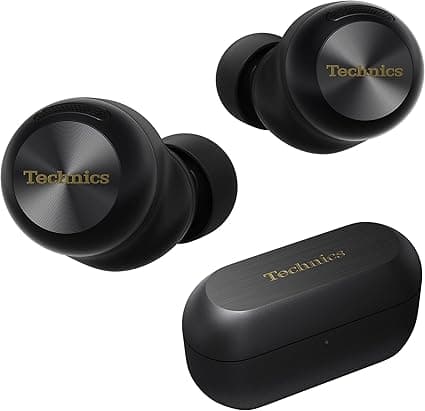
Technics has made meaningful changes to the physical design of the AZ100. Each earbud now weighs just 5.9 grams, down from 7 grams on the AZ80, and the overall footprint is about 10% smaller. That might not sound like much on paper, but the difference in how they feel during extended listening sessions is noticeable. The new concha-fit design follows the natural contours of your ear more closely, creating a secure seal without needing to be jammed into your ear canal.
The build quality is what you'd expect from a company with Technics' pedigree. The earbuds feature a metal casing that feels premium without being excessively heavy. The touch-sensitive panels on the outer face are responsive and customizable through the Technics Audio Connect app, though we did experience occasional issues with accidental touches. A single tap sometimes registers as a double tap, which can be frustrating when you're trying to adjust volume or pause a track. This is a minor annoyance rather than a dealbreaker, but it's worth noting.
The charging case has also been redesigned. It's slimmer and more pocketable than the AZ80's case, with a pleasant soft-touch finish on the exterior. It supports Qi wireless charging and USB-C wired charging, and it provides approximately two full charges for the earbuds. The case magnet feels slightly weaker than we'd like, and the lid doesn't snap shut with the satisfying precision of the AirPods Pro 3 case. These are small details, but at this price point, small details matter.
Technics includes five sizes of silicone ear tips (XS through XL), which is more generous than most competitors. The tips themselves include a foam backing inside the silicone bore that helps maintain shape and improve the seal. Finding a good fit is relatively straightforward, and once you do, the passive isolation is impressive even before you turn on active noise cancellation.
That said, comfort during long sessions is a point of contention among reviewers. Some listeners can wear the AZ100 for hours without discomfort, while others report a claustrophobic sensation after about three hours due to the deep fit and relatively large nozzle. If you're someone who wears earbuds for entire workdays, this is something to be aware of. On the other end of the spectrum, the earbuds are stable enough for light activity like walking or working around the house, though we wouldn't recommend them for intense workouts due to the lack of wing tips or ear hooks.
Sound Quality
This is where the Technics EAH-AZ100 truly shines. The star of the show is the new 10mm Magnetic Fluid Driver, a technology derived directly from Technics' flagship wired in-ear monitor, the EAH-TZ700, which costs over $1,100. The magnetic fluid — an oil-like substance suspended in the driver's magnetic gap — stabilizes the diaphragm during movement, allowing for a thinner surround that delivers greater bass punch without adding mass. The result is remarkably low distortion across the frequency range and a level of clarity that's rare in any wireless earbud, let alone one in this price bracket.
The sound signature is best described as balanced with a gentle bass elevation. Unlike some competitors that boost bass to an almost comical degree, the AZ100 serves up bass that's tight, articulate, and well-defined. Sub-bass extension is excellent, with enough rumble to make electronic music and cinematic scores feel substantial, but the low end never bleeds into the mids. Kick drums have proper attack and decay. Bass guitars retain their tonal character rather than dissolving into a one-note thud.
The midrange is where the AZ100 separates itself from the pack. Vocals are rendered with exceptional clarity and presence, whether you're listening to intimate singer-songwriter recordings or dense metal mixes. Acoustic instruments sound natural and uncolored. The upper mids are slightly forward without being aggressive, which helps vocals cut through busy arrangements. This is a sound that prioritizes transparency — you hear into recordings rather than hearing the earbuds themselves.
High frequencies are detailed and extended but never harsh. Cymbals have realistic shimmer, string textures are preserved, and there's a sense of air and space that's often missing from wireless earbuds. If we're being critical, the very top end could use a touch more sparkle for listeners who crave maximum treble detail, but this is a matter of taste rather than a deficiency. The direct EQ mode (which bypasses all processing) delivers the cleanest presentation, while the various EQ presets in the app offer useful alternatives for different genres. The Bass+ mode adds punch at the expense of some refinement, and the app's 8-band custom EQ gives you full control if you want to dial in your own curve.
Soundstage performance is exceptional for a closed-back in-ear design. Instruments are spread across a convincing three-dimensional space, with good width, depth, and height. The AZ100 doesn't sound like you're wearing earbuds — it sounds like you're in a room with the musicians. This spatial quality is particularly noticeable on well-recorded live albums and orchestral recordings. The Dolby Atmos implementation with head tracking is a nice bonus for Apple Music subscribers, though it does introduce some loss of clarity compared to the standard stereo mix. It's fun to play with but not something we used consistently.
Comparing the AZ100 to its direct competitors reveals a clear hierarchy. Against the Sony WF-1000XM5, the Technics offers superior detail retrieval, better soundstage depth, and more natural timbre. Sony's earbuds have a fuller, richer sound that some listeners will prefer, especially for bass-heavy genres, but the Technics is the more technically capable performer. Against the Sennheiser Momentum True Wireless 4, the Technics matches or exceeds them in clarity and dynamics while offering better comfort and ANC. The Bowers & Wilkins Pi8, at $399, has a thicker, more romantic sound that some find appealing, but it lacks the transparency and separation of the AZ100.
Active Noise Cancellation
The ANC on the AZ100 represents a massive leap over the AZ80. Technics has implemented an adaptive system that adjusts noise cancellation in real-time based on your environment, and it works remarkably well. Low-frequency noise like engine rumble and HVAC hum is suppressed effectively. Mid-frequency noise like office chatter and street traffic is significantly reduced. High-frequency noise is handled adequately, though not at the level of the very best in class.
In our testing, the ANC performance sits somewhere between the Sony WF-1000XM5 and the Bose QuietComfort Ultra Earbuds (2nd Gen). It's better than Sony's implementation for consistent droning noise but slightly less effective than Bose at eliminating unpredictable sounds like clattering dishes or sudden voices. What Hi-Fi describes the ANC as "Bose-bothering," and we largely agree. On a typical commute or in a busy coffee shop, the difference between the AZ100 and the Bose QC Ultra is marginal enough that most people won't notice.
The adaptive mode adjusts smoothly without the pumping or hissing that plagued earlier adaptive ANC implementations. There's also a manual slider in the app if you prefer to set the level yourself. The passthrough (ambient) mode is impressively natural, making it easy to hold conversations or hear announcements without removing the earbuds. It doesn't have the hyper-realistic quality of Apple's transparency mode, but it's close enough that the difference only matters in side-by-side comparisons.
Where the AZ100 falls short is in-flight noise cancellation. If you're a frequent flyer, the AirPods Pro 3 remain the gold standard for reducing cabin noise. The Technics handles the low-frequency drone of engines adequately, but it's less effective at suppressing the chaotic mix of noises that defines air travel. This is a niche concern for most buyers, but it's worth knowing if you spend significant time on planes.
Battery Life
Battery life is one of the AZ100's strongest selling points. Technics rates the earbuds at 10 hours of playback with ANC on and up to 12 hours with ANC off. With the charging case, total listening time reaches about 28 hours with ANC on. In our real-world testing with a mix of ANC and passthrough usage, we consistently got between 9 and 10 hours from the earbuds themselves, which is excellent by any standard.
To put that in perspective, the Sony WF-1000XM5 manages about 6 hours with ANC on, and the AirPods Pro 3 (with their newly redesigned case) deliver roughly 7 hours. The Bose QC Ultra Earbuds offer about 6 hours. The AZ100's battery advantage is substantial — you can easily go a full workday plus a commute without needing to put the earbuds back in the case.
With LDAC enabled (Android only), battery life drops to approximately 7 hours, which is still competitive. A 10-minute quick charge provides about 90 minutes of playback, which is handy when you're in a rush. The case supports both Qi wireless charging and USB-C, giving you flexibility in how you recharge.
Call Quality
This is the AZ100's biggest weakness, and it's a significant one. Despite incorporating six microphones and Technics' Voice Focus AI technology, call quality is inconsistent. In quiet environments, the person on the other end can hear you clearly enough, though your voice may sound slightly processed or robotic. In moderate noise environments like a street corner or coffee shop, background noise is well-suppressed, but your voice can sound muffled or distant.
The real problem, however, appears in noisier environments. Multiple reviewers report that voices cut out completely or become garbled during calls in anything beyond moderate background noise. TechGearLab gave the call quality a score of 3.2 out of 10, describing it as a dealbreaker. Our experience wasn't quite that dire — we managed acceptable call quality in quiet offices and at home — but we wouldn't recommend the AZ100 if you spend a significant portion of your day on phone calls. The AirPods Pro 3 and Google Pixel Buds Pro 2 remain significantly better choices for voice communication.
Connectivity and Features
The AZ100 supports Bluetooth 5.3 with LDAC, AAC, SBC, and LC3 codecs. LDAC support is great for Android users who want high-resolution wireless audio, though you'll need to manually enable it in Android's Bluetooth settings (the app defaults to AAC). The inclusion of LC3 is forward-looking — as more devices adopt Bluetooth LE Audio, having LC3 support ensures compatibility with future hardware and potentially better efficiency at lower bitrates.
One of the AZ100's standout connectivity features is three-device multipoint — you can be connected to your phone, laptop, and tablet simultaneously and switch between them seamlessly. This is genuinely useful for anyone who works across multiple devices throughout the day. Sony's WF-1000XM5 manages two-device multipoint; the AZ100's three-device implementation is best in class, and the switching is smooth enough that you rarely notice the transition between audio sources.
The Technics Audio Connect app is functional if not beautiful. It offers an 8-band EQ with presets, ANC slider, touch control customization, spatial audio settings, and a fit test that adjusts the sound to your ear shape. The app also includes a Find My feature with both audible chirp and last-location tracking. The interface isn't as polished as Sony's Headphones Connect app or Sennheiser's Smart Control, but it covers all the essential features without unnecessary bloat.
IPX4 water resistance means the AZ100 can handle sweat and light rain but isn't suitable for submersion. This is standard for premium earbuds and sufficient for most use cases.
The Competition
At $299, the Technics EAH-AZ100 sits at the upper end of the premium earbud market. Here's how it stacks up against its main rivals:
The Sony WF-1000XM5 (now available for around $175-200) offers a fuller, richer sound and slightly better overall ANC, but falls short on battery life, detail retrieval, and multipoint connectivity. The Sony is the safer choice if you want a well-rounded package at a lower price, but the Technics is the better earbud for sound quality.
The Apple AirPods Pro 3 ($249) remains the best choice for iPhone users who prioritize ecosystem integration, call quality, and comfort. The Technics sounds significantly better, but Apple's transparency mode, spatial audio implementation, and seamless device switching are hard to beat if you're fully invested in Apple's ecosystem.
The Bose QuietComfort Ultra Earbuds (2nd Gen) ($229-249) still hold the crown for raw noise cancellation, particularly against low-frequency noise. The Technics offers better sound quality and substantially better battery life, but Bose remains the ANC leader.
The Sennheiser Momentum True Wireless 4 ($249) is the closest competitor in terms of audio philosophy. Both prioritize sound quality over ancillary features. The Technics edges ahead with better ANC, better battery life, and a more versatile multipoint implementation, while the Sennheiser has a slightly more refined app experience.
The Google Pixel Buds Pro 2 ($199) offers similar sound quality and ANC at a significantly lower price, with much better call quality and comfort. If you're an Android user who doesn't need the absolute best in audio performance, the Pixel Buds Pro 2 represents better value.
Verdict
The Technics EAH-AZ100 is the best-sounding pair of true wireless earbuds under $300, and quite possibly the best under $400. The new Magnetic Fluid Driver delivers a level of clarity, detail, and soundstage depth that was previously unavailable in the wireless space at this price. The ANC is competitive with the best in class, the battery life is class-leading, and the three-device multipoint is genuinely useful.
The compromises are real: call quality is below average, comfort during extended sessions is hit-or-miss depending on your ear shape, and the touch controls can be overly sensitive. The lack of aptX support may matter to some Android users, though LDAC covers similar ground.
For whom is the AZ100 the right choice? If sound quality is your absolute top priority in a wireless earbud and you're willing to accept compromises in other areas to get it, the Technics EAH-AZ100 is the earbud to buy. If you're looking for the best all-around package with strong performance across every category, the Sony WF-1000XM5 or AirPods Pro 3 may serve you better. But if you value musical transparency, dynamic expression, and the feeling of hearing your favorite recordings as if for the first time, the AZ100 delivers an experience that its competitors simply cannot match.
Who Should Buy the Technics EAH-AZ100
These earbuds are ideal for anyone who considers music listening a primary use case rather than a secondary function. If you're the kind of listener who notices the difference between a 320kbps MP3 and a lossless stream, who has favorite test tracks for evaluating new gear, or who finds yourself pulled into recordings rather than passively listening to them, the AZ100 will reward you every day.
They're also a strong choice for frequent travelers who value long battery life. The combination of 10-hour playback and effective ANC means you can fly across the Atlantic without needing to recharge the case, which is more than can be said for most competitors. The three-device multipoint is particularly valuable for people who work across multiple platforms — you can take a Zoom call on your laptop, switch to a music break on your phone, and check a video on your tablet without ever having to think about what's connected to what.
Who Should Look Elsewhere
If call quality is critical — and for many people in 2026, it genuinely is — you should look at alternatives. The AZ100's microphone performance is simply not reliable enough for people who spend significant time on phone calls or virtual meetings while on the go. The AirPods Pro 3, Google Pixel Buds Pro 2, or even the Samsung Galaxy Buds 4 Pro all handle voice communication more consistently.
Similarly, if you need maximum noise cancellation in the most challenging environments, Bose remains the benchmark. The QC Ultra Earbuds (2nd Gen) still suppress more noise more consistently, particularly in the mid-frequency range where human speech lives. And if you prioritize comfort above all else — the kind of comfort that lets you forget you're wearing earbuds at all — the AirPods Pro 3 are still the leaders by a meaningful margin.
The Bottom Line
The Technics EAH-AZ100 represents a maturation of the brand's wireless audio strategy. The AZ80 was a promising foundation, and the AZ100 builds on it in every meaningful dimension: better sound, better ANC, better battery life, better design. The call quality issue is unfortunate and prevents these from being an unqualified recommendation, but for the core use case of wireless music listening, there's nothing better in the true wireless space at this price.
Available in Black, Silver, Midnight Blue, and Champagne Gold at $299 from Amazon and other major retailers, the Technics EAH-AZ100 earns a strong recommendation for anyone who prioritizes sound quality in their wireless audio experience. Just keep a dedicated headset handy for your phone calls.
Pros
- Superb sound quality with exceptional detail and clarity from the Magnetic Fluid Driver
- Class-leading battery life at 10+ hours with ANC on
- Excellent adaptive noise cancellation competitive with Bose and Sony
- Three-device Bluetooth multipoint switching
- Better LDAC support and LC3 codec for forward compatibility
Cons
- Below-average call quality in noisy environments
- Touch controls can be overly sensitive
- Comfort is hit-or-miss for extended listening sessions
Final Verdict
The Technics EAH-AZ100 delivers best-in-class sound quality with its innovative 10mm Magnetic Fluid Driver, class-leading battery life of 10+ hours with ANC, and competitive noise cancellation. While call quality is a notable weakness, these are the best-sounding true wireless earbuds under $300.