Valerion VisionMaster Max Review: The $4,000 Projector That Challenges $10,000 Systems
The Valerion VisionMaster Max delivers stunning RGB triple laser performance with 3,500 lumens, 4ms input lag, and a swappable lens system — offering 80 percent of a $10,000 home theater experience for $3,999.
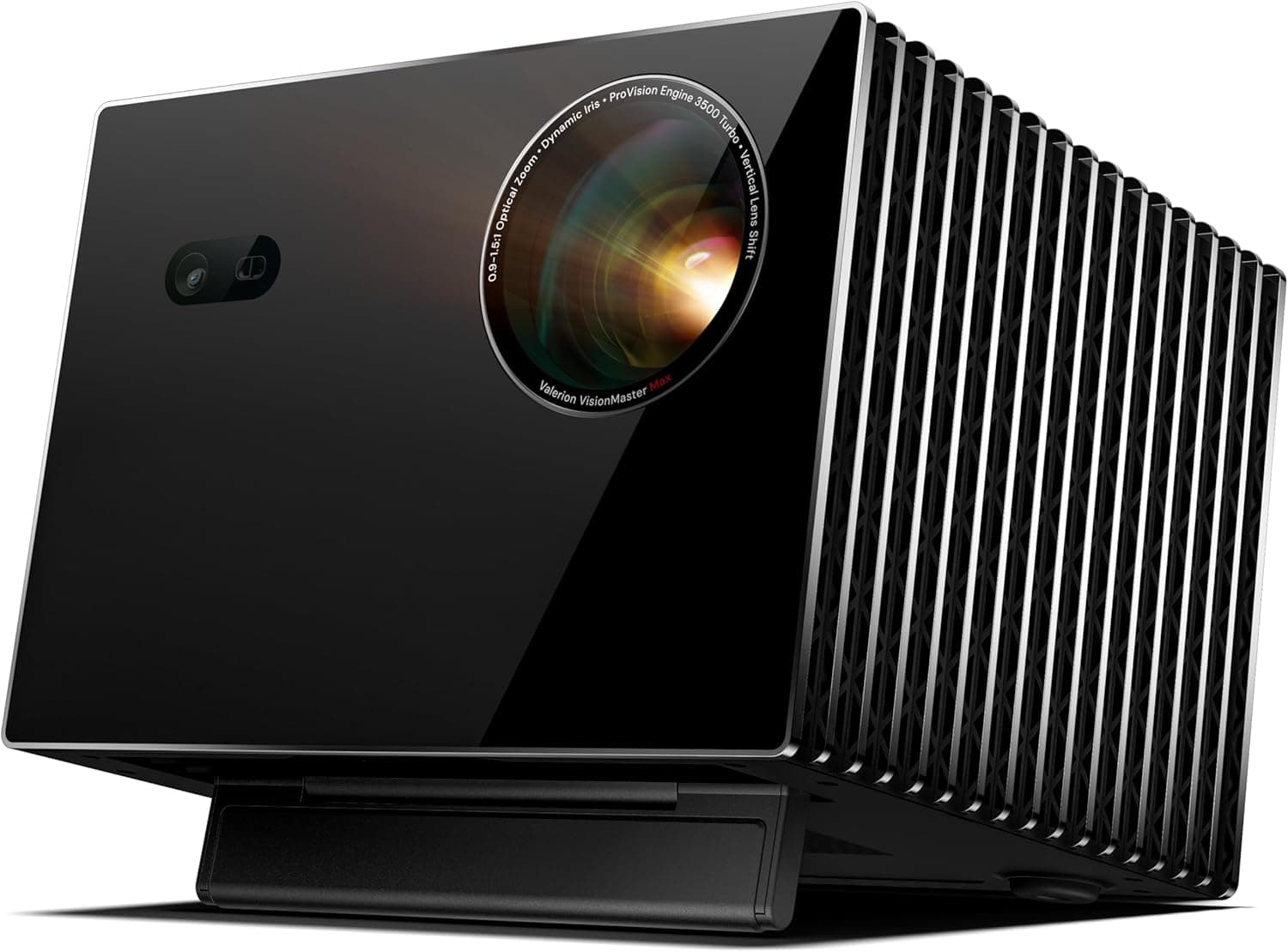
The Valerion VisionMaster Max is the projector that the home theater community has been talking about since its record-breaking Kickstarter campaign raised over $10.9 million from more than 4,800 backers in late 2024. As a premium sub-brand of AWOL Vision, Valerion set out to build a standard-throw RGB triple laser projector that could compete with established players from Sony, JVC, and Epson — but at a fraction of the price. The result is a $3,999 DLP projector that delivers between 80 and 90 percent of the performance you would get from a $10,000 to $20,000 system.
And that is precisely the right way to think about the VisionMaster Max. It is not a JVC NZ7 killer, and anyone expecting inky black levels on par with LCoS technology in a fully light-controlled room will be disappointed. But for the vast majority of home theater enthusiasts — particularly those setting up in a mixed-use living room where ambient light is a factor — this projector offers a combination of brightness, color accuracy, gaming performance, and smart features that is genuinely difficult to match at any price.
The projector is available now from Valerion's online store and Amazon at a retail price of $3,999 (with a $4,999 MSRP that is frequently discounted). That puts it in direct competition with the Hisense C2 Ultra, the XGIMI Horizon Ultra, and Epson's LS11000, while offering features that challenge projectors costing two to three times as much.
Design and Build Quality
The VisionMaster Max adopts a distinctive design language that sets it apart from the black rectangles that dominate the projector market. Measuring 10.2 inches wide by 7.3 inches tall by 9.2 inches deep and weighing 16.5 pounds, it is luggable rather than portable — this is a projector you can move between rooms, but you won't want to travel with it regularly.
The chassis combines glass, metal, and plastic in a ribbed block design accented with electroplated metal strips. The construction feels substantial for the price point, though it naturally lacks the milled-aluminum solidity of a $10,000 JVC. The front houses the motorized lens assembly with its 1.7x optical zoom and the interchangeable lens mount, while the rear features a flip-down flap that conceals the port panel and power button.
AppleInsider's review noted that the power button being behind the port flap is a minor annoyance — you have to open the flap to turn the projector on or off, which means the flap cannot remain closed if you want easy access to the power switch. A small criticism, but one that speaks to the overall polish of the design.
The packaging deserves special mention: the VisionMaster Max ships in a reusable styrofoam container with latches and a carrying handle, effectively doubling as a protective transport case. It includes the projector, power adapter, remote control, batteries, cleaning cloth, and manual — everything you need to get started except a screen.
Light Source and Optical System
The heart of the VisionMaster Max is its RGB triple laser light source, rated for 25,000 hours of operation. That is roughly 17 years of daily four-hour viewing sessions before you need to consider replacement, meaning the light engine will outlast virtually every other component in your home theater system.
The optical system is where Valerion has made some genuinely innovative choices. The motorized 1.7x zoom lens offers a throw ratio of 0.9 to 1.5:1, giving you significant placement flexibility. The +/-105 percent vertical lens shift is optical rather than digital, meaning you are projecting through the lens rather than cropping the image — a critical distinction for image quality purists. There is no horizontal lens shift, so lateral placement must be centered on the screen.
The interchangeable lens system is the headline feature and is genuinely unique in this price bracket. The projector uses a bayonet mount that allows you to swap lenses for different throw distances or specialty applications. Valerion offers an official long-throw lens (1.3 to 2.1:1), and third-party options including the Spexman anamorphic lens are available. For home theater enthusiasts who want to experiment with different optical configurations, this is a rare and welcome capability.
The manual 6-blade iris adds another layer of control over image quality. By closing the iris, you increase contrast at the expense of brightness — a trade-off that lets you optimize the image for your specific environment. The iris blades feature a new black coating that absorbs excess light, reducing internal reflections that can wash out black levels. However, the iris is manual only — there is no auto iris function, which means you cannot dynamically adjust contrast scene by scene without getting up to physically turn the ring.
Image Quality and Brightness
The VisionMaster Max uses a 0.47-inch DLP DMD chip with XPR pixel-shifting technology to achieve a 4K UHD (3,840 by 2,160) resolution. The DLP panel is paired with Texas Instruments' latest DLPC8445 controller, which reduces the hardware footprint by 90 percent compared to previous generations and adds support for variable refresh rates and 240Hz operation.
Out of the box, the projector delivers impressive color accuracy in Theater and Filmmaker modes. ProjectorReviews.com measured a grayscale color temperature of 6,578 Kelvin in Theater mode — very close to the 6,500K industry standard. Color accuracy measured a delta E of 4.4 out of the box, which improved to 1.0 after calibration — an excellent result that puts it in contention with projectors costing significantly more.
Brightness is where the VisionMaster Max makes its strongest case. Valerion claims 3,500 ISO lumens, and ProjectorReviews' testing confirmed approximately 2,400 lumens in Theater and Filmmaker modes, 3,230 lumens in Vivid mode with the brightness enhancer off, and a staggering 4,450 lumens in Vivid mode with the enhancer set to level 2 — a mode the reviewer nicknamed "NUCLEAR" because it made the image "glow green, and so bright it was hard to look at" in a dark room. The enhancer mode should be used sparingly — it introduces a green bias and may accelerate laser degradation — but it is there if you need to battle significant ambient light.
Color gamut coverage is exceptional, with the triple laser achieving 110 percent of the Rec.2020 color space and 132 percent of DCI-P3. The practical result is vibrant, saturated colors that handle HDR content with authority. Both HDR10+ and Dolby Vision are supported, along with IMAX Enhanced mode and standard HDR10 and HLG.
Black Levels and Contrast
Black level performance is the area where the VisionMaster Max reveals its DLP heritage — and where expectations need to be managed. ProjectorReviews measured a native on/off contrast of 3,419:1 (against Valerion's claimed 5,000:1) and a dynamic contrast of 28,586:1 (against a claimed 50,000:1).
In absolute terms, a 3,419:1 native contrast ratio is excellent for a DLP projector but still falls short of JVC's LCoS technology, which can achieve 20,000:1 or higher natively. In a dedicated, pitch-black theater room, JVC projectors produce deeper, more immersive black levels. But in a living room with any ambient light, the difference narrows considerably, and the VisionMaster Max's superior brightness actually gives it an advantage in real-world viewing.
Valerion's NoirScene Engine uses AI-driven Enhanced Black Level (EBL) processing to improve perceived contrast. It works by dynamically adjusting the laser diodes and gamma curve in real-time based on the content being displayed. In dark scenes — think the Batman interrogation room or Harry Potter's encounter with Dementors — EBL dramatically improves the sense of depth and shadow detail. The trade-off is occasional brightness pumping and a subtle blue-green tint in shadows during challenging dark-to-light transitions, but for a software-based solution, it is remarkably effective.
The anti-rainbow effect (RBE) elimination is another software triumph. Rainbow artifacts are a known issue with single-chip DLP projectors, where brief flashes of red, green, and blue appear in high-contrast moving images. Approximately 10 to 15 percent of viewers are sensitive to this effect. Valerion's software-based solution actively detects high-contrast motion and subtly alters the projection to eliminate rainbows. AppleInsider tested five viewers — including two known to be RBE-sensitive — and none saw rainbow artifacts on the VisionMaster Max. That is a genuinely impressive result and removes one of the primary objections to DLP technology for home theater use.
Gaming Performance
For gamers, the VisionMaster Max is arguably the best projector under $5,000. The 4ms input lag at 1080p and 240Hz is negligible — literally imperceptible to human reflexes. Combined with support for variable refresh rate (VRR) and Auto Low Latency Mode (ALLM), this projector is equally at home with competitive shooters, racing sims, and cinematic single-player adventures. For the ultimate home theater display, consider pairing it with a premium TV like the Samsung S95H OLED.
The 240Hz mode requires you to bypass the XPR pixel-shifting and run at 1080p resolution, but the trade-off is well worth it for competitive gaming. The motorized iris helps with dark atmospheric games like Elden Ring or Resident Evil, where deep shadows are part of the visual design.
For PC gamers, the VisionMaster Max supports ultra-wide aspect ratios including 21:9 and 32:9, giving you an immersive field of view that standard 16:9 projectors cannot match. The projector even supports 3D content, a niche capability that has all but disappeared from modern home theater displays.
Smart Features and Software
The VisionMaster Max runs Google TV as its operating system, powered by a MediaTek MT9618 quad-core Cortex-A73 processor with 4GB of RAM and 128GB of storage. Google TV provides access to the full ecosystem of streaming apps — Netflix, YouTube, Disney+, Apple TV, Amazon Prime Video — all running natively on the projector without requiring an external streaming device.
Wireless connectivity includes Wi-Fi 6E and Bluetooth 5.2, along with AirPlay 2, Miracast, and Chromecast built-in for screen mirroring. Smart home integration covers HomeKit, Google Home, and Alexa, though voice control requires an external device like a HomePod or Echo.
The onboard Google TV experience is functional but not exceptional. AppleInsider's review noted that the interface can occasionally feel sluggish compared to a dedicated Apple TV 4K, and the recommendation is to use an external streaming device if you want the best software experience. For most users, the built-in system will be perfectly adequate for Netflix and YouTube, but videophiles will likely prefer the processing power and app selection of a dedicated streamer.
The projector includes AI Super Resolution 2.0 for upscaling lower-resolution content. It does an adequate job with 1080p content on a 120-inch screen, but it cannot perform miracles with heavily compressed streaming video or standard-definition sources. The 1080p upscaling is competitive with other projectors in its class but does not match the quality of a high-end video processor.
Audio Performance
The built-in audio system consists of dual 12-watt speakers with support for Dolby Atmos, DTS:X, and DTS Virtual:X. They are adequate for casual viewing — dialogue is clear, and there is enough volume for a medium-sized room — but anyone spending $4,000 on a projector should budget for a proper audio system. The projector supports eARC over HDMI, which means you can connect a soundbar or AV receiver and pass high-bitrate audio formats without compromise.
The projector is also WiSA Ready, meaning it can connect wirelessly to compatible WiSA speakers for a cable-free surround sound setup — a nice option for users who want to avoid running speaker wire across their living room.
Connectivity
The port selection is generous for a projector in this class. You get three HDMI ports — two HDMI 2.1 inputs and one HDMI 2.0 with eARC — along with two USB ports (one USB 3.0 and one USB 2.0), S/PDIF optical audio output, a headphone jack, and a Gigabit Ethernet port. The inclusion of Gigabit Ethernet is noteworthy — many projectors at this price point still ship with 100-megabit Ethernet, which can be a bottleneck for high-bitrate streaming over Plex or a local media server.
Competitors and Alternatives
The VisionMaster Max competes in a crowded market, and understanding its position requires looking at three key alternatives.
The Hisense C2 Ultra ($2,499) is the closest competitor on price. It is a triple laser projector with 3,000 lumens, Google TV, and excellent color accuracy. The C2 Ultra is slightly less bright than the VisionMaster Max and lacks the interchangeable lens system, but it costs $1,500 less and delivers comparable image quality in most viewing conditions. For buyers on a tighter budget, the C2 Ultra is arguably the better value.
The XGIMI Horizon Ultra ($1,999) is a dual-light (laser + LED) projector with 2,300 lumens and impressive color accuracy. It is significantly cheaper, smaller, and quieter than the VisionMaster Max, but it cannot match the Max's brightness, contrast, or gaming performance. The Horizon Ultra is a better choice for casual home theater use; the VisionMaster Max is for enthusiasts.
The Epson LS11000 ($3,999) is the direct competitor from the LCD camp. It uses Epson's 3LCD technology with laser phosphor illumination, delivering 2,700 lumens and excellent color accuracy. The LS11000 has better lens memory and a longer zoom range, but it lacks the VisionMaster Max's HDMI 2.1 support, 240Hz gaming mode, and Google TV integration. If you prioritize lens flexibility over gaming performance, the LS11000 is worth considering.
Who Should Buy the Valerion VisionMaster Max
The VisionMaster Max is for home theater enthusiasts who want the best possible image quality without crossing into the $10,000-plus territory of high-end JVC and Sony projectors. It is specifically suited for mixed-use rooms where ambient light is a factor — its 3,500 lumens of brightness give it a significant advantage over lower-lumen projectors in rooms with windows or imperfect light control.
Gamers who want a projector that can handle both competitive esports (4ms lag at 240Hz) and cinematic single-player titles (Dolby Vision, HDR10+, IMAX Enhanced) will find the VisionMaster Max uniquely capable. The combination of low input lag and high brightness is rare in this price bracket.
It is not for purists with dedicated, pitch-black theaters who demand the absolute best black levels money can buy. A JVC DLA-NZ7 or NZ8 remains the superior choice for that use case, and the difference in contrast is visible in side-by-side comparison. The VisionMaster Max gets close — ProjectorReviews estimates it delivers about 80 percent of the high-end performance for 40 percent of the price — but close is not the same as parity.
Installation and Setup
Setting up the VisionMaster Max is refreshingly straightforward compared to many projectors in its class. The motorized lens system includes auto focus, auto keystone, and auto screen fit — collectively branded as OpticFlex. The auto focus system uses a camera on the projector to analyze the projected image and adjust the lens until it detects optimal sharpness. In testing, the system consistently delivered accurate focus within five seconds of power-on.
The auto keystone correction handles both horizontal and vertical keystone adjustments digitally. While digital keystone correction introduces a small amount of image degradation (pixel distortion and reduced contrast in the corrected areas), the system is accurate enough for casual setups. For serious home theater use, optical lens shift and physical positioning remain the preferred approach.
The auto screen fit feature detects the edges of your projection screen and automatically adjusts the image to fill it perfectly. This works well with standard 16:9 aspect ratio screens and saves significant time during initial installation. The system also supports multiple aspect ratios — 4:3, 16:9, 21:9, and 32:9 — and remembers your settings for each.
For ceiling mounting, the projector includes standard mounting points compatible with most universal projector mounts. At 16.5 pounds, it is well within the weight limit of any quality ceiling mount. The motorized zoom and focus are controllable from the remote, making adjustments easy even after installation.
Real-World Viewing Experience
In practical use across a variety of content types, the VisionMaster Max consistently impressed. With 4K Blu-ray content like Dune: Part Two and Blade Runner 2049, the image quality is genuinely stunning. The triple laser light source produces deep, saturated colors that make HDR content look vivid and lifelike. Shadow detail is excellent thanks to the combination of decent native contrast and the EBL processing, and the speckle reduction technology effectively eliminates the gritty texture that can plague laser projector images.
With streaming content from Netflix and Disney+, the quality depends heavily on the source bitrate. At 15 to 25 megabits per second (typical for 4K streaming), the VisionMaster Max's AI Super Resolution 2.0 does an admirable job of upscaling to fill a 120-inch screen. At lower bitrates below 10 Mbps, artifacts become visible and the upscaling cannot fully compensate. For the best experience with streaming content, a dedicated streaming device like an Apple TV 4K or NVIDIA Shield TV Pro will deliver noticeably better image processing than the onboard Google TV.
Sports content benefits enormously from the projector's brightness. A 120-inch image at 3,500 lumens is genuinely daylight-viewable in a room with ambient light — something that lower-lumen projectors cannot achieve. The 240Hz refresh rate ensures that fast-moving sports like soccer and basketball appear smooth without motion blur.
Calibration and Fine-Tuning
For enthusiasts who want to dial in the perfect image, the VisionMaster Max offers extensive calibration controls. The projector includes ISF-certified calibration modes, giving professional calibrators access to full CMS (Color Management System) controls for adjusting individual color points. After calibration, ProjectorReviews measured a grayscale delta E of 1.0 and color delta E of 1.3 — both well below the threshold of perceptible error.
The six-level manual iris provides meaningful control over the brightness-versus-contrast trade-off. At the widest iris setting (fully open), the projector achieves maximum brightness at the cost of elevated black levels. At the narrowest setting, black levels improve significantly but peak brightness drops by approximately 30 to 40 percent. Finding the right balance for your specific room and screen material is a one-time adjustment that pays dividends in image quality.
The Filmmaker Mode deserves special mention. It automatically disables all post-processing — motion interpolation, noise reduction, edge enhancement — and sets the color temperature to D65 (6,500K). The result is an image that matches the director's intent, with accurate colors and natural motion. For movie purists, Filmmaker Mode on the VisionMaster Max is excellent and rivals the implementation on much more expensive projectors.
Value and Long-Term Ownership
The $3,999 price tag positions the VisionMaster Max in an interesting spot. It costs more than mainstream projectors like the Hisense C2 Ultra ($2,499) and XGIMI Horizon Ultra ($1,999), but significantly less than the JVC DLA-NZ7 ($7,999) and Sony VPL-XW5000ES ($5,999). The question is whether the premium over the Hisense is justified. For a closer look at another impressive projector in this price range, read our Nexigo PJ40 Pro review.
The answer depends on your priorities. If you need the brightness for a living room setup, the VisionMaster Max's 3,500 lumens give it a real advantage over the Hisense C2 Ultra's 3,000 lumens. If you want the gaming performance — 4ms at 240Hz versus the Hisense's 15ms — the Valerion is the clear winner. And if you value the swappable lens system and manual iris for future flexibility, there is no alternative at this price point.
Long-term ownership costs are minimal. The 25,000-hour laser light source means no lamp replacements, and the sealed optical engine prevents dust buildup on the DMD chip. Valerion offers a standard two-year warranty, and the Kickstarter backers received extended coverage. The projector's firmware is updatable over the internet, and Valerion has committed to regular updates based on community feedback.
The Bottom Line
The Valerion VisionMaster Max is an extraordinary achievement in the projector market. It delivers genuine RGB triple laser performance, exceptional brightness, competitive gaming features, and a swappable lens system — all for $3,999. The native contrast cannot match JVC's LCoS technology, and the onboard software is merely adequate, but those are the trade-offs that allow Valerion to undercut the competition by thousands of dollars.
For anyone building a home theater on a realistic budget, the VisionMaster Max represents the best combination of brightness, color accuracy, gaming performance, and smart features available under $5,000. It is not perfect, but it is remarkably close — and at this price, it redefines what you should expect from a premium home theater projector.
Pros
- Exceptional RGB triple laser image quality with 3,500 lumens brightness
- 4ms input lag at 240Hz — best-in-class gaming performance
- Swappable lens system adds future flexibility
- Excellent Filmmaker Mode and ISF-certified calibration
- Anti-rainbow and speckle reduction are genuinely effective
- Gigabit Ethernet, Wi-Fi 6E, and HDMI 2.1 connectivity
Cons
- Native contrast cannot match JVC LCoS projectors in pitch-black rooms
- No auto iris — manual 6-blade iris requires physical adjustment
- Onboard Google TV software is adequate but not exceptional
- Heavy at 16.5 pounds — install with a quality ceiling mount
- Power button behind port flap is an ergonomic annoyance
Final Verdict
The Valerion VisionMaster Max delivers stunning RGB triple laser performance with 3,500 lumens, 4ms input lag, and a swappable lens system — offering 80 percent of a $10,000 home theater experience for $3,999.