ASUS ROG Zephyrus G14 (2026) Review: Compact Gaming Power Refined
The 2026 ROG Zephyrus G14 combines Intel's Core Ultra 9 processor with NVIDIA RTX 5070 Ti graphics, a stunning 120Hz OLED display, and dramatically improved battery life in a premium 14-inch chassis — though the $3,199 price tag limits its audience.
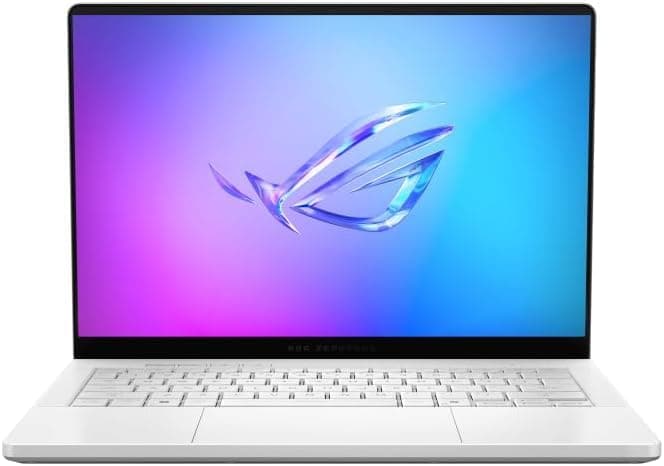
ASUS has been refining the ROG Zephyrus G14 formula for years, and the 2026 model represents the most complete version of that vision yet. Powered by Intel's new Core Ultra 9 386H processor (codenamed Panther Lake) and paired with NVIDIA's RTX 5070 Ti graphics, this 14-inch gaming laptop delivers desktop-class performance in a chassis that weighs just 3.5 pounds. The addition of a brighter OLED display with a 120Hz refresh rate, dramatically improved battery life, and a full-size SD card reader addresses the most common complaints about previous generations. But improvements come at a cost — literally — with the G14's price climbing to $3,199 for the RTX 5070 Ti configuration, making it one of the most expensive 14-inch gaming laptops on the market.
ASUS ROG Zephyrus G14 (2026) Review: Compact Gaming Power Refined
Design and Build Quality
The 2026 ROG Zephyrus G14 retains the same exterior design language that debuted with the 2024 model, and that's entirely fine. The all-aluminum chassis delivers a premium feel that rivals the build quality of Apple's MacBook Pro lineup, with precise tolerances and zero flex in the keyboard deck or lid. The lid features the now-signature slash lighting design — a diagonal array of mini-LEDs that can be customized through the Armoury Crate software to display animations, system metrics, or simply glow in your preferred color.
At 1.6 kilograms (3.5 pounds) and 16.3 millimeters thick, the G14 is remarkably portable for a laptop that packs a discrete RTX 5070 Ti GPU. It slides easily into a backpack sleeve and doesn't feel significantly heavier than a thin-and-light ultrabook. The Platinum White finish on the reviewed configuration resists fingerprints well, though the palm rest area will show wear over time with heavy use.
ASUS has made meaningful improvements to serviceability this generation. The bottom panel is secured by standard Phillips-head screws, and the previously glued magnetic covers for the SSD and Wi-Fi module are now held in place with proper screws. This makes upgrading storage or replacing the Wi-Fi card straightforward — a rarity in premium laptops in 2026, where soldered components and glued assemblies have become distressingly common.
Display: OLED Brilliance at 120Hz
The display is arguably the most impactful upgrade in the 2026 G14. The 14-inch ROG Nebula HDR OLED panel (similar to the ASUS ROG Swift OLED PG32UCDM3) runs at a 3K resolution (2880 by 1800 pixels) with a 120Hz refresh rate and a response time rated at 0.2 milliseconds. In SDR mode, the display averages around 508 nits of brightness, making it usable in well-lit environments and genuinely bright outdoor settings. HDR performance is where this panel truly shines, however — peak brightness reaches approximately 1,140 nits, which is sufficient for proper HDR content playback in games and streaming video.
Color coverage is exceptional. Notebookcheck's calibration measurements show 100 percent sRGB, 99.8 percent DCI-P3, and 94.1 percent AdobeRGB coverage, figures that rival professional-grade reference monitors. The display comes with factory-calibrated color profiles for both sRGB and DCI-P3, so creative professionals can trust the color accuracy out of the box. The Delta-E deviation of under 2 ensures that what you see on screen closely matches the intended output.
The 120Hz refresh rate strikes an excellent balance between fluidity and battery conservation. For gaming, 120Hz is noticeably smoother than 60Hz while being less demanding on the GPU than 240Hz panels found in some competitors. For everyday use, scrolling through documents and web pages feels silky smooth. The OLED panel's near-instantaneous response time eliminates motion blur entirely, making fast-paced games like Call of Duty and Overwatch 2 particularly enjoyable.
The only compromise is the glossy screen finish. While it enhances contrast and color saturation, reflections from overhead lighting and windows can be distracting in bright environments. The 500-nit SDR brightness helps mitigate this, but a matte option would have been welcome for users who work in variable lighting conditions.
Keyboard and Trackpad
ASUS has long produced some of the best laptop keyboards in the industry, and the G14's implementation reinforces that reputation. The keycaps feature 1.7 millimeters of travel — generous by modern ultrabook standards — with a crisp actuation and a satisfying bottom-out feel. The key spacing is comfortable for touch typing, and the single-zone RGB backlighting provides even illumination across four adjustable brightness levels. The keyboard deck shows minimal flex even during aggressive typing sessions.
The trackpad is large for a 14-inch laptop, measuring approximately 5.3 by 3.2 inches. The glass surface provides smooth tracking with consistent friction, and the integrated physical click mechanism offers a firm, reassuring feedback. Windows Precision Driver support ensures gesture recognition works reliably, with three-finger and four-finger gestures executing without the hit-or-miss behavior that plagued earlier Windows laptops.
Ports and Connectivity
The 2026 G14 offers the most comprehensive port selection in its class. The left side hosts a USB-C 4.0 port with Thunderbolt 4 support, capable of 40 Gbps data transfers, DisplayPort 2.1 output, and USB Power Delivery charging. A full-size HDMI 2.1 FRL port connects to external displays and TVs at up to 4K 120Hz without compression. The right side adds a USB-C 3.2 Gen 2 port, two USB-A 3.2 Gen 2 ports, and a headphone jack.
The inclusion of a full-size SD card reader (UHS-II, supporting transfer speeds around 182 MB/s) is a welcome addition that content creators will appreciate. Previous G14 models omitted this feature, requiring photographers and videographers to carry an external reader. Its return in the 2026 model suggests ASUS is listening to customer feedback.
Wireless connectivity is handled by Wi-Fi 7 and Bluetooth 5.4, ensuring compatibility with the latest routers and peripherals. The Intel BE200 module in the reviewed configuration delivered consistent throughput in testing, with no dropped connections during extended use.
Performance: The Intel Core Ultra 9 386H and RTX 5070 Ti
The Intel Core Ultra 9 386H processor represents a significant architectural leap for the G14 lineup. Built on the Panther Lake platform, this chip features a hybrid architecture with performance cores and efficiency cores that Intel claims deliver substantial generational improvements in both raw performance and power efficiency. In the G14, the CPU pairs with NVIDIA's RTX 5070 Ti laptop GPU, which features 12GB of GDDR7 memory and a configurable TGP ranging from 95 watts in Performance mode to 115 watts in Turbo mode.
CPU performance is excellent across both single-threaded and multi-threaded workloads. Cinebench R23 scores of approximately 2,012 points in single-core and over 19,000 points in multi-core place the G14 ahead of AMD's Ryzen AI 9 HX 370 in most benchmarks. The Panther Lake architecture's efficiency cores handle background tasks effectively, allowing the performance cores to focus on demanding applications like games and creative software.
Gaming performance is where the G14 truly distinguishes itself. At the native 3K resolution with high settings, Cyberpunk 2077 runs at approximately 77 frames per second in Turbo mode with DLSS enabled, while more competitive titles like Call of Duty and Overwatch 2 easily exceed 100 fps. The RTX 5070 Ti's 12GB of VRAM provides headroom for texture-heavy games at high resolutions, and ray tracing performance is strong enough to enable moderate ray-traced effects in supported titles.
The 3DMark Time Spy graphics score of 16,295 points confirms that the G14 delivers genuine desktop-replacement gaming performance in a portable form factor. The GPU's 115-watt Turbo mode provides a meaningful performance uplift over the 95-watt Performance mode, though the additional fan noise means most users will prefer the quieter setting for everyday gaming.
Thermal Management and Noise
ASUS has equipped the G14 with a sophisticated cooling system that includes dual Arc Flow fans, liquid metal thermal compound on the CPU, and a vapor chamber that covers both the CPU and GPU. The system is effective at managing thermals under sustained load, with CPU temperatures stabilizing around 85 degrees Celsius and GPU temperatures remaining below 80 degrees during extended gaming sessions. The vapor chamber design is particularly effective at spreading heat across a larger surface area, preventing localized hot spots that can cause thermal throttling even during marathon gaming sessions.
The fan noise profile is a mixed bag and deserves careful consideration depending on your use case. In Silent mode, the fans are barely audible at around 38 dB(A) even under light gaming loads, making the G14 suitable for use in quiet environments like libraries or coffee shops. Performance mode pushes noise to approximately 50 dB(A) — noticeable but tolerable with headphones, and perfectly acceptable in a dorm room or shared living space. Turbo mode pushes fans to 55.5 dB(A), which is loud enough to be heard through closed-back headphones and will be distracting for anyone in the same room. The reality is that most users will spend their time in Performance mode, which offers 95 watts of GPU power with manageable noise levels. Turbo mode is best reserved for short benchmarking sessions or moments when you need every frame you can get.
The fan curve is well-tuned by default, ramping up gradually rather than surging abruptly when a game launches. This prevents the jarring experience of sudden fan noise that plagues some competitors. In Armoury Crate, you can create custom fan curves that prioritize silence over thermals, though this will result in higher overall temperatures and potential performance throttling during extended gaming sessions.
The surface temperatures remain well-controlled, with the keyboard deck staying comfortably cool even during extended gaming sessions thanks to the keyboard's position away from the internal heat sources. The WASD cluster — the area most relevant for gamers — stays particularly cool, rarely exceeding 35 degrees Celsius during testing. The hottest points on the underside reach approximately 42 degrees Celsius, which is warm but not uncomfortable when using the laptop on a desk. Lap use is feasible for light tasks but not recommended during gaming due to the heat vented from the rear exhaust, which can become uncomfortably warm against bare skin.
Real-World Gaming and Workflows
Putting the G14 through its paces across a variety of modern titles reveals consistent performance that punches above the laptop's size class. In Cyberpunk 2077 at 3K resolution with the High preset and DLSS set to Balanced, the G14 maintains an average of 65 to 72 frames per second in the built-in benchmark, with frame times remaining consistent and no noticeable stuttering. Dropping the resolution to 1440p and enabling DLSS Performance mode pushes frame rates past 100 fps, making even the densest city environments feel fluid.
Competitive titles are where the G14's 120Hz OLED panel and capable GPU truly shine. Overwatch 2 runs at over 120 fps at native resolution with Epic settings, and Call of Duty Modern Warfare sits comfortably above 100 fps at high settings. The 0.2-millisecond response time of the OLED panel eliminates motion blur entirely, giving a tangible advantage in fast-paced shooters where every millisecond counts.
For content creation, the G14 handles video editing in DaVinci Resolve with ease, scrubbing through 4K timelines smoothly and rendering previews faster than many desktop workstations from just a few years ago. Blender renders complete in roughly half the time of the previous generation G14, and the 12GB of VRAM provides enough headroom for complex 3D scenes with high-resolution textures. The color-accurate OLED display means you can trust the grading decisions you make on the laptop without needing to dock it to an external monitor — a significant workflow advantage for traveling creative professionals.
Build Quality Comparison: Premium Laptop Standards
The G14's build quality invites direct comparison with the Razer Blade 14 and Apple MacBook Pro 14, both of which set high bars for laptop construction. The all-aluminum chassis matches the Razer's build quality while offering a more refined aesthetic that doesn't scream "gamer" in professional settings. The hinge mechanism is smooth and stable, holding the display firmly at any angle without wobble.
The 2026 model benefits from ASUS's continued refinement of the chassis design rather than a ground-up redesign. This means the fit and finish have been polished over multiple generations, resulting in consistent panel gaps, solid button feel, and a rigidity that inspires confidence when carrying the laptop in a backpack. The Platinum White finish shows some discoloration on the palm rest after extended use, which is a minor durability concern for such an expensive device.
Speakers and Audio
The G14's speaker system is among the best available on any laptop, regardless of category. The quad-speaker setup, tuned in collaboration with Dolby Atmos, delivers clear, well-separated audio with surprising bass response for a laptop of this size. Dialogue in movies remains clear, music sounds full and detailed, and gaming audio provides effective spatial awareness for footsteps and environmental cues.
The integrated microphone array handles voice chat and calls competently, with effective background noise suppression that filters out keyboard noise and ambient sounds. The 1080p IR webcam provides adequate image quality for video calls, with support for Windows Hello facial recognition for password-free login. The image quality won't impress anyone accustomed to modern smartphone cameras, but it's serviceable for Teams and Zoom meetings.
Battery Life: A Dramatic Improvement
The most surprising aspect of the 2026 G14 is its battery life, which represents a generational leap over previous models. In Notebookcheck's standardized Wi-Fi web browsing test at 150 nits of brightness, the Intel-powered G14 lasted approximately 14 hours and 24 minutes — a 37 percent improvement over the 2025 AMD model's 10.5 hours. At maximum brightness, runtime drops to approximately 8.3 hours, which is still competitive for a gaming laptop.
These numbers transform the G14's usability as a daily driver. Previous generations required carrying the bulky 250-watt power adapter for anything beyond a few hours of use. The 2026 model can comfortably handle a full workday of productivity tasks on a single charge, making it viable as a primary laptop for users who need gaming performance during evenings and weekends without sacrificing all-day battery life for work.
The 73 watt-hour battery charges via the included 250-watt barrel plug adapter or through USB-C Power Delivery at up to 100 watts. USB-C charging is slower but convenient for topping up during the day without carrying the large power brick.
Software and Bloatware
The G14 ships with Windows 11 Pro and the Armoury Crate software suite for system management. Armoury Crate provides control over performance modes, fan curves, GPU settings, and lighting effects. The software has improved significantly in recent years and is now reasonably lightweight, though it still runs background processes that some users may prefer to disable.
ASUS includes approximately 500MB of pre-installed software beyond Armoury Crate, including a trial of McAfee antivirus and some ASUS-branded utilities. The bloatware is less aggressive than in previous generations but still present — a clean Windows installation will reclaim some storage space and reduce background processes.
How the Zephyrus G14 Compares to Competitors
The 14-inch gaming laptop segment has become increasingly competitive in 2026. The Razer Blade 14 offers comparable build quality with a slightly thinner chassis, but starts at a similar price point with an RTX 5070 configuration. The Lenovo Legion Pro 7i Gen 10 provides good performance at a lower price, but compromises on display quality and battery life.
The AMD-powered variant of the G14 itself offers an alternative for users who prefer Team Red, with the Ryzen AI 9 HX 370 delivering competitive CPU performance at a slightly lower price point. The Intel variant reviewed here edges ahead in single-threaded performance and battery life, making it the better choice for users who prioritize all-day endurance alongside gaming capability.
The most direct competitor is the upcoming Alienware x14 R3, which will feature similar specifications but with Dell's premium support and Alienware's distinctive design language. Based on early reviews, the G14 holds an edge in display quality and battery life, while the Alienware offers a more distinctive aesthetic and slightly better serviceability.
Who Should Buy the ASUS ROG Zephyrus G14
The 2026 ROG Zephyrus G14 is an exceptional laptop for a specific type of buyer: the gamer or creative professional who needs desktop-class performance in a portable, premium package. The combination of the Intel Core Ultra 9 386H and RTX 5070 Ti delivers genuine high-refresh-rate gaming at 3K resolution, while the OLED display provides color accuracy that rivals professional monitors.
Students who split their time between gaming and productivity will appreciate the improved battery life, which now approaches all-day usability. Creative professionals working with video editing, 3D rendering, or photo processing will find the GPU performance and color-accurate display valuable for on-the-go work. Travelers who want a single laptop for both work and play will appreciate the 3.5-pound weight and comprehensive port selection.
The price is the most significant barrier. At $3,199 for the tested configuration, the G14 costs more than many full-size gaming laptops with higher-performing GPUs. The premium is justified by the build quality, display, and portability, but budget-conscious buyers should consider the G14's AMD variant or the previous-generation 2025 model, which remains available at a meaningful discount.
Final Thoughts
The ASUS ROG Zephyrus G14 (2026) refines an already exceptional gaming laptop into something approaching perfection. The brighter OLED display, dramatically improved battery life, and thoughtful quality-of-life improvements like the SD card reader and easier serviceability address the most common criticisms of previous generations. The Intel Core Ultra 9 386H and RTX 5070 Ti deliver performance that comfortably exceeds what was possible in a 14-inch chassis just two years ago.
The high price and aggressive fan noise under full load are the trade-offs, but they're reasonable ones for a laptop that packs this much capability into such a portable package. For gamers and creators who value portability without compromising on performance, the 2026 ROG Zephyrus G14 is the best 14-inch gaming laptop money can buy. The all-day battery life transforms what was once a compromise machine into a viable primary laptop for professionals who game after hours. It's expensive, loud under load, and the glossy display won't suit everyone — but in every area that matters for a portable gaming machine, it sets a new standard that competitors will struggle to match throughout 2026 and into 2027.
Pros
- Bright 120Hz OLED display with exceptional HDR and color accuracy
- Dramatically improved battery life (14+ hours) for a gaming laptop
- Premium all-aluminum build with refined design language
- Comprehensive port selection including Thunderbolt 4 and SD card reader
- Best-in-class keyboard with 1.7mm travel and comfortable key spacing
Cons
- Very expensive at $3,199 for the RTX 5070 Ti configuration
- Fan noise is aggressive under full gaming load (55 dB(A) in Turbo)
- Glossy display causes reflections in bright environments
- Previous generation 2025 model offers similar performance for less
Final Verdict
The 2026 ROG Zephyrus G14 combines Intel's Core Ultra 9 processor with NVIDIA RTX 5070 Ti graphics, a stunning 120Hz OLED display, and dramatically improved battery life in a premium 14-inch chassis — though the $3,199 price tag limits its audience.