Marshall Emberton III Review: Style Meets Substance in a Portable Speaker
The Marshall Emberton III delivers clearer, more balanced sound, a built-in microphone, Bluetooth 5.3 with LE Audio, and longer battery life in the same iconic design that made the series a favorite.
Marshall has carved out a distinctive niche in the portable Bluetooth speaker market by doing something that few competitors even attempt: making a speaker that looks as good as it sounds. The Marshall Emberton III continues this tradition with the company's iconic amp-inspired design, but beneath that familiar exterior lies a thoroughly updated speaker that addresses many of the limitations of its predecessors. The third-generation Emberton brings a dramatically more powerful amplifier section, a newly added microphone for hands-free calls, Bluetooth 5.3 with LE Audio and Auracast support, improved battery life, and a refined acoustic tuning that prioritizes clarity and detail. After spending extensive time with the Emberton III, testing it across various environments and music genres, I can say that Marshall has delivered the most complete version of this speaker yet.
Design and Build Quality
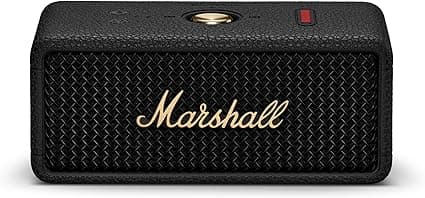
The Marshall Emberton III is immediately recognizable as a Marshall product. It retains the rectangular, rock-and-roll-inspired design language that made the original Emberton stand out in a sea of cylindrical and pill-shaped Bluetooth speakers. The iconic Marshall logo in its burnished golden finish sits prominently on the front grille, framed by the familiar diamond-patterned grille cloth that evokes the look of vintage guitar amps.
At 160 by 76.9 by 68 millimeters and 670 grams, the Emberton III is slightly thicker than its predecessor but actually a touch lighter, dropping from 700 grams to 670. The weight reduction comes from refinements in the internal components and materials, and it makes the speaker feel more portable without sacrificing any of the solid, premium heft that characterizes Marshall products.
The build quality is excellent. The silicone body has a new, smoother texture that feels less rubbery and more refined than the Emberton II. It still provides plenty of grip and impact protection, but it picks up less lint and dust. The front grille is metal, and the top panel features a new dedicated power button alongside the familiar multifunction joystick control. The joystick handles play, pause, track skipping, and volume adjustment with the same satisfying analog feel that Marshall users have come to appreciate.
A new addition is the carry loop integrated into the top corner of the speaker. It is a reinforced loop designed for attaching a wrist strap, though Marshall does not include a strap in the box. The loop is sturdy and gives you a place to attach a carabiner or a third-party strap if you want one. It is a small but welcome addition that improves the speaker's portability.
The Emberton III carries an IP67 rating, which means it is fully dust-tight and can survive immersion in up to one meter of water for thirty minutes. This is the same rating as the Emberton II, and it remains competitive for this class of speaker. It is not as extreme as the IP68 rating on the JBL Charge 6, but it is more than adequate for beach trips, poolside use, and outdoor adventures.
Sustainability
Marshall has made a significant effort to improve the environmental credentials of the Emberton III. The speaker is made from 79 percent recycled plastic, up from 50 percent in the Emberton II. The packaging is completely plastic-free and made from FSC-certified paper. The speaker itself is PVC-free. These are meaningful steps toward sustainability, and it is good to see a major brand taking this seriously without compromising on build quality or aesthetics.
Sound Quality
The sound quality of the Emberton III represents the biggest departure from its predecessor. Where the Emberton II was known for its fun, bass-forward sound signature, the Emberton III takes a more mature, balanced approach that prioritizes clarity and detail over sheer impact.
The audio hardware consists of two 2-inch full-range drivers and two passive radiators, driven by amplifiers that have been dramatically upgraded to 38 watts per channel — a significant increase from the 10 watts per channel in the Emberton II. This extra power translates to approximately 6 decibels of additional headroom, which means the Emberton III can play significantly louder without distortion.
The default sound signature is rich and satisfying with a noticeable midrange focus. Vocals are the standout feature of the Emberton III's sound. They are clear, present, and natural, with excellent definition and texture. Instruments are well separated, and complex arrangements remain coherent even at higher volumes. The midrange clarity is a genuine step up from the Emberton II, and it makes the speaker particularly enjoyable for vocal-centric genres like folk, singer-songwriter, indie rock, and acoustic performances.
Bass is present but not dominant. The Emberton III has less bass punch and impact than the Emberton II, which is a deliberate trade-off for improved clarity. The low end provides a solid foundation for the music without overwhelming the mids and highs. If you place the speaker in a corner of a room, the bass response gets a noticeable boost from boundary reinforcement, which can satisfy those who want more low-end weight. But if you are looking for a speaker that delivers chest-thumping bass out of the box, the Emberton III may not be the right choice.
High frequencies are well extended and crisp without being harsh. Treble detail is good, with cymbals and high-hats having the right amount of shimmer and decay. The overall tonal balance is much more even than the Emberton II, and the speaker rewards careful listening with detail that cheaper speakers obscure.
The Emberton III uses Marshall's True Stereophonic technology, which delivers consistent audio from any direction around the speaker. The sound dispersion is genuinely 360-degree, and the speaker sounds essentially the same from the front, back, and sides. However, this is not true stereo separation — it is mono with very wide dispersion. The stereo effects come from above the speaker rather than from the sides, which creates a sense of space but not the kind of left-right imaging you get from a pair of speakers. At higher volumes, the sides are slightly weaker than the front and back, but the overall coverage is excellent for a single-box speaker.
The speaker includes three EQ presets accessible through the Marshall Bluetooth app: Marshall (the default signature), Push (which adds bass boost), and Voice (which optimizes for spoken word content). The Push preset adds noticeable low-end weight but cuts into the lower mids, which can make the sound a bit less natural. The Voice preset is useful for podcasts and audiobooks.
Battery Life and Charging
Marshall claims up to 32 hours of battery life for the Emberton III, up from 30 hours in the Emberton II. In real-world testing at moderate volume levels, the speaker lost approximately two to three percent of battery per hour, which makes the 32-hour claim realistic for typical usage. If you push the volume higher, battery life will be shorter, but you can still expect a full day of playback on a single charge.
Charging has been improved significantly. A full charge from empty takes about two hours, down from three hours in the Emberton II. A 20-minute quick charge provides approximately six hours of playback, which is a meaningful increase from the four hours offered by the Emberton II's quick charge feature.
The Marshall Bluetooth app includes a Battery Preservation mode that limits the maximum charge to 95 percent, which extends the long-term lifespan of the lithium-ion battery. There is also an option to slow down the charging speed for the same purpose. These are thoughtful additions that show Marshall is thinking about longevity.
Connectivity
Bluetooth has been upgraded to version 5.3 with LE Audio support. This brings improvements in connection stability, range, and power efficiency. The Emberton III supports SBC and AAC codecs, which covers the majority of smartphones and music sources. AAC performance on iPhones is excellent, with stable connections and good audio quality.
Multipoint Bluetooth is supported, allowing you to connect two devices simultaneously and switch between them seamlessly. I tested this with an iPhone and a MacBook, and switching playback between the two was smooth and automatic. The speaker remembers paired devices across power cycles, which makes reconnection quick and hassle-free.
The major connectivity upgrade is Auracast support. Auracast is a new Bluetooth standard that allows you to broadcast audio from one source to multiple Auracast-compatible speakers simultaneously. It replaces the Stack feature from the Emberton II, which allowed linking multiple Emberton speakers for synchronized playback. Auracast has the potential to be more versatile, but the ecosystem is still in its early stages. Currently, only a limited number of devices support broadcasting audio over Auracast, and it is not yet clear how broadly compatible the feature will be across different brands and devices.
The Emberton III does not include a 3.5-millimeter auxiliary input, which is a notable omission for a speaker at this price point. Anyone who wants to connect a device without Bluetooth — such as a monitor, an older MP3 player, or a turntable — will need to use a Bluetooth transmitter or look elsewhere.
Microphone and Speakerphone
One of the most welcome additions to the Emberton III is a built-in microphone for hands-free calling. This was a feature missing from the Emberton II, and its inclusion here brings the speaker in line with most competitors at this price point. The microphone quality is good for a Bluetooth speaker. Callers reported that I sounded clear and natural, with minimal background noise pickup. The speaker handles the audio side of calls well, with clear voice reproduction.
The microphone is also useful for voice assistants. You can trigger Siri or Google Assistant through the speaker, and the microphone picks up your voice reliably from a reasonable distance.
Marshall Bluetooth App
The Marshall Bluetooth app is straightforward but basic. It offers three EQ presets, battery level information, battery preservation settings, firmware updates, and the ability to manage Auracast connections. The app design is clean and matches Marshall's aesthetic, but it lacks some features that competitors offer.
Notable omissions include the inability to manage paired Bluetooth devices from the app, even though the hardware supports multipoint. There is also no way to reassign the battery level indicator — the speaker has LED dots that show battery level on startup, but there is no option to use them as a volume indicator instead. And there is no noise reduction or mic settings for the built-in microphone.
Comparison to Competitors
The Emberton III competes in the premium portable Bluetooth speaker category, where it goes up against the JBL Charge 6, the Bose SoundLink Flex, and the Sonos Roam 2.
Against the JBL Charge 6 at $159.95, the Emberton III at $129.99 is the more affordable option. The Charge 6 offers deeper bass, higher maximum volume, USB-C hi-res audio, and a power bank feature. The Emberton III counters with a more distinctive design, better midrange clarity, a speakerphone, and a smaller, lighter form factor. If you prioritize design and vocal clarity, the Emberton III is the better choice. If you want maximum bass and volume, the Charge 6 wins.
Against the Bose SoundLink Flex at around $149, the Emberton III offers longer battery life, a more distinctive design, and Auracast support. The SoundLink Flex has better bass for its size and a more robust feature set in the app. Both speakers have excellent build quality, and the choice comes down to whether you prefer Marshall's vintage-inspired design or Bose's more utilitarian approach.
Against the Sonos Roam 2 at $159, the Emberton III offers longer battery life and a lower price. The Roam 2 has Wi-Fi connectivity and Sonos multi-room support, which the Emberton III lacks. For Sonos ecosystem users, the Roam 2 is the obvious choice. For standalone Bluetooth use, the Emberton III is the better value.
What Could Be Better
The Emberton III is an excellent speaker, but it has areas where improvement would be welcome. The lack of an auxiliary input limits connectivity options for devices without Bluetooth. The app is basic and lacks features that competitors offer, such as the ability to manage paired devices or customize the LED indicator behavior. The Auracast implementation is still early and not yet as useful as the older Stack feature was for multi-speaker setups. And the buttons on the top panel are quite small and difficult to distinguish by touch, especially in low light.
The bass performance, while improved in clarity, is less fun and punchy than the Emberton II. This is a deliberate tuning choice, and many listeners will prefer the more balanced sound. But anyone who bought the Emberton II specifically for its bass-heavy character may find the Emberton III less satisfying. The lack of an included carry strap is a minor annoyance — the loop is there, but you have to provide your own strap.
Should You Buy the Marshall Emberton III?
The Marshall Emberton III is the best-sounding and most feature-complete portable speaker Marshall has ever made. It improves on the Emberton II in every meaningful area: more power, better clarity, longer battery life, a dedicated power button, a microphone for calls, and Bluetooth 5.3 with LE Audio and Auracast. The design remains as iconic as ever, and the build quality is excellent.
The Emberton III is best suited for listeners who prioritize vocal clarity, balanced sound, and distinctive design over maximum bass output. It is an excellent choice for anyone who wants a portable speaker that looks as good on a shelf as it sounds at the park. It is less ideal for bass heads who want maximum low-end impact, anyone who needs an auxiliary input for wired connections, or users who want robust multi-speaker features through the app.
Who Is the Marshall Emberton III For?
The Marshall Emberton III is for the listener who values design and personality in their tech products. It is for someone who wants a portable speaker that makes a style statement as much as it delivers quality audio. It is for the person who listens to a wide range of music and wants clarity and balance rather than exaggerated bass. It is for the outdoor enthusiast who needs a rugged, waterproof speaker that does not look like a rugged, waterproof speaker. It is for the person who takes calls on their speaker and wants a built-in microphone that actually works well.
The Emberton III is less ideal for the bass enthusiast who wants maximum low-end thump from a compact speaker. It is not the best choice for someone who needs multi-room Wi-Fi audio integration since it is Bluetooth-only. It is not for the budget-conscious buyer who wants the absolute cheapest speaker with decent sound, and it is not for anyone who relies on an auxiliary input for wired connections to older devices.
Real-World Testing
I used the Marshall Emberton III in a variety of settings to understand how it performs outside of a controlled listening environment. At a weekend picnic with friends, the speaker sat in the center of a picnic blanket and provided clear, room-filling audio for a group of five. The 360-degree sound dispersion meant that everyone around the blanket heard the same level of audio regardless of where they were sitting. The IP67 rating gave me confidence when a sudden light drizzle started — I simply wiped the speaker dry and kept the music going.
During a day of remote work, I used the Emberton III as a desktop speaker for both music and conference calls. The built-in microphone handled voice calls admirably, with callers reporting that I sounded clear and natural. The speaker's balanced sound profile made it pleasant to listen to for extended periods, and the battery showed only about 15 percent depletion after a full workday of moderate-volume playback.
For evening listening, the Emberton III works well as a bedside or living room speaker. At moderate volumes, it delivers enough detail to make music enjoyable without being intrusive. The app's Battery Preservation mode is a thoughtful addition for anyone who plans to keep the speaker plugged in most of the time — it extends battery lifespan by limiting the maximum charge, which is the kind of feature that shows Marshall is thinking about long-term ownership.
Comparison to the Emberton II
If you own the Emberton II and are considering an upgrade, the question is whether the improvements justify the cost. The Emberton III brings three major upgrades over the Emberton II: significantly more amplifier power, a built-in microphone, and Bluetooth 5.3 with LE Audio and Auracast. The sound signature is also notably different — more balanced and clearer, but less fun and bass-forward.
For Emberton II owners who are happy with their speaker's sound and do not need a microphone or the latest Bluetooth features, the upgrade is not essential. The Emberton II remains a capable speaker that sounds great in its own right. But for anyone who wants better clarity, the ability to take calls, or the latest connectivity standards, the Emberton III is a meaningful step forward.
Final Thoughts
The Marshall Emberton III is a thoughtful evolution of a speaker that was already excellent. It takes the iconic design that made the Emberton series a favorite and refines the experience with better sound, longer battery life, a microphone, and modern connectivity. The sound tuning is more mature and balanced than the Emberton II, trading some bass excitement for clarity, detail, and vocal presence that make it a more versatile all-around speaker.
The areas where it could improve are mostly minor: the lack of an auxiliary input, the basic app, the omission of an included wrist strap, and the still-evolving Auracast ecosystem. None of these are deal-breakers, and they do not detract from the overall quality of the product.
At $129.99, the Marshall Emberton III offers a compelling combination of style, performance, and durability that is hard to find elsewhere in the portable Bluetooth speaker market. It is a speaker that you will want to display on your shelf, grab on your way out the door, and rely on for clear, balanced sound wherever you go. If that sounds like the kind of speaker you are looking for, the Emberton III is an easy pick.
Related: JBL Charge 6 Review · Samsung Galaxy Buds 4 Pro Review · JBL Flip 7 Review
Pros
- Clear, balanced sound with excellent vocal detail
- Iconic Marshall design with premium build quality
- Built-in microphone for hands-free calls
- 32+ hour battery life with fast charging
- IP67 dust and water resistance
- Bluetooth 5.3 with LE Audio and Auracast
Cons
- Bass less punchy than Emberton II
- No 3.5mm auxiliary input
- No included carry strap
- Basic companion app with limited features
Final Verdict
The Marshall Emberton III delivers clearer, more balanced sound, a built-in microphone, Bluetooth 5.3 with LE Audio, and longer battery life in the same iconic design that made the series a favorite.