Marshall Milton A.N.C. Review: The On-Ear ANC Headphones That Redefine a Forgotten Category
Marshall's Milton A.N.C. delivers adaptive noise cancellation, LDAC, and an absurd 80-hour battery in a compact foldable on-ear design at $230 — the premium on-ear pair to beat in 2026.
Marshall has spent the last few years proving it can make speakers that look as good as they sound, but its headphone strategy has been curiously conservative. The Major line has been the brand's on-ear workhorse since 2017, the Monitor line its over-ear flagship, and for a long time that was the whole story. The Marshall Milton A.N.C. changes that. It is the first serious attempt by the iconic amp maker to take on the premium on-ear ANC category, and it arrives at $230 (list price $279.99) with a feature list that reads like a flagship: adaptive noise cancellation, up to 80 hours of battery life, LDAC support, spatial audio, and a companion app that reviewers keep calling one of the best in the business. Engadget scored it 8/10 and called it "category-defining," which is strong praise for a segment that most headphone brands have quietly abandoned.
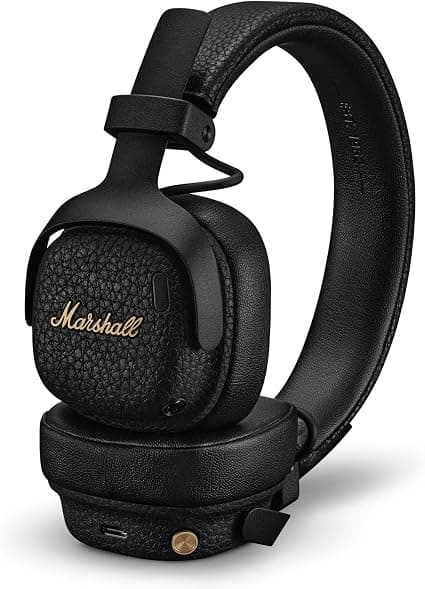
The Milton sits between the Major and Monitor lines both in size and ambition — Marshall calls it the "third pillar" of its headphone range. It takes the compact on-ear form factor of the Major V, dresses it in the design language of the Monitor (gold logo motif, rounded edges, metal headband details), and then stuffs it with the most feature-dense package Marshall has ever shipped in a headphone. The result is a pair that does something almost nobody else is doing right now: taking on-ear headphones seriously. Here is the full breakdown of what the Milton A.N.C. gets right, where it falls short, and who should actually buy it.
A New Pillar in the Marshall Lineup
Understanding the Milton requires understanding the gap it fills. Marshall's Major V is a beloved budget on-ear with 100+ hours of battery but no noise cancellation. The Monitor III A.N.C. is a full-size over-ear flagship with excellent ANC but a bulkier footprint and a higher price. Between them sat a hole: people who wanted the compact, lightweight on-ear form factor with the convenience of active noise cancellation, without stepping up to a big over-ear pair.
The Milton A.N.C. fills that hole, and it does so with a design that Marshall describes as the Monitor "squashed into the shape and size of the Major." Engadget's reviewer coined the term "undermiliar" — understated plus familiar — to describe the aesthetic, and it fits. The gold Marshall logo sits on each ear cup in the classic script, the headband carries the rounded metal details of the Monitor line, and the signature tolex-like textured finish mimics the vinyl covering of Marshall's guitar amps. It is unmistakably a Marshall product, which is exactly the point. The on-ear form factor keeps it compact, and the cups fold flat for travel, so this is a pair that lives comfortably in a backpack pocket or a jacket.
Build quality is solid for the price. The headband is sturdy with a metal core, the adjustment sliders are firm and positive, and the synthetic leather on the cups and headband feels premium without pretending to be real leather. Marshall also deserves credit for repairability: the ear pads are user-replaceable, and — more unusually — so is the battery. A user-replaceable cell in a wireless headphone is almost unheard of at this price, and it means the Milton is a pair you can realistically own for a decade rather than replacing every two years when the lithium cell degrades.
Comfort and Fit: The On-Ear Question
The biggest question anyone has about the Milton is the one that applies to all on-ear headphones: will it be comfortable for long sessions? On-ear designs rest the cushions directly on your ears rather than around them, which means weight and clamp force matter enormously. Marshall has kept the Milton light — it comes in well under a pound — and the cushions are plush enough that the pressure distributes evenly rather than concentrating on the cartilage.
Engadget's reviewer, who wore the Milton through gym sessions, street commutes, and full workdays, came away impressed, noting that comfort was a genuine strength. The on-ear fit also has a practical advantage: it runs cooler than most over-ear pairs, because there is less heat trapped around your ears. For people who find big over-ear headphones sweaty or claustrophobic, the Milton is a genuinely more comfortable daily companion.
The trade-off is the one inherent to the category: an on-ear seal is never as complete as an over-ear seal, and that affects both noise cancellation and bass response. Marshall mitigates the bass issue with a tuning that is deliberately bass-forward, and the ANC with an adaptive system that works harder to compensate. It is not the same experience as a great over-ear pair, but for the target audience — commuters, students, travelers who hate bulky headphones — it is a trade most will happily make.
Noise Cancellation: Best-in-Class for Its Form Factor
The Milton's ANC is the feature that turns skeptics into believers. Engadget tested it against a busy road and found it eliminated constant city traffic and engine noise almost completely, calling it "probably some of the best I've experienced on this style of headphone." That is a meaningful statement, because on-ear ANC has historically been a compromise category — brands skimped on the mic arrays and DSP because they assumed buyers of compact headphones would not care.
Marshall did not skimp. The Milton uses adaptive noise cancellation that continuously samples the environment and adjusts the cancellation curve, plus a transparency mode that lets the world back in when you need to hear a train announcement or order a coffee. There is also an ANC-off mode for battery maximization, and the left-ear cup has a customizable button you can assign to cycle ANC modes — one of several controls you can reconfigure in the app.
The honest caveat is that the Milton cannot match the sheer stillness of a top-tier over-ear pair like the Sony WH-1000XM6 or the Bose QuietComfort Ultra. Engadget's reviewer noted that the on-ear form factor's weaker physical seal lets a bit of ambient "vibe" through, and that the Milton lacks the hard-to-quantify sense of calm that the best over-ear ANC delivers. What it does deliver is a level of quiet that would have been impossible to find in an on-ear pair two years ago — and for most everyday environments, it is more than enough. The Reddit reaction from early owners echoes the reviewers: ANC is "quite impressive considering they are on ear," with the caveat that conversational noise at close range is where on-ear ANC always struggles.
Sound Quality: The Marshall Signature, Dialed In
The Milton sounds like a Marshall, which is a specific and beloved flavor. The tuning is bass-forward with a scooped midrange — the classic rock-and-roll voicing that makes guitars snarl and kick drums punch. It is fun, lively, and energetic rather than neutral or analytical, and it flatters the pop, rock, hip-hop, and electronic music that most listeners actually stream. Engadget's reviewer praised the balance even at maximum volume: bass never gets overcooked, and female vocals, hi-hats, and highs never turn shrill or sibilant.
The drivers are 32mm with a 32-ohm impedance, a sensible pairing for a portable pair that needs to work efficiently from a phone. Wireless playback supports LDAC for high-resolution audio on Android, plus the standard AAC and SBC codecs — notably, there is no aptX support, which is a non-issue for iPhone users and a mild annoyance for Android users on aptX-only devices, though LDAC covers most high-res Android scenarios. Engadget flagged the missing aptX as a con, and it is a fair point, but LDAC's presence softens the blow considerably.
If the default tuning is not to your taste, the Milton's app gives you the tools to fix it — more on that in a moment. There is also an Adaptive Loudness feature that keeps the frequency balance consistent as you change volume, so the pair does not lose its bass at low levels or get harsh at high ones. It works in the background and you will barely notice it, which is exactly the point.
The one sound-quality weakness reviewers consistently mention is dynamic range. On complex electronic productions, the Milton compresses the gain staging slightly, so layers sit "a bit closer together" than on a more resolving pair like the Sennheiser HDB 630. It is the kind of difference you only notice in an A/B comparison, and it is a fair price to pay for the Marshall tuning's liveliness.
Call Quality and Everyday Use
For a pair that will spend a lot of time on commutes and in shared spaces, the Milton's microphone performance matters as much as its music playback, and it holds up well. The microphone array is tuned for voice pickup with background-noise suppression, and early owner reports and reviewer tests agree that callers can hear you clearly even in moderately noisy environments — a bus, a coffee shop, a windy street. It is not a dedicated headset-grade boom mic, and if you take calls in genuinely chaotic environments all day, a pair like the Yealink or Jabra office headsets will do better, but for the typical mix of phone calls, video meetings, and voice notes, the Milton is more than adequate. The multipoint Bluetooth connection handles the classic phone-plus-laptop pairing smoothly, switching audio sources as calls start and stop, and the Bluetooth 6.0 radio (with LE Audio support) gives the pair a strong, stable range indoors.
The in-box experience is refreshingly complete. Marshall includes the USB-C to 3.5mm analog cable, a USB-C charging cable, and a soft carry pouch, plus the usual documentation and a quick-start guide that actually gets you paired in under a minute. There is no hard-shell case in the box — the foldable design is meant to live loose in a bag — but the cups fold flat and the headband tucks in, so the pair takes up barely more space than a paperback book. Charging is via USB-C, and while Marshall does not publish an exact fast-charge figure, the battery is large enough that a full charge from empty takes a couple of hours and a short top-up covers days of use. Between the replaceable cell, the foldable build, and the 80-hour battery ceiling, the Milton is about as low-maintenance as a wireless headphone gets.
Battery Life: The Number That Embarrasses Everyone Else
Here is where the Milton humiliates the rest of the category: up to 50 hours of playback with ANC on, and up to 80 hours with ANC off. Those are not typo numbers. Fifty hours with ANC is more than double the Sony WH-1000XM6's 36 hours, nearly triple the Bose QuietComfort Ultra's 24 hours, and roughly four times the AirPods Max 2's battery. Engadget's real-world test ran more than a week of daily use — gym, street, work, ANC on almost continuously — and the pair still had about 10 percent remaining on the first charge.
The long battery is not just a convenience; it changes how you treat the product. A pair that lasts two weeks of commutes does not need a nightly charging ritual, does not need a charging case, and does not need to be babied on trips. For travelers, the Milton is effectively a "charge it before the trip, forget about it" device. And because the battery is user-replaceable, the longevity story extends for years — when the cell finally degrades after several hundred cycles, you replace it instead of the whole headphone.
The one quirk to know about: wired playback requires the headphones to be powered on. The Milton ships with a USB-C to 3.5mm cable, and it works for connecting to in-flight entertainment or a laptop — but if the battery is dead, the cable alone will not save you, because the DSP and amplifier need power. That is a real (if minor) limitation compared to pairs that support true passive listening, and it is worth knowing before you pack it for a long flight.
The App: Marshall's Secret Weapon
Marshall's companion app is the sleeper hit of this product. Engadget called it "maybe the best I've ever used" — not faint praise from a reviewer who has seen every headphone app in the industry — and the depth of control is genuinely unusual for the price.
The home screen puts ANC control front and center, with toggles for ANC, transparency, and off, plus a deeper ANC level configuration that lets you fine-tune the cancellation strength. The EQ section offers presets and fully custom curves, and Marshall's implementation is clean enough that you can actually hear what each adjustment does. There is an Adaptive Loudness toggle, a power-off timer configurable from immediate sleep to eight hours, and battery preservation tools that limit the maximum charge and slow charging speed to extend cell life — the same philosophy Apple builds into the iPhone.
Two features deserve special mention. The first is Auracast support: the Milton can discover and join Bluetooth broadcast streams through the app, which means it is ready for the emerging world of public Auracast audio — airport announcements, museum guides, gym TVs. The second is device tracking: the Milton supports both Apple Find My and Google's Find Hub, with in-app setup guidance. If you have ever watched a pair of headphones disappear into the couch cushions forever, this is the feature that saves you $230.
There is also Spotify Tap — a double-click on the M button that jumps straight into your personalized music suggestions — and the customizable left-ear button can be assigned to ANC toggling, EQ switching, Soundstage, or a voice assistant. Marshall also added Soundstage, its spatial audio implementation, which simulates room speakers rather than in-head sound. It is a distinctive take on virtual surround — some listeners love the room-like presentation, others find it pushes the drums and bass down too far. It is free to try, easy to turn off, and a nice differentiator in a category where spatial audio is increasingly table stakes.
Marshall Milton A.N.C. vs the Competition
The Milton's natural rivals are the other premium on-ear options and the budget over-ear crowd, and it compares well against both.
Against the Beats Solo 4, which sells for roughly the same $230 and has been the default premium on-ear for years, the Milton wins on almost every spec that matters: it has ANC (the Solo 4 has none), it has a user-replaceable battery, it has LDAC, and it has a dramatically better app. The Solo 4 counters with Apple's H1-class integration and the Beats brand cachet, but as Engadget put it, "Beats has been charging that for its Solo 4 without ANC for long enough that a little bit of competition from the Milton is probably a good thing." Our Beats Solo 4 review covers the incumbent if you want the full comparison.
Against the JBL Live 780NC, the closest budget over-ear ANC option at around $160, the Milton is pricier but delivers a more distinctive design, superior battery life, and the app experience. The JBL is the value pick; the Milton is the one you will want to be seen wearing. We covered the JBL's strengths in our JBL Live 780NC review.
Against over-ear flagships, the Milton is honest about being a different animal. The Sony WH-1000XM6 and the Bose QuietComfort Headphones (2nd Gen) — which we reviewed at launch this week — both deliver more complete noise cancellation and more resolving sound, but they are heavier, bulkier, and pricier. If you are deciding between an over-ear flagship and the Milton, the question is really about form factor: do you want the maximum quiet, or do you want headphones you can forget you are wearing? The Milton is the best argument yet that you can have the latter without giving up ANC.
And against the Sennheiser Momentum 5 Wireless at $399, the Milton undercuts it by $170 while matching its user-replaceable battery trick and exceeding its battery life — though the Momentum 5's over-ear ANC and more neutral tuning remain compelling if your budget stretches. Our Sennheiser Momentum 5 Wireless review has the details.
Who Should Buy the Marshall Milton A.N.C.
The Milton is the right pair for a specific and surprisingly large group of people:
- Commuters who want effective ANC without carrying a bulky over-ear rig on a train or bus every day.
- Students who need a pair that survives back-to-back lecture days, a week of study sessions on a single charge, and the occasional flight home.
- Travelers who hate checking a headphone case and want a foldable pair that disappears into a backpack.
- Marshall fans — and there are a lot of them — who want the brand's iconic look in a headphone that finally has the features to match the aesthetic.
- Anyone who is tired of replacing headphones every two years because the battery dies; the user-replaceable cell is a genuine long-term-ownership argument.
- Android users who will take advantage of LDAC and the deep app customization.
Who Should Look Elsewhere
- If noise cancellation is your absolute top priority and you want the quietest possible room, buy an over-ear flagship like the Bose QuietComfort Headphones (2nd Gen) or the Sony WH-1000XM6 instead — on-ear ANC has a physical ceiling.
- If you are an iPhone user who lives in the Apple ecosystem, the AirPods Max 2 and Beats options integrate more seamlessly, and the missing aptX is irrelevant to you anyway.
- If you need true passive wired listening with a dead battery, look elsewhere — the Milton requires power even in wired mode.
- If you want a neutral, analytical sound signature for critical listening, the Marshall tuning (bass-forward, mid-scooped) is the wrong flavor, though the EQ can get you closer than you might expect.
The Bottom Line
The Marshall Milton A.N.C. is the rare headphone that invents a category position and then defends it immediately. There has not been a serious premium on-ear ANC pair worth recommending in years — the segment was left to the ANC-less Beats Solo and a scattering of budget also-rans — and Marshall has walked in and delivered one with flagship-level features: best-in-class-for-the-form-factor ANC, an absurd 50-to-80-hour battery, a user-replaceable cell, LDAC, a genuinely excellent app, and the best-looking headphone design in the category. It is not the quietest pair you can buy, and the bass-forward tuning will not please purists, but for the commuter, traveler, or student who wants real noise cancellation in a compact, foldable, long-lasting package, the Milton is the pick of 2026. At $230 — or $229.99 on Amazon right now — it is also fairly priced for what it delivers. You can check current pricing on Amazon, and if you have been waiting for someone to make on-ear ANC worth buying again, this is the pair that finally does it.
Pros
- Best-in-class ANC for an on-ear design
- Massive 50-80 hour battery with user-replaceable cell
- Excellent companion app with EQ, Auracast, and Find My
- Comfortable, foldable, and genuinely stylish
Cons
- On-ear ANC can't match flagship over-ears
- Wired playback requires power
- No aptX support
- Bass-forward tuning won't suit purists
Final Verdict
Marshall's Milton A.N.C. delivers adaptive noise cancellation, LDAC, and an absurd 80-hour battery in a compact foldable on-ear design at $230 — the premium on-ear pair to beat in 2026.