Sonos Ace Review: First-Generation Headphones with Premium Ambition and Smart Features
The Sonos Ace offers premium build quality, excellent battery life, and the unique TV Audio Swap feature for Sonos soundbar owners — but shallow ear cups and a mediocre carrying case hold it back from greatness.
Sonos has been synonymous with multi-room audio for nearly two decades. From the iconic Play:5 to the Arc soundbar that anchors countless home theaters, the brand has built a reputation for premium sound quality and seamless ecosystem integration. With the Sonos Ace, the company is making its long-awaited entry into the personal audio space — and the result is a compelling first attempt that gets many things right while leaving clear room for improvement.
I've been using the Sonos Ace as my primary headphones for two weeks, testing them across commutes, work calls, late-night listening sessions, and even a couple of long-haul flights. Here's my comprehensive take on whether Sonos's first headphones are worth your attention in 2026.
Design and Build Quality
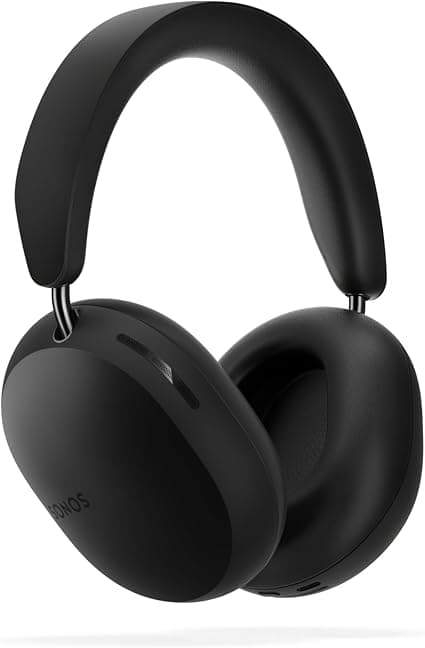
The Sonos Ace makes a strong first impression. The design language is unmistakably Sonos — clean, minimalist, and understated in a way that feels premium without being flashy. The matte plastic ear cups are smooth to the touch and resist fingerprints well, while the stainless steel headband provides a solid, confidence-inspiring structure. Available in black and white, both colors look elegant and professional.
At 312 grams, the Sonos Ace is significantly lighter than the Apple AirPods Max (385 grams) and comparable to the Sony WH-1000XM6 (254 grams). The weight distribution is excellent — I wore them for a four-hour flight without any discomfort, and they didn't create any noticeable pressure points on the crown of my head. The memory foam ear cushions are plush and covered in soft vegan leather that feels pleasant against the skin.
However, there's one comfort consideration: the ear cups are somewhat shallow. If you have larger ears, you might find that your ears touch the inside of the cups, which can become uncomfortable over extended periods. This is a known issue that several reviewers have noted, and it's something to be aware of if you have particularly large ears. For average-sized ears, the fit is comfortable and the clamping force is just right — secure without being tight.
The carrying case is one area where Sonos made a noticeable compromise. It's made of a felt-like material that doesn't offer much impact protection compared to the hard-shell cases that come with the Sony WH-1000XM6 or the AirPods Max's Smart Case. The zipper feels adequate but not premium, and the case doesn't have any internal padding beyond the felt itself. If you plan to travel frequently with these headphones, you'll want to handle the case with care or invest in a third-party hard case.
Controls and Software
The Sonos Ace uses a combination of physical buttons and a slider switch for controls, and I have to say — this is one of the best control schemes I've used on any pair of headphones. The Content Key is a slider on the right ear cup that handles volume (slide up/down), playback (single press), track skipping (double/triple press), and TV Audio Swap (long press). It's intuitive, responsive, and much more reliable than touch-sensitive controls that can misfire when you're adjusting your headphones.
The Noise Control button on the left ear cup toggles between ANC and Aware (transparency) modes. It has a satisfying click and is easy to find by touch. A long press activates your voice assistant.
Setting up the headphones through the Sonos app is straightforward, though I appreciate that you can use them without the app if you prefer. The app gives you access to firmware updates, EQ adjustments, and the TV Audio Swap feature. The EQ is disappointingly basic — just bass and treble sliders with no mid-range control. For a company that prides itself on sound quality, this feels like a significant oversight. The app's functionality is also limited to Bluetooth connections; you can't adjust EQ or settings when the headphones are connected via USB-C.
The TV Audio Swap feature is the Sonos Ace's party trick. If you have a compatible Sonos soundbar (currently Arc and Arc SL only), you can press and hold the Content Key to instantly transfer the TV audio from your soundbar to your headphones. The transition takes about two seconds and works reliably within a range of roughly four meters through walls. It's genuinely useful for late-night viewing when you don't want to disturb others, and it works with any audio source connected to your TV — streaming apps, gaming consoles, cable boxes — since the audio is routed from the soundbar rather than the source device.
Sound Quality
The Sonos Ace features 40mm custom-designed drivers, and the sound quality is ... complicated. On one hand, there's a lot to like. The soundstage is wide and immersive, particularly with Dolby Atmos content. The bass is punchy and extends deep, making electronic music and action movie soundtracks exciting to listen to. The treble has good detail retrieval, and cymbals and hi-hats have appropriate sparkle.
However, the default frequency response tuning has some quirks that may not appeal to everyone. The sub-bass (20-30Hz) and upper bass (50-175Hz) are both emphasized, which gives music a warm, weighty character but can become fatiguing over long listening sessions. More importantly, there's a notable dip in the mid-range around 1.25-2kHz that reduces the presence and clarity of vocals and string instruments. This is particularly noticeable on acoustic tracks and spoken word content, where voices can sound slightly recessed or muffled.
The treble region has an emphasis around 5-8kHz that adds detail but can make cymbals and high-frequency content sound slightly harsh at higher volumes. It's not unpleasant, but it's not as refined as the tuning on the Sony WH-1000XM6 or the Sennheiser Momentum 4.
There's also a significant caveat: the Sonos Ace's sound signature changes dramatically when you turn ANC off. With ANC disabled, the bass response drops off considerably, and the headphones sound thin and anemic. According to SoundGuys' measurements, the overall sound quality score drops from 4.3 to much lower without ANC. This means you're essentially locked into using ANC whenever you want to listen to music — not ideal for situations where you want to conserve battery or don't need noise cancellation.
Dolby Atmos performance is genuinely impressive. The head tracking is responsive and creates a convincing sense of spatial audio that surpasses the Sony WH-1000XM6's 360 Reality Audio implementation. The Sonos Ace supports Dolby Atmos with dynamic head tracking out of the box, and it works with any content that supports the format. The spatial audio experience is comparable to Apple's Spatial Audio on the AirPods Max, which is high praise.
Active Noise Cancellation
The ANC on the Sonos Ace has improved significantly since launch thanks to firmware updates. At launch, the noise cancellation was merely average for the premium segment. With the latest firmware (v3.9.7), the ANC is competitive with the top tier — achieving around 88% isolation against transit and plane noise. That's close to the Sony WH-1000XM6 and Bose QuietComfort Ultra 2, though not quite at the very top of the class.
Against low-frequency noise like airplane engine hum and air conditioning, the ANC is very effective. Against higher-frequency noises like human voices and keyboard clatter, it's good but not exceptional — some noise bleeds through that the Sony and Bose handle better.
The Aware Mode (transparency) is good for a first-generation product. Voices sound natural and clear, and ambient sounds are reproduced without obvious processing artifacts. However, there's no adjustable ambient level — you get what you get — and there's a slight hiss in very quiet environments that some users may find distracting. The leakage compensation mode is a nice touch — it adjusts the ANC to maintain performance when wearing glasses or when your hair breaks the seal of the ear pads.
One issue I noticed is that the ANC performance is somewhat inconsistent depending on fit. If the headphones shift slightly on your head, the ANC effectiveness can vary noticeably. This isn't unique to the Sonos Ace — all ANC headphones are somewhat dependent on fit — but it seems more pronounced here than on competing products.
Microphone Quality
The Sonos Ace uses eight beamforming microphones (four per ear cup) for call quality and ANC. In practice, call quality is very good indoors. My voice came through clearly to callers, and background noises like keyboard typing and office chatter were effectively suppressed. Outdoors, the aggressive noise suppression can occasionally cause my voice to sound slightly choppy when there's strong wind, but overall, the microphone performance is competitive with other premium wireless headphones.
The eight-microphone array also enables a feature that Sonos calls "voice beamforming" — it focuses on capturing your voice while rejecting ambient noise. In my testing, this worked well in moderately noisy environments like a coffee shop. In very noisy environments like a busy street, callers reported that my voice was still understandable but had a slightly processed quality to it.
Battery Life
Battery life is one of the Sonos Ace's strongest features. Sonos advertises 30 hours of playback with ANC on, and in my testing, I consistently got between 30 and 35 hours depending on volume levels. That's better than the AirPods Max (20 hours), on par with the Sony WH-1000XM6 (30 hours), and competitive with the Bose QuietComfort Ultra 2 (26 hours).
In SoundGuys' standardized battery test, the Sonos Ace achieved 32 hours and 13 minutes with ANC on — an excellent result. The fast charging is also impressive: a three-minute charge provides three hours of playback, which is perfect for those "I forgot to charge" moments before a commute.
The USB-C charging port is standard, and the headphones support charging while in use, which is essential for long listening sessions or gaming sessions.
Connectivity
The Sonos Ace supports Bluetooth 5.4 with SBC, AAC, and aptX Lossless via Snapdragon Sound. The aptX Lossless support is a significant advantage for audiophiles with compatible source devices — it delivers CD-quality audio over Bluetooth, which neither the AirPods Max nor the AirPods Pro 3 can match.
Multipoint Bluetooth supports two simultaneous connections, which works well for juggling a phone and laptop. The switching is fast and reliable — I could seamlessly switch from music on my phone to a Zoom call on my laptop without any manual intervention.
Wired listening is supported via USB-C to USB-C or USB-C to 3.5mm, and both cables are included in the box. The USB-C connection delivers high-resolution audio without any compression, making the Sonos Ace a viable option for desktop use with a computer or with a high-quality DAC.
However, there's no support for Wi-Fi audio streaming directly from services like Spotify or Tidal. Given that this is a Sonos product, the absence of Wi-Fi streaming feels like a missed opportunity. You'd think a company built on wireless multi-room audio would include Wi-Fi connectivity in its headphones, but the Sonos Ace is Bluetooth-only for music streaming. The only Wi-Fi-related feature is the TV Audio Swap, which uses Wi-Fi to connect to your Sonos soundbar.
Comfort for Long Sessions
I mentioned the ear cup depth earlier, and it's worth discussing comfort in more detail because it's a make-or-break factor for premium headphones. The memory foam padding is excellent — dense enough to provide support without being hard, and plush enough to feel luxurious. The vegan leather covering is smooth and doesn't cause heat buildup as quickly as some other materials.
For glasses wearers, the clamping force is light enough that the headphones don't press your glasses into your temples, but substantial enough that the headphones stay in place when you move your head. This is a delicate balance that many headphones get wrong, and Sonos deserves credit for getting it right.
However, the shallow ear cups remain a concern. After about three hours of continuous wear, I started to feel the memory foam pressing against my ears. This isn't painful, but it's noticeable and requires a brief break to reset. If you have average-sized or small ears, you may not have this issue at all.
Competitor Comparison
The premium wireless headphone market in 2026 is more competitive than ever, and the Sonos Ace faces formidable rivals. Here's how it stacks up against the three main competitors.
vs. Sony WH-1000XM6: The Sony WH-1000XM6 remains the king of the hill for most people. Sony's ANC is marginally better, the sound quality is more balanced and refined, the ear cups are deeper and more accommodating, and the carrying case is a proper hard-shell design. The Sony also includes useful features like Speak-to-Chat, adaptive sound control, and a more comprehensive EQ in the app. The Sonos Ace fights back with better physical controls (Sony's touch panel can be finicky), superior spatial audio with Dolby Atmos head tracking, and the TV Audio Swap feature. At its discounted price of $279, the Sonos Ace is significantly cheaper than the Sony's $399 MSRP, which makes it a compelling value proposition for budget-conscious buyers.
vs. Apple AirPods Max (USB-C): The AirPods Max is showing its age — the design hasn't changed significantly since 2020, the Lightning port was only recently replaced with USB-C, and the battery life at 20 hours is the worst in the premium segment. However, Apple's ecosystem integration is unmatched: seamless switching between Apple devices, Siri integration, and spatial audio that works system-wide. The Sonos Ace is lighter, has better battery life, supports more Bluetooth codecs including aptX Lossless, and costs about the same or less. For iPhone users deeply invested in the Apple ecosystem, the AirPods Max remains a strong contender, but for everyone else, the Sonos Ace offers a more modern and versatile package.
vs. Bose QuietComfort Ultra 2: Bose's premium headphones are the ANC champions. The QC Ultra 2 offers marginally better noise cancellation than anything else on the market, including the Sonos Ace. Bose's CustomTune technology automatically adjusts ANC based on your environment, and the sound signature is well-balanced with excellent clarity across the frequency range. The Bose are also more comfortable for larger ears with deeper ear cups. The Sonos Ace counters with better battery life (32 hours vs. 26 hours), superior spatial audio for Dolby Atmos content, and the unique TV Audio Swap feature. At $279 (discounted), the Sonos Ace is also significantly more affordable than the Bose QC Ultra 2 at $429.
Long-Term Durability and Firmware Updates
One of Sonos's strengths as a company is its commitment to long-term software support. The Sonos Ace has already received several significant firmware updates since launch, including the major v3.9.7 update that dramatically improved ANC performance. This track record suggests that the Ace will continue to improve over time, much like Sonos speakers have received new features years after their initial release.
However, there are durability concerns. The lack of an IP rating means these headphones aren't designed for workouts or use in rain. The felt carrying case provides minimal protection compared to competitors. And the plastic construction, while premium-feeling, may not hold up as well over years of use as the metal build of the AirPods Max.
Who Is This Headphone For?
After spending extensive time with the Sonos Ace, I've developed a clear picture of who should buy them and who should skip them.
The Sonos Ace is ideal for:
- Sonos ecosystem owners: If you already have a Sonos Arc or Arc SL soundbar, the TV Audio Swap feature alone justifies the purchase. Being able to switch from the soundbar to headphones for late-night viewing without disturbing others is genuinely transformative.
- Dolby Atmos fans: If you actively seek out spatial audio content on Apple Music, Tidal, or Amazon Music, the Sonos Ace's head tracking implementation is among the best available.
- Comfort seekers who value lightweight design: At 312 grams, these are significantly lighter than the AirPods Max and comfortable for extended wear (provided your ears fit).
- Value-conscious buyers: At the current street price of $279, the Sonos Ace offers premium build quality, excellent battery life, and competitive performance at a significant discount to its original $449 MSRP.
The Sonos Ace is NOT ideal for:
- Audiophiles seeking reference sound: The Sony WH-1000XM6 and Sennheiser Momentum 4 offer more balanced, detailed sound signatures.
- Frequent travelers who need maximum ANC: The Bose QuietComfort Ultra 2 blocks more noise.
- Gym-goers or runners: The lack of an IP rating and the fabric ear cup material make these unsuitable for workouts.
- People with larger ears: The shallow ear cups can be a dealbreaker.
A Note on Value in 2026
The Sonos Ace launched at $449 in June 2024, which was a tough sell given the competition. In 2026, with the price having settled to around $279 at major retailers like Amazon, the value proposition has shifted dramatically. At $279, the Sonos Ace competes not with the premium flagships but with the upper mid-range — and in that context, it's an exceptional value.
You're getting premium build quality, best-in-class battery life, excellent physical controls, good ANC, and a genuinely useful ecosystem feature (TV Audio Swap) at a price that undercuts the Sony WH-1000XM6 by $120 and the Bose QC Ultra 2 by $150. The main compromises — the shallow ear cups, the mediocre carrying case, and the basic app EQ — are easier to accept at this price point.
Final Thoughts
The Sonos Ace represents a promising first step into the headphone market from a company that understands audio. The build quality is excellent, the controls are thoughtful and intuitive, the battery life leads the premium segment, and the Dolby Atmos spatial audio implementation is genuinely impressive. The TV Audio Swap feature, while currently limited to two soundbar models, is a genuinely useful differentiator that adds real value for Sonos ecosystem users.
The sound quality is good but not great, the ANC is competitive but not class-leading, and the shallow ear cups and flimsy case are real compromises. At the original $449 price, these shortcomings were hard to overlook. But at $279, the Sonos Ace is a compelling option that offers a excellent blend of premium design, useful features, and solid performance.
For Sonos ecosystem users, the Sonos Ace is an easy recommendation. For everyone else, it's worth a serious look — especially if you can find it at the discounted price. Just make sure your ears aren't too large before you buy.
Related: Bose QuietComfort Ultra Headphones (2nd Gen) Review · Bowers & Wilkins PX8 S2 Review · Sony WF-1000XM6 Review
Pros
- Excellent physical controls with intuitive slider and buttons
- Best-in-class battery life at 32+ hours with ANC
- Premium build quality with lightweight 312g design
- Impressive Dolby Atmos spatial audio with head tracking
- Unique TV Audio Swap feature for Sonos soundbar owners
Cons
- Shallow ear cups uncomfortable for larger ears
- Fragile felt carrying case offers minimal protection
- Basic EQ with no mid-range adjustment
- Sound quality clearly changes with ANC off
- No IP rating for workouts or weather resistance
Final Verdict
The Sonos Ace offers premium build quality, excellent battery life, and the unique TV Audio Swap feature for Sonos soundbar owners — but shallow ear cups and a mediocre carrying case hold it back from greatness.