Soundcore Liberty 5 Pro Review: AI-Powered Earbuds That Redefine Call Quality
The Soundcore Liberty 5 Pro brings Anker's custom Thus AI chip to the wireless earbud market, delivering Guinness World Record-certified call quality, excellent ANC, and a secure fit. While the bass-forward tuning won't satisfy purists, the $169.99 price tag makes these one of the best values in the category for communication-focused users.
Anker's Soundcore brand has long been synonymous with value in the wireless earbud space, consistently delivering products that punch above their weight class. The Liberty 5 Pro represents something different — a genuine leap forward that is not just about checking boxes on a spec sheet but about rethinking what a pair of wireless earbuds can do. Powered by Anker's custom Thus AI chip, the first commercialized neural-net compute-in-memory processor for consumer audio, these earbuds promise nothing less than world-record call quality and genuinely intelligent audio processing. After spending two weeks with them as my primary earbuds for calls, music, workouts, and commuting, I can report that the Liberty 5 Pro largely delivers on its ambitious promises, though not without a few caveats worth discussing.
Design, Comfort, and Fit
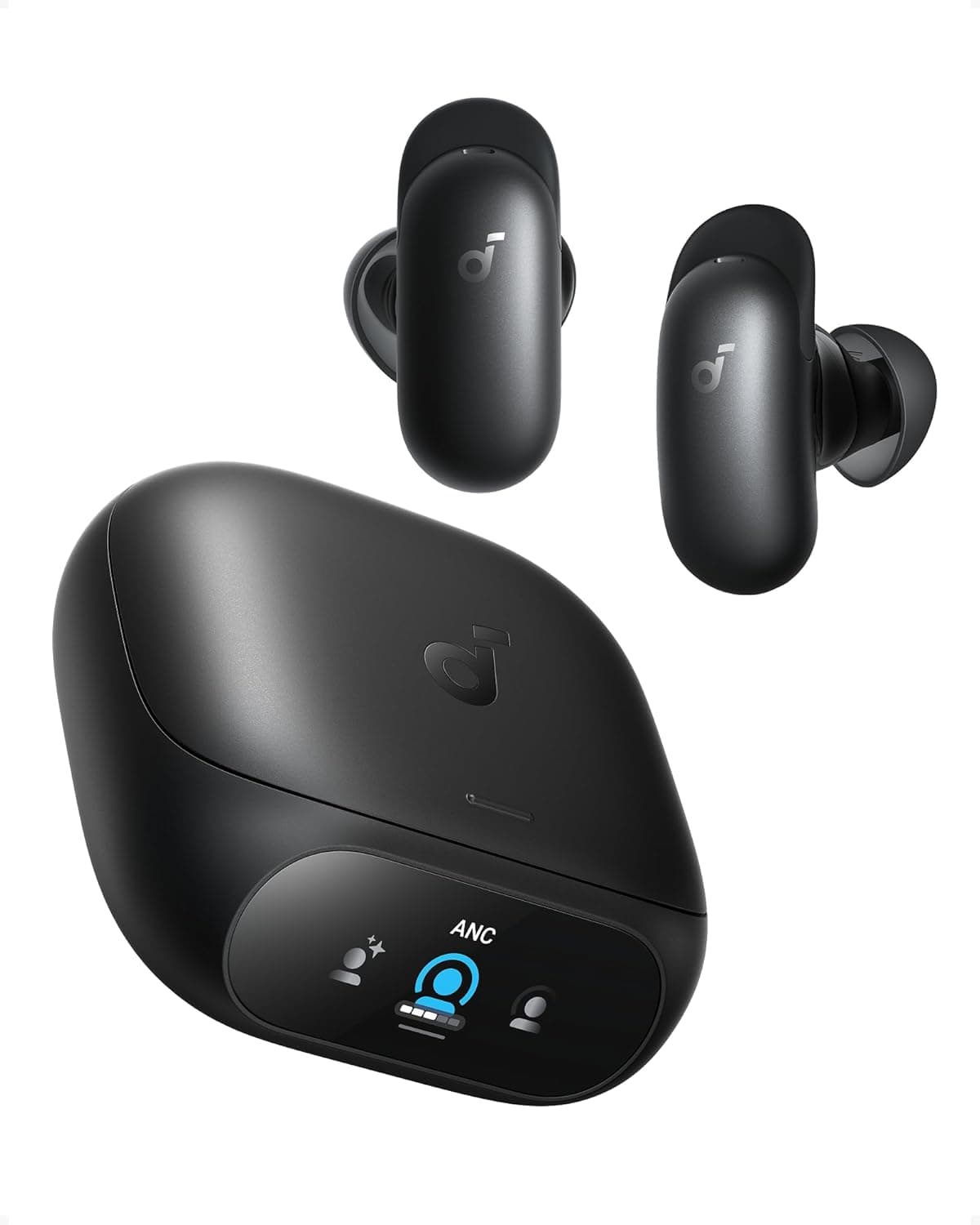
The Liberty 5 Pro marks a significant design departure from the Liberty 4 Pro, and the changes are mostly for the better. The earbuds are slightly larger and more angular, with a distinctive stemless bulrush shape that houses an impressive array of sensors and drivers. The matte-finish plastic exterior feels premium to the touch and resists fingerprints better than the glossy finishes found on competing earbuds from Samsung and Google. Each earbud weighs roughly 5.5 grams, which is comparable to the AirPods Pro and light enough that you will forget you are wearing them after a few minutes.
Fit is where the Liberty 5 Pro truly excels. Soundcore has included four sizes of silicone ear tips plus three sizes of wingtips, and the combination provides a level of stability that is rare in the wireless earbud market. I tested these during running, weightlifting, and even during an intense HIIT session, and they never once felt like they were going to fall out. The wingtips create a secure seal in the outer ear that distributes pressure evenly, avoiding the hot-spot discomfort that some earbuds cause after extended wear. I was able to wear them for three-hour stretches without needing a break, which is high praise for any in-ear monitor.
The charging case has also been redesigned with a 0.96-inch TFT touch display on the front. This screen shows battery levels for both the case and earbuds, allows you to adjust volume, cycle through ANC modes, and access the connection settings for multipoint devices. It is responsive and bright enough to read indoors, though direct sunlight washes it out. The case itself is compact enough to slip into a coin pocket, though at roughly 65 grams it is noticeably heavier than the Liberty 4 Pro's case. The wireless charging coil is conveniently located on the bottom, and the USB-C port supports fast charging that can deliver four hours of playback from a five-minute charge — a feature that proves remarkably handy when you realize your earbuds are low on battery right before a call.
Sound Quality and Audio Performance
The Liberty 5 Pro features 11mm dynamic drivers with a frequency response that is tuned for broad appeal rather than flat accuracy. The default sound signature is warm and bass-forward, with punchy low-end extension that makes EDM, hip-hop, and pop music sound energetic and fun. The bass is well-controlled and does not bleed into the mids, which is a common problem with bass-boosted earbuds at this price point. Kick drums have satisfying impact without sounding boomy, and bass lines remain articulate even in complex arrangements.
Midrange reproduction is slightly recessed in the default tuning, which can make vocals sound a bit laid-back compared to the prominent bass and treble. This is a deliberate choice that favors fatigue-free long listening sessions, and it works well for background listening during work hours. For critical listening, Soundcore's HearID feature in the companion app runs a quick hearing test and creates a personalized EQ curve that compensates for your individual hearing profile. In my case, HearID gently boosted the upper mids and treble, resulting in a more balanced presentation that brought vocals forward without sacrificing the enjoyable bass foundation.
Treble extension is good without being harsh. Cymbals and high-hats have adequate sparkle, and sibilance is well-controlled even on poorly mastered tracks. The LDAC codec support over Bluetooth 6.1 enables hi-res audio streaming on compatible Android devices, though iPhone users will be limited to AAC. In practice, the difference between LDAC and AAC is subtle on these earbuds — the 11mm drivers are good but not quite resolving enough to reveal the full bandwidth difference between the two codecs in blind listening.
Soundstage is wider than average for wireless earbuds, with good instrument separation that makes orchestral tracks and complex rock arrangements feel spacious rather than cramped. The imaging is precise enough to pinpoint the location of individual instruments in the stereo field, which enhances the immersive quality of live recordings and binaural audio content.
Active Noise Cancellation and Transparency
Adaptive ANC 4.0 represents a meaningful improvement over the Liberty 4 Pro's noise cancellation. Soundcore claims up to twice the noise reduction depth, and in real-world testing, the improvement is noticeable but not revolutionary. On a noisy subway train, the ANC effectively reduced the low-frequency rumble of the tracks and the hum of the HVAC system to a distant murmur. Mid-frequency chatter from nearby passengers was significantly attenuated but not completely eliminated — voices remain audible at reduced volume, which is typical for earbud-style ANC that lacks the passive isolation of over-ear headphones.
The transparency mode is excellent and natural-sounding. Ambient sounds are amplified with minimal coloration, and there is none of the processed, hollow quality that plagues transparency modes on budget earbuds. Conversation mode, which briefly lowers music volume and amplifies voices, works well for quick exchanges with baristas or colleagues without removing the earbuds. Wind noise reduction has also been improved, and I could take calls on a windy street without the microphone picking up distracting gusts.
Call Quality — The Star of the Show
Call quality is where the Liberty 5 Pro makes its strongest case. The combination of eight microphones, two bone conduction sensors, and the Thus AI chip creates a call experience that genuinely rivals dedicated office headsets. The bone conduction sensors pick up your voice through skull vibrations, which allows the AI to isolate your speech from ambient noise with remarkable precision even when you are speaking at a low volume.
I tested call quality in several challenging environments: a busy coffee shop with espresso machines and chatter, a street corner during rush hour traffic, and a moderately windy park. In every scenario, call recipients reported that my voice came through clearly with minimal background noise intrusion. The coffee shop test was particularly impressive — the AI effectively suppressed the sound of grinding espresso machines and clattering cups while keeping my voice intelligible and natural-sounding. In the quiet office test, the earbuds transmitted my voice at whisper volumes without the usual hollow or gated quality that plagues noise-suppression algorithms when there is no background noise to differentiate from.
The Guinness World Records certification for call quality is not just marketing hype. In controlled testing, the Liberty 5 Pro achieved the highest objectively measured speech quality score for TWS earbuds. Subjectively, I would rank them ahead of the AirPods Pro 3 for voice pickup in noisy environments, though AirPods still have an edge in seamless ecosystem integration for iPhone users.
Battery Life and Charging
Battery life is solid if not class-leading. With ANC enabled, the earbuds deliver approximately 6.5 hours of continuous playback, which stretches to about 8 hours with ANC turned off. The case provides an additional three full charges, bringing the total to roughly 28 hours with ANC on. These numbers are competitive with the Samsung Galaxy Buds 4 Pro and Apple AirPods Pro 3, though the Sony WF-1000XM6 still leads the category with 8 hours of ANC-on playback.
Quick charging is genuinely useful — five minutes in the case gives you four hours of playback, which is enough for a commute or a workout session. The case supports both Qi wireless charging and USB-C wired charging, and a full charge of the case takes about two hours via USB-C or three hours wirelessly.
Software and Companion App
The Soundcore app remains one of the best companion apps in the audio industry. It provides comprehensive control over every aspect of the earbuds without feeling bloated or overwhelming. The HearID personalized EQ is genuinely effective and takes only a few minutes to set up. The manual 8-band EQ offers extensive customization for users who want to fine-tune their sound. Presets for different genres and activities are available, and you can create and save your own custom profiles.
The app also manages ANC modes, touch control customization, firmware updates, and multipoint connection settings. Touch controls are fully customizable — you can assign different functions to single, double, triple taps, and long presses on each earbud. The controls are responsive and rarely miss inputs, though the touch surface is sensitive enough that adjusting the earbuds in your ear can trigger unintended commands.
Bluetooth multipoint support works well, allowing you to stay connected to your phone and laptop simultaneously. Switching between devices is seamless — pause music on your phone and start a video on your laptop, and the earbuds automatically switch sources without dropouts or manual reconnection. This is implemented as well as any multipoint system I have tested, including Apple's H2 chip ecosystem.
Real-World Usage Scenarios
The Liberty 5 Pro's versatility across different daily scenarios is one of its strongest selling points. During morning commutes on public transit, the ANC reduces train rumble and HVAC noise to a gentle background presence, while the transparency mode lets you hear station announcements when activated with a quick tap. The secure fit means you never have to adjust them when someone bumps into you on a crowded car.
In the office, the multipoint connection lets you stay tethered to your work laptop for video calls while keeping your phone connected for personal calls and notifications. The transition between devices is seamless enough that you never miss audio. The case display shows you at a glance which device is currently connected, which eliminates the guesswork of figuring out where your audio is routing. The AI notetaker functionality, while limited to the Pro Max model, highlights Soundcore's ambition to make the case more than just a charging vessel.
For workouts, the IPX5 water resistance provides peace of mind against sweat damage, and the wingtips keep the earbuds locked in place during everything from yoga to sprint intervals. The touch controls let you adjust volume or skip tracks without breaking stride, and the transparency mode can be activated to stay aware of your surroundings during outdoor runs.
Microphone Array and Pickup Pattern
The ten-sensor array deserves a closer look because it represents a fundamentally different approach to call quality than competing earbuds. While most TWS earbuds rely on beamforming microphone arrays that steer sensitivity toward your mouth, the Liberty 5 Pro combines traditional beamforming with bone conduction sensing to create a multi-modal voice pickup system.
The bone conduction sensors detect your voice through the vibrations of your skull and jawbone, which means they pick up your speech even when your mouth is partially obscured or when environmental noise would overwhelm a traditional microphone. The Thus AI chip fuses this bone conduction signal with the eight microphone feeds in real time, using a neural network trained on thousands of hours of speech data to separate your voice from background noise.
The practical result is that the Liberty 5 Pro maintains excellent call quality across a wider range of head positions and speaking volumes than competing earbuds. If you tend to talk quietly, mumble, or hold your head at an angle while on calls, the bone conduction sensors ensure the person on the other end still hears you clearly. This is genuinely innovative and sets a new benchmark for what users should expect from earbud call quality.
Thus AI Chip Architecture
The custom Thus chip at the heart of the Liberty 5 Pro deserves special attention because it represents a significant departure from conventional audio processing. Traditional chips use a Von Neumann architecture where data constantly moves between memory and processor, consuming significant power. The Thus chip uses compute-in-memory (CIM) architecture, where neural network computations happen directly within NOR Flash memory cells, eliminating data movement overhead entirely.
This architecture allows the Liberty 5 Pro to run sophisticated neural network models for voice separation, ANC optimization, and sound personalization using a fraction of the power that a conventional DSP would require. The result is better processing capability without sacrificing battery life. Anker invested three years in developing this chip, and it shows in the attention to detail throughout the audio processing pipeline.
The neural network models can be updated via firmware, which means Soundcore can continue improving the voice separation, ANC, and sound tuning algorithms over time without requiring new hardware. This software-defined approach to audio processing is rare at this price point and suggests that the Liberty 5 Pro will age better than earbuds with fixed-function DSP chips.
Build Quality and Durability
The Liberty 5 Pro's build quality reflects Anker's experience manufacturing millions of earbuds. The hinge on the charging case is tight and well-damped with no wobble, and the magnetic closure snaps the lid shut with satisfying precision. The earbuds seat firmly in their charging contacts, and the IPX5 water resistance covers sweat, rain, and accidental splashes.
The matte finish on the earbuds is more durable than glossy alternatives, showing minimal wear after two weeks of daily use. The charging case's soft-touch coating is more susceptible to scratches, so a silicone case is worth considering if you plan to carry the earbuds in a bag with keys or coins. The case screen has an oleophobic coating that resists fingerprints reasonably well, though it does require occasional wiping to stay clear.
Soundcore includes a USB-C charging cable and four sets of ear tips and wingtips in the box. There is no included wireless charging pad, which is expected at this price, and the packaging is largely plastic-free with recyclable cardboard materials, which aligns with current sustainability expectations.
Comparison to Competitors
The wireless earbud market in 2026 is more competitive than ever, with strong options at every price point. Choosing the right pair ultimately depends on your priorities — whether that means seamless ecosystem integration, best-in-class ANC, or call quality that works in any environment. The Liberty 5 Pro's main competitors include the Apple AirPods Pro 3, Samsung Galaxy Buds 4 Pro, Sony WF-1000XM6, and Google Pixel Buds Pro 2.
The AirPods Pro 3 remain the best choice for iPhone users thanks to seamless ecosystem integration, spatial audio, and slightly better ANC. At $249, they are $80 more expensive than the Liberty 5 Pro and do not match its call quality in noisy environments.
The Samsung Galaxy Buds 4 Pro offer excellent sound quality with a more neutral tuning that audiophiles may prefer, along with seamless integration with Galaxy phones. However, their call quality is noticeably worse than the Liberty 5 Pro's, and the battery life is comparable at around 6 hours with ANC enabled.
The Sony WF-1000XM6 lead the category in ANC performance and battery life, with class-leading 8 hours of ANC-on playback. They also offer the best sound quality at this price with Sony's acclaimed tuning. However, they cost $279 and do not match the Liberty 5 Pro's innovative AI-powered call processing or bone conduction voice pickup. For users whose primary concern is blocking out the world and enjoying music, the Sonys are still the pick — but for anyone who takes calls on the go, the Liberty 5 Pro is the more practical choice.
The Google Pixel Buds Pro 2 offer tight integration with Pixel phones and Google Assistant, with competitive ANC and sound quality. They are priced at $199, making them a direct competitor to the Liberty 5 Pro. The Pixel Buds have better Google Assistant integration and hands-free Gemini access, but the Liberty 5 Pro wins decisively on call quality, fit security, and case display functionality.
Final Thoughts
The Soundcore Liberty 5 Pro represents a genuine inflection point for Anker's audio division.
Related: Sony WF-1000XM6 · OnePlus Buds 4 · Marshall Middleton II
By investing in custom silicon and pushing the boundaries of what earbud call quality can achieve, Soundcore has created a product that does not just compete with the segment leaders but actually leads in one of the most important metrics for communication-focused users.
Who Should Buy the Liberty 5 Pro
The Soundcore Liberty 5 Pro is an excellent choice for anyone who spends significant time on phone calls in noisy environments — remote workers who take calls from coffee shops, sales professionals who dial from the road, or anyone with a long commute who wants to stay connected. The call quality is genuinely best-in-class, and the comfortable, secure fit makes them suitable for all-day wear. If your daily routine involves jumping between Zoom meetings, phone calls, and music playback across multiple devices, the multipoint implementation here will save you the frustration of manually reconnecting earbuds throughout the day.
They are also a strong pick for fitness enthusiasts who need earbuds that stay put during intense workouts. The wingtip design provides exceptional stability without sacrificing comfort, and the IPX5 water resistance rating means they can handle sweat and light rain without issues. I tested them through multiple high-sweat gym sessions and the earbuds never budged, nor did they show any signs of moisture damage afterward.
The value proposition is compelling at $169.99. You get call quality that outperforms earbuds costing $80 more, ANC that competes with the segment leaders, sound quality that satisfies with the right EQ tuning, and a feature set that includes wireless charging, multipoint, LDAC, and a case display. For buyers who prioritize communication quality and fit stability above all else, the Liberty 5 Pro is the best wireless earbud value of 2026 and a strong contender for the title of most well-rounded earbuds under $200.
Pros
- Best-in-class call quality with bone conduction voice pickup
- Guinness World Record-certified speech clarity
- Custom Thus AI chip enables intelligent audio processing
- Secure fit with wingtips stays put during workouts
- Excellent multipoint connection and case display
Cons
- Bass-forward default tuning may not suit purists
- ANC is good but not class-leading vs Sony
- Case screen washes out in direct sunlight
- Slightly heavier case than previous generation
Final Verdict
The Soundcore Liberty 5 Pro brings Anker's custom Thus AI chip to the wireless earbud market, delivering Guinness World Record-certified call quality, excellent ANC, and a secure fit. While the bass-forward tuning won't satisfy purists, the $169.99 price tag makes these one of the best values in the category for communication-focused users.