VIOFO A229 Pro 3-Channel Dash Cam Review: Cabin Coverage Makes This the Definitive Setup for Rideshare and Family Safety
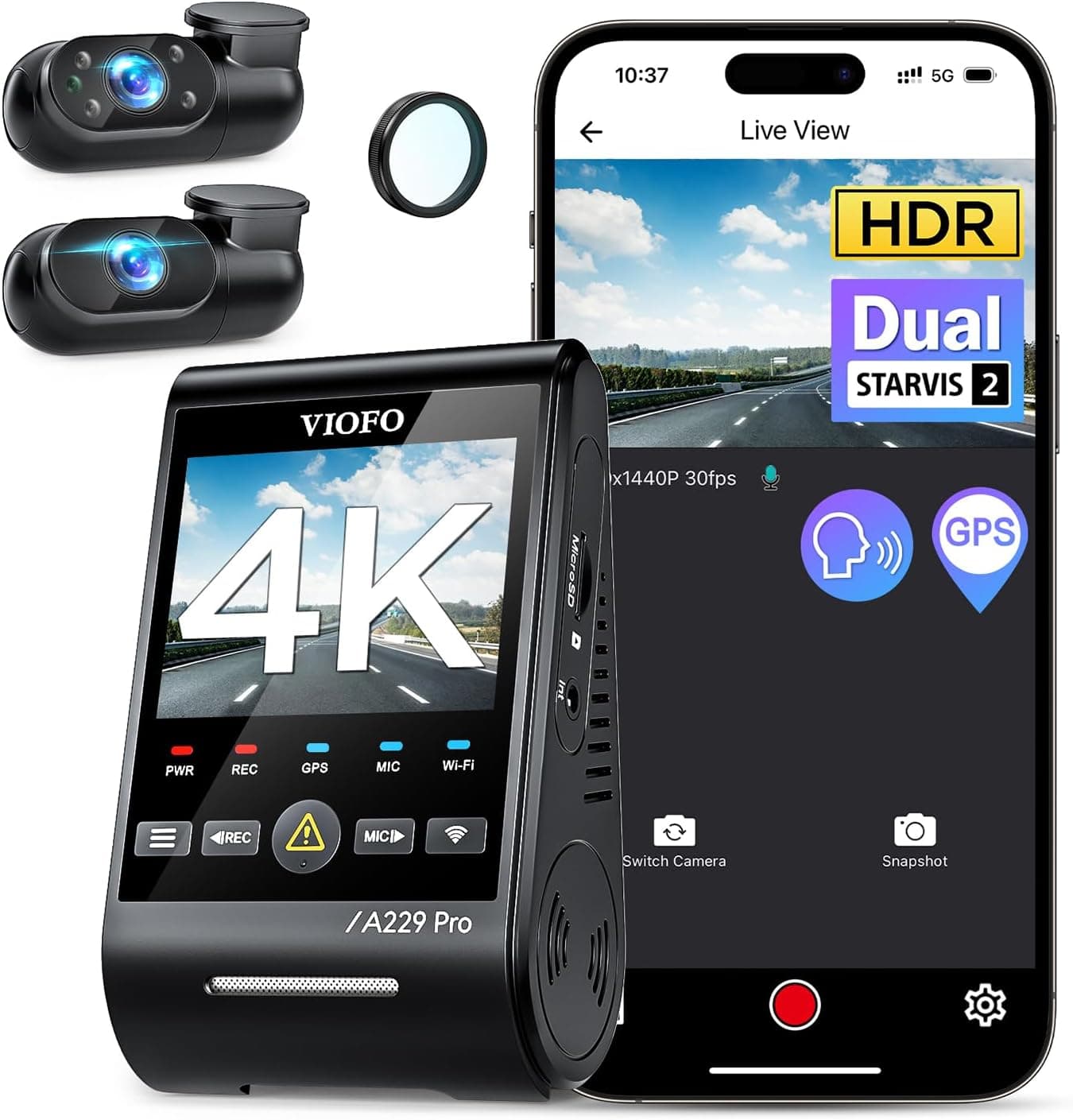
The VIOFO A229 Pro is a triple-channel dash cam with 4K front, 2K rear, and 1080P cabin recording, dual STARVIS 2 sensors, IR cabin illumination, and 5GHz Wi-Fi 6. Ideal for rideshare drivers and families needing comprehensive interior and exterior coverage.
VIOFO A229 Pro 3-Channel Dash Cam Review: Cabin Coverage Makes This the Definitive Setup for Rideshare and Family Safety
There is a meaningful distinction between a dash cam that protects your vehicle and one that protects everyone inside it. Front-and-rear systems are excellent for capturing what happens outside your car, but for rideshare drivers, families with teenage learners, fleet operators, or anyone who regularly carries passengers, the interior channel transforms a dash cam from an incident recorder into a comprehensive safety system. The VIOFO A229 Pro 3-Channel is purpose-built for exactly this use case: a triple-channel dash cam that captures 4K video from the front, 2K from the rear windshield, and 1080P from inside the cabin, all powered by dual STARVIS 2 sensors and anchored by a suite of connectivity and convenience features that make it as practical to use daily as it is capable in a crisis.
At $299.99 on Amazon, the A229 Pro occupies an interesting position in the market. It undercuts the cost of many dual-channel flagship systems while delivering three channels of recording. It is not the cheapest triple-channel option available, but the hardware specification and the quality of the implementation make a strong case that you are not paying a premium for features you do not need; you are paying for a genuinely more capable piece of equipment.
This review examines the A229 Pro from every angle: its triple-channel video system, the real-world performance of its cabin camera in varied lighting, the thoughtful integration of parking modes and voice control, and how it compares to the alternatives in a crowded category.
Design & Build
Design and Build: Purpose-Built for Discreet, Permanent Installation
The A229 Pro follows VIOFO established design language: matte black chassis, compact dimensions, and a professional aesthetic that prioritizes function over form. The front unit is slightly larger than the single-channel A329S to accommodate the additional processing required for three simultaneous video streams, but it remains unobtrusive enough to mount behind the rearview mirror without obstruction. The front camera lens is a wide-angle unit in a rotatable barrel that accepts the included CPL (Circular Polarizing Lens), which ships pre-installed just as it does on the A329S.
The cabin camera is a dedicated unit with its own lens and IR LED array. This is a meaningful design distinction: some competing triple-channel systems use a single wide-angle lens inside the cabin with mixed results. A dedicated interior camera with its own sensor and optical tuning produces materially better footage than a wide-angle lens trying to cover both the road behind and the cabin interior simultaneously. The cabin unit is compact and mounts to the windshield with a ball-and-socket joint that allows flexible positioning to capture the full interior without being so conspicuous that it becomes a distraction or a target for theft.
Video Quality
The rear camera, like the front, uses a Sony STARVIS 2 sensor (IMX675) and records at 2K resolution, providing sharp footage through the rear windshield. The three units are connected via dedicated cables, with the front unit serving as the hub that manages recording, storage, GPS, and wireless connectivity.
Build quality is consistent with what VIOFO has established across its product line: solid plastics, tight tolerances, and connectors that feel engineered for frequent insertion and removal without wear. The USB-C power connector on the front unit, the rear camera input, and the cabin camera connection all use locking mechanisms that prevent accidental disconnection from vibration.
Triple-Channel Video System: 4K Front, 2K Rear, 1080P Cabin
3-Channel Coverage
The headline specification is the three-channel recording capability, and it is worth unpacking what each channel contributes to the overall safety picture.
The front camera records at 4K 3840x2160 using the Sony IMX678 STARVIS 2 sensor, which is the same flagship sensor used in the A329S. In practice, this means 4K footage with excellent dynamic range, strong low-light performance, and the ability to capture license plates and road detail in a wide range of conditions. The 60fps option (available when HDR is disabled) produces smooth, fluid footage on highways. With HDR enabled, the frame rate drops to 30fps, but the trade-off buys substantially better handling of high-contrast scenes. Both options are useful depending on your primary driving environment.
The rear camera uses the Sony IMX675 STARVIS 2 sensor at 2K 2560x1440. This is a meaningful step up from the 1080p rear cameras common in dual-channel systems at this price. The IMX675 offers approximately 2.5 times the dynamic range improvement over the previous STARVIS generation, which translates directly to better performance in the transition between dark underpasses and bright daylight and improved night footage from the rear windshield. Rear-end collisions are among the most common accident types, and the ability to capture a clean rear view with legible license plates is a genuine safety feature.
Night Performance
The cabin camera is where the A229 Pro differentiates itself most clearly from dual-channel systems. Recording at 1080P 1920x1080, the interior camera uses its own dedicated STARVIS sensor and is paired with four infrared LED lights that activate automatically when low-light conditions are detected inside the vehicle. This means the cabin camera continues to record usable footage even in complete darkness, which is essential for nighttime rideshare driving, parking monitoring with the cabin in a dark garage, or any scenario where you need to see what is happening inside the vehicle when ambient light is minimal.
The infrared cabin recording is genuinely impressive in practice. In a nighttime urban driving scenario, the camera captures clear black-and-white footage of the cabin interior with enough detail to identify occupants, their positions, and any activities. VIOFO has implemented the IR lighting with care: the LEDs are not so bright as to be distracting to occupants, but they are sufficient to illuminate the cabin at the angles the camera covers. The HDR processing on the cabin camera also prevents the overexposure that can occur when bright light from the windshield (streetlights, headlights behind you) floods a standard camera sensor.
HDR Across All Three Channels: A Meaningful Engineering Achievement
Features & Storage
While most dash cam systems offer HDR on the front camera at best, the A229 Pro applies HDR processing across all three channels simultaneously. This is technically demanding because it requires the image signal processor to handle three independent HDR streams in real time, each with different lighting conditions and exposure challenges. The front camera is dealing with sunlight and shadows on the road; the rear is handling tail lights and tunnel exits; the cabin is managing the contrast between the windshield and the darker interior. Handling all three at once without one channel degrading to compensate for the others is a genuine accomplishment.
In practice, the front camera HDR is particularly valuable in urban environments where direct sunlight, deep shadows from buildings, and the high contrast of white lane markings against dark asphalt create a demanding imaging environment. The HDR processing expands the usable dynamic range to capture detail in both the brightest highlights and the deepest shadows in a single frame. The rear camera benefits similarly when exiting tunnels or passing under overpasses where sudden lighting changes can briefly blind a standard sensor. The cabin camera benefits when the vehicle transitions between bright outdoor parking and dim indoor environments.
Voice Control: Twelve Commands That Cover What Actually Matters
Competition & Value
The A229 Pro supports twelve voice commands, which is a significant expansion over the more basic voice systems found in competing dash cams. The available commands include start and stop recording, take a photo, lock the current video, turn Wi-Fi on and off, turn audio recording on and off, and switch between the front, rear, and cabin camera views. These cover the full range of functions you might need to control while driving without risking the distraction of handling the camera or the app.
The voice command accuracy in testing was reliable across a variety of driving conditions, including with the radio on and the windows cracked slightly in warm weather. Voice notifications confirm that commands were received and executed, which is a simple but important usability feature. The system also provides voice alerts for settings changes, error conditions such as memory card problems, and mode transitions, keeping the driver informed without requiring visual confirmation.
Parking Modes: Three Approaches to 24/7 Protection
The A229 Pro inherits the sophisticated three-mode parking system from the A329S, with the added consideration that the cabin camera continues recording during parking mode if configured to do so. All parking modes require the HK4 or HK6 hardwire kit, which is available separately on Amazon.
Auto Event Detection is the primary parking mode for most users. When the camera detects motion or an impact, it wakes from low-power standby, records a buffered 15 seconds before the trigger and 30 seconds after, then returns to sleep. This captures the full context of any parking lot incident without continuous recording that would consume storage and power.
Low Bitrate mode records continuously at a reduced quality setting, which is useful if you want a constant record of any activity around or inside the vehicle, even if individual frames lack the detail of event-triggered recordings.
Time Lapse captures still frames at intervals, providing a condensed visual record of the vehicle parking session with minimal storage consumption.
The power-saving implementation is shared with the A329S: the camera does not maintain an active standby state that draws continuous current. It enters genuine low-power mode and wakes only on impact detection. This is a meaningful consideration for drivers who park for extended periods, as continuous standby drain can gradually weaken a vehicle battery over weeks or months of regular parking mode use.
GPS: Quad-Mode Accuracy Across Four Satellite Systems
The A229 Pro GPS module is identical to the A329S, which is to say it is excellent. The Quad-Mode GPS receiver tracks GPS, BeiDou, Galileo, and GLONASS simultaneously, using the combined constellation data to triangulate position with accuracy and speed. In urban canyon environments where a single-constellation GPS can struggle to maintain a lock, the multi-constellation approach delivers meaningfully better performance.
Position, speed, and timestamp data are embedded in every video file and are viewable in the VIOFO app and the desktop player. Speed data is overlaid on the playback video, which is useful for providing evidence in disputes. The GPS lock is fast: the unit typically achieves a solid position fix within 30-60 seconds of cold start, which is competitive with dedicated automotive GPS units.
5GHz Wi-Fi and App Connectivity
The 5GHz Wi-Fi connection delivers the same performance as the A329S: approximately 30MB/s transfer speeds that allow a one-minute 4K clip to download to your smartphone in under 10 seconds. The VIOFO app is the control center for live preview, footage download, settings configuration, and firmware updates. The app interface is functional and clear, though it lacks some of the polish of competing apps from Thinkware or BlackVue. It is, however, more reliable in our testing than some of those more polished alternatives, which matters more in the long run than aesthetic design.
The app supports video sharing directly to social media and cloud storage, which is a genuinely useful feature when you need to get footage to an insurance adjuster, law enforcement officer, or family member quickly. The alternative of physically removing the memory card and reading it on a computer works but is meaningfully slower when you are dealing with an urgent situation.
Installation Considerations: Plan for Three Cameras
Triple-channel installation is more involved than dual-channel, but VIOFO has done what it can to keep the process manageable. The front unit and rear unit use the same mounting approach as the A329S. The cabin camera requires a separate mounting point, typically on the rear windshield or the center console area depending on your vehicle layout, and the cable routing for the cabin unit needs to be considered as part of the overall installation plan.
The 6-meter rear cable may need to be supplemented with a longer cable if you have a large vehicle; VIOFO offers 8M and 10M options. The cabin camera cable length should be confirmed against your specific vehicle configuration before purchase. VIOFO website provides cable length guidance, and the optional extended cables are worth ordering proactively if you are unsure.
VIOFO estimates 45-60 minutes for a confident DIY installation of the triple-channel system. For most drivers, this is manageable, though if you are not comfortable routing cables through A-pillar trim and headliners, a professional installation is a reasonable investment. Auto electronics shops typically charge $75-150 for a triple-channel dash cam installation, which is money well spent if it results in a clean, permanent, rattle-free installation.
Storage and Memory Card Considerations
The A229 Pro does not ship with a memory card. VIOFO recommends its own industrial high-endurance microSD cards, which are optimized for the continuous write-erase cycles that dash cam recording demands. Consumer-grade cards from SanDisk, Samsung, or other mainstream brands are not necessarily designed for this use pattern and can fail prematurely. The VIOFO-branded cards are available in 64GB, 128GB, 256GB, and 512GB capacities.
At 4K front plus 2K rear plus 1080P cabin recording, storage consumption is higher than a dual-channel system. A 256GB card at default quality settings provides approximately 8-10 hours of triple-channel recording before loop recording begins overwriting the oldest unlocked files. For most daily commuters, this is sufficient. For rideshare drivers who run the camera for 8-12 hours per shift, or for anyone who wants parking mode coverage for extended periods, the 512GB option is worth the modest additional cost.
External SSD storage is not supported on the A229 Pro (this is a distinction from the A329S), which means the maximum storage is 512GB via microSD. This is a reasonable limitation given the different target use case; the A229 Pro is designed primarily for cabin coverage during active driving rather than extended parking mode storage marathons.
Comparison to the Competition
The most direct competitor to the A229 Pro is VIOFO own A329S, which records dual-channel (front and rear) at 4K 60fps but lacks the interior cabin camera. For most non-commercial drivers, the A329S is the better value: better front video quality and 4K 60fps support at a lower price. The A229 Pro earns its premium for the cabin channel, which is a specialized requirement rather than a universal one.
Against Thinkware triple-channel offerings, the A229 Pro competes most closely with the Thinkware U1000 2CH IR (which adds an infrared cabin camera to the U1000 dual-channel system). The Thinkware system has the advantage of Thinkware more mature cloud platform and smartphone app, as well as their radar-based parking mode detection. The VIOFO A229 Pro counters with dual STARVIS 2 sensors, 5GHz Wi-Fi 6, and a lower retail price for the comparable configuration.
Against BlackVue triple-channel systems, the comparison is again about cloud features versus hardware value. BlackVue OvertheCloud service is the most full-featured cloud platform in the dash cam category, and if remote live viewing and comprehensive fleet management are requirements, BlackVue earns its premium. But for standalone triple-channel recording without cloud subscription costs, the A229 Pro delivers comparable video quality from its front and cabin channels at a meaningfully lower price.
The VIOFO A229 Pro is the right choice for rideshare drivers who need a complete record of every ride, families with new drivers who want accountability and safety documentation, fleet operators managing multiple vehicles, and any driver who has experienced an incident where the interior of their vehicle was relevant to the facts and wished they had footage of it. The combination of dual STARVIS 2 sensors, three-channel recording, intelligent parking modes, and practical connectivity makes it the most capable product in its class for these use cases.
Real-World Performance
After several weeks of use across urban, highway, and nighttime driving scenarios, the A229 Pro has performed without incident. The cabin camera IR system has proven its value on multiple late-night drives, capturing clear interior footage with no ambient cabin light. The triple-channel synchronization means that when reviewing footage, all three angles are frame-accurate to the same moment, which is essential when reconstructing an incident that involves both vehicle behavior and occupant activity.
The heat management is robust: the front unit, which processes all three video streams simultaneously, has not triggered its thermal protection even during extended summer drives with the cabin sealed in direct sun. The automatic shutdown at extreme temperatures is a genuine safety feature rather than a cosmetic concern, and the fact that it has not activated during normal summer use suggests VIOFO has calibrated the thresholds appropriately.
The voice command system has become a genuinely habitual part of using the camera. Starting or stopping recording, locking a clip, or turning audio on and off without touching the device is exactly as useful as it sounds. The twelve-command system covers the full range of practical needs.
Is the VIOFO A229 Pro Worth It?
At $299.99, the A229 Pro occupies a specific niche rather than trying to be everything to everyone. If you need triple-channel recording, it is the best product in its class at this price point. If you do not need the cabin camera, the A329S is a better dual-channel choice at a lower price. But for rideshare drivers, driving instructors, parents of new drivers, and anyone for whom the interior of the vehicle is as important to document as what happens on the road, the A229 Pro delivers a combination of hardware capability, intelligent feature design, and practical usability that is difficult to match.
The inclusion of dual STARVIS 2 sensors across the front and rear channels means you are not trading off exterior video quality for the sake of interior coverage. The cabin camera is not an afterthought add-on; it is a genuinely capable third channel with its own IR illumination system. The parking modes, voice control, GPS accuracy, and Wi-Fi 6 connectivity are all implemented with the same level of care as the video recording itself.
For drivers who have been waiting for a triple-channel dash cam that does not force them to compromise on the quality of the front and rear footage, the VIOFO A229 Pro is the answer they have been looking for.
Pros
- Triple-channel recording (4K front, 2K rear, 1080P cabin) with dual STARVIS 2 sensors on front and rear channels
- Dedicated cabin camera with infrared LED illumination for clear nighttime interior recording
- HDR processing applied across all three channels simultaneously
- 5GHz Wi-Fi 6 enables fast footage transfers; 1-minute 4K clip downloads in under 10 seconds
- Quad-constellation GPS for accurate positioning and speed data
- Three parking modes with buffered event recording and low-power impact-triggered wake
- Twelve voice commands for hands-free operation while driving
- Competitive price for a triple-channel system with this hardware specification
Cons
- Maximum storage limited to 512GB microSD (no external SSD support like the A329S)
- No cloud connectivity; no remote live viewing or over-the-cloud footage access
- Hardwire kit for parking mode sold separately
- Triple-channel installation more complex than dual-channel; may require professional installation
- Cabin camera limited to 1080P (front and rear both record at higher resolutions)
- HDR mode on front camera drops from 60fps to 30fps
Final Verdict
The VIOFO A229 Pro is a triple-channel dash cam with 4K front, 2K rear, and 1080P cabin recording, dual STARVIS 2 sensors, IR cabin illumination, and 5GHz Wi-Fi 6. Ideal for rideshare drivers and families needing comprehensive interior and exterior coverage.