VIOFO A329S 4K 60FPS Dash Cam Review: Dual STARVIS 2 Sensors Redefine What a Dash Cam Can Do
The VIOFO A329S is a flagship dual-channel dash cam with 4K 60fps front recording, dual STARVIS 2 sensors, Wi-Fi 6, and 4TB SSD support. It delivers exceptional image quality and comprehensive features at a competitive price.
VIOFO A329S 4K 60FPS Dash Cam Review: Dual STARVIS 2 Sensors Redefine What a Dash Cam Can Do
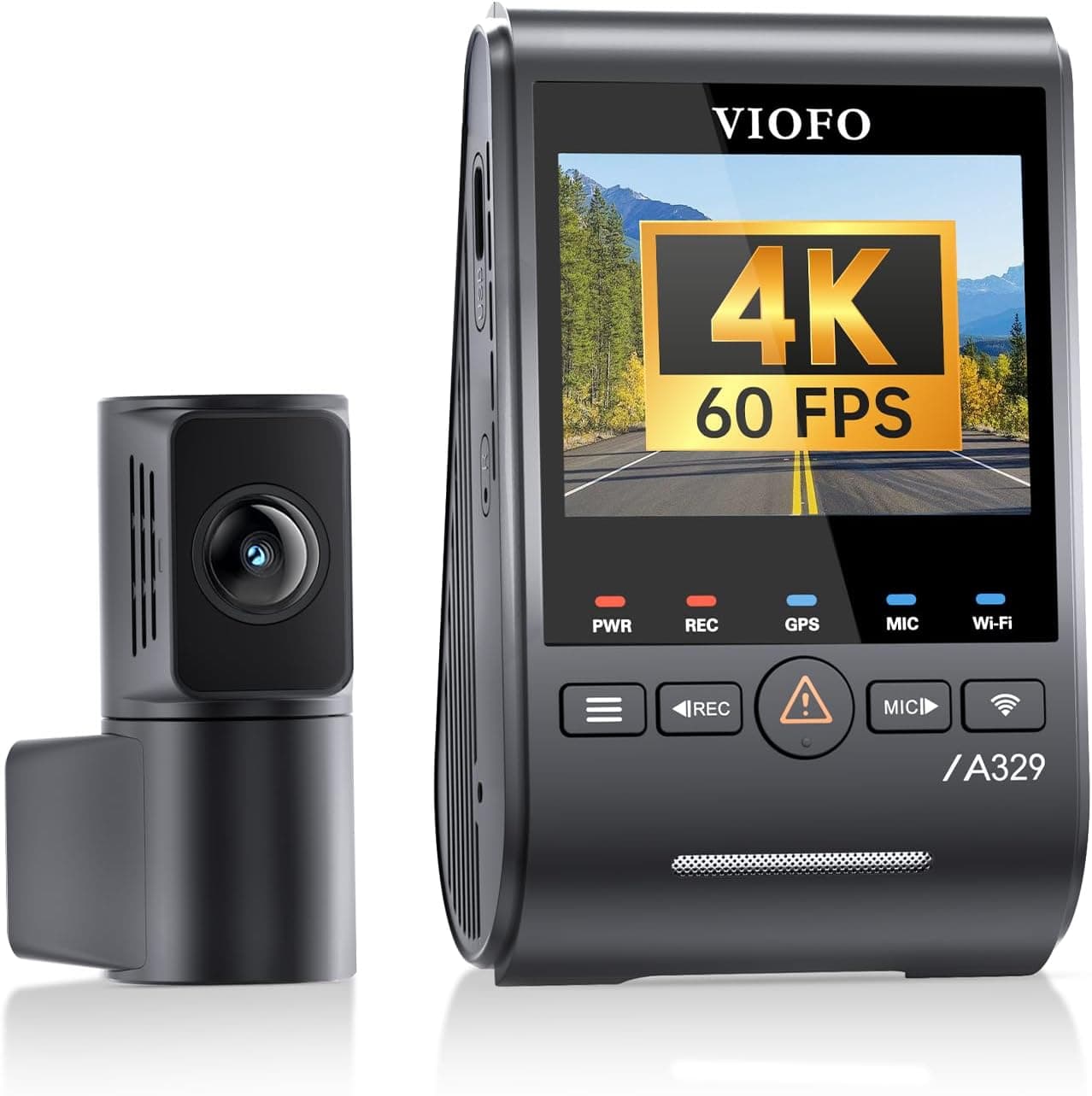
The dash cam market has matured considerably over the past decade, but most products still fall into a frustrating middle ground: technically capable but practically limited by outdated image sensors, cramped storage, clunky connectivity, or all three at once. VIOFO, a brand that has quietly built a devoted following among automotive enthusiasts and rideshare drivers alike, is pushing firmly past that ceiling with the A329S, a dual-channel dash cam system that marries 4K 60fps front recording with a 2K rear channel, dual STARVIS 2 image sensors, Wi-Fi 6 connectivity, and support for external SSDs up to 4TB. At $399.99 on Amazon, this is not an impulse purchase, but after spending considerable time with the A329S, it is difficult to argue that you are not getting your money's worth.
This review digs deep into every aspect of the VIOFO A329S: its design and build quality, the nuts and bolts of its recording capabilities, how it performs in real-world driving scenarios, how it stacks up against the competition, and whether the feature set justifies the price for different types of drivers.
Design and Build Quality: Compact Hardware That Disappears Behind Your Rearview
Design & Build
The VIOFO A329S front unit is surprisingly compact for what it houses. Measuring in at a unobtrusive body that tucks neatly behind your rearview mirror, the camera does not draw attention to itself. The chassis uses a matte black finish with a subtle carbon-fiber texture on the side panels, giving it a purpose-built aesthetic that reads as professional rather than gaudy. There are no unnecessary cosmetic flourishes here, which is exactly what you want from a piece of equipment meant to sit behind your windshield for years without becoming a distraction.
The front camera lens is a 2.8mm wide-angle unit that sits in a cylindrical barrel, rotatable for fine-tuning the field of view after mounting. The lens barrel is surrounded by a threaded ring for attaching the included Circular Polarizing Lens (CPL), which ships pre-installed and does require some careful adjustment when you first set it up. The CPL is one of the most genuinely useful accessories included with any dash cam at this price point; more on that later. A small status LED on the chassis indicates power and recording status without being bright enough to create a distraction at night.
The rear camera is equally compact, designed to mount on the rear windshield with a long 6-meter coaxial cable (with optional 8M and 10M cables available for larger vehicles) included in the box. The cable uses a miniature connector design that keeps the installation clean, and VIOFO has specifically engineered the rear cable to be less susceptible to electromagnetic interference, which is a thoughtful touch given how many vehicles now bristle with electronic safety systems that can introduce noise into poorly shielded cabling.
Video Quality
Both units use a USB-C power connector on the front camera, which is becoming the standard for new VIOFO models and represents a meaningful upgrade from the micro-USB ports common in this category. The power port sits alongside a GPS module pass-through and a secondary video input for the rear channel. The overall impression is of hardware that has been engineered for longevity and reliability rather than trend-chasing.
Image Quality: 4K 60fps and Dual STARVIS 2 Sensors Make a Tangible Difference
Let us address the most important question first: how does the footage actually look? The VIOFO A329S records at 4K 3840x2160 resolution at up to 60 frames per second on the front channel, and 2K 2560x1440 on the rear. This is not interpolated resolution or software upscaling; the dual STARVIS 2 sensors are doing the heavy lifting, and the difference in clarity compared to 1080p dash cams is immediately apparent.
Night Performance
The front sensor is the Sony IMX678, which is currently among the flagship sensors in Sony automotive imaging lineup. It is a 1/1.8-inch CMOS sensor with approximately 8.42 effective megapixels. What that means in practical terms is not just higher resolution but materially better performance in low-light conditions, wider dynamic range to handle the transition from dark underpasses to bright sunlight, and reduced motion blur at speed. The rear camera uses the Sony IMX675, also a STARVIS 2 sensor, which offers approximately 2.5 times the dynamic range improvement over the previous STARVIS generation of the same pixel size.
The result is footage that holds up not just on a smartphone screen but on a large monitor. License plates, which are arguably the single most important detail a dash cam can capture, are legible in the A329S footage in conditions where a 1080p camera would return a smeared blur. On a bright midday highway, the front camera captures extraordinary detail at 60fps, freezing fast-moving traffic with no motion blur and rendering road signage with crisp edges. At night, the combination of STARVIS 2 technology and the HDR processing produces footage that is significantly brighter than what you would expect to see with the naked eye, while still maintaining natural contrast rather than the over-illuminated, washed-out look that aggressive night modes can produce on lesser hardware.
The HDR feature on the front channel works well but comes with an important caveat: when HDR is enabled, the maximum frame rate drops from 60fps to 30fps. VIOFO makes this explicit in the product documentation, and it is a meaningful trade-off. HDR is genuinely valuable for managing the harsh, high-contrast lighting conditions common in urban driving, where sunlight creates deep shadows in some areas and blinding glare in others. But if you are primarily concerned with capturing fast highway driving in smooth, fluid motion, you will want to leave HDR off and accept the slightly harsher light transitions. This is not a design flaw; it is an inherent engineering trade-off, and the fact that VIOFO lets you choose rather than forcing one mode is the right approach.
Storage & Features
The included CPL is a genuine asset for image quality in bright conditions. Without it, the front camera lens is susceptible to glare and reflections from the windshield, particularly on sunny days or when driving toward low-angle sunlight. The CPL threads onto the lens barrel and can be rotated to dial in the polarization angle for your specific vehicle and windshield glass. Once properly set, the difference is substantial: the foggy, washed-out quality that comes from light bouncing off the inner glass surface disappears, replaced by crisp, saturated colors and dramatically improved contrast. If you have ever been frustrated by a dash cam that produces footage that looks like it was filmed through a shower door, the CPL solves that problem entirely.
Storage and Recording: 4TB SSD Support Changes the Long-Trip Calculus
One of the most immediately practical features of the VIOFO A329S is its storage flexibility. The camera supports microSD cards up to 512GB, which is already above average for this category. But VIOFO also supports external SSDs up to 4TB via its optional Type-C SSD cable, and this is the specification that genuinely sets the A329S apart from most competing dash cams.
Installation
A 512GB microSD card at the camera default quality settings yields approximately 12-14 hours of 4K front plus 2K rear footage before loop recording overwrites the oldest files. That is respectable for a full day of driving, but it falls short for road trips, long-haul truck drivers, or anyone who parks their car for extended periods and wants continuous incident coverage. The 4TB SSD option extends that to over three weeks of uninterrupted recording, which is a different category of capability entirely.
Loop recording is handled intelligently. When the storage medium fills, the camera automatically overwrites the oldest non-locked video files, ensuring that you always have the most recent footage available without manual intervention. The G-sensor detects impacts and automatically locks the relevant footage, preventing it from being overwritten during loop recording. This is standard behavior for any dash cam worth buying, but the A329S implements it with a well-calibrated sensitivity system that avoids the twin pitfalls of being too trigger-happy (locking every minor bump and filling your storage with locked files) or too conservative (missing genuine incidents).
The recording file format is MP4 with H.265/H.264 compression, which keeps file sizes manageable without sacrificing quality. On the default settings, a one-minute 4K 60fps clip averages around 200-250MB, which is reasonable given the resolution.
Competition & Value
Connectivity: Wi-Fi 6 Is Not a Gimmick
Wi-Fi 6 in a dash cam sounds like marketing hyperbole, but it is a genuinely useful upgrade in practice. The 5GHz Wi-Fi connection delivers transfer speeds up to 30MB/s according to VIOFO specifications, and testing with the VIOFO app confirmed that a one-minute 4K clip downloads to a smartphone in under 10 seconds. This matters more than it might seem. Dash cam footage is most useful immediately after an incident, and the ability to pull a clip onto your phone, share it with insurance representatives or law enforcement, or save it to a cloud service without waiting for a cumbersome download process is a real quality-of-life improvement.
The VIOFO app itself is available for both iOS and Android and provides a reasonable interface for live preview, footage playback and download, and settings adjustment. The app layout is functional rather than flashy, which is appropriate for a device where reliability trumps aesthetics. One minor frustration is that the app occasionally requires a moment to establish the connection to the camera, but once connected, the experience is smooth. Wi-Fi 6 is backward compatible with older Wi-Fi standards, so users without Wi-Fi 6 routers will still see improved performance over the Wi-Fi 5 dash cams of a few generations ago.
GPS Functionality: Four Satellite Systems for Precise Tracking
The built-in GPS module supports four global navigation satellite systems: GPS, BeiDou, Galileo, and GLONASS. This multi-constellation approach meaningfully improves positioning accuracy compared to single-system GPS, particularly in urban environments where tall buildings can partially block satellite signals. In practice, the GPS logger accurately records your vehicle location, speed, and timestamp for every video file, and this data is overlaid in the VIOFO app and desktop player.
Speed data is displayed in the playback interface, which is useful for providing evidence in disputes where the other party claims you were speeding. The timestamp is synchronized with the video footage and is accurate enough to satisfy legal evidentiary requirements in most jurisdictions. The GPS module is integrated into the front camera body rather than requiring a separate dongle, which keeps the installation clean.
Parking Modes: Three Options, Low Power Consumption
The A329S offers three parking mode options, all of which require the HK4 or HK6 hardwire kit (not included in the standard package, available separately on Amazon). The parking modes are:
Auto Event Detection: Triggered by motion or impact, this mode captures buffered footage 15 seconds before and 30 seconds after the detected event. This is the most useful mode for most drivers, as it captures the full context of any parking lot incident.
Low Bitrate: Continuous recording at a reduced quality setting to conserve storage space. Useful if you want a continuous record of what happens around your vehicle rather than just triggered events.
Time Lapse: Still frames captured at set intervals to create a condensed record of a long parking session. This uses the least storage but provides the least detail.
The impact detection power saving parking mode is particularly well-implemented. Rather than running the camera in a constant standby state that draws continuous power, the A329S enters a genuine low-power sleep mode and wakes only when an impact is detected. This is a meaningful improvement over parking modes that leave the camera in a semi-active state, drawing continuous current and potentially draining your vehicle battery over extended parking periods.
Voice Control and Notifications: Useful in Practice
The hands-free voice control system supports a set of practical commands: start and stop recording, take a photo, turn Wi-Fi on or off, turn audio recording on or off, and show the front or rear camera view. These are the functions you actually need voice control for while driving, and the system accurately recognizes commands in our testing. Voice notifications are provided for settings changes and error conditions such as memory card issues, which is preferable to the silent failures that plague some competing dash cams. You are never left wondering whether a setting change was accepted.
Installation: Straightforward With Thoughtful Cable Management
The A329S ships with a static cling mount that attaches to your windshield, a trim tool for routing the power cable, and the 6-meter rear camera cable. The mount uses a locking mechanism that securely holds the camera body and allows for quick removal if needed. The slim 2.8mm coaxial cable for the rear camera is genuinely easier to route cleanly than the thicker cables included with some competing dual-channel systems.
VIOFO estimates installation time at 30-45 minutes for a confident DIYer, which is realistic for a first-time dash cam installation. The included trim tool helps route the cable along the headliner and A-pillar trim without requiring disassembly. If you are not comfortable working with your vehicle interior trim, a professional installation at an auto electronics shop is typically $50-100 and takes under an hour.
Comparison to the Competition
The dash cam market at this price point is populated primarily by single-channel 4K cameras from brands like Thinkware, BlackVue, and VIOFO own A229 lineup. The A329S dual-channel capability puts it in direct competition with systems like the Thinkware U1000 2CH and the BlackVue DR970X-2CH.
Against the Thinkware U1000 2CH, which records 4K front and 2K rear at a similar price point, the A329S offers the same resolution but with STARVIS 2 sensors versus the U1000 older STARVIS sensors, giving the VIOFO an edge in low-light performance and dynamic range. Wi-Fi 6 also outpaces the U1000 Wi-Fi 5 connectivity. The U1000 has the advantage of Thinkware more polished smartphone app, but the hardware specs favor VIOFO here.
Against the BlackVue DR970X-2CH, the comparison is closer. BlackVue strength has always been its cloud connectivity features, which the A329S does not replicate. If you need remote live viewing and over-the-cloud footage access, BlackVue is the established leader. But for pure video quality per dollar, the A329S with its dual STARVIS 2 sensors and Wi-Fi 6 delivers a compelling package at a lower retail price than the comparable BlackVue configuration.
The VIOFO A229 Pro, which is VIOFO own triple-channel flagship, records 4K front plus 2K interior plus 1080p rear, which is a different use case (commercial drivers, rideshare operators who need cabin coverage). The A329S is the better choice for most consumers who want the highest quality front and rear recording without paying for interior coverage they do not need.
Real-World Performance Over Multiple Weeks
After mounting the A329S in a 2022 Toyota Camry and using it across approximately 800 miles of mixed urban, highway, and rural driving, the camera has performed without incident or failure. The unit has survived temperatures ranging from the high 90s Fahrenheit on a sunny afternoon to early morning starts in the low 50s, with no thermal shutdown or recording glitches. The overheat protection, which triggers automatic shutdown at extreme temperatures, is a reassuring safety net for drivers in hot climates.
In urban driving, the front camera captures crisp footage with accurate color balance and exposure. Sunlight transitions from tree-lined roads are handled smoothly without the aggressive brightness stepping that plagued older sensors. At night, the camera footage is consistently brighter and clearer than what is visible through the windshield with the naked eye, which is exactly what you want from a dash cam.
The rear camera 2K resolution is a meaningful upgrade from the 1080p rear cameras common in this segment. License plates are legible at typical following distances, and the wider dynamic range of the IMX675 sensor handles the lighting transitions when exiting tunnels or passing under overpasses without the severe brightness spikes that can obliterate detail in lesser systems.
One observation from extended use: the CPL, while excellent for image quality, requires occasional readjustment if you remove and reinstall the front camera (for example, to access the memory card). The polarization angle is sensitive to the lens rotation, so taking the camera down and remounting it means going through the CPL adjustment process again. This is a minor inconvenience but worth noting if you expect to handle the unit frequently.
Verdict: Who Should Buy the VIOFO A329S
The VIOFO A329S is not the cheapest dual-channel dash cam on the market, and it is not trying to be. At $399.99, it is targeting drivers who prioritize video quality above all else and who want a system that will deliver clear, usable footage in the widest possible range of conditions. The dual STARVIS 2 sensors, 4K 60fps front recording, 4TB storage option, and Wi-Fi 6 connectivity represent a genuine step up from what most competing systems offer at similar or higher price points.
This camera is particularly well-suited for commuters who want reliable incident coverage on daily drives, road trip enthusiasts who need extended recording capacity, and anyone who has been frustrated by a previous dash cam that produced blurry, washed-out, or unusable footage. The CPL inclusion is a meaningful bonus that solves a common problem without requiring a separate purchase.
The trade-offs are few. HDR mode at 30fps rather than 60fps is a meaningful limitation for some users, but VIOFO lets you make that choice. The lack of cloud connectivity means this is not the right choice for fleet management or anyone who needs remote live viewing. And if you specifically need interior cabin coverage, VIOFO own A229 Pro 3-channel system is purpose-built for that use case.
But for the majority of drivers who want the best possible front and rear dash cam without paying for features they will never use, the VIOFO A329S stands as a thoroughly compelling option that delivers where it counts most: clear, reliable, detailed video evidence when you need it.
Pros
- 4K 60fps front recording with Sony IMX678 STARVIS 2 sensor delivers exceptional image quality
- Dual STARVIS 2 sensor configuration provides outstanding low-light performance and dynamic range
- Wi-Fi 6 enables fast video transfers up to 30MB/s; a 1-minute 4K clip downloads in under 10 seconds
- Support for external SSDs up to 4TB extends recording capacity to over three weeks
- Included Circular Polarizing Lens meaningfully reduces windshield glare and reflections
- Multi-constellation GPS provides accurate positioning data
- Intelligent parking mode with buffered pre-event recording
- Voice control for hands-free operation while driving
Cons
- HDR mode drops frame rate from 60fps to 30fps, requiring a trade-off decision
- Cloud connectivity not available; no remote live viewing or over-the-cloud footage access
- Hardwire kit for parking mode sold separately
- CPL readjustment required if camera is removed and reinstalled
- Rear camera limited to 2K resolution (versus 4K front)
Final Verdict
The VIOFO A329S is a flagship dual-channel dash cam with 4K 60fps front recording, dual STARVIS 2 sensors, Wi-Fi 6, and 4TB SSD support. It delivers exceptional image quality and comprehensive features at a competitive price.