Wooting 80HE Review: The Hall Effect Gaming Keyboard That Sets the Standard
The Wooting 80HE delivers True 8kHz polling, improved Lekker V2 switches, and a more practical TKL layout — making it the fastest and most complete gaming keyboard Wooting has ever built, despite a flex-prone plastic chassis at its $199 price point.
The Wooting 80HE is the keyboard that competitive gaming has been waiting for. After the legendary success of the 60HE, which effectively created the Hall Effect gaming keyboard category as we know it, Wooting is back with a larger, faster, and more refined follow-up. Pair it with a top-tier gaming laptop like the ASUS ROG Zephyrus G14 for the ultimate competitive setup. And make no mistake — this is the keyboard to beat in 2026. With True 8kHz polling, the new Rappy Snappy feature, and Lekker V2 switches that improve on an already excellent formula, the 80HE doesn't just rest on its predecessor's laurels. It pushes the envelope further while addressing one of the biggest criticisms of the 60HE: the typing experience.
Priced at $199 for the PCR ABS version and $289 for the zinc alloy variant, the Wooting 80HE sits at the premium end of the gaming keyboard market. That's a tough ask when competitors like the Endgame Gear KB65HE offer all-metal builds for $139 and the Keychron Q3 Max delivers better construction at a similar price. But the 80HE isn't about build quality alone — it's about performance, and in that regard, it's still the benchmark.
Design and Build Quality
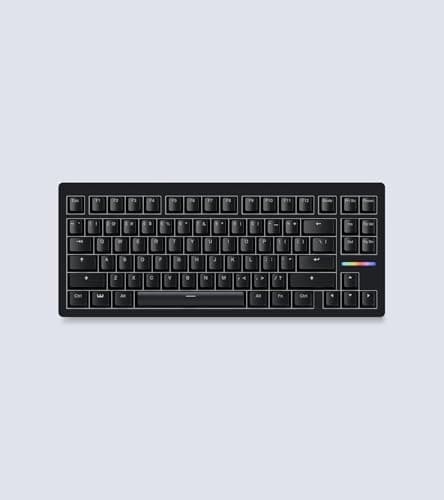
The Wooting 80HE adopts an unconventional 80% layout that sits somewhere between a traditional tenkeyless (TKL) and a 75% board. It retains the F-row, dedicated arrow keys, and a condensed navigation cluster, but compresses everything into a more compact footprint than a standard TKL. The result is a keyboard that measures 346mm by 142mm with a front height of 19.4mm at the case and 28.4mm with the included OEM-profile keycaps.
The PCR ABS version comes in three finishes: Black, Ghost (a frosted translucent black that the IGN review described as evoking "the early noughties craze of translucent everything"), and Frost (a milky white). The Ghost variant is particularly striking — it lets RGB shine through the chassis in a way that feels intentional rather than gimmicky. The zinc alloy version steps things up considerably with Black, Raw, and White finishes, adding nearly 1.4 kilograms of heft for a total of 2,160 grams.
This is where the criticism starts, though. At $199, the plastic chassis exhibits noticeable flex. PC Gamer's review noted that the board is "quite bendy under load, with a bit of flex in the middle and at the case edges," which feels out of place at this price point. The zinc alloy version solves this with a rigid, premium feel, but at $289, you're paying a significant premium for what should arguably be standard at the $200 price tier.
The interchangeable feet system is another polarizing design choice. Instead of traditional flip-out stands, Wooting provides three sets of silicone wedges offering 2.8, 6, and 10 degrees of tilt. They work well enough, but they look "out of place" according to multiple reviewers, and swapping them is less intuitive than flipping out standard feet.
The 80% Layout
The layout is the most distinctive thing about the 80HE, and it takes some getting used to. Wooting has compressed the navigation cluster into two columns of three keys each (Insert, Delete, Home, End, Page Up, Page Down), flanked by the arrow keys and supplemented by a light bar and a mode switch above the arrow cluster. It's not a layout you've seen before, and it requires a brief adjustment period.
But here's the thing — it works. After a few days, the layout feels natural. The dedicated arrow keys are a massive upgrade over the 60HE's function-layer arrows, and having an actual Delete key without reaching for a layer is a quality-of-life improvement that's hard to overstate. The mode switch above the arrow keys lets you toggle between saved profiles, which is faster than digging into software mid-game.
IGN's Chris Coke put it well: "It's unconventional, but it works well. It's just as easy to use outside of gaming." The 80HE is genuinely usable as a daily driver — something that couldn't always be said about the 60HE's cramped layout.
Lekker V2 Switches and Typing Experience
The biggest upgrade from the 60HE isn't the layout or the polling rate — it's how the keyboard feels to type on. Wooting has made sound and feel a priority with the 80HE, and the improvements are immediately noticeable.
The Lekker L60 V2 Hall Effect switches are pre-lubed from the factory, resulting in smoother keypresses with less wobble than the first-generation Lekker switches used in the 60HE. You can choose between 60-gram and 45-gram variants, giving you some flexibility in weighting. The 60-gram version has enough resistance to feel substantial without being fatiguing, while the 45-gram option is ideal for rapid-tapping in games where every millisecond counts.
Under the hood, Wooting has implemented a silicone gasket mount that absorbs impact and softens the bottom-out feel. The polycarbonate switch plate mutes higher frequencies and emphasizes a deeper "thock" sound profile — a far cry from the hollow, clacky acoustics of the 60HE. There's also EPDM foam in the case and tape on the back of the PCB, both of which contribute to a typing experience that multiple reviewers have called genuinely pleasant.
The PC Gamer review noted that "the acoustics can be quite loud in crowded spaces," so this isn't a quiet keyboard by any stretch. But for a gaming-focused board with Hall Effect switches, the sound signature is impressive. TechPowerUp's review praised Wooting for making "a keyboard that sounds as good as it performs," which is high praise for a category that typically prioritizes function over feel.
Gaming Performance
This is where the Wooting 80HE justifies its price tag. The headline feature is True 8kHz polling, activated through Tachyon Mode in the Wootility software. Unlike other keyboards that claim 8kHz polling but scan the matrix at a lower rate, the 80HE syncs its USB polling rate with its matrix scan rate at a true 8,000 Hz. The result is a theoretical input latency of just 0.125 milliseconds — faster than any competing keyboard on paper.
Is that difference noticeable in practice? Probably not to most gamers. IGN's review tested it side-by-side with a Nuphy Field75 HE (8kHz polling, 2.5kHz scan rate) and found no perceptible difference. But the psychological confidence that comes from owning the fastest keyboard money can buy shouldn't be dismissed — for competitive players, every advantage matters, even if it's just in your head.
The real-world impactful features are Rapid Trigger, SOCD (Snappy Tappy / Rappy Snappy), and Dynamic Keystrokes (DKS).
Rapid Trigger
Rapid Trigger is the feature that made the Wooting name synonymous with competitive gaming. It allows a key to reset and re-activate based on movement rather than a fixed reset point. In practical terms, this means you can spam the A and D keys for counter-strafing without fully releasing either key. The actuation point is adjustable from 0.1mm to 4.0mm per key, and with Rapid Trigger enabled, you can achieve a cadence that's simply impossible on a mechanical keyboard.
PC Gamer called Rapid Trigger "the standout inclusion" and noted that it creates "insanely snappy inputs for WASD and weapon swapping." In games like Valorant and Counter-Strike 2, this translates directly to faster peeks and more precise movement. ProSettings.net data shows that Wooting is the number one keyboard brand in Valorant (28.35% of players), CS2 (20.91%), and Fortnite (17.25%), which tells you everything you need to know about how the competitive community values these features.
Rappy Snappy and SOCD
Rappy Snappy is Wooting's latest innovation, and it addresses a specific use case: preventing two bound keys from being active simultaneously. When you bind both A and D to a single key (for counter-strafing), Rappy Snappy ensures that only the deeper-pressed key registers. It's a refinement of the SOCD (Simultaneous Opposing Cardinal Directions) processing that Wooting pioneered with the 60HE.
The SOCD implementation lets you choose your priority logic: last input wins, both canceled, or first input priority. This flexibility is crucial because different games handle opposing directional inputs differently. Counter-Strike 2 has banned SOCD processing in official matchmaking (as has Valve's VAC network), so you'll want to check your game's policy before enabling it in competitive play. But for casual play and single-player titles, the instant direction changes are transformative.
Dynamic Keystrokes and Analog Input
DKS allows you to map up to four different actions to a single keypress based on how far the key is pressed. A shallow press could be a walk, a medium press a jog, and a full press a sprint — all on the same key. The analog input mode lets the keyboard function like a controller, with variable input based on key depth. In racing games like Forza Horizon 5, this effectively turns your keyboard into a set of analog triggers, giving you throttle and brake control that's usually only possible with a gamepad.
Wootility Software
The Wootility software is accessed through a browser, not a traditional desktop application. It works offline after the first load and offers a clean, intuitive interface for configuring every aspect of the keyboard. You can remap keys, adjust actuation points per key, configure Rapid Trigger sensitivity, set up SOCD logic, create DKS macros, and manage up to four onboard profiles that are stored directly on the keyboard.
There's a glaring omission, however: macro support. Despite Wootility's comprehensive feature set, you cannot record or play back macros natively. Instead, you need a separate open-source application called Wootomation. IGN called this "baffling," and it's a fair criticism. For a $200+ keyboard that targets competitive gamers, macro support should be table stakes.
The software does include excellent profile templates for FPS, Racing, Typing, and Analog modes, which is a good starting point for new users. The real-time actuation point visualization is also a nice touch — you can see exactly how far each key is pressed as you type or play.
Sound and Acoustics
The 80HE represents a significant step forward from the 60HE in sound quality. The silicone gasket mount, PC switch plate, screw-in stabilizers, and internal dampening all work together to create a typing sound that's deeper and more refined than anything Wooting has produced before. The stabilizers are particularly impressive — they're pre-lubed screw-in units that exhibit virtually no rattle, even on the longer keys like the spacebar and left Shift.
The zinc alloy version sounds slightly better than the plastic version due to the increased mass and rigidity of the case. Both versions benefit from the internal foam and tape, but the zinc alloy's density adds a satisfying heft to the bottom-out sound. If sound quality is a priority, the zinc alloy version is worth the extra cost.
Competitors and Value
The Wooting 80HE faces stiff competition in 2026. The Hall Effect keyboard market has exploded since the 60HE launched, and there are now compelling alternatives at every price point.
The Endgame Gear KB65HE ($139) offers an all-metal case, Rapid Trigger, and 8kHz polling for significantly less money. It's a 65% board, so you lose the F-row and dedicated arrows, but the build quality is superior to the plastic 80HE at a lower price.
The Keychron Q3 Max ($189) delivers exceptional build quality with a full aluminum chassis, wireless connectivity, and a traditional TKL layout. It doesn't have Hall Effect switches, so you miss out on Rapid Trigger and analog input, but for gamers who prioritize typing feel and build quality, it's a strong alternative.
The Razer Huntsman V3 Pro TKL ($179) is Razer's Hall Effect offering with similar features — Rapid Trigger, adjustable actuation, and an 8kHz polling rate. It's slightly cheaper than the Wooting, but Razer's Synapse software is heavier and the build quality doesn't match the zinc alloy 80HE.
The Wooting 60HE ($175) is still available and shares most of the 80HE's features. If you prefer a 60% layout or want to save $25, it's an excellent keyboard. But the 60HE lacks the 8kHz polling, improved typing feel, and expanded layout of the 80HE.
Who Should Buy the Wooting 80HE
The Wooting 80HE is for competitive gamers who want every possible advantage. If you play Valorant, CS2, Fortnite, or any game where rapid inputs and precise movement matter, the combination of Rapid Trigger, SOCD, and 8kHz polling will make you faster. Whether that translates to winning more games depends on your skill, but the hardware won't hold you back.
It's also for enthusiasts who want the most feature-rich keyboard on the market. The Wootility software, analog input capabilities, and extensive customization options make it a tinkerer's paradise. If you enjoy fine-tuning every aspect of your peripherals, the 80HE gives you more control than any competing keyboard.
It is not for users who prioritize build quality at this price point. The plastic version's chassis flex is disappointing for a $200 keyboard, and if you're coming from a premium mechanical keyboard like a Keychron Q series or a custom build, you'll notice the difference immediately. The zinc alloy version fixes this, but at $289, the value proposition becomes more difficult to justify.
It's also not for users who need wireless connectivity, macro support out of the box, or a quiet typing experience.
Real-World Gaming Scenarios
To understand what the Wooting 80HE actually does in practice, it helps to look at specific scenarios rather than abstract specs.
In Counter-Strike 2, counter-strafing is the fundamental mechanics test. With a traditional mechanical keyboard, you press A to move left, release A, then press D to stop your momentum and fire accurately. The gap between releasing A and pressing D is governed by the physical reset distance of the switch — typically 1.5 to 2 millimeters. With Rapid Trigger on the 80HE, you set the actuation to 0.1mm and the reset point becomes dynamic. You can rock between A and D without ever fully releasing either key, shaving milliseconds off every peek. Over the course of a round, that adds up to a meaningful advantage.
In Valorant, the benefit is even more pronounced because the game's movement mechanics punish inaccuracy more severely. The 80HE's SOCD processing lets you override directional inputs instantly, so you can jiggle-peek corners with a rhythm that's physically impossible on a standard keyboard. ProSettings.net reports that nearly a third of Valorant professionals use a Wooting keyboard, and that adoption rate reflects the real competitive edge these features provide.
Racing games are an entirely different use case, and one where the 80HE's analog mode shines. In Forza Horizon 5, the Lekker V2 switches can emulate analog triggers, giving you proportional throttle and brake control. You press a key lightly for 30% throttle, press harder for full acceleration. It's not as precise as a dedicated racing wheel or high-end analog pedals, but it's a significant upgrade over the binary on-off control of standard mechanical keyboards. For sim-racing enthusiasts who can't justify a wheel setup, this feature alone could justify the investment.
Compatibility and Connectivity
The Wooting 80HE is a wired-only keyboard, connecting via a 2-meter USB-C to C nylon-braided cable. The package includes a USB-C female to USB-A male dongle for legacy ports. There is no wireless option, which is a deliberate choice — wireless adds latency and complexity, and for a keyboard that markets itself on having the lowest possible input delay, a wired connection is non-negotiable.
The keyboard is plug-and-play with Windows, macOS, and Linux at a basic level. All 8kHz polling, Rapid Trigger, and analog features work through the Wootility browser app, which is platform-agnostic. You don't need to install a heavy desktop application like Razer Synapse or Logitech G Hub — just open a browser tab, configure your profiles, and they're stored on the keyboard's onboard memory.
The 4-year warranty is notably generous and reflects Wooting's confidence in their hardware. Components are socketed and theoretically repairable — the USB-C daughterboard is replaceable, and the hot-swap switch sockets mean you can swap Lekker switches without soldering. Wooting also commits to backward compatibility for new firmware features, which means your 80HE should continue gaining new capabilities over time.
Build Quality and Durability
Durability testing on the 80HE has been positive overall. The Lekker V2 switches are rated for 100 million keystrokes — roughly five times the rated lifespan of a standard Cherry MX switch. Because Hall Effect switches have no physical contact points, there's no contact wear or debounce delay to degrade over time. The switches should outlast the rest of the keyboard by a significant margin.
The screw-in stabilizers are a meaningful upgrade over the clip-in stabilizers found on many pre-built keyboards. They stay firmly in place and don't rattle or wobble even after extended use. The keycaps are double-shot PBT on the pre-built version, which means the legends won't wear off over time — a common issue with cheaper ABS keycaps. The texture is slightly grainy, providing good grip without feeling rough.
The case itself is where longevity concerns arise, particularly on the PCR ABS version. The flex we mentioned earlier isn't just a feel issue — over years of use, a flexing chassis could potentially stress the PCB and solder joints. The zinc alloy version eliminates this concern entirely, and if you're planning to keep this keyboard for the long term, the extra $90 is probably worth the peace of mind.
The Competition in 2026
The Hall Effect keyboard market has matured rapidly since the 60HE launched. Here's how the 80HE stacks up against its most credible alternatives:
The Endgame Gear KB65HE ($139) is the value king. It offers an all-metal case, 8kHz polling, and Rapid Trigger for significantly less than the 80HE. The trade-off is a 65% layout (no F-row, condensed arrows) and less refined software. If you're on a budget and want Hall Effect performance, it's the better deal.
The Keychron K2 HE ($119) brings Hall Effect switches to Keychron's popular K-series design. It has wireless connectivity, a more conventional layout, and Keychron's excellent build quality at almost half the price. But Keychron's Hall Effect implementation lacks the polish of Wooting's Wootility software, and the polling rate is 1kHz rather than 8kHz.
The Razer Huntsman V3 Pro TKL ($179) is the closest direct competitor. It offers similar Rapid Trigger functionality, adjustable actuation, and an aluminum top plate. Razer's Synapse software is more mature than Wootility for macro recording and RGB management, but it's also heavier and requires an account. The Huntsman's optical switches are excellent, but they lack the analog input capability of Wooting's Lekker switches.
The Corsair K70 CORE ($129) is a budget-friendly Hall Effect option with a full-size layout and decent build quality. It lacks the advanced software features and esports credibility of the Wooting, but for casual gamers who want magnetic switches without the premium price tag, it's a viable option.
Final Verdict
The Wooting 80HE is a keyboard that defines a category. It's not the best value, and it's not the best-built keyboard at its price point, but it is the best performing gaming keyboard money can buy in 2026. The Lekker V2 switches deliver an improved typing experience that addresses the biggest criticism of the 60HE. The True 8kHz polling is arguably excessive, but the Rapid Trigger, SOCD, and analog input features provide real, measurable benefits in competitive gaming scenarios.
The plastic chassis flex at $199 is disappointing and feels like a cost-cutting measure on an otherwise premium product. The zinc alloy version fixes this but at $289, the value proposition becomes harder to swallow. The lack of native macro support in Wootility is baffling for a keyboard at this price point. Complete your gaming rig with a premium headset like the Razer BlackShark V3 Pro.
But when you weigh the total package — the Lekker V2 switches, the Wootility ecosystem, the four-year warranty, the deep customization options, and the proven esports track record — the 80HE earns its place at the top. It is the keyboard that competitive gamers should buy if they want every possible advantage. And for enthusiasts who appreciate fine-grained control over every aspect of their input hardware, there's simply nothing else like it.
Pros
- True 8kHz polling with 0.125ms input latency
- Dramatically improved typing sound and feel over the 60HE
- Excellent Wootility software with deep customization
- Rapid Trigger and SOCD provide real competitive advantages
- Four-year warranty and backward-compatible firmware updates
- Practical 80% layout with dedicated arrow keys and F-row
Cons
- Plastic chassis flex at $199 feels disappointing for the price
- No native macro support in Wootility — requires separate app
- No wireless connectivity option
- Zinc alloy version fixes flex but costs $289
Final Verdict
The Wooting 80HE delivers True 8kHz polling, improved Lekker V2 switches, and a more practical TKL layout — making it the fastest and most complete gaming keyboard Wooting has ever built, despite a flex-prone plastic chassis at its $199 price point.