Glorious GHS Wireless InfinitePlay Review: The Headset That Never Dies
The Glorious GHS Wireless InfinitePlay pairs balanced 40mm sound with a genuinely innovative hot-swappable battery system — two 85-hour packs plus a Guardian backup that keeps audio alive mid-swap. At $229.99, it ends battery anxiety for good.
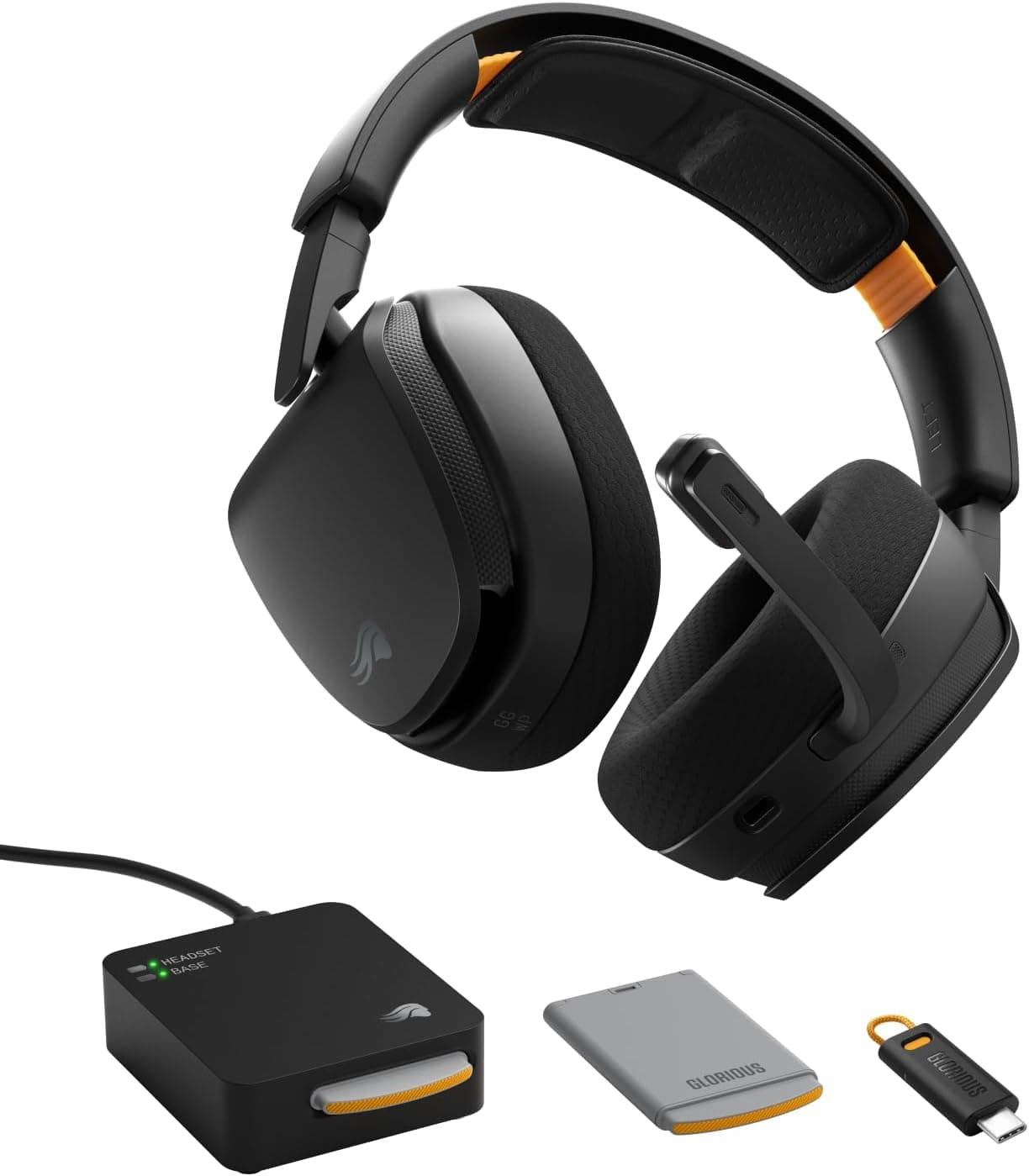
Wireless gaming headsets have one recurring problem that no amount of battery optimization has ever fully solved: they run out of power at the worst possible moment. You are three rounds deep in a ranked match, clutching a 1v3, and the headset starts beeping its low-battery warning. The beeping gets faster, the audio stutters, and then — silence. You scramble for a charging cable, but the headset is dead weight for the next hour, and your squad is left wondering why you went AFK at the pivotal moment of the game. Glorious, the peripherals company best known for its gaming mice and keyboards, has spent the last couple of years trying to kill that scenario dead, and the GHS Wireless InfinitePlay is its boldest attempt yet. Announced in July 2026 and priced at $229.99 on Amazon, it is a wireless gaming headset that ships with two hot-swappable 85-hour battery packs, a charging dock that tops up the spare, and a built-in backup battery that keeps the headset running while you swap the main pack out. The result is a headset that can, in theory, run indefinitely without ever being plugged in.
The name says it all: InfinitePlay. Glorious wants you to stop thinking about battery life entirely, and after spending a few weeks with the headset, I can tell you the concept mostly works. But the InfinitePlay is also a $230 headset going up against some of the best-established names in gaming audio — SteelSeries, Astro, Turtle Beach, and Razer all have flagships in this price range — so the battery gimmick alone is not enough. The sound quality, the microphone, the comfort, the software, and the build all have to hold up. Here is the full picture.
Design and Comfort
The GHS Wireless InfinitePlay has a deliberately stealthy aesthetic that stands out in a category full of RGB-lit, angular, gamer-bro designs. There is no RGB lighting anywhere on the headset. The chassis is matte black with subtle gray accents — a small Glorious logo on the right earcup, orange flashes inside the ear cushions, and colored edges on the elastic headband. It is the kind of headset you could wear on a video call without looking like you just stepped out of a LAN party, which is more than you can say for most of its competition.
The build is a mix of plastic and metal. The headband is plastic with an elastic strap underneath that does most of the weight distribution work, and the earcups attach via yokes that allow them to swivel and fold flat. The overall weight is 361 grams with the battery and microphone installed, which is right in the middle of the pack for wireless gaming headsets — lighter than the SteelSeries Arctis Nova Pro Wireless and comparable to the Razer BlackShark V2 Pro. Comfort is one of the headset's genuine strengths. The elastic suspension system distributes weight evenly across the top of your head, and the memory foam ear cushions are soft, pliable, and breathable. Tom's Hardware's reviewer, who is notably susceptible to head pain from headsets, reported no discomfort over two weeks of testing. The cushions also accommodate glasses well, sealing around the arms without crushing them, which is a nice touch for the bespectacled among us.
There are a couple of build-quality nits to mention. The earcup yokes are a bit weak — the cups have a tendency to rotate on their own if you move your head quickly, and the overall plastic construction means the headset does not feel as premium in the hand as its $230 price suggests. Tom's Hardware put it bluntly: "this doesn't feel like a $230 headset when you're picking it up and putting it down." It is not flimsy, exactly, but it lacks the solid, machined feel of a SteelSeries or Astro flagship. The controls are also a mild annoyance: each earcup has a tall, unlabeled rotary knob (left is game/chat balance, right is volume), and they are easy to bump accidentally when you hang the headset around your neck or reach for something. You will learn the layout quickly, but the first few days involve a lot of accidentally turning the chat mix down instead of the volume.
The InfinitePlay Battery System
The headline feature is the battery system, and it is genuinely clever. The headset ships with two battery packs, each rated for 85 hours of use, plus a base station that serves as both the wireless receiver and a charging dock for the spare pack. The battery slides into a spring-loaded slot on the bottom of the right earcup, and swapping it takes about two seconds: pop the old pack out, slide the fresh one in, done. The dock charges the spare pack whenever it is not in the headset, so you always have a full battery waiting. Combined, the two packs give you 170 hours of playtime before you ever need to plug anything into the wall, which works out to roughly two months of normal gaming for most people.
The killer feature, though, is the built-in Guardian backup battery. Every other hot-swappable battery headset on the market — the SteelSeries Arctis Nova Pro Wireless and the Turtle Beach Stealth Pro II, to name the two big ones — briefly disconnects when you pull the battery out. The InfinitePlay has a small non-removable battery inside that keeps the headset powered for up to three hours while the main pack is out, so the audio and the microphone never cut out during a swap. You just hear a subtle audio cue, swap the pack, and keep playing. It is the kind of feature that seems obvious in retrospect but nobody else has shipped, and Tom's Hardware predicts it "will become standard among the swappable battery headsets." I agree. Once you have experienced a battery swap that does not interrupt your game, it is hard to go back to the alternatives.
The base station is also nicely designed. It is a compact hockey-puck-shaped dock with the 2.4GHz USB dongle built in, and the dongle can be unplugged from the dock for a low-profile connection if you prefer. The dock itself charges the spare battery whenever it is seated, with a small LED indicating charge status. It is not as elaborate as the SteelSeries GameDAC or the Astro base stations, but it does the job with minimal desk footprint. One thing to note: there is no simultaneous 2.4GHz and Bluetooth audio. You can use either the 2.4GHz dongle or Bluetooth, but not both at once, which means you cannot listen to game audio over the dongle while taking a Discord call on your phone. The SteelSeries Arctis Nova Pro Wireless supports simultaneous audio, and its absence here is a real limitation for streamers and multitaskers.
Sound Quality
Under the hood, the InfinitePlay uses 40mm angled dynamic drivers, positioned so that sound enters your ear at a slightly off-axis angle that mimics how you naturally hear. It is a technique borrowed from high-end audiophile headphones, and while its impact is "real but not profound" in Tom's Hardware's assessment, it does contribute to a sense of space and realism. The frequency response is rated at 20Hz to 20kHz, with 32-ohm impedance and up to 95dB sensitivity — standard numbers for the category, but the tuning is where Glorious has done its homework.
The default tuning is refreshingly balanced for a gaming headset. Most gaming headsets ship with a bass-heavy V-shaped curve that sounds impressive in the store but gets fatiguing and muddy in practice. The InfinitePlay instead emphasizes the bass while keeping mids and highs lifted enough to preserve detail. Tom's Hardware called it "just about the perfect balance between engaging, fun bass and high-resolution, realistic, and positionally detailed sound." In my testing, that balance held up across music, movies, and games. Explosions and gunfire have real impact without overwhelming the mix, footsteps and environmental cues stay crisp, and dialogue comes through clearly even in busy scenes.
Layering and positional audio are above average. In competitive shooters, I could pick out enemy footsteps and pinpoint their direction with confidence, and in games with heavy ambient audio like Battlefield 6, the headset kept occluded dialogue and distant sound effects intelligible. The soundstage is mid-sized and more horizontal than vertical — it is not the expansive, holographic presentation you get from planar magnetic drivers on headsets like the Audeze Maxwell — but it plays very well with in-game surround virtualization like Windows Sonic and Dolby Atmos. For a $230 closed-back gaming headset, the spatial performance is genuinely competitive.
Music performance is solid too. The default tuning handles most genres without muddiness, from dense metal to mellow acoustic, and the headset does not fall apart on complex arrangements the way many gaming headsets do. It is not an audiophile headset — the bass is a touch emphasized and the treble lacks the last bit of air you would get from a dedicated music headphone — but it is more than listenable for everyday use. If you want to tweak it, the Glorious Core software gives you the tools (more on that below).
There is no active noise cancellation on the InfinitePlay, which is worth flagging because several competitors in this price range — including the Razer BlackShark V2 Pro and the Astro A50 X — offer it. The ear cushions do a decent passive isolation job, but if you play in a noisy environment or travel a lot, the lack of ANC might be a dealbreaker. The cushions also leak sound both ways: at high volume, your roommate will hear what you are playing, and you will hear them. Tom's Hardware warned, "don't listen to anything at high volume you wouldn't want your roommate to hear."
Microphone
The InfinitePlay ships with a detachable omnidirectional boom microphone, and there is also a built-in mic in the headset for when you want to go mic-less. The boom mic plugs into a 3.5mm jack on the left earcup and blends seamlessly into the design when attached. Audio quality is good for a gaming headset — your voice comes through clearly and consistently, and the Glorious Core software includes an environment noise cancellation (ENC) toggle that noticeably improves clarity in noisy rooms. In testing, the boom mic handled loud background noise well, keeping the voice clean and intelligible.
There are two caveats. First, the built-in mic is significantly worse than the boom mic — it sounds tinny and hollow, with audible hiss, even with the software enhancements enabled. You will want to use the boom mic for anything important. Second, the boom mic's connection is not as secure as it should be. The basic-tutorials review noted that the mic is "too easy to pull out of its socket" — even slight force during adjustment can disconnect it. It is not a constant problem, but it is annoying when it happens mid-game, and it is the kind of detail that separates a great headset from a merely good one.
Software: Glorious Core
The Glorious Core software is where the InfinitePlay pulls ahead of much of its competition. It is not strictly plug-and-play on PC — you will want the software installed, because it does a lot of the heavy lifting — but once you have it, the feature set is impressive. You get a five-band equalizer with a library of presets for music, gaming, and voice calls, plus game-specific presets for titles like Valorant, EA Sports FC 26, and Marvel Rivals. There are two custom EQ slots for your own tunings.
The standout feature is a parametric EQ system, currently in beta, which lets you make surgical adjustments to specific frequency ranges rather than just boosting or cutting broad bands. Tom's Hardware compared standard EQ to "a hairbrush" and parametric EQ to "a barber" — the latter can completely reinvent the sound. For a gaming headset, that level of control is almost unheard of at this price. The software also includes distortion protection that automatically manages gain so you cannot accidentally push the drivers past their limits, which is a thoughtful safeguard.
Beyond the EQ, Glorious Core handles the rest of the headset's settings: battery status for both packs, microphone volume and ENC toggle, up to five saved profiles, the ability to permanently disable Bluetooth, and an auto-off timer that kicks in after 30 minutes of inactivity. The interface is clean and modern, a significant step up from the clunky software some competitors ship. If you are the type of person who likes to dial in your sound, the InfinitePlay gives you more control than almost anything else in its class.
Wireless Performance and Compatibility
The InfinitePlay connects via a 2.4GHz USB dongle for low-latency gaming audio or Bluetooth 5.3 for mobile and general use. The 2.4GHz connection is rock-solid in my testing — no dropouts, no perceptible latency, no audio artifacts even at extended range. Glorious rates the wireless range at 10 meters, which is typical for the category. The headset remembers the last active mode and resumes it on power-on, and switching between Bluetooth and 2.4GHz is a simple button press.
Compatibility is broad: PC, PS5, PS4, Nintendo Switch, and mobile devices all work, either through the dongle or Bluetooth. There is also a USB-C wired mode with a 6.5-foot cable included, so you can use the headset even if the batteries are completely drained — though with 170 hours of battery life in the packs and a 3-hour backup, you will almost never need to. The wired cable connects directly to the receiver, which is a thoughtful touch.
Comparisons
The InfinitePlay's most direct competitors are the SteelSeries Arctis Nova Pro Wireless, the Turtle Beach Stealth Pro II, and the Razer BlackShark V2 Pro.
The SteelSeries Arctis Nova Pro Wireless ($349.99) is the category leader and the headset we have reviewed in depth on this site. It offers simultaneous 2.4GHz and Bluetooth audio, ANC, a GameDAC with hi-res audio support, and swappable batteries — but it costs $120 more than the InfinitePlay, and its hot-swap battery system disconnects the headset briefly when you swap packs. The InfinitePlay's Guardian battery gives it a genuine usability advantage where it counts most, and at $230 it is the better value for most gamers. The Arctis Nova Pro remains the pick if you need simultaneous audio or the GameDAC's EQ capabilities, but the price difference is hard to ignore.
The Turtle Beach Stealth Pro II ($329.99) is another hot-swap flagship. It has ANC, a bigger feature set, and the same swappable battery concept, but again, it disconnects during swaps and costs $100 more. If you want the absolute best audio quality in a wireless headset, the Stealth Pro II edges out the InfinitePlay, but the InfinitePlay's battery system is more elegant and the price is meaningfully lower.
The Razer BlackShark V2 Pro ($199.99) is the closest in price and a solid all-rounder, but it has a non-removable battery and a more conventional design. If you do not care about swappable batteries, the BlackShark V2 Pro is a fine choice that costs $30 less. But the InfinitePlay's battery system is the difference-maker for anyone who has been burned by low-battery anxiety.
On the budget side, Glorious's own GHS Eternal line offers a more affordable entry point if the $230 price is too steep, and we have covered other options like the Beyerdynamic MMX 150 for audiophile-minded gamers. For keyboard enthusiasts, the Wooting 80HE pairs beautifully with this headset for a full competitive setup.
Real-World Testing
Beyond the benchmarks and spec sheets, I used the InfinitePlay as my daily driver for several weeks to see how it holds up in real scenarios. The first thing that struck me was how quickly the battery anxiety disappeared. With my old wireless headset, I had developed a habit of checking the battery percentage every time I sat down to play, and I would reflexively reach for the charging cable whenever it dipped below 50 percent. With the InfinitePlay, I stopped thinking about it entirely. The dock keeps the spare pack topped up, the headset reports both battery levels in Glorious Core, and even if I forgot to swap packs for a week, the 85-hour runtime meant there was always plenty of headroom. Over a two-week stretch of daily gaming sessions — typically three to five hours a night — I swapped the battery exactly twice, and both swaps happened between matches without interrupting anything.
The seamless swap deserves extra emphasis because it is the feature that most surprised me in practice. On the SteelSeries Arctis Nova Pro Wireless, swapping the battery kills the audio for a second or two, which is long enough to miss a callout or a critical audio cue. On the InfinitePlay, the Guardian battery takes over so smoothly that the first time I swapped packs mid-game, I actually wondered whether the swap had registered. There is a subtle audio prompt when the battery is ejected, but the game audio and the microphone never drop. For competitive play, where every second of audio matters, that continuity is a real advantage, not a gimmick.
Comfort held up on marathon sessions too. I did several four-hour-plus sessions in a row, including a long evening of co-op gaming, and never felt the kind of hotspot or clamping fatigue that plagues many headsets after the two-hour mark. The elastic suspension and the pliable ear cushions do their job, and the 361-gram weight is low enough that the headset essentially disappears after a few minutes. I also wore it for a couple of video calls during the workday, and the stealthy design meant nobody asked if I was gaming — it just looked like a normal pair of headphones.
The one scenario where the headset frustrated me was streaming. I like to listen to game audio through the 2.4GHz dongle while taking Discord calls on my phone over Bluetooth, and the InfinitePlay cannot do both at once. I had to choose between game audio and the call, which forced me to fall back to the built-in speaker on my phone for the call. It is a niche use case, but it is exactly the kind of thing streamers and content creators do every day, and the lack of simultaneous dual-wireless is a genuine miss at this price. If that describes your workflow, the SteelSeries Arctis Nova Pro Wireless remains the better tool, even at its higher price.
Who Should Buy It
The GHS Wireless InfinitePlay is the right headset for anyone who has ever had a wireless headset die mid-session and swore they would never let it happen again. The swappable battery system with the Guardian backup is a genuine innovation that solves the category's biggest pain point, and the 170-hour combined battery life means you can go months between charges. The balanced sound, the excellent software, and the broad compatibility make it a strong all-rounder at a price that undercuts its direct competitors.
It is not the right headset for everyone. If you need active noise cancellation, simultaneous 2.4GHz and Bluetooth audio for streaming, or the most premium build quality money can buy, the SteelSeries Arctis Nova Pro Wireless or the Turtle Beach Stealth Pro II are worth the extra cash. And if you want the most comfortable, best-sounding headset regardless of price, the Audeze Maxwell remains the enthusiast pick. But for the majority of gamers who just want a great-sounding wireless headset that never runs out of battery, the InfinitePlay is an easy recommendation.
Final Thoughts
The Glorious GHS Wireless InfinitePlay is the best headset Glorious has ever made, and the battery system is the most compelling argument for buying it. Two swappable 85-hour packs plus a 3-hour Guardian backup battery means the headset effectively never needs to be plugged in, and the seamless swap is a feature every competitor should copy. The sound is balanced and detailed, the microphone is solid, and the Glorious Core software is among the best in the business. The trade-offs — no ANC, no simultaneous dual-wireless, a slightly plasticky build, and an easily-detached boom mic — are real but forgivable at the $229.99 price. If low-battery anxiety has ever ruined a session for you, this is the headset that finally ends it.
Pros
- 170 hours of battery life with two hot-swappable packs
- Guardian backup battery keeps audio alive during swaps
- Balanced, detailed sound with excellent positional audio
- Parametric EQ in Glorious Core is best-in-class
- Comfortable for marathon sessions and glasses-friendly
Cons
- No active noise cancellation and earcups leak sound
- No simultaneous 2.4GHz and Bluetooth audio
- Plasticky build with floppy earcup yokes
Final Verdict
The Glorious GHS Wireless InfinitePlay pairs balanced 40mm sound with a genuinely innovative hot-swappable battery system — two 85-hour packs plus a Guardian backup that keeps audio alive mid-swap. At $229.99, it ends battery anxiety for good.