Marshall Stanmore IV Review: The Best-Looking Home Speaker Gets Even Better
The Marshall Stanmore IV pairs a timeless amp-inspired design with meaty bass, airy treble, LDAC and Auracast support — if you can live without Wi-Fi, it's the best-looking home speaker you can buy.
Few home speakers manage to look like furniture you would actually want in your living room while sounding like a proper hi-fi system, but the Marshall Stanmore IV pulls off that trick better than almost anything else at its price. Announced on July 7, 2026 alongside the smaller Acton IV, the Stanmore IV is the fourth generation of Marshall's mid-size home speaker and the direct successor to the Stanmore III, which had been on shelves for four years. It keeps the brand's unmistakable amp-inspired aesthetic — the faux-leather vinyl wrap, the brass-toned grille, the row of knobs on top — while upgrading the drivers, adding LDAC and Auracast support, and relocating nearly every port to the underside so you can finally push it flush against a wall. At $429.99 on Amazon, it costs a bit more than the Stanmore III did at launch, but the sound quality, the build, and the sheer presence of the thing justify a good chunk of that premium. I spent the better part of a month living with one in my living room, and while the lack of Wi-Fi and voice assistant support will be a dealbreaker for some, anyone who values timeless design and full-bodied analog sound will find a lot to love here.
The home speaker market in 2026 is a strange place. On one end you have smart speakers with voice assistants, Wi-Fi streaming, and app ecosystems that do everything short of making you breakfast. On the other end you have products like the Stanmore IV, which deliberately strips away the smarts and focuses on doing one thing exceptionally well: making music sound great. Marshall has been leaning into that analog-first philosophy for years, and the Stanmore IV is the most polished expression of it yet. It is a speaker you plug in, pair over Bluetooth, and forget about — no accounts, no network setup, no firmware updates nagging you every other week. For a lot of people, that simplicity is exactly the point. For others, the missing Wi-Fi will feel like a glaring omission at this price, especially when the Sonos Era 300 costs only about fifty dollars more and brings AirPlay 2, Spotify Connect, and a voice assistant with it. This review will dig into all of it: the design, the new audio hardware, the connectivity options, the app, and how it stacks up against the competition.
Design and Build Quality
The first thing you notice about the Stanmore IV is how heavy it is. At 8.81 pounds and 13.78 by 7.99 by 7.28 inches, this is not a speaker you casually move from room to room. It is mains-powered, has no battery, and is clearly designed to live in one spot — on a media console, a bookshelf, or a window sill — where it can become part of the room's furniture. The cabinet is wooden underneath the vinyl wrap, which gives it a solidity and resonance you simply do not get from the plastic shells of most competitors. Tap the side of it and you get a dull, dense thud rather than the hollow rattle of cheaper enclosures.
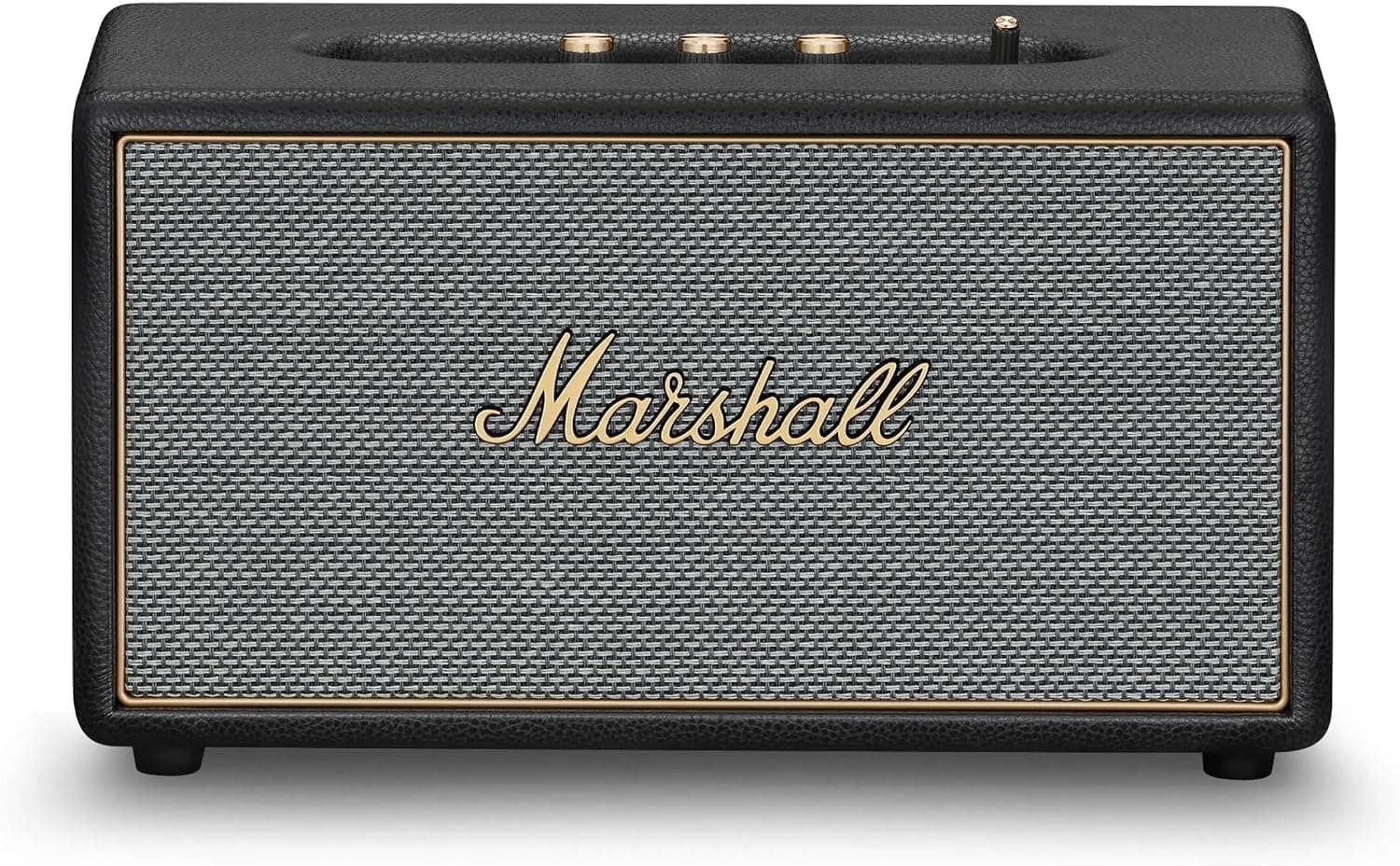
Visually, the Stanmore IV is a stunner. The black and cream finishes both look fantastic, with the brass and gray accents adding just enough contrast to keep it from being boring. The front grille is a woven mesh with the iconic Marshall logo in gold block letters, and the whole thing has a vintage amp vibe that somehow still feels contemporary. There is no RGB lighting anywhere on this speaker — just a small red LED indicator on the top plate that shows which source you are on — and that restraint is part of the appeal. This is a speaker that would look at home in a mid-century modern apartment, a rustic farmhouse, or a minimalist loft. Tom's Guide called it "one of the most stunning speakers" they have tested, and ZDNET praised its "timeless, classy look, which would complement any living space." Both reviews ran the same theme: the Stanmore IV is the rare tech product that people will actually want on display rather than hidden away.
The build quality extends to the controls. The top plate features three physical knobs for volume, bass, and treble, each with a satisfying detent as you turn it, plus a source button, a playback joystick, and a power switch that clicks like an amplifier from the 1960s. There is also a new customizable M button that defaults to launching Spotify but can be reassigned in the app to switch EQ presets instead. The tactile feedback on every control is excellent — ZDNET's reviewer summed it up nicely: "Marshall's use of buttons and knobs means you don't have to take out your phone to change the EQ, volume, and source settings. It is simply a more joyful experience." That joy is real. There is something deeply satisfying about reaching over and twisting a knob to adjust the bass rather than digging through a mobile app.
Marshall has also made the Stanmore IV more repairable than any of its predecessors. The front grille, the knobs, the feet, and even the iconic logo can all be swapped out if they get damaged, which is a meaningful step toward longevity in a category where most products are glued-shut disposable slabs. The company clearly wants this speaker to last a decade, not a couple of years.
One design change worth calling out: the RCA ports have moved from the back of the unit to the underside. That, combined with the power cable now exiting from the bottom, means you can place the Stanmore IV flush against a wall or tuck it neatly onto a shelf without a nest of cables sticking out the back. The only port that remains on top is the 3.5mm AUX input, which is a sensible location for quickly plugging in a phone or a laptop.
Sound Quality
The Stanmore IV's acoustic setup is a stereo three-way design: two 0.75-inch tweeters, each powered by its own 25-watt Class D amplifier, and a single 5-inch woofer driven by a 60-watt Class D amp, for 110 watts of total output. The tweeters sit behind a new waveguide structure that widens the soundstage, and the bass port has been redesigned for a cleaner low end. Marshall also introduced a Dynamic Loudness feature that continuously adjusts the high and low frequencies based on volume, so the speaker sounds balanced whether you are playing music at a whisper or shaking the windows.
The frequency response is rated at 36Hz to 38kHz, and in practice the bass extension is genuinely impressive for a speaker this size. Listening to The xx's "Intro," the bass line held real weight and filled the room without becoming bloated or overpowering, and the clean attack and release of each note kept the hypnotic rhythm intact. This is the kind of bass performance that makes you forget the subwoofer is only five inches across.
Treble performance is where the Stanmore IV really separates itself from the Acton IV and most of its direct competition. The waveguide tweeters produce an airy, detailed high end that never tips into harshness or fatigue. Tom's Guide tested it with Dire Straits' "Romeo and Juliet" and described the result as "perhaps the best the song has ever sounded" — the textured resonator guitar, the warmth, the subtle nuances of Mark Knopfler's breath work all came through clearly, and the treble never got piercing even at higher volumes. That is high praise, but it matches my own experience. Acoustic music, in particular, sounds wonderfully alive on this speaker, with instrument separation that punches well above the price class.
The midrange deserves its own mention. Vocals are clear and forward across all genres and all volume levels, whether you are listening to a podcast, a jazz vocalist, or a heavy rock track. ZDNET noted that the Stanmore IV delivers "deep bass without ear fatigue — the lower frequencies have a thumping impact while remaining clear, without sacrificing mids," and that balance is the speaker's signature trick. So many speakers in this category are either bass cannons that smear the mids or bright and thin affairs that lack impact. The Stanmore IV threads the needle.
The soundstage is wide — Tom's Guide described it as "almost three-dimensional" — and the speaker handles complex arrangements without collapsing into a mush of competing frequencies. On Tame Impala's "Apocalypse Dreams," the swirling synths and layered guitars extended well beyond the physical cabinet, and the instrument separation was commendable. This is not a speaker that just fills a room with noise; it presents a coherent stereo image that rewards careful listening.
Loudness is another area where the Stanmore IV excels. It can get far louder than you would realistically need indoors, and — critically — it stays clean at maximum volume. That is a notable improvement over the smaller Acton IV, which distorts when you push it hard. If you like to host parties or just enjoy the occasional wall-shaking session, the Stanmore IV will not embarrass you.
There is no IP rating, so this is strictly an indoor speaker. Do not put it in the bathroom or on a covered patio where it might get splashed. If you need something weatherproof, Marshall's own Middleton II (IP67) or the JBL Xtreme 5 (IP68) are better options, and we have covered portable speakers like the JBL Flip 7 in depth if that is the direction you want to go.
Connectivity
The Stanmore IV's connectivity story is a study in both strengths and omissions. On the wireless side, you get Bluetooth 5.3 with support for SBC, AAC, LC3, and — significantly — LDAC. LDAC is Sony's high-resolution Bluetooth codec, and its inclusion is a big deal for a speaker at this price, because it allows Android users to stream hi-res audio over Bluetooth without needing Wi-Fi. ZDNET tested the speaker with a Vivo X300 Ultra over LDAC and an iPhone 17 Pro Max over AAC, and while both sounded excellent, vocals over LDAC came through "slightly more detailed and had more space." The LC3 codec, meanwhile, offers better stability and efficiency than the older SBC and AAC standards.
Multipoint is supported, so you can keep two devices connected and switch between them, which is handy if you want to pair your phone and your laptop and have whichever one plays audio take over. Wired connectivity includes a 3.5mm AUX input on top and RCA inputs on the underside, the latter being a welcome addition for turntable owners — you can plug a record player directly into the Stanmore IV with no extra gear, which is a genuinely thoughtful feature for vinyl enthusiasts.
The other new wireless feature is Auracast, the Bluetooth LE audio broadcast standard. The Stanmore IV can connect to other Auracast-enabled Homeline speakers — including the Acton IV and Woburn IV — for multi-room playback, and pairing them takes just seconds. This is an upgrade over the Stanmore III, which could only pair with another Stanmore III. For a proper multi-room setup across different speaker sizes and models, Marshall sells the Heddon streaming hub for $299, which connects Homeline III and IV speakers over Wi-Fi; notably, Marshall gives you the hub free if you buy two or more Homeline speakers, which softens the sting of that price considerably.
And now the elephant in the room: there is no Wi-Fi on the Stanmore IV. No AirPlay 2, no Spotify Connect, no Chromecast, no voice assistant. You cannot cast to it from your phone's apps, you cannot ask it to play something, and you cannot group it with non-Marshall speakers. For a $430 speaker in 2026, that is a significant gap, and it is the single biggest reason to hesitate before buying. ZDNET's reviewer was candid about the trade-off: "I'd like to connect my speaker to the home network and cast songs via AirPlay — not for quality but for a no-interruption experience. On Bluetooth, my music pauses when I'm scrolling through social media, and a video starts playing." That interruption problem is real, and it is the main practical downside of Bluetooth-only operation. The Stanmore IV does remember up to eight paired Bluetooth devices and switches between them reasonably gracefully, but it cannot fix the fundamental limitation that Bluetooth is a point-to-point connection and your phone remains the source of everything.
The direct comparison here is the Sonos Era 300 at $449, which adds Wi-Fi streaming, AirPlay 2, and voice assistant support for about fifty dollars more. Tom's Guide framed it as "worth the extra spend if you want Wi-Fi streaming and voice assistant support, though neither of which the Stanmore IV can manage." If your home is already invested in the Sonos ecosystem, the Era 300 is the obvious choice. But if you do not care about smart features and just want a gorgeous, great-sounding speaker, the Stanmore IV's simplicity can feel like a feature rather than a limitation. It is also worth noting that the Klipsch The Three Plus at $399 has the same Bluetooth-only limitation while supporting only SBC and AAC — no LDAC — so the Stanmore IV actually offers the better wireless spec sheet among analog-first options.
The Marshall App
While the Stanmore IV can be used entirely without the app, downloading the Marshall app (available on iOS and Android) unlocks several genuinely useful features. The app is clean and easy to navigate, and it gives you a five-band equalizer with up to three custom EQ presets, so you can tune the sound to your room and your taste. There is a placement compensation feature that optimizes the audio based on where the speaker is positioned — useful if you have it tucked in a corner or against a wall. You can also adjust the brightness of the LED indicators, which is a thoughtful touch for a speaker that lives in your living room, and the M button can be remapped from its default Spotify behavior to cycle through EQ presets instead.
Over-the-air firmware updates are delivered through the app, which means Marshall can improve the speaker's performance after you buy it. That is a nice reassurance for a product you are likely to keep for years. None of these app features are essential — the knobs on top already cover the basics — but together they make the Stanmore IV feel like a modern product rather than a retro novelty. The app experience is notably better than the Klipsch app, which has historically been clunky, and it is on par with what you get from more mainstream brands.
Comparisons
The Stanmore IV's most direct competitors are the Sonos Era 300, the Klipsch The Three Plus, and Marshall's own Acton IV. Let's take them one at a time.
The Sonos Era 300 at $449 is the smart-speaker alternative. It has Wi-Fi, AirPlay 2, Spotify Connect, a voice assistant, and access to the entire Sonos multi-room ecosystem. It also sounds excellent, with a distinctive spatial-audio-forward design that many listeners love. What it does not have is the Stanmore IV's timeless looks, its analog control scheme, or its LDAC support. If you are building a multi-room Sonos system, the Era 300 is clearly the right call. If you just want one great speaker that looks beautiful and sounds fantastic, the Stanmore IV is arguably the better value — and it is $20 cheaper.
The Klipsch The Three Plus at $399 is the closest in philosophy. It is also a Bluetooth-only, analog-styled home speaker with a retro aesthetic, and it also sounds good for its size. But it supports only SBC and AAC codecs, has no LDAC, and its app and build quality trail Marshall's. The Stanmore IV is $30 more and gives you a bigger soundstage, better codec support, and a more polished overall package. Unless you specifically prefer Klipsch's aesthetic, the Stanmore IV is the stronger buy.
The Acton IV at $299 is Marshall's smaller sibling, and the choice between them mostly comes down to room size and how loud you need to go. The Acton IV is genuinely good for its size, but it distorts at maximum volume, whereas the Stanmore IV stays clean. If you have a large living room or like to host, the extra $130 for the Stanmore IV is money well spent. If you are outfitting a bedroom, a home office, or a small apartment, the Acton IV will serve you fine — though the Stanmore IV's superior bass extension and soundstage make it the more satisfying all-rounder.
On the higher end, Denon's Home 350 ($749) and Home 600 ($799) offer Wi-Fi and better raw fidelity, but they cost nearly double the Stanmore IV and lack its character. If you are the kind of listener who values warmth and musicality over clinical accuracy, the Stanmore IV gets you 90 percent of the way there for half the price. We have also reviewed Marshall's own portable and open-ear audio lineup elsewhere on the site — the Shokz OpenFit Pro is a completely different category but shows the same design-forward thinking — and the Sennheiser Momentum 5 Wireless is worth a look if you want the closest thing to this sound signature in a pair of headphones.
Who Should Buy It
The Stanmore IV is an easy recommendation for a specific kind of buyer: someone who wants a beautiful, great-sounding home speaker and does not care about smart features. If you already have a smart speaker ecosystem you love, or if you want to cast music from your phone without interruptions, this is probably not the speaker for you — go with the Sonos Era 300 or something in the Wi-Fi-enabled category. But if you want a speaker that looks like a piece of furniture, sounds like a proper stereo, and never asks you to create an account or update its firmware, the Stanmore IV is genuinely excellent.
It is also a great choice for vinyl enthusiasts. The RCA inputs let you plug a turntable straight in, and the analog control scheme fits the ritualistic nature of record listening beautifully. The repairability angle matters too: Marshall has designed this speaker to be serviced, and the company's track record suggests it will support it for years. ZDNET's reviewer has owned a Stanmore II for six years and still uses it daily, which is the kind of longevity testimony that should give you confidence in the IV.
The $429.99 asking price on Amazon is a little above the $399.99 MSRP announced at launch, reflecting the ongoing component cost pressures in 2026, but it is still competitive with the alternatives. If you catch it on sale — and Marshall speakers do go on sale periodically — it becomes an even better deal. Best Buy and B&H Photo also carry it at the same price, so you have options for where to buy.
Final Thoughts
The Marshall Stanmore IV is the best-looking home speaker you can buy at this price, and it sounds every bit as good as it looks. The meaty bass, the airy treble, the wide soundstage, and the clean performance at high volumes make it a joy to listen to, and the build quality and repairability suggest it will still be going strong years from now. The missing Wi-Fi and voice assistant support are real limitations that will rule it out for some buyers, and if you are heavily invested in a smart-speaker ecosystem, the Sonos Era 300 is the better pick. But for everyone else — especially vinyl fans, design lovers, and anyone who appreciates the simple pleasure of twisting a knob — the Stanmore IV is about as good as a Bluetooth home speaker gets in 2026. It earns my wholehearted recommendation.
If you are in the market for a home speaker and this one has caught your eye, you can grab it on Amazon using the link below. And if you are still weighing options across the audio spectrum, our reviews of the Sonos Ace headphones, the JBL Flip 7 portable speaker, and the Sennheiser Momentum 5 Wireless should help you round out your shortlist. Whatever you choose, the Stanmore IV sets a high bar that the rest of the category will be chasing for a while.
Pros
- Gorgeous, timeless amp-inspired design that fits any room
- Meaty bass with airy, detailed treble and a wide soundstage
- LDAC, LC3, Auracast, and multipoint Bluetooth support
- Stays clean and distortion-free at maximum volume
- Repairable build with swappable grille, knobs, and logo
Cons
- No Wi-Fi streaming, AirPlay, or voice assistant support
- Mains-powered only — not portable and no IP rating
Final Verdict
The Marshall Stanmore IV pairs a timeless amp-inspired design with meaty bass, airy treble, LDAC and Auracast support — if you can live without Wi-Fi, it's the best-looking home speaker you can buy.